Continually Updated Clinical Reference
 
 
  All Sources     eMedicine     Medscape     Drug Reference     MEDLINE
 
eMedicine - Ankle Fracture : Article by

Quick Find
Authors & Editors
Introduction
Clinical
Differentials
Workup
Treatment
Follow-up
Miscellaneous
References

Related Articles
Talofibular Ligament Injury


Patient Education
Breaks, Fractures, and Dislocations Center

Sports Injury Center

Ankle Fracture Overview

Ankle Fracture Causes

Ankle Fracture Symptoms

Ankle Fracture Treatment

Ankle Sprain Overview


Author: Phillip M Steele, MD, Consulting Staff, Primary Care Sports Medicine, Gem City Bone and Joint; Team Physician, University of Wyoming

Phillip M Steele is a member of the following medical societies: American Academy of Family Physicians, American College of Sports Medicine, and American Medical Association

Coauthor(s): John D Kelly IV, MD, Associate Professor of Orthopedic Surgery, Vice Chairman, Department of Orthopedic Surgery, Temple University; Consulting Surgeon, Temple Children's Hospital and Shriner's Hospital for Surgery

Editors: David T Bernhardt, MD, Director of Adolescent and Sports Medicine Fellowship, Associate Professor, Department of Pediatrics, University of Wisconsin; Francisco Talavera, PharmD, PhD, Senior Pharmacy Editor, eMedicine; Russell D White, MD, Professor of Medicine, Department of Community and Family Medicine, University of Missouri-Kansas City School of Medicine, Truman Medical Center Lakewood; Jon B Whitehurst, MD, Clinical Instructor of Surgery, University of Illinois College of Medicine; Consulting Staff, Rockford Orthopedic Associates; Sherwin SW Ho, MD, Section of Orthopedic Surgery and Rehabilitation Medicine, Associate Professor, Department of Surgery, University of Chicago

Author and Editor Disclosure

Synonyms and related keywords: ankle fracture distal, distal ankle fracture, tibia distal fibular injury, medial malleolus, lateral malleolus, malleoli, tibial plafond, Ottawa ankle rules, OAR, broken ankle, sprained ankle, ankle sprain, ankle injury, distal fibular fracture, distal tibial fracture, malleolus fracture, lateral malleolus fracture, Danis-Weber classification, Danis-Weber fracture, Jones fracture, Salter-Harris classification, Salter-Harris fracture

Background

For many primary care physicians, ankle injuries are the most common sports-related injury seen in their practice. Of those patients evaluated for ankle injuries, only approximately 15% have a clinically significant fracture. Therefore, familiarity with a thorough ligamentous examination and the Ottawa ankle rules is essential for proper management.

Successful primary care management of an ankle fracture begins with differentiation of a stable injury versus an unstable injury. The bones and ligaments of the ankle form a ring around the ankle mortise; thus, for instability to occur, ligamentous injury or fracture must include both the medial and lateral sides of the ring. The ring involves the structures that surround the talus, which are composed of the tibial plafond, the medial and lateral malleoli, the deltoid ligament complex, anterior talofibular ligament, calcaneofibular ligament, posterior talofibular ligament, and the anterior and posterior tibiofibular ligaments.

Generally, isolated nondisplaced distal fibular or distal tibial fractures are stable when no ligamentous instability is present on the opposite side of the ring. Careful evaluation of the ankle for medial and lateral swelling and ecchymosis should be routine, and their presence should increase clinical consideration of an unstable injury.

Frequency

United States

The ankle joint is the most commonly injured joint in sports. Approximately 70% of basketball players have sprained an ankle, and the likelihood of reinjury is as high as 80%. Lateral ankle sprains account for 90% of all ankle injuries, while an ankle fracture occurs only approximately 15% of the time.

Functional Anatomy

The distal tibia, distal fibula, and talus bones make up the ankle joint. These 3 bones are bound together by the joint capsule and surrounding ligaments. The anatomic relationship of the tibial plafond (joint surface of the distal tibia) to the talus is important for ankle stability. Because the anterior portion of the talus is more broadly shaped, dorsiflexion increases bone surface contact, thus improving stability. This relationship causes decreased stability during plantarflexion, accounting for the vulnerability to ligamentous injuries when the foot is plantarflexed.

Sport Specific Biomechanics

Forces acting on the ankle lead to typical fracture or ligamentous patterns. Determining the position of the ankle during injury can assist in assessing for ligament stability. Although simple unidirectional forces can be involved in an ankle injury, multidirectional forces are usually involved, making diagnosis a challenge.

Medial complex injuries typically occur from eversion and abduction forces. The medial complex consists of the medial malleolus, the medial facet of the talus, and the superficial and deep components of the deltoid ligament. Eversion of the ankle causes injury to the superficial deltoid ligaments and, if sufficient, the deep deltoid ligament. Avulsion of the distal medial malleolus tends to occur in young and old patients because the ligamentous strength may be greater than the strength of the bone in these individuals. With continuation of these forces, impaction of the distal lateral malleolus occurs, resulting either in rupture of the syndesmosis or in transverse fracture of the distal fibula.

Most unstable ankle fractures are the result of excessive external rotation of the talus with respect to the tibia. If the foot is supinated at the time of external rotation, an oblique fracture of the fibula ensues. If the foot is pronated at the time of external rotation, a mid- or high-fibular fracture results.

The lateral complex consists of the distal fibula, the lateral facet of the talus, and the lateral collateral ligaments of the ankle and subtalar joints. Lateral malleolus injury (most common type of fracture involving the ankle) typically occurs with supination external rotation forces. The inversion force first strains the lateral ligament complex or avulses (transverse fracture) the lateral malleolus. With continuation of this force, the talus impacts the medial malleolus, causing an oblique fracture of the distal tibia. Inversion ligamentous injuries of the ankle are the most commonly observed soft tissue trauma in sports.

Posterior malleolus injury typically occurs with a supination-external rotation or a pronation-external rotation injury and represents avulsion of the posterior tibiofibular ligament from the posterior distal tibia.


History

The following important questions should be included in the history of the patient's present illness:

  • What was the mechanism of the injury? Was it inversion or eversion; external or internal rotation? Many patients cannot recall whether their foot was plantarflexed or dorsiflexed; if the patient does know the position, this information is useful in assessing stability.


  • Was the patient able to bear weight after the injury? The Ottawa ankle rules specify that the inability to bear weight immediately after the injury or at the time of the radiograph is taken indicates the need for radiographic examination because of the increased risk of a clinically significant fracture.


  • Is there or was there an audible sound (eg, a pop)?


  • Is there a history of previous trauma to the ankle?

Physical

Begin the physical examination of the ankle by inspecting for swelling and ecchymosis and by palpating for areas of maximal tenderness. However, swelling is time-dependent and may be an unreliable indicator of the presence or the severity of the injury. Generally, more severe injuries are accompanied by more severe swelling.

  • Using light touch, palpate the medial and lateral malleolus for crepitation.


  • Assess the range of motion in plantar flexion, dorsiflexion, inversion, and eversion.


  • Assess ligamentous laxity with talar tilt and drawer testing.


  • Assess and document the neurovascular status.


  • Begin palpation of the medial and lateral malleoli at the distal posterior margins because the incidence of a false-positive result is increased when palpating the anterior portions.


    • The Ottawa ankle rules specify that if a patient demonstrates tenderness at the posterior malleoli (up to and including the crest), then the likelihood of a fracture is increased and radiography should be performed.


    • Failure to palpate the entire distal 6 cm of both malleoli is a common error made by physicians and primary care providers. Failure to do so increases the likelihood of missing a clinically significant fracture.


    • Palpate over the tibial and fibular physis in children. If tender, assume the patient has a type I Salter-Harris classification of epiphysial plate injury, even if radiographic findings are negative.


    • Crepitation felt during palpation of the ankle is suggestive of underlying fracture pathology and necessitates radiologic examination.
       
  • Check the joint above and below the area of the patient's chief complaint in order to not miss concomitant adjacent fractures.


  • Palpate over the proximal fifth metatarsal and navicular for tenderness.


  • Palpate the soft tissues, including ligamentous areas, peroneal and posterior tibial tendons, and the anterior process of calcaneus, to assess injury to these areas.


  • Palpate for tenderness over the proximal fibula to exclude potential Maisonneuve fracture (proximal fibular fracture associated with medial-sided and syndesmotic injury).
  • Assess strength in resisted external and internal rotation, ankle plantarflexion, dorsiflexion, supination, and pronation.
Fracture classification

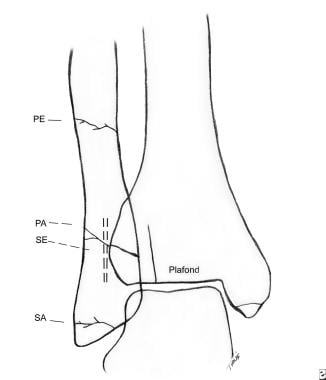
Ankle fractures can be classified as single malleolar, bimalleolar, and trimalleolar if the posterior part of the tibial plafond is involved. Careful attention must be paid to all single malleolar fractures because ligament instability is frequently associated with the contralateral side. Distal fibula fractures are the most common fracture type to the ankle, and the Danis-Weber classification system is listed below.

  • The Danis-Weber classification for ankle fractures is simple and is the most useful for primary care management. This classification scheme is based on the level of the fracture in relationship to the joint mortise of the distal fibula.
    • Type A fractures are horizontal avulsion fractures found below the mortise. They are stable and amenable to treatment with closed reduction and casting unless accompanied by a displaced medial malleolus fracture.


    • Type B fracture is a spiral fibular fracture that starts at the level of the mortise. This type of fracture occurs secondary to external rotational forces. These fractures may be stable or unstable depending on ligamentous injury or associated fractures on the medial side.


    • Type C fracture is above the level of the mortise and disrupts the ligamentous attachment between the fibula and the tibia distal to the fracture. These fractures are unstable and require open reduction and internal fixation.

Causes

Ankle injuries are caused by acute trauma.


Talofibular Ligament Injury

Other Problems to be Considered

Osteochondritis dissecans of talus
Fifth metatarsal fracture
Fracture of anterior process of calcaneus
Fracture of lateral process of talus
Peroneal tendon dislocation
Cuboid fracture or dislocation


Lab Studies

  • No routine laboratory studies are indicated unless syncope or other medical conditions are involved.

Imaging Studies

  • Radiographs should include anteroposterior, lateral, and mortise views (which are taken with the foot internally rotated 15-20°). The mortise view eliminates the overlapping shadow of the tibia on the fibula. Stress-view radiographs have a limited role in evaluating an acute ankle injury. They should only be taken while a patient is under anesthesia prior to reconstructive surgery. A standing mortise view of the ankle can help identify ligamentous instability in patients who are difficult to examine. Comparison of the normal radiographic relationships from the mortise and standing mortise views shows loss of the normal tibiofibular overlap and asymmetry of clear spaces. A comparison view with the uninjured ankle can be useful in difficult cases.

    • When reviewing ankle radiographs, consider that transverse fractures usually result from avulsion forces, whereas oblique fractures (usually fibular) generally result from torsional stress of the talus against the malleolus. Vertical malleolar fractures are secondary to an impact on the talus. Any displaced malleolar fracture should be considered unstable, and they are almost always associated with ligamentous injury of the opposite side. In general, all displaced medial malleolus fractures and oblique fibular fractures that are 2-3 inches proximal to the joint line should be assumed to have associated ligament injury and should be considered unstable.


    • In addition to using the radiographic guidelines of alignment, bone, and connective tissue to evaluate ankle radiographs, checking for the 5 most commonly missed foot and ankle fractures is advised. Close attention to the fifth metatarsal base, lateral process of the talus, os trigonum or posterior malleolus, anterior process of the calcaneus, and talar dome (forming the mnemonic FLOAT) can help correlate radiographic findings with tenderness upon physical examination.
       
  • The radiographic relationships of the ankle mortise view are as follows:

    • A lateral clear space of more than 2 mm suggests a syndesmosis sprain.


    • The normal tibiofibular overlap is greater than 1 mm.


    • The normal medial clear space is less than 4 mm or a difference from medial to lateral of less than 2 mm.
       
  • Radiographic relationships of the anteroposterior ankle view are as follows:

    • A medial clear space of more than 3 mm may indicate deltoid ligament or syndesmosis injury.


    • The tibiofibular space is normally less than 6 mm.


    • In the standing anteroposterior view, syndesmotic widening of greater than 3 mm indicates syndesmotic sprain.


Acute Phase

Rehabilitation Program

Physical Therapy

As always, acute management involves analgesics for pain, immobilization, and patient comfort. Use either a well-padded posterior splint or a stirrup splint to keep the patient from bearing weight on the ankle until definitive treatment is instituted in 3-4 days. Small avulsion Danis-Weber type A fractures without medial-sided injury can be symptomatically treated with a walking cast or stirrup brace and ambulation as tolerated. The patient should apply ice to the injured area over a compressive dressing for 20 minutes every 2-3 hours for the first 24 hours and every 4-6 hours thereafter until casting. Keeping the limb elevated above the level of the heart also significantly reduces swelling.

Medical Issues/Complications

Isolated lateral malleolus fractures are the most common fracture involving the ankle. Most inversion injuries result in an isolated sprain of the anterior talofibular ligament. However, a small avulsion fracture can occasionally be seen near the distal portion of the lateral malleolus. Barely visible osseous chip fractures do not alter the routine active management of grade 1 and 2 ankle sprains.

  • Most primary care physicians can treat isolated nondisplaced Danis-Weber type A fractures.
  • More experienced providers can treat stable, nondisplaced fractures of the malleoli with posterior malleolus involvement of less than 25% of the articular surface.
  • Bimalleolar or trimalleolar injuries are always unstable and are treated with open reduction and internal fixation. All displaced medial malleolar fractures are openly reduced and fixed to restore normal ankle congruency and deltoid integrity.

Consultations

Referral to an orthopedist is advisable for all displaced fractures because minor changes involving the joint mortise can cause chronic pain and early osteoarthritis. Patients with possible unstable injury (Danis-Weber classification types B or C) or those with bimalleolar fractures should be referred to an orthopedist. In the presence of medial malleolar tenderness and more than 5 mm of medial clear space on the mortise view, make a presumptive diagnosis of deltoid ligament rupture if a displaced fibular fracture is present. Treat these injuries as a bimalleolar fracture, and refer patients with this injury for treatment by an orthopedist.

Referral is also indicated for all trimalleolar fractures, which involve fracture to both the medial and lateral malleoli, along with a fracture to the posterior lip of the tibial plafond. This fracture is usually secondary to an avulsion of the posterior tibiofibular ligament at its insertion site. Fractures that show no radiographic evidence of healing after 8 weeks are best evaluated for adjunctive measures.

Recovery Phase

Rehabilitation Program

Physical Therapy

After the acute phase, cast immobilization can be accomplished with either a short leg walking cast or walking cast fracture boot in a reliable patient with a stable fracture.

Medical Issues/Complications

The ankle should be put in a cast in a neutral position to avoid shortening of the Achilles tendon. Generally, 4-6 weeks of immobilization is required for healing. Cast boots are generally preferred after swelling dissipates so that intermittent motion can commence. If the fracture site is not tender, gradual ankle rehabilitation can begin because clinical healing is present. If no evidence of fracture healing is present, an additional 2-4 weeks of immobilization may be required.

Consultations

If no evidence of fracture healing is present by 8 weeks, referral to an orthopedist is mandatory.

Maintenance Phase

Rehabilitation Program

Physical Therapy

After completing the immobilization period, the patient should begin ankle rehabilitation. Range of motion and strength returns quickly in young patients, and referral to a physical therapist may not be necessary. Patients motivated to complete rehabilitation at home can perform calf stretching and strengthening exercises, along with range-of-motion activities. Instruct patients to pay particular attention to the attainment of dorsiflexion. Older patients with premorbid conditions often require formal physical therapy to successfully regain strength and range of motion.


Return to Play

Return to play depends on both the fracture and the athlete. Motivated athletes can generally return to sports with documentation of fracture healing and return of normal strength and motion. The goal of rehabilitation should be symmetric range of motion and 85% of contralateral strength prior to returning to sport.

The first phase of rehabilitation is restoration of motion and pain-free ambulation after cast immobilization. During the first several days after cast removal, crutch-assisted ambulation can assist the patient in gaining motion and in preventing ankle reinjury secondary to weakness. After the return of passive motion, active motion and active-assisted motion should begin, along with a strengthening program. Particular attention is devoted to the recovery of peroneal and gastrocnemius complex strength. Proprioception and balance training are also an important part of the overall rehabilitation program and have been shown to be effective in reducing the risk for recurrent ankle injury.

Complications

Nonunion or delayed union is the most common complication requiring referral to an orthopedist.

Education

For excellent patient education resources, visit eMedicine's Breaks, Fractures, and Dislocations Center and Sports Injury Center. Also, see eMedicine's patient education articles Ankle Fracture and Ankle Sprain.


Medical/Legal Pitfalls

  • Failure to use the Ottawa ankle rules in assessing for the necessity of radiographic examination: Remember to inform the patient that associated fractures could be present and that persistent pain should be reevaluated.
  • Failure to identify associated ligament instability and/or other associated fractures at the time of the initial evaluation: Fractures, such as a fracture of the fifth metatarsal base or a Jones fracture (location at the metadiaphyseal junction at proximal fifth metatarsal), can be easily missed in an inversion ankle sprain. Osteochondral fractures of the talar dome are easily missed on routine radiographs. Therefore, persistent ankle pain may require additional imaging studies.
  • Failure to identify an open fracture: This can lead to significant morbidity, and inspection of any surface wound should be routine. If an open ankle fracture is confirmed or suggested, urgent referral to an orthopedic surgeon is indicated.


  • Clanton TO, Porter DA. Primary care of foot and ankle injuries in the athlete. Clin Sports Med. Jul 1997;16(3):435-66. [Medline].
  • Michelson JD. Fractures about the ankle. J Bone Joint Surg Am. Jan 1995;77(1):142-52. [Medline].
  • Schwartz DT, Reisdorff E, Williamson B, eds. Emergency Radiology. ed. New York, NY: McGraw-Hill; 1999.
  • Tandeter HB, Shvartzman P. Acute ankle injuries: clinical decision rules for radiographse. Am Fam Physician. Jun 1997;55(8):2721-8. [Medline].
  • Thordarson DB. Detecting and treating common foot and ankle fractures. In: The Physician and Sportsmedicine. 24. Minneapolis, Minn: McGraw-Hill; 1996:29-38.
  • Wedmore IS, Charette J. Emergency department evaluation and treatment of ankle and foot injuries. Emerg Med Clin North Am. Feb 2000;18(1):85-113, vi. [Medline].

Ankle Fracture excerpt

Article Last Updated: Jun 5, 2006