Continually Updated Clinical Reference
 
 
  All Sources     eMedicine     Medscape     Drug Reference     MEDLINE
 
eMedicine - Arrhythmogenic Right Ventricular Dysplasia (ARVD) : Article by

Quick Find
Authors & Editors
Introduction
Differentials
Radiograph
MRI
Ultrasound
Nuclear Medicine
Angiography
Intervention
Multimedia
References

Related Articles
Cardiomyopathy, Dilated


Patient Education
Click here for patient education.


Author: Lawrence Ashker, DO, Director of Abdominal Imaging, Department of Radiology, St Joseph Mercy Oakland

Lawrence Ashker is a member of the following medical societies: American College of Radiology

Coauthor(s): Janaina Alnajjar, MD, Staff Physician, Department of Radiology, St Joseph Mercy Oakland; Kostaki G Bis, MD, Assistant Clinical Professor of Radiology, Magnetic Resonance Research, Department of Diagnostic Radiology, Wayne State University School of Medicine; Chief, William Beaumont Hospital

Editors: Justin D Pearlman, MD, PhD, ME, MA, Director of Dartmouth Advanced Imaging Center, Professor of Medicine, Professor of Radiology, Adjunct Professor, Thayer Bioengineering and Computer Science, Dartmouth-Hitchcock Medical Center; Bernard D Coombs, MB, ChB, PhD, Consulting Staff, Department of Specialist Rehabilitation Services, Hutt Valley District Health Board, New Zealand; David S Levey, MD, PhD, Orthopedic/Spine MRI TeleRadiologist, Radsource, LLC; Robert M Krasny, MD, Consulting Staff, Department of Radiology, The Angeles Clinic and Research Institute; Eugene C Lin, MD, Consulting Staff, Department of Radiology, Virginia Mason Medical Center

Author and Editor Disclosure

Synonyms and related keywords: Uhl's anomaly, Uhl anomaly, Uhl disease, parchment right ventricle, Naxos disease, arrhythmogenic right ventricular cardiomyopathy, right ventricular dysplasia, RVD, right ventricular cardiomyopathy, right precordial ST-segment elevation, Brugada syndrome, Brugada's syndrome

Background

Sir Osler was the first to describe right ventricular dysplasia (RVD). In 1950, Segal presented a picture of the disease.1 Guy Fontaine first described and named arrhythmogenic RVD (ARVD) in 1977.

ARVD is an unusual, often familial, condition characterized by the replacement of myocardial tissue by fat and fibrous tissue. ARVD has a wide spectrum of clinical presentations, including mechanical dysfunction and various forms of ventricular arrhythmias. It is a cause of sudden death, mostly in young people and in athletes.2, 3, 4, 5, 6, 7, 8, 9, 10, 11, 12

Pathophysiology

Etiopathogenesis

Although several theories have been proposed, the pathogenesis and etiology of ARVD are not yet fully established.

Basso et al proposed 4 theories that may potentially explain the development and occurrence of the disease.2 These are the dysontogenic, degenerative, inflammatory, and apoptotic theories.

  • The dysontogenic theory attributes the disease to a serious congenital abnormality of the right ventricle leading to dysplasia (maldevelopment).
  • In the degenerative theory, a metabolic disorder may affect the right ventricle, resulting in progressive replacement of myocardial cells by fat and fibrous tissue. Although this condition bears a striking similarity to muscular dystrophy, as observed with Duchenne disease, no skeletal muscular involvement is detected in ARVD.
  • In the inflammatory theory, the fibrofatty replacement is considered a healing process in the context of myocarditis. This finding is underscored by the observation of lymphocyte infiltrates associated with myocardial cell death.
  • In the apoptotic theory, abnormal bouts of recurring or continued programmed cell death (apoptosis) lead to progressive myocardial muscle loss followed by fibrofatty replacement. These apoptotic bouts may enhance the electrical vulnerability of the right ventricle, leading to potentially life-threatening arrhythmias.

Some authors believe that the fibrofatty pattern of the ARVD is not limited to the right ventricle but that the disease may also migrate to the interventricular septum and the left ventricle.

Histology

The most striking morphologic feature of the disease is the diffuse or segmental loss of myocardium in the mediomural and epicardial layers of the right ventricular free wall with replacement by fat and fibrous tissue. Persisting strands of cardiomyocytes bordered by or embedded in a variable extent of fibrous tissue are observed inside fat. Only the subendocardial layers are preserved.

In contrast, the trabeculae carne of the apex and the right side of the ventricular septum are hypertrophied. This observation explains some of the findings obtained during angiography. The anterior, diaphragmatic, and posterior walls are involved, as are some parts of the septum and, to a lesser extent, the left ventricle. Aneurysmal dilatations are sometimes present at the apex, in the subtricuspid area, or in both. Infundibular dilatation is present in the most severe forms.

Inflammation and a variable degree of fibrosis are observed in numerous cases. Fat intermixed with cardiomyocytes is sometimes observed in normal hearts. Isolated adiposity of the right ventricle without inflammation or fibrosis may represent a distinct disease process that has been described only in humans. In this disease process, adipose tissue partially or almost totally replaces the right ventricular wall, and no inflammatory infiltrates are noted.

Genetics

ARVD is due to a type of cardiomyopathy, which is possibly familial in some patients. Hypokinetic areas involve the wall of the right ventricle. In the familial form, the genetic abnormality has been mapped to chromosome bands or subbands 1q42-q43, 2q32.1-q32.3, 3p23, 14q12-q22, 14q23-q24, and, most recently, 10p12-p14.13, 14, 15, 16, 17, 18

ARVD can be an important cause of ventricular arrhythmia in children and young adults with apparently normal hearts, as well as in older patients.

The most common pattern of inheritance is autosomal dominant, with a penetrance in family members of 20-35% in most countries, reaching 50% in the Veneto region of Italy. However, an autosomal recessive pattern has also been reported on the Greek island of Naxos, where dysplasia is associated with palmoplantar keratosis. In this condition, signs of the disease are more severe, and penetrance in family members is greater than 90%.

Frequency

United States

The prevalence of ARVD is estimated to be 1 case per 10,000 population. The frequency of disease is estimated to be 0.4%.

International

The occurrence of ARVD depends on geographic circumstances, particularly in certain regions of Italy, such as Padova and Venice, and in Greece on the Island of Naxos, where a prevalence of as high as 0.8% has been reported.

In several autopsy studies of sudden death in young athletes, ARVD is uncommon (<5%). An exception is described in reports from the Veneto region of Italy, where ARVD is the most common cause of sudden death in competitive athletes (in whom hypertrophic cardiomyopathy is uncommon). This difference may be due to a unique genetic substrate or the long-standing Italian national screening program for competitive athletes. This screening program has probably led to the identification and disqualification of far more athletes with hypertrophic cardiomyopathy than athletes with ARVD.

Mortality/Morbidity

  • ARVD is a progressive disease. In the long term, it probably leads to right ventricular failure unless sudden cardiac death occurs first. The death rate associated with arrhythmia is estimated to be 2.5% per year.
  • ARVD certainly cannot be considered a benign condition in patients with symptoms of syncope,episodes of recurrent ventricular tachycardia (VT), or anatomic and/or functional abnormalities of the right ventricle.
  • Patients with recurrences of VT have a favorable outcome when treated medically.

Related Medscape topics:
Resource Center Cardiometabolic Risk Factor Management 
Catheter Ablation of Stable and Unstable Ventricular Tachycardias in Patients with Arrhythmogenic Right Ventricular Dysplasia 
CME  Supraventricular Tachycardia -- An Interactive Case


Race

ARVD most frequently appears in Caucasian patients of Southern European ancestry.

Sex

ARVD occurs predominantly in male individuals, with a male-to-female ratio of 2.7:1.

Age

The mean age of patients at symptom onset is about 33 years, with a range of 13-73 years.

Anatomy

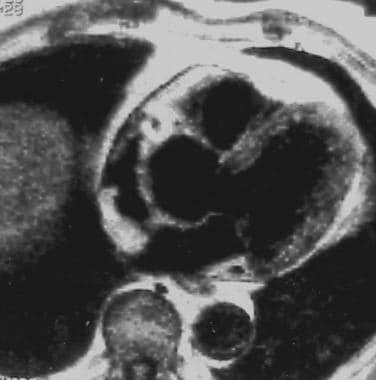
Anatomic changes of the right ventricle consist of mild-to-severe global dilatation, aneurysms, and segmental hypokinesia. Sites of involvement of the right ventricle are found in the triangle of dysplasianamely, the right ventricular outflow tract, the apex, and the infundibulum (see Image 1).

The regional sympathetic dysinnervation of these areas may electrophysiologically form an electrical hole, which potentially constitutes a substrate for arrhythmias. Paper-thin right ventricle with hypokinesis and dilation is known as the Uhl anomaly or parchment right ventricle (see the discussion about Differential diagnosis, below). This condition is believed to be congenital.

Clinical Details

Clinical diagnosis

In as many as 80% of patients, the first manifestation of the disease is unexplained syncope or sudden cardiac death.

The Task Force of the Working Group on Myocardial and Pericardial Disease of the European Society of Cardiology (Sophia-Antipolis, France) and the Task Force of the Scientific Council on Cardiomyopathies of the World Heart Federation (Geneva, Switzerland) proposed standardized diagnostic criteria. The diagnosis of ARVD is based on the presence of major and minor criteria encompassing structural, histologic, electrocardiographic, arrhythmic, and genetic factors. To fulfill the appropriate criteria for ARVD, the patient's condition must meet 2 major criteria, 1 major and 2 minor criteria, or 4 minor criteria (see Table, below).

Major and Minor Criteria for ARVD

CategoryMajor CriteriaMinor Criteria
Global or regional dysfunction and structural alterations(1) Severe dilatation and reduction in the right ventricular ejection fraction with no or only mild left ventricular impairment or (2) localized right ventricular aneurysms (akinetic-dyskinetic areas of diastolic bulging)(1) Minor global right ventricular dilatation or ejection fraction reduction with normal left ventricle, (2) mild segmental dilation of the right ventricle, or (3) regional right ventricular hypokinesia
Repolarization of abnormalitiesNoneInverted T waves in the right precordial leads beyond V1 (patient >12 y, in the absence of a right bundle branch block)
Depolarization or conduction abnormalitiesEpsilon waves* or localized prolongation (110 ms) of the QRS complex in precordial leads (V1, V2, or V3)Late potentials (signal-averaged electrocardiography)
ArrhythmiasSustained left bundle-branch-block type of VT (as determined with electrocardiography, Holter monitoring, or exercise testing)Frequent ventricular extrasystoles with left bundle-branch-block morphology (>1000 per 24 h, as seen with Holter monitoring)
Family historyFamilial disease confirmed at necropsy or surgery(1) Family history of premature sudden death (<35 y) caused by suspected RVD or (2) family history (clinical diagnosis based on current criteria)

*Epsilon waves are ventricular postexcitation waves that occur after the QRS complex at the beginning of the ST segment. These waves represent delayed depolarization of some parts of the right ventricle.

Differential diagnosis

The differential diagnosis of ARVD includes right precordial ST-segment elevation (Brugada syndrome) and the Uhl anomaly (Uhl disease).19, 20

Right precordial ST-segment elevation (Brugada syndrome) has been observed in young adults who are at risk for sudden death during rest or sleep. This syndrome has been reported with an increased prevalence in Southeast Asia. Some patients with the typical ECG findings of this condition have clinically or histologically proven ARVD.

In some patients with tachycardia associated with right ventricular outflow tract, MRIs show signs of structural heart disease. In some cases, angiographic findings confirm this condition, suggesting the presence of ARVD localized to the infundibular area. The benign extrasystoles have a pattern suggestive of an infundibular origin similar to that of patients with right ventricular outflow tract tachycardia. Therefore, the observation that ARVD occurs in some patients with premature ventricular contractions of this morphology is not surprising.

Uhl anomaly is a rare anomaly and does not represent a late form of ARVD. This disease occurs in individuals of 2 age groups, and it has a clearly distinctive clinical and pathologic presentation. The Uhl anomaly generally leads to congestive cardiac failure at an early age and death after a few weeks or months. In adults, death is a result of congestive heart failure and/or cardiac arrhythmias. Uhl disease shows the unmistakable pattern of a huge and transparent right-ventricular free wall that is easily diagnosed by using MRI. This disease is the result of apposition of the endocardium with the epicardium with some fatty tissue but without intervening myocardium (paper-thin right ventricle, or parchment heart).

Preferred Examination

The recognition of mild, forme fruste, or localized forms of the disease remains a clinical challenge. Diagnosing ARVD in patients with minimal right ventricular abnormalities is difficult by means of echocardiography, ultrafast CT, radionuclide angiography, or contrast-enhanced angiography.5, 20, 21, 22, 23, 24, 25, 26, 27, 28, 29, 30

MRI is a promising technique for showing the anatomy and function of the right ventricle, as well as for characterizing the composition of the right ventricle wall, especially with regard to adipose tissue. However, the diagnostic sensitivity and specificity of MRI remain to be defined because the quality of images detected is currently observer dependent. Signal intensity suggesting the presence of fat in the right ventricle may be related to a latent form of the disease or to the dissociation of myocardial tissue by fat. Therefore, only the combination of MRI signs, including the size, function, and fat content in the free wall, is necessary to support the diagnosis.

MRI has the advantage of offering methods that specifically eliminate or selectively include signal from only fat, which resonates at a different frequency than tissue or water. For example, a spatiospectral pulse sequence can be used to selectively image fat by using a gradient-echo technique, and a triple-inversion recovery sequence can be applied to nullify signal from fat. However, wall motion, gating abnormalities, or other artifacts can produce false-positive results, which must be eliminated by means of inspection and/or the acquisition of confirmatory views.

In some cases, endomyocardial biopsy may be necessary to confirm the diagnosis.


Cardiomyopathy, Dilated

Other Problems to Be Considered

Right precordial ST-segment elevation (Brugada syndrome)
Right ventricular outflow tract tachycardia
Uhl anomaly (Uhl disease)


Findings

Chest radiographs may show a wide spectrum of manifestations, which range from a completely normal cardiac silhouette to moderate or major cardiomegaly with a convexity between the aortic knob and the left ventricle without pulmonary vascular redistribution. The cardiothoracic index is less than 0.6 in most patients. In young athletes, this relative cardiomegaly may be incorrectly attributed to training.

Degree of Confidence

Chest radiographs can be normal, or they can demonstrate a wide variety of manifestations not specific for ARVD. Therefore, chest radiography is not a good tool for diagnosing ARVD, but it can help in assessing the patient's prognosis.

False Positives/Negatives

In young athletes, mild cardiomegaly may be wrongly attributed to training; however, it can be the first clue for the diagnosis of ARVD.


Findings

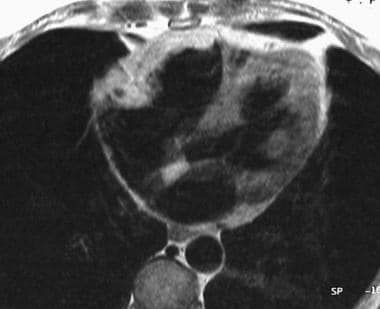
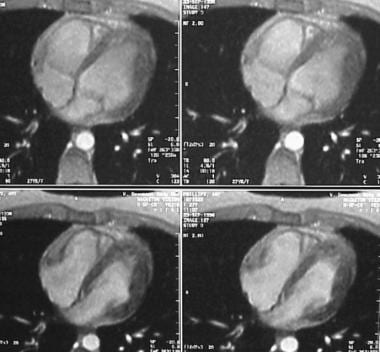
MRI enables clear visualization of morphology of the right ventricle, and it permits characterization of the composition of the wall, especially with regard to fatty tissue. Typical MRI ARVD protocols include (1) bright-blood gradient-echo imaging in cine mode to assess wall motion, (2) dark-blood T1-weighted imaging to evaluate wall thickness, and (3) specific fat-sensitive or fat-suppressive imaging to confirm fatty infiltration or transdifferentiation on short-axis views spanning the entire right ventricle. Use of orthogonal views, attention to gating, and/or alternative fat-sensitive methods help in eliminating a false-positive signal dropout.21, 22, 23, 24, 25, 26, 28

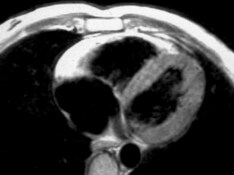
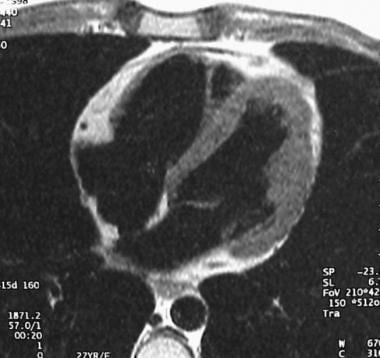
In ARVD, MRI findings consist of abnormalities in signal intensity, which usually affect the right ventricular free wall and/or the previously mentioned triangle of dysplasia (see Image 1). Fibrofatty deposition in these regions of the right ventricle may be found on both T1- and T2-weighted images, on which they appear as areas of either focal or diffuse high signal intensity. Other relatively nonspecific signal-intensity abnormalities in the right ventricle may be due to fibrosis or inflammation.

Regardless of these findings, myocardial biopsy is often warranted. In terms of morphology, diffuse or focal dilatation of the chamber of the right ventricle is a key finding in ARVD. Often, the free wall of the right ventricle is noticeably thinned. Motion abnormalities depend on the extent of the underlying fibrofatty infiltration and vary from a focal bulge to a low ejection fraction due to more-diffuse disease.

MRI may be indicated in (1) young athletes with frequent simple arrhythmias, even in absence of echocardiographic abnormalities; (2) patients with ventricular tachyarrhythmias in a left bundle-branch-block pattern; (3) patients with palpitations, syncopal episodes, or echocardiographic abnormalities of the right ventricle; and (4) patients with a familial occurrence of ARVD or sudden death syndrome.

Degree of Confidence

The role of MRI in the diagnosis of ARVD has been established. In conjunction with electrophysiologic, ECG, and familial indicators, MRI results are specific. MRI is considered highly sensitive and highly specific when all of the considerations discussed above are applied.

False Positives/Negatives

MRI can be an effective noninvasive examination for detecting fatty infiltration of the myocardium. However, because fat is a normal component of the right ventricle in humans, it is necessary to interpret MRI results in light of all the findings in the clinical context.


Findings

Echocardiography may show morphologic abnormalities such as dilatation of the right ventricle and outflow tract, segmental wall bulging or aneurysms in the predominantly affected portions during diastole, and hypokinetic or dyskinetic areas in the inferobasal region. However, in most cases of ARVD, the structural abnormalities are moderate, and they may be difficult to detect. The posterior and inferior walls of the right ventricular inflow tract under the tricuspid valve are the most important regions that must be visualized because they are most frequently affected.

Contrast-enhanced echocardiography with injections of sodium chloride solution may aid in evaluating the outline of the right ventricle to permit an analysis of right ventricular volume.

Degree of Confidence

Echocardiography is sensitive but not specific for ARVD because it does not allow for an assessment of the adipose substitution of the myocardium, which is a hallmark of ARVD. Echocardiography is less sensitive than MRI because it may fail to depict focal right ventricular wall thickening, and it does not reliably help in distinguishing fat from muscle. The last limitation also decreases the specificity of echocardiography.

Three-dimensional (3D) echocardiography, particularly combined with the transesophageal approach, is being investigated to enhance the diagnostic accuracy of this technique.

False Positives/Negatives

Right ventricular hypertrophy, right ventricular infarct, and prominent pericardial fat contribute to false-positive results. Limitation of views and focality of thickening of the right ventricular wall contribute to false-negative findings.


Findings

Nuclear ventriculoscintigraphy provides data concerning the size, ejection fraction, and contraction pattern of the ventricles. In most cases of ARVD, the size of the right ventricle is increased, but it can also be within normal limits. Wall motion during contraction is not uniform as a result of dyskinetic areas of fat replacement in the free wall of the right ventricle. Specific isotopic markers have demonstrated regional sympathetic denervation of these areas.31

Degree of Confidence

Although nuclear ventriculoscintigraphy is accurate in the quantitative evaluation of right ventricular function, it does not provide specific information.

False Positives/Negatives

With nuclear ventriculoscintigraphy, ARVD should be in the differential diagnosis for any condition that results in a big right ventricle, a diminished ejection fraction, or an alternating contraction pattern in the right ventricle.


Findings

The angiographic features of ARVD include global and/or regional function and morphologic abnormalities of the right ventricle. Such features include localized akinetic or dyskinetic bulges, outpouchings, dilatation of the infundibulum, trabecular hypertrophy, and/or disarray with deep fissures.27

Degree of Confidence

Because MRI and 3D echocardiography are noninvasive and repeatable examinations, they are preferred over angiography for the evaluation of structure and function of the right ventricle.


Electrocardiography

Signs that may suggest ARVD are inverted T waves in right precordial leads, QRS prolongation greater than 110 ms, extrasystoles with a left bundle-branch-block pattern, and a history of palpitations associated with neurologic signs of an obviously nonvasovagal origin. Another sign is sudden death, syncope, or both in close family members, especially if sudden death occurred in a young adult, regardless of the presumed cause.

In the absence of an emergency, ARVD should be investigated by using noninvasive techniques, invasive techniques, or both. Repolarization abnormalities in terms of T-wave inversion in leads beyond V1 are generally the first suggestive sign, and it is observed in one half of the cases. Extension of T-wave inversion in left precordial leads is positively correlated with the right ventricular end-diastolic index.

Endomyocardial biopsy

In some cases, it is important to examine the involvement of the myocardium of the right ventricular free wall with fibrous and/or fatty replacement and to validate the clinical diagnosis by means of pathologic examination of right ventricular endomyocardial biopsy samples. The clinical presentation of myocarditis predominantly affecting the right ventricle can mimic that of ARVD. Structural abnormalities of development of the right ventricle may be difficult to differentiate from ARVD with certainty without histopathologic analysis.

Although the results of endomyocardial biopsy are specific, this examination has low sensibility. Indeed, the only region that can be safely sampled in patients with ARVD is the septum, which is not usually affected by the disease. The right ventricular wall is generally thin, and the risk of perforation is consequently high. Furthermore, adipose replacement of myocardium commonly affects only the subepicardial layers. The subendocardial layer, the site of the biopsy sample, is less commonly affected. Therefore, the indication for endomyocardial biopsy in these patients should be well evaluated.

Medical/Legal Pitfalls

  • Failure to identify ARVD in patients undergoing anesthesia
  • Failure to identify family members of patients with known ARVD
  • Poor communication about the risk factors, such as sudden cardiac death, with the patient and family
  • False-negative echocardiogram or angiogram obtained with a full evaluation of the right ventricle and without clear definition of the wall thickness of the right ventricle in all segments

See also the Medscape topic Medical Malpractice and Legal Issues.


Media file 1:  Triangle of dysplasia.
Click to see larger pictureClick to see detailView Full Size Image
Media type:  Image

Media file 2:  Four-chamber electrocardiographically gated cine gradient-echo images show an abnormality in right ventricular wall motion during systole or a systolic aneurysm.
Click to see larger pictureClick to see detailView Full Size Image
Media type:  MRI

Media file 3:  Electrocardiographically gated axial spin-echo T1-weighted image demonstrates diffuse high signal intensity in the myocardium of the right ventricular anterior free wall. This finding corresponds to fatty infiltration.
Click to see larger pictureClick to see detailView Full Size Image
Media type:  MRI

Media file 4:  Electrocardiographically gated axial spin-echo T1-weighted image shows the high signal intensity due to fatty infiltration of the right ventricular free wall.
Click to see larger pictureClick to see detailView Full Size Image
Media type:  MRI

Media file 5:  Electrocardiographically gated T1-weighted image shows arrhythmogenic right ventricular dysplasia (ARVD) with prominent epicardial fat in the right ventricular outflow tract.
Click to see larger pictureClick to see detailView Full Size Image
Media type:  MRI


  1. Segal HN. Parchment heart. Am Heart J. 1950;40:948.
  2. Basso C, Thiene G, Corrado D, et al. Arrhythmogenic right ventricular cardiomyopathy. Dysplasia, dystrophy, or myocarditis?. Circulation. Sep 1 1996;94(5):983-91. [Medline].
  3. Braunwald E, Libby P, Zipes DD. Heart Disease: A Textbook of Cardiovascular Medicine. 6th ed. WB Saunders; 2001: 324-4, 863-89, 2052-6.
  4. Burke AP, Farb A, Tashko G, Virmani R. Arrhythmogenic right ventricular cardiomyopathy and fatty replacement of the right ventricular myocardium: are they different diseases?. Circulation. Apr 28 1998;97(16):1571-80. [Medline].
  5. Carlson MD, White RD, Trohman RG, et al. Right ventricular outflow tract ventricular tachycardia: detection of previously unrecognized anatomic abnormalities using cine magnetic resonance imaging. J Am Coll Cardiol. Sep 1994;24(3):720-7. [Medline].
  6. Fontaine G, Fontaliran F, Hebert JL, et al. Arrhythmogenic right ventricular dysplasia. Annu Rev Med. 1999;50:17-35. [Medline].
  7. Fontaine G, Gallais Y, Fornes P, Hébert JL, Frank R. Arrhythmogenic right ventricular dysplasia/cardiomyopathy. Anesthesiology. Jul 2001;95(1):250-4. [Medline].
  8. Kinsara AJ, Zaman L, Gorgels A. Arrhythmogenic right ventricular dysplasia. Am J Emerg Med. Jan 2001;19(1):67-70. [Medline].
  9. Willerson JT, Cohn JN. Cardiovascular Medicine. 2nd ed. New York, NY: Churchill Livingstone; 2000: 1665-76.
  10. Fontaine G, Tonet J, Gallais Y, et al. Ventricular tachycardia catheter ablation in arrhythmogenic right ventricular dysplasia: a 16-year experience. Curr Cardiol Rep. Nov 2000;2(6):498-506. [Medline].
  11. El Masry HZ, Yadav AV. Arrhythmogenic right ventricular dysplasia/cardiomyopathy. Expert Rev Cardiovasc Ther. Feb 2008;6(2):249-60. [Medline].
  12. Celbis O, Aydin NE, Mizrak B, Ozdemir B. Arrhythmogenic right ventricular dysplasia cases in forensic autopsies. Am J Forensic Med Pathol. Sep 2007;28(3):235-7. [Medline].
  13. Ahmad F, Li D, Karibe A, et al. Localization of a gene responsible for arrhythmogenic right ventricular dysplasia to chromosome 3p23. Circulation. Dec 22-29 1998;98(25):2791-5. [Medline].
  14. Li D, Ahmad F, Gardner MJ, et al. The locus of a novel gene responsible for arrhythmogenic right- ventricular dysplasia characterized by early onset and high penetrance maps to chromosome 10p12-p14. Am J Hum Genet. Jan 2000;66(1):148-56. [Medline].
  15. Rampazzo A, Nava A, Danieli GA, et al. The gene for arrhythmogenic right ventricular cardiomyopathy maps to chromosome 14q23-q24. Hum Mol Genet. Jun 1994;3(6):959-62. [Medline].
  16. Rampazzo A, Nava A, Miorin M, et al. ARVD4, a new locus for arrhythmogenic right ventricular cardiomyopathy, maps to chromosome 2 long arm. Genomics. Oct 15 1997;45(2):259-63. [Medline].
  17. Severini GM, Krajinovic M, Pinamonti B, et al. A new locus for arrhythmogenic right ventricular dysplasia on the long arm of chromosome 14. Genomics. Jan 15 1996;31(2):193-200. [Medline].
  18. Moric-Janiszewska E, Markiewicz-Loskot G. Review on the genetics of arrhythmogenic right ventricular dysplasia. Europace. May 2007;9(5):259-66. [Medline].
  19. Corrado D, Basso C, Thiene G, et al. Spectrum of clinicopathologic manifestations of arrhythmogenic right ventricular cardiomyopathy/dysplasia: a multicenter study. J Am Coll Cardiol. Nov 15 1997;30(6):1512-20. [Medline].
  20. Daliento L, Rizzoli G, Thiene G, et al. Diagnostic accuracy of right ventriculography in arrhythmogenic right ventricular cardiomyopathy. Am J Cardiol. Sep 15 1990;66(7):741-5. [Medline].
  21. Blake LM, Scheinman MM, Higgins CB. MR features of arrhythmogenic right ventricular dysplasia. AJR Am J Roentgenol. Apr 1994;162(4):809-12. [Medline].
  22. Midiri M, Finazzo M. MR imaging of arrhythmogenic right ventricular dysplasia. Int J Cardiovasc Imaging. Aug 2001;17(4):297-304. [Medline].
  23. Midiri M, Finazzo M, Brancato M, et al. Arrhythmogenic right ventricular dysplasia: MR features. Eur Radiol. 1997;7(3):307-12. [Medline].
  24. Ricci C, Longo R, Pagnan L, et al. Magnetic resonance imaging in right ventricular dysplasia. Am J Cardiol. Dec 15 1992;70(20):1589-95. [Medline].
  25. Van der Wall EE, Kayser HW, Bootsma MM, et al. Arrhythmogenic right ventricular dysplasia: MRI findings. Herz. 25(4):356-64. [Medline].
  26. White RD, Trohman RG, Flamm SD, et al. Right ventricular arrhythmia in the absence of arrhythmogenic dysplasia: MR imaging of myocardial abnormalities. Radiology. Jun 1998;207(3):743-51. [Medline].
  27. Peters S. Left ventricular impairment in arrhythmogenic right ventricular dysplasia: what we can learn from angiography. Cardiology. 1995;86(6):473-6. [Medline].
  28. Tandri H, Macedo R, Calkins H, Marcus F, Cannom D, Scheinman M. Role of magnetic resonance imaging in arrhythmogenic right ventricular dysplasia: insights from the North American arrhythmogenic right ventricular dysplasia (ARVD/C) study. Am Heart J. Jan 2008;155(1):147-53. [Medline].
  29. Kantarci M, Bayraktutan U, Sevimli S, Bayram E, Durur I. Multidetector computed tomography findings of arrhythmogenic right ventricular dysplasia: a case report. Heart Surg Forum. 2007;10(6):E431-3. [Medline].
  30. Bomma C, Dalal D, Tandri H, Prakasa K, Nasir K, Roguin A. Evolving role of multidetector computed tomography in evaluation of arrhythmogenic right ventricular dysplasia/cardiomyopathy. Am J Cardiol. Jul 1 2007;100(1):99-105. [Medline].
  31. Wichter T, Hindricks G, Lerch H, et al. Regional myocardial sympathetic dysinnervation in arrhythmogenic right ventricular cardiomyopathy. An analysis using 123I-meta-iodobenzylguanidine scintigraphy. Circulation. Feb 1994;89(2):667-83. [Medline].

Arrhythmogenic Right Ventricular Dysplasia (ARVD) excerpt

Article Last Updated: Feb 29, 2008