Practice Essentials
Osgood-Schlatter disease (OSD) is one of the most common causes of knee pain in adolescents who participate in sports. Onset of disease coincides with the growth spurt (ages 10-15 yr in males, 8-13 yr in females). It is more common in males and in adolescents who engage in sports involving running and jumping. Prevalence in those aged 12-15 years is 9.8% (11.4% in males, 8.3% in females), with symptoms presenting bilaterally in 20-30%. In 10% of cases, symptoms may continue into adulthood. [1, 2, 3, 4]
Two authors, Robert Bayley Osgood and Carl Schlatter, working independently, were the first to describe the condition, in 1903. Originally, the Osgood-Schlatter lesion was thought to result from an avulsion of bone or cartilage in the tibial tuberosity. However, subsequent findings have indicated that most cases of Osgood-Schlatter disease are caused by microtrauma in the deep fibers of the patellar tendon at its insertion on the tibial tuberosity; even so, avulsion may be present in some cases. [5, 6, 7, 8, 9, 10]
In children, the cartilaginous tibial tuberosity is an inferior extension of the proximal tibial physis. The tuberosity usually ossifies as an inferior extension of the main epiphyseal ossification center. Sometimes, one or more secondary ossification centers develop separately in the cartilaginous tuberosity. These eventually unite with the main, proximal tibial epiphyseal ossification center. Hence, the presence of multiple ossific nodules anterior to the tibial metaphysis is, by itself, a normal variant. The patellar tendon extends anterior to the infrapatellar fat pad of Hoffa and inserts into the cartilage of the anterior tibial tuberosity. OSD has been associated with increased posterior tibial slope angle (PTSA). It has been suggested that greater PTSA causes abnormal stress to the proximal tibial physis leading to OSD. [11, 12]
The quadriceps femoris muscle, the largest muscle in the human body, inserts on a relatively small area of the tibial tuberosity. As a consequence, naturally high tension exists at the insertion site. In children, additional stress is placed on the cartilaginous site as a result of vigorous physical activity, leading to traumatic changes at the insertion; this is especially true in the case of activities, such as kicking, that involve particularly high stress at the insertion.
The diagnosis of an Osgood-Schlatter disease is usually made on the basis of characteristic localized pain at the tibial tuberosity, and radiographs are not needed for diagnosis. However, radiographic results confirm the clinical suspicion of the disease and exclude other causes of knee pain.
Imaging modalities
Lateral radiographs of the knee demonstrate pertinent soft-tissue findings in Osgood-Schlatter disease, as well as bony changes, such as ossicle formation. If the tibial tuberosity must be examined in detail, the knee should be slightly rotated internally to obtain a lateral view, because the tibial tuberosity lies slightly lateral to the midline of the knee. An anteroposterior (AP) image can be obtained to exclude other pathologic bone conditions. [13, 14]
Computed tomography (CT) scanning and magnetic resonance imaging (MRI) are not routinely performed, but they may be helpful in cases in which additional pathologic conditions are being considered or in rare cases in which a complication may not be detectable with plain radiographs. Examples of the latter situation include the presence of a physeal fusion bar, which may lead to the complication of tibia recurvatum, or the existence of a small, painful, unfused ossicle. [15]
On CT scans, tendon enlargement and focal decreased attenuation at the insertion of the tendon on the tibial tuberosity are seen in the active stage. Distended deep or superficial infrapatellar bursae may be seen in either the active or late stage. An ossicle also may be visible in either the active or late stage. The donor site of an ossicle may be visible as a defect in the anterior tibial tuberosity.
In the acute stage of Osgood-Schlatter disease, T1- and T2-weighted magnetic resonance images demonstrate increased signal intensity in the tendon at its insertion site. Distended deep and superficial infrapatellar bursae are frequently demonstrated. Ossicles are not depicted as well as they are on CT scans. Marrow edema may be seen in the tibial tuberosity and tibial epiphysis. [16]
In the late stage, signal intensity in the abnormal tendon and marrow edema may normalize. In some cases, thickened cartilage is seen anterior to the tibial tuberosity.
Ultrasonography is not routinely performed in most centers. With an experienced imager, the findings can confirm the diagnosis. Ultrasonography can show both bone and soft tissue from a variety of angles and reveal bony irregularities or neovascularization of surrounding tissue. [17, 18, 9, 10]
Ultrasonograms can depict the same anatomic abnormalities as can plain radiographs, CT scans, and magnetic resonance images. The distal patellar tendon is thickened, and it is more echogenic than it is in individuals with no Osgood-Schlatter lesion. [19] A hypoechoic zone of soft-tissue swelling may exist around the apophysis of the anterior tibial tuberosity. A curvilinear, echogenic line may be seen anterior to the tibial tuberosity; this finding is consistent with the presence of an avulsed fragment of the tuberosity. [18, 9, 10]
(See the images below.)
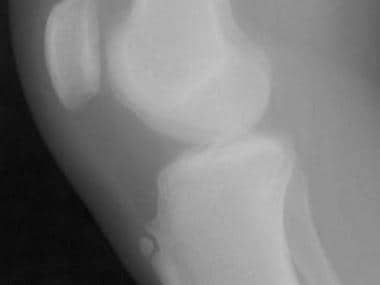 Radiograph of a patient who is skeletally mature. Note that the tibial tubercle is enlarged and that an ossicle is present, with an overlying bursa. Image courtesy of J Andy Sullivan, MD.
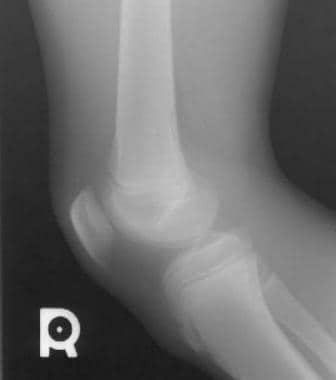 Radiograph of a patient who is skeletally immature. The tubercle is elongated and fragmented, and overlying soft-tissue swelling is present. Image courtesy of J Andy Sullivan, MD.
Little information is available regarding the scintigraphic findings of the Osgood-Schlatter disease. In a published series of 3-phase bone scintigrams that were performed in 10 patients, the findings were normal in all but 1 patient. In this single case, increased flow was seen at the time the symptoms appeared, and normal activity was depicted on delayed images. A follow-up scintigram that was obtained in this patient after the symptoms resolved showed a return to normal activity in all 3 scintigraphic phases.

Radiography
Radiographic findings in patients with Osgood-Schlatter disease vary with the age of the child and the stage of the condition at the time the radiograph is obtained (see the images below). [20]
In the acute stage, edema of the skin and tissues anterior to the tibial tuberosity are present, and the edges of the patellar tendon may be blurred. The Hoffa fat pad may be edematous. If the tibial tuberosity is cartilaginous, no change is seen initially; after 3-4 weeks, fragmented ossification may be visible within the tendon.
In the older patient, whose tibial tuberosity is ossified, linear or nodular avulsed bony fragments may be concomitantly visible with the soft-tissue findings, and a bony defect may be visible at the donor site.
In the subacute stage, soft-tissue edema subsides. A previously visible avulsed ossific fragment may remain. New ossific opacities may develop in the injured patellar tendon.
In the late stage, ossific fragments may unite completely to form a normal-appearing tibial tuberosity. If the fragments are dislocated, they may remain superior and anterior to the tibial tuberosity. If they fuse to the tuberosity, the fragments form a bony excrescence from the tibia that extends into the patellar tendon.
Radiograph of a patient who is skeletally mature. Note that the tibial tubercle is enlarged and that an ossicle is present, with an overlying bursa. Image courtesy of J Andy Sullivan, MD.
Radiograph of a patient who is skeletally immature. The tubercle is elongated and fragmented, and overlying soft-tissue swelling is present. Image courtesy of J Andy Sullivan, MD.
Soft-tissue edema in the region of the tibial tuberosity, with thickening and indistinct margins of the patellar tendon, enables the diagnosis of active Osgood-Schlatter disease with a high degree of confidence; usually, radiologic confirmation of this diagnosis is not necessary.
Accessory ossification centers may mimic findings in the late changes of Osgood-Schlatter disease. The radiographic differential diagnosis of multiple ossific opacities in the area of the anterior tibial tuberosity includes accessory ossification centers, which are normal variants, and late changes from a previous Osgood-Schlatter lesion.
-
Radiograph of a patient who is skeletally mature. Note that the tibial tubercle is enlarged and that an ossicle is present, with an overlying bursa. Image courtesy of J Andy Sullivan, MD.
-
Radiograph of a patient who is skeletally immature. The tubercle is elongated and fragmented, and overlying soft-tissue swelling is present. Image courtesy of J Andy Sullivan, MD.