Continually Updated Clinical Reference
 
 
  All Sources     eMedicine     Medscape     Drug Reference     MEDLINE
 
eMedicine - Rickets : Article by

Quick Find
Authors & Editors
Introduction
Differentials
Radiograph
Intervention
Multimedia
References

Related Articles
Bone Metastases


Patient Education
Click here for patient education.


Author: Rick R van Rijn, MD, PhD, Staff Physician, Department of Radiology, Academic Medical Center Amsterdam

Coauthor(s): Kieran McHugh, MBBCh, Honorary Lecturer, The Institute of Child Health; Consultant Pediatric Radiologist, Department of Radiology, Great Ormond Street Hospital for Children, London, UK

Editors: Beverly P Wood, MD, MS, PhD, Professor, Departments of Radiology and Pediatrics, Division of Medical Education, Keck School of Medicine, University of Southern California; Bernard D Coombs, MB, ChB, PhD, Consulting Staff, Department of Specialist Rehabilitation Services, Hutt Valley District Health Board, New Zealand; David A Stringer, BSc, MBBS, FRCR, FRCPC, Professor, National University of Singapore; Clinical Director, Diagnostic Imaging, National University Hospital; Head, Diagnostic Imaging, KK Women's and Children's Hospital, Singapore; Robert M Krasny, MD, Consulting Staff, Department of Radiology, The Angeles Clinic and Research Institute; Felix S Chew, MD, MBA, EdM, Professor, Department of Radiology, Vice Chairman for Radiology Informatics, Section Head of Musculoskeletal Radiology, University of Washington

Author and Editor Disclosure

Synonyms and related keywords: English disease, osteomalacia, rachitis, vitamin D deficiency, abnormal vitamin D metabolism, scoliosis, craniotabes, bowing of long bones, knock-knees, genu valgum, triradiate pelvis, metaphyseal cupping, metaphyseal widening, metaphyseal spur, widened epiphyseal plates, metaphyseal fraying, metaphyseal splaying, rickets rosary, saber shin deformity

Background

Rickets is an entity in which mineralization is decreased at the level of the growth plates, resulting in growth retardation and delayed skeletal development. Osteomalacia is found within the same spectrum, affects trabecular bone, and results in undermineralization of osteoid bone. By definition, rickets is found only in children prior to the closure of the growth plates, while osteomalacia occurs in persons of any age. Any child with rickets also has osteomalacia, while the reverse is not necessarily true.

The term rickets is said to have derived from the ancient English word wricken, which means "to bend." In several European countries, rickets is also called English disease, a term that appears to stem from the fact that at the turn of the 19th century, rickets was endemic in larger British cities.

Pathophysiology

Rickets results from a Vitamin D deficiency, the abnormal metabolism of vitamin D, or the abnormal metabolism or excretion of inorganic phosphate. Histologic changes are seen at the level of the growth plates or, more specifically, at the level of the hypertrophic zone, where an increased number of disorganized cells is found. The increased number of cells results in increased width and thickness of the hypertrophic zone.

Understanding of the pathophysiology of vitamin D–deficiency rickets requires knowledge of the biochemistry of vitamin D (cholecalciferol). What generally is termed vitamin D is actually a prohormone, which requires activation. In the human body, vitamin D can be either exogenous (vitamin D2, acquired through food supplements) or endogenous (vitamin D3, resulting from exposure of the body to sunlight). Activation is accomplished by hydroxylation of vitamin D at 2 sites. The first hydroxylation, at the 25 site on the vitamin D molecule, occurs mainly in the liver, although this process may also occur in the kidneys and intestine. This step in the vitamin D pathway is a self-limiting feedback system, which is necessary because 25-hydroxyvitamin D persists only for several days in the human body, while vitamin D itself can be stored in the liver for months.

The second hydroxylation, at the 1 site on the vitamin D molecule, always takes place in the kidneys; this process is regulated by the enzyme 25-hydroxyvitamin D1a-hydroxylase. Only after the second hydroxylation occurs does vitamin D become active (1,25-dihydroxyvitamin D). Activation is regulated by parathyroid hormone (PTH), a potent inhibitor of 25-hydroxyvitamin D1 a-hydroxylase. When PTH is suppressed, 25-hydroxyvitamin D is converted into the much less potent 24,25-dihydroxyvitamin D. The action of 1,25-dihydroxyvitamin D is 2-fold; first, it regulates and enhances absorption of calcium from the intestines, and second, it may stimulate differentiation of stem cells into osteoclasts.

Metabolic bone disease of prematurity, seen in infants with very low birthweight (VLBW), can occur in as many as 55% of infants weighing less than 1000 g at birth (Backstrom et al, 1996). In the third trimester of pregnancy, bone mineral density shows the highest rate of increase. In this stage, the requirement for calcium and phosphorus is at its maximum level. If the amount of dietary calcium is too low, renal a-1-hydroxylase is activated and 1,25-dihydroxyvitamin D is generated. This in turn increases the uptake of calcium and phosphorus in the gastrointestinal tract and inhibits the release of PTH.

Although PTH reduces the output of phosphorus in urine and decreases bone absorption, the potent bone-absorbing capacities of 1,25-dihydroxyvitamin D leads to a net decrease in bone mass. Therefore, it is of the utmost importance that nutrition be especially adapted in infants with VLBW. In utero, the fetus receives approximately 120-140 mg/kg of calcium and 70-80 mg/kg of phosphorus, but breast milk contains only 60 mg/kg of calcium and 30 mg/kg of phosphorus. It is easy to see that these levels are inadequate and that infants with VLBW need special formula to gain bone mass.

(For further discussion, see Backstrom, as well as Disorders of Bone Mineralization, Hypophosphatemic Rickets, and Osteomalacia and Renal Osteodystrophy.)

Because rickets results from a metabolic disturbance, the underlying disease should be diagnosed. The causes of rickets can be classified into 11 main categories:

  • Vitamin D deficiency
    • Dietary deficiency
    • Deficient endogenous synthesis
  • Gastrointestinal tract disorders
    • Small intestine diseases with malabsorption
    • Partial or total gastrectomy
    • Hepatobiliary disease
    • Chronic pancreatic insufficiency
  • Disorders of vitamin D metabolism
    • Hereditary - Pseudovitamin D deficiency or vitamin D dependency (types I and II)
    • Acquired
      • Use of anticonvulsants
      • Chronic renal failure
  • Acidosis
    • Distal renal tubular acidosis (classic or type I)
    • Secondary forms of renal acidosis
    • Ureterosigmoidostomy
    • Drug-induced disease
      • Chronic acetazolamine ingestion
      • Chronic ammonium chloride ingestion
  • Chronic renal failure
  • Phosphate depletion
    • Dietary - Low phosphate intake plus ingestion of nonabsorbable antacids
      • Hereditary - X-linked hypophosphatemic rickets or adult-onset vitamin D–resistant hypophosphatemic osteomalacia
      • Acquired - Sporadic hypophosphatemic osteomalacia (phosphate diabetes), tumor-associated (oncogenous) rickets, osteomalacia, neurofibromatosis, and fibrous dysplasia
  • Generalized renal tube disorders
    • Primary renal tube disorders
    • Renal tube disorders associated with systemic metabolic abnormality
      • Cystinosis
      • Glycogenosis
      • Lowe syndrome
    • Systemic disorder with associated renal disease
      • Hereditary - Inborn errors (Wilson disease, tyrosinemia) and neurofibromatosis
      • Acquired - Multiple myeloma, nephrotic syndrome, and kidney transplantation
      • Intoxication-related - Cadmium, lead, outdated tetracycline
  • Primary mineralization defects
    • Hereditary
    • Acquired
      • Diphosphonate treatment
      • Fluoride treatment
  • States of rapid bone formation with or without a relative defect in bone resorption
    • Postoperative hyperparathyroidism with osteitis fibrosa cystica
    • Osteopetrosis
  • Defective matrix synthesis - Fibrogenesis imperfecta ossium
  • Miscellaneous
    • Magnesium-dependent conditions
    • Axial osteomalacia
    • Parenteral alimentation
    • Aluminum intoxication
    • Isofosfamide treatment

Frequency

United States

In the Western world, exact data on the prevalence of rickets are hard to find; however, Welch and colleagues (2000) stated that around the year 1900, finding children younger than 2 years who were not affected would have been difficult in urban areas. In the following 50 years, with the introduction of dietary supplements for children, rickets was eradicated almost completely.

In the last few years, reports have indicated that the prevalence of rickets has increased. A recent study described 5 cases of vitamin D–deficient rickets in Georgia; in all cases, the child was a black male who was breastfed for more than 6 months without additional vitamin D supplementation (Tomashek, 2001).

When the mother has a low vitamin D level, the child can be born with a relative vitamin D deficiency as a result of decreased maternal transfer. In these cases, vitamin D supplementation during pregnancy can increase birthweight and growth. Additionally, the breast milk of a mother with a low vitamin D level will contain less vitamin D than normal, adding to the risk of development of rickets. However, even in mothers with a normal vitamin D level, breastfeeding can cause rickets because the recommended daily vitamin D intake for infants is 200 IU, while breast milk contains only 12-60 IU/L. This has led to the advice to supplement vitamin D when breastfeeding.

International

In most developing countries, rickets is seldom seen, supposedly as a result of high exposure to sunlight. An exception occurs in groups of women who are rarely allowed to leave the house (largely for religious reasons) or who must wear veils (chadors) when they do. Because these women may have low vitamin D levels, their babies are at a higher risk of developing rickets.

Premature babies: This group is at a relatively high risk of developing rickets. Dabezies and Warren (1997) described a 39% incidence of rickets and an associated 10% fracture incidence in premature infants with VLBW.

Mortality/Morbidity

  • When patients receive adequate treatment, no mortality is associated with rickets; however concomitant diseases, such as pneumonia, tuberculosis, and enteritis, occur with a higher frequency in individuals with the disorder and may cause death.
  • Morbidity is nonexistent in patients who are diagnosed and treated in a timely fashion. Even in more advanced cases, bowed limbs may return to normal over a period of years. Only in patients with advanced rickets may permanent skeletal deformities occur. Sequelae consist of bowed legs or arms, knock-knees, deformities of the thoracic cage and spine, and skeletal dysplasia.

Race

  • In the Western world, blacks develop rickets more often than whites. This is probably a result of darkly pigmented skin, which may reduce the penetration of ultraviolet light.
  • In a Dutch article reporting on rickets in adults, Muslim women in the Netherlands wearing a chador were shown to be at high risk for developing vitamin D deficiency, resulting in osteomalacia. The deficiency resulted from underexposure to sunlight. If these women breastfeed their infants, the children also are at high risk of developing vitamin D deficiency. This issue has also been addressed by other authors, from different countries (Wauters and van Soesbergen, 1999).

Sex

Boys and girls are affected equally with rickets. There is a form of genetic rickets, called X-linked hypophosphatemic rickets, in which some children, often girls, may be only moderately affected. However, girls with this disorder can have rickets symptoms that are just as severe as those in boys.

Age

  • By definition, rickets occurs only in children whose growth plates have not closed. The growth plates close at the end of puberty, at approximately age 17 years in females and age 19 years in males.
  • Premature neonates are especially at risk because their requirements for vitamin D, calcium, and phosphate are higher than those in full-term neonates.

Anatomy

The most affected skeletal sites are the anterior costochondral junctions of the middle ribs, the proximal humerus, the distal radius and ulna, the distal femur, and the proximal and distal tibia.

Clinical Details

Clinical findings are related to the involved skeletal site.

  • Head
    • Skull - Craniotabes may occur, in which the bones of the skull soften and flattening of the posterior skull can be seen. These effects may be transient or permanent. Another feature is the prominence of the frontal bones and the major foramen, resulting in frontal bossing or a prominent, sometimes square, forehead (caput quadratum).
    • Teeth - Teeth may erupt later than normal because of undermineralization. Enamel can be of poor quality, resulting in caries.
  • Thorax
    • Rachitic rosary - The enlarged ends of the ribs, resembling beads, can be palpable and visible at the costochondral junction. As a result, the sternum can become more prominent, leading to a pigeon breast or pectus carinatum appearance.
    • Harrison groove - The groove is a semicoronal impression over the abdomen at the level of the insertion of the diaphragm, which can be seen in rickets.
  • Spine - A mild to more pronounced scoliosis may be seen as a result of rickets.
  • Pelvis - A prominent promontory can be found, and the anteroposterior (AP) diameter of the pelvis can shrink as a result of scoliosis. If this persists in girls, it can cause complications later in life during childbirth.
  • Extremities
    • Arms
      • Bowing of the long bones, as a reaction to greenstick fractures, results from concurrent osteomalacia.
      • Thickening of the wrist at the level of the epiphysis is not visible radiographically, since the lesion consists of cartilage, although fraying and cupping of the metaphysis is evident.
    • Legs
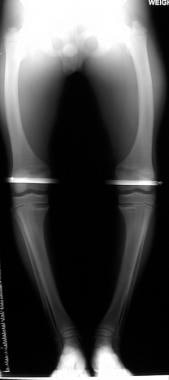
      • Bowing of the long bones (genu varum)as a result of weight bearing is typical.
      • Anterior bowing of the tibia (saber shin deformity) may occur.
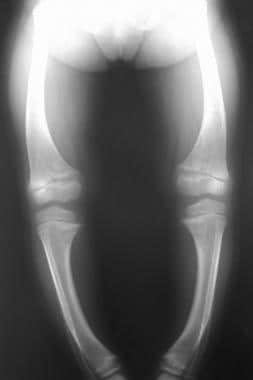
      • Development of knock-knees (genu valgum) may occur because of displacement of the growth plates during active disease.
      • Thickening at the level of the ankle may occur, identical to the process in the wrist.
  • Ligaments and muscles - Laxity in the ligaments is increased, and muscle tone is decreased. This combination leads to a delay in motor development.

Preferred Examination

Plain radiography of the affected bones is the preferred examination. The distal radius and ulna typically demonstrate rachitic lesions early on radiographs. In preterm neonates and young infants, radiographs of the knee may be more reliable than those of the wrist.

Limitations of Techniques

In the early stage of rickets, radiographs depict no pathology; however, chemical changes in blood serum can already be found at this time.


Bone Metastases

Other Problems to be Considered

Metaphyseal chondroplasia (type, Schmid)


Findings

Plain radiograph findings include the following:

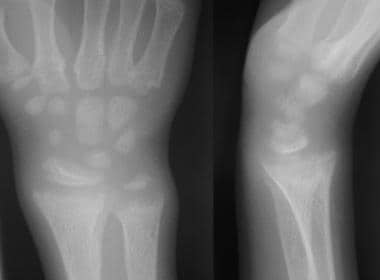
  • Widening and cupping of the metaphyseal regions (see Image 1)
  • Fraying of the metaphysis (see Images 2-3)
  • Craniotabes
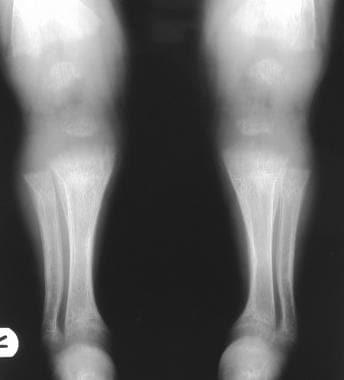
  • Bowing of long bones (see Images 4-6)
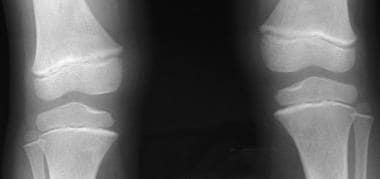
  • Development of knock-knees, or genu valgum (see Images 5-7)
  • Development of scoliosis
  • Impression of the sacrum and femora into the pelvis, leading to a triradiate configuration of the pelvis
  • In healing rickets, the zones of provisional calcification become denser than the diaphysis. In addition, cupping of the metaphysis may become more apparent.

A useful mnemonic for remembering the findings of rickets is as follows:

  • Reaction of the periosteum (may occur)
  • Indistinct cortex
  • Coarse trabeculation
  • Knees, wrists, and ankles affected predominantly
  • Epiphyseal plates, widened and irregular
  • Tremendous metaphysis (cupping, fraying, splaying)
  • Spur (metaphyseal)

Degree of Confidence

In more advanced stages of rickets, radiographic changes are pathognomonic; however, the underlying cause needs to be established using clinical and biochemical assessments.

False Positives/Negatives

False-negative findings can occur in the early phase of disease.


For the prevention of rickets in breastfed children, the US Department of Health and Human Services recommends a daily dose of 400 IU of vitamin D beginning at age 2 months at the youngest.

Special Concerns

  • Mothers who breastfeed their children for a longer period, as is advised by the Workgroup on Breastfeeding of the American Academy of Pediatrics, should be advised to give supplemental vitamin D to their babies.
  • Vitamin D–deficient rickets may be complicated by tetany, which resolves once treatment has commenced.


Media file 1:  Anteroposterior and lateral radiographs of the wrist of an 8-year-old boy with rickets demonstrates cupping and fraying of the metaphyseal region.
Click to see larger pictureClick to see detailView Full Size Image
Media type:  X-RAY

Media file 2:  Radiographs of the knee of a 3.6-year-old girl with hypophosphatemia depict severe fraying of the metaphysis.

Click to see larger pictureClick to see detailView Full Size Image
Media type:  X-RAY

Media file 3:  Radiograph in a 4-year-old girl with rickets depicts bowing of the legs caused by loading.
Click to see larger pictureClick to see detailView Full Size Image
Media type:  X-RAY

Media file 4:  Radiograph in a 4-year-old girl with rickets, focused on the knees. Image depicts the development of knock-knees.
Click to see larger pictureClick to see detailView Full Size Image
Media type:  X-RAY

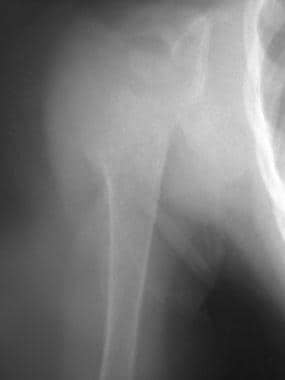
Media file 5:  Radiograph of the proximal humerus in a 2.5-year-old girl who had a peripheral neuroectodermal tumor of the right brachial plexus. After treatment with ifosfamide, the patient developed rickets of the proximal femur. In this case, metastasis should be incorporated into the differential diagnosis.
Click to see larger pictureClick to see detailView Full Size Image
Media type:  X-RAY

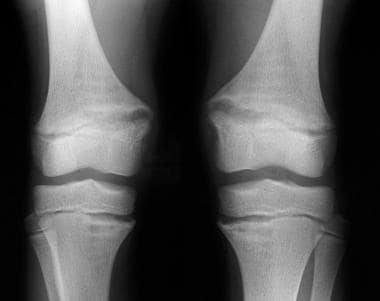
Media file 6:  Radiograph of the knees of an 11-year-old boy with treated vitamin D–resistant rickets. Image demonstrates bilateral multiple growth arrest lines and underdevelopment of the medial aspect of both the tibial plateau and the femoral condyle.
Click to see larger pictureClick to see detailView Full Size Image
Media type:  X-RAY

Media file 7:  Radiograph of a leg with the patient in a standing position demonstrates knock-knees. The patient is an 11-year-old boy with treated vitamin D–resistant rickets.
Click to see larger pictureClick to see detailView Full Size Image
Media type:  X-RAY

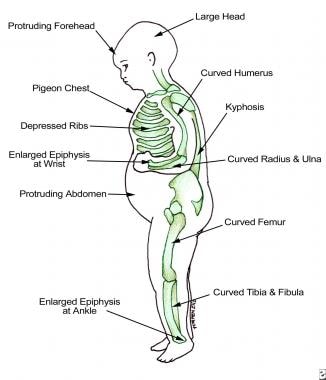
Media file 8:  Findings in patients with rickets.
Click to see larger pictureClick to see detailView Full Size Image
Media type:  Image


  • Allgrove J. Is nutritional rickets returning?. Arch Dis Child. Aug 2004;89(8):699-701. [Full Text].
  • Arthur A. Rickets in the welfare state. N Z Med J. Oct 27 2000;113(1120):452. [Medline].
  • Backstrom MC, Kuusala AL, Maki R. Metabolic bone disease of prematurity. Ann Med. Aug 1996;28(4):275-282.
  • Behrman RE, Kliegman RM, Jensen HB, et al. Nelson Textbook of Pediatrics. 17th ed. Philadelphia, Pa: WB Saunders Co;2004.
  • Brunvand L, Brunvatne R. [Health problems among immigrant children in Norway]. Tidsskr Nor Laegeforen. Feb 28 2001;121(6):715-8. [Medline].
  • CDC. Severe malnutrition among young children—Georgia, January 1997-June 1999. MMWR Morb Mortal Wkly Rep. Mar 30 2001;50(12):224-7.
  • Dabezies EJ, Warren PD. Fractures in very low birth weight infants with rickets. Clin Orthop. Feb 1997;(335):233-9. [Medline].
  • Do TT. Clinical and radiographic evaluation of bowlegs. Curr Opin Pediatr. Feb 2001;13(1):42-6. [Medline].
  • Kottamasu SR. Metabolic Bone Diseases. In: Kuhn JP, Slovis TL, Haller JO, eds. Caffey's Pediatric Diagnostic Imaging. 10th ed. Philadelphia, Pa: Mosby; 2004: 2242-2253.
  • Krane SM, Hollick MF. Metabolic bone disease. In: Wilson JD, et al, eds. Harrison's Principles of Internal Medicine. 12th edition. New York, NY: McGraw-Hill;1991:1921-31.
  • Pal BR, Shaw NJ. Rickets resurgence in the United Kingdom: improving antenatal management in Asians. J Pediatr. Aug 2001;139(2):337-8. [Medline].
  • Pitt MJ. Rickets and osteomalacia. In: Resnick D, Bralow L, eds. Bone and Joint Imaging. 2nd ed. Philadelphia, Pa: WB Saunders Co;1996:511-24.
  • Renton P. Radiology of rickets, osteomalacia and hyperparathyroidism. Hosp Med. May 1998;59(5):399-403. [Medline].
  • Rowe PM. Why is rickets resurgent in the USA?. Lancet. Apr 7 2001;357(9262):1100. [Medline].
  • Thacher TD, Fischer PR, Strand MA. Nutritional rickets around the world: causes and future directions. Ann Trop Paediatr 2006 Mar;26(1):1-16.
  • Tomashek KM, Nesby S, Scanlon KS, et al. Nutritional rickets in Georgia. Pediatrics. Apr 2001;107(4):E45. [Medline].
  • Wauters IM, van Soesbergen RM. [Disease caused by lack of sunlight: rickets and osteomalacia]. Ned Tijdschr Geneeskd. Mar 20 1999;143(12):593-7. [Medline].
  • Welch TR, Bergstrom WH, Tsang RC. Vitamin D–deficient rickets: the reemergence of a once-conquered disease. J Pediatr. Aug 2000;137(2):143-5. [Medline].

Rickets excerpt

Article Last Updated: Feb 2, 2007