AUTHOR AND EDITOR INFORMATION
Section 1 of 12
Author: Patrick M Foye, MD, FAAPMR, FAAEM, Associate Professor of Physical Medicine and Rehabilitation, Co-Director of Musculoskeletal Fellowship, Co-Director of Back Pain Clinic, Director of Coccyx Pain (Tailbone Pain, Coccydynia) Service, University of Medicine and Dentistry of New Jersey, New Jersey Medical School
Patrick M Foye is a member of the following medical societies: American Academy of Physical Medicine and Rehabilitation, American Association of Neuromuscular and Electrodiagnostic Medicine, Association of Academic Physiatrists, and International Spine Intervention Society
Coauthor(s):
Todd P Stitik, MD, Professor, Department of Physical Medicine and Rehabilitation, Acting Director of Sports Medicine, UMDNJ-New Jersey School of Medicine; Lead Physician, Practice Medical Director of University Hospital PM & R Clinic
Editors: Robert L Sheridan, MD, Assistant Chief of Staff, Chief of Burn Surgery, Shriners Burns Hospital; Associate Professor of Surgery, Department of Surgery, Division of Trauma and Burns, Massachusetts General Hospital and Harvard Medical School; Francisco Talavera, PharmD, PhD, Senior Pharmacy Editor, eMedicine; Michael T Andary, MD, MS, Residency Program Director, Professor, Department of Physical Medicine and Rehabilitation, Michigan State University College of Osteopathic Medicine; Kelly L Allen, MD, Consulting Staff, Department of Physical Medicine and Rehabilitation, Lourdes Regional Rehabilitation Center, Our Lady of Lourdes Medical Center; Rene Cailliet, MD, Professor-Chairman Emeritus, Department of Rehabilitation Medicine, University of Southern California School of Medicine; Former Director, Department of Rehabilitation Medicine, Santa Monica Hospital Medical Center
Author and Editor Disclosure
Synonyms and related keywords:
olecranon bursitis, septic bursitis, posterior elbow swelling, draftsman's elbow, student's elbow, miner's elbow
Background
Olecranon bursitis is inflammation of the bursa overlying the olecranon process at the proximal aspect of the ulna.1 The bursa is located between the ulna and the skin at the posterior tip of the elbow.
Related eMedicine topics: Bursitis [Emergency Medicine] Bursitis [Orthopedic Surgery] Olecranon Bursitis [Sports Medicine]
Pathophysiology
Normally, the olecranon bursa prevents tissue tears by providing a mechanism with which the skin can glide freely over the olecranon process. Bursal inflammation may be caused by a variety of mechanisms. Owing to its superficial location, this bursa is susceptible to inflammation from either acute or repetitive (cumulative) trauma. Less commonly, inflammation may result from infection (septic bursitis).2, 3, 4
Related Medscape topic: Resource Center Joint Disorders
Frequency
United States
This condition is relatively common.
Mortality/Morbidity
- Generally, no mortality is associated with this condition.
- Pain at the posterior elbow may cause morbidity, limiting some functional activities, such as writing. Complications of aspiration/injection include recurrence, infection, and persistent drainage.
Race
No racial predisposition is recognized.
Sex
No predisposition for either sex is recognized.
Age
This condition occurs in children and adults. In patients on long-term hemodialysis treatment, uremia or a mechanical factor (such as resting the posterior elbow during hemodialysis treatment) is thought possibly to cause the inflammation.5
History
- Focal swelling at the posterior elbow is usually noticed by the patient.
- The patient may report pain at the affected site, although sometimes the swelling is painless.
- Pain often is exacerbated by pressure, such as when the patient leans on the elbow or when the patient rubs the elbow against a table while writing with the ipsilateral hand.
- Chronic recurrent swelling usually is not tender.
- Frequent bumping of the swollen elbow may occur because the elbow protrudes farther than normal.
- The patient may report a history of isolated trauma (eg, contusion) or repetitive microtrauma (such as constant rubbing of the elbow against a table while writing).
- Onset may be sudden if the condition is secondary to infection or acute trauma.
- Onset may be gradual if olecranon bursitis is secondary to chronic irritation.
Physical
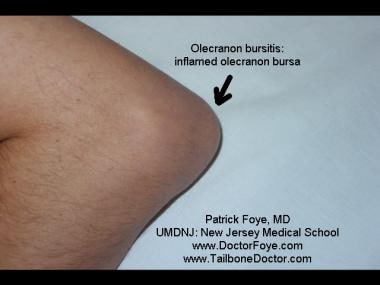
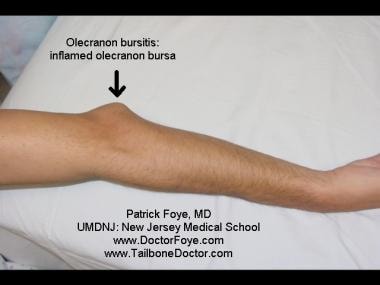
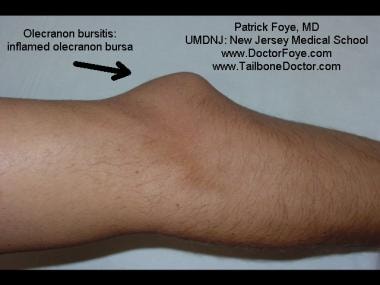
- The most classic finding is posterior elbow swelling that is very clearly demarcated, appearing as a goose egg over the olecranon process.
- The affected site may be tender to palpation.
- The area may be warm and red, particularly with infection.
- Skin inspection may reveal abrasion or contusion if trauma recently occurred.
- Vital signs may reveal fever, but generally only with advanced infection.
- Elbow range of motion (ROM) usually is normal, but occasionally the end range of elbow flexion may be slightly limited because of pain.
- Patients with systemic inflammatory processes (eg, rheumatoid arthritis) or crystal deposition disease (eg, gout, pseudogout) may reveal evidence of focal inflammation at other sites.
- Upon inspection of the elbow, rheumatoid nodules may be found in patients with rheumatoid arthritis.
- If there is a history of trauma, elbow pain during active or passive ROM may increase the clinician's suspicion of fracture of the olecranon process.
Causes
- Acute trauma (such as falling onto a hard floor or a playing field with artificial turf and landing on the olecranon process)
- Minor cumulative trauma, such as repetitive rubbing of the olecranon region against a desktop during writing
- Infection resulting from abrasion or laceration at the site or owing to seeding from hematogenous spread by bacteremia
- Inflammation as part of a systemic inflammatory process (eg, rheumatoid arthritis) or a crystal deposition disease (eg, gout, pseudogout)
Rheumatoid Arthritis
Other Problems to Be Considered
Crystalline inflammatory arthropathy (eg, gout, pseudogout) Fracture of the olecranon process of the ulna Synovial cyst of the elbow joint Perhaps the most important consideration is whether or not an infection is present.
Lab Studies
- Usually, laboratory studies are necessary only if the clinician suspects that an underlying condition is present. It is necessary to check for infection (complete blood count [CBC], including a differential count of the white blood cells [WBCs]). Tests should also be run for rheumatoid factor, the erythrocyte sedimentation rate, and the C-reactive protein level, in order to assess for rheumatoid arthritis. The uric acid level should be checked in order to assess for gout.
- If infection is suggested due to fever, redness, previous puncture wounds, or cellulitis, the bursa should be aspirated and the fluid should be sent for immediate Gram stain for bacteria, as well as a cell count (WBCs, red blood cells [RBCs]).
- The leukocyte count can help to determine whether the fluid is infectious or merely inflammatory.
- Within synovial aspirates, WBC counts are assessed as follows:
- A WBC count less than 200/µL is considered normal.
- A WBC count is considered noninflammatory at 200-2000/µL.
- A WBC count in the range of 2000-100,000/µL is considered to be an indication of inflammation.
- A WBC count greater than 100,000/µL is considered to be an indication of a septic condition.
- Gram stain also is helpful to determine quickly whether bacterial infection appears to be present.
- If the Gram stain is positive, antibiotics should be started immediately and bursal corticosteroid injection should be avoided.
- Even if the Gram stain is negative or initially unavailable, antibiotics may seem indicated based on the mechanism of injury (eg, abrasion or puncture), physical examination findings suggestive of infection (eg, fever, significant local redness and warmth), or the gross appearance of the aspirate (eg, turbid, purulent).
- Gram stain can be followed by culture and sensitivity testing. The culture and sensitivity results should guide the use of antibiotics in cases of bacterial infection.
- Crystal analysis may reveal monosodium urate crystals in a patient with gout, calcium pyrophosphate crystals in a patient with pseudogout, or hydroxyapatite crystals.
Imaging Studies
- If there has been significant trauma, a radiograph of the elbow should be obtained to assess for possible fracture.
- In rare cases, magnetic resonance imaging (MRI) may be indicated to exclude concomitant osteomyelitis or abscess formation.6, 7
Procedures
- Bursal aspiration still remains the criterion standard to differentiate septic and aseptic olecranon bursitis.2, 3, 4
- The olecranon bursa can be aspirated using an 18-gauge needle inserted through the posterior-lateral approach, using a zigzag approach to minimize the risk of fistula formation.
- Aspiration can be helpful diagnostically because any cloudy fluid should be sent for immediate Gram stain, leukocyte count, and culture, with tests for antibiotic sensitivity.
- Aspiration can also be therapeutic, because it relieves the swelling.
- If the clinician is confident that no infection is present, corticosteroid injection can be considered (for instance, immediately after aspiration of the fluid).8
Histologic Findings
In cases of bacterial infection, synovial fluid analysis may reveal increased WBC counts.9
Rehabilitation Program
Physical Therapy
In general, physical and occupational therapy are not needed for this condition. In some cases of nonseptic bursitis, however, the physician may recommend a course of physical or occupational therapy to speed recovery time. Individuals who exhibit olecranon bursitis often are advised to apply the RICE (rest, ice, compression, elevation) method of treatment. Physical therapy modalities (eg, phonophoresis, electrical stimulation) also may be helpful in further reducing pain and inflammation, although these modalities are not necessary for most patients with this condition. The therapist can also complete patient education and present compensatory strategies for resting the involved upper extremity while healing takes place. If the patient's condition becomes severe and does not respond to conservative treatment, surgery may be indicated. For the patient who undergoes bursal excision (bursectomy), physical therapy may be recommended postoperatively for regaining or maintaining the elbow's ROM and strength.
Medical Issues/Complications
- Complications of the disease process include persistent pain and associated decreased functional use of the affected upper extremity.
- Potential complications of aspiration/injection are as follows:
- Swelling - This may recur, particularly if the patient does not maintain adequate pressure or icing at the site or if an infection was present at the time of the initial aspiration.
- Infection
- Persistent drainage through the injection tract
- Ulnar nerve injury - This theoretically may occur if a medial approach is used for the aspiration/injection.
Surgical Intervention
Usually, no surgical intervention is required; however, very severe cases of recalcitrant bursitis may require bursectomy.10
Consultations
- Consultation with a physiatrist (physical medicine and rehabilitation physician) or with another qualified musculoskeletal specialist may be considered by physicians without the training, comfort, or procedural office supplies necessary for aspiration.
- Consultation with a rheumatologist may be helpful if findings are consistent with inflammatory arthropathy.
- Consultation with an orthopedist is generally required only if a fracture is present or in very severe cases of recalcitrant bursitis requiring excision (bursectomy). Some cases may require incision and drainage.
Other Treatment
- Oral nonsteroidal anti-inflammatory drugs (NSAIDs) may be helpful. See Medication.
- Focal corticosteroid injection may be an option, but only if the clinician is confident that no local infection is present.
- A retrospective study by Weinstein and colleagues showed that in 47 patients with traumatic olecranon bursitis, almost all cases resolved via aspiration, with or without intrabursal glucocorticoid injection.11 The 25 patients who did receive glucocorticoid injection (20 mg of triamcinolone) in addition to the bursal aspiration resolved much more rapidly, usually within 1 week. However, glucocorticoid injection seemed to be more highly associated with complications, such as infection and skin atrophy.
- The injection should be on the lateral side of the elbow, so as to avoid the ulnar nerve. The target injection site is the soft-tissue center of the triangle formed by the lateral olecranon, the head of the radius, and the lateral epicondyle. As with most injections, the physician should first aspirate to ensure that the needle is not in a blood vessel and then inject using a slow, but consistent, pressure.12
- A compressive elbow sleeve (eg, a neoprene or elastic sleeve) may help to prevent the bursal fluid from re-accumulating after aspiration.
For this musculoskeletal condition, medications are used primarily to decrease pain and inflammation. Thus, the most commonly used medications are oral NSAIDs and focal corticosteroid injection in conjunction with the rest of the rehabilitation plan.13
Drug Category: Nonsteroidal anti-inflammatory drugs
Can help to decrease pain and inflammation. Various oral NSAIDs can be used. The choice of NSAID is largely a matter of the adverse effect profile, as well as convenience (how frequently doses must be taken to achieve adequate analgesic and anti-inflammatory effects), patient preferences, and cost.
| Drug Name | Ibuprofen (Motrin, Advil, Nuprin, Rufen) |
| Description | DOC for mild to moderate pain. Inhibits inflammatory reactions and pain by decreasing prostaglandin synthesis. |
| Adult Dose | 200-800 mg PO tid/qid |
| Pediatric Dose | <6 months: Not established 6 months to 12 years: 4-10 mg/kg/dose PO tid/qid >12 years: Administer as in adults |
| Contraindications | Documented hypersensitivity to other NSAIDs or aspirin; peptic ulcer disease, recent GI bleeding or perforation, renal insufficiency, and high risk of bleeding |
| Interactions | May decrease effects of loop diuretics with coadministration; coadministration with anticoagulants may increase PT (monitor and watch for signs of bleeding); may increase serum lithium levels and risk of methotrexate toxicity; probenecid may increase toxicity; may increase retention of sodium and fluid and may raise blood pressure |
| Pregnancy | D - Unsafe in pregnancy
|
| Precautions | Minimize risks of adverse effects by not taking multiple NSAIDs concurrently; caution in patients on anticoagulants or systemic corticosteroids and with bleeding disorders or significant alcohol use; caution in aspirin/NSAID-induced asthma; hypertension, CHF, and advanced age |
| Drug Name | Naproxen (Anaprox, Naprelan, Naprosyn) |
| Description | For relief of mild to moderate pain. Inhibits inflammatory reactions and pain by decreasing activity of cyclooxygenase, which is responsible for prostaglandin synthesis. |
| Adult Dose | 500 mg PO followed by 250 mg PO q6-8h; not to exceed 1.25 g/d |
| Pediatric Dose | <2 years: Not established >2 years: 2.5 mg/kg PO; not to exceed 10 mg/kg/d |
| Contraindications | Documented hypersensitivity, peptic ulcer disease, recent GI bleeding or perforation, and renal insufficiency |
| Interactions | Probenecid may increase toxicity; coadministration with ibuprofen may decrease effects of loop diuretics; coadministration with anticoagulants may prolong PT (watch for signs of bleeding); may increase serum lithium levels and risk of methotrexate toxicity (eg, stomatitis, bone marrow suppression, nephrotoxicity) |
| Pregnancy | B - Usually safe but benefits must outweigh the risks.
|
| Precautions | Acute renal insufficiency, interstitial nephritis, hyperkalemia, hyponatremia, and renal papillary necrosis may occur; patients with preexisting renal disease or compromised renal perfusion risk acute renal failure; leukopenia occurs rarely, is transient, and usually returns to normal during therapy; persistent leukopenia, granulocytopenia, or thrombocytopenia warrant further evaluation and may require discontinuation of drug |
| Drug Name | Ketoprofen (Oruvail, Orudis, Actron) |
| Description | For relief of mild to moderate pain and inflammation. Small doses are indicated initially in patients with small body size, elderly patients, and those with renal or liver disease. |
| Adult Dose | 25-50 mg PO q6-8h prn; not to exceed 300 mg/d Doses >75 mg do not increase therapeutic effects; administer high doses with caution and closely observe patient for response |
| Pediatric Dose | <3 months: Not established 3 months to 12 years: 0.1 mg/kg PO q6-8h >12 years: Administer as in adults |
| Contraindications | Documented hypersensitivity |
| Interactions | May decrease effects of loop diuretics with coadministration; coadministration with anticoagulants may increase PT (monitor and watch for signs of bleeding); may increase serum lithium levels and risk of methotrexate and phenytoin toxicity; probenecid may increase toxicity of NSAIDs |
| Pregnancy | B - Usually safe but benefits must outweigh the risks.
|
| Precautions | Caution in CHF, hypertension, and decreased renal and hepatic function; caution in anticoagulation abnormalities or during anticoagulant therapy |
Drug Category: Cyclooxygenase-2 (COX-2) inhibitors
Although increased cost can be a negative factor, the incidence of costly and potentially fatal gastrointestinal (GI) bleeds is clearly less with cyclooxygenase-2 (COX-2) inhibitors than with traditional NSAIDs. Ongoing analysis of cost avoidance of GI bleeds will further define the populations that will find COX-2 inhibitors the most beneficial.
| Drug Name | Celecoxib (Celebrex) |
| Description | Inhibits primarily COX-2. COX-2 is considered an inducible isoenzyme, induced during pain and inflammatory stimuli. Inhibition of COX-1 may contribute to NSAID GI toxicity. At therapeutic concentrations, COX-1 isoenzyme is not inhibited; thus, GI toxicity may be decreased. Seek lowest dose of celecoxib for each patient. |
| Adult Dose | 200 mg/d PO qd; alternatively, 100 mg PO bid |
| Pediatric Dose | Not established |
| Contraindications | Documented hypersensitivity |
| Interactions | Coadministration with fluconazole may cause increase in plasma concentrations because of inhibition of celecoxib metabolism; coadministration with rifampin may decrease celecoxib plasma concentrations |
| Pregnancy | C - Safety for use during pregnancy has not been established.
|
| Precautions | May cause fluid retention and peripheral edema; caution in compromised cardiac function, hypertension, conditions predisposing to fluid retention; severe heart failure and hyponatremia, because may deteriorate circulatory hemodynamics; NSAIDs may mask usual signs of infection; caution in presence of existing controlled infections; evaluate symptoms and signs suggesting liver dysfunction, or in abnormal liver lab results |
Drug Category: Corticosteroids
In contrast to the widespread systemic distribution of an oral anti-inflammatory drug, a local corticosteroid injection can achieve focal placement of a potent anti-inflammatory agent at the site of maximal tenderness or inflammation. A variety of corticosteroid preparations are available for injection. Commonly, the corticosteroid is mixed with a local anesthetic agent prior to injection. Various local anesthetic agents also are available.
| Drug Name | Methylprednisolone (Depo-Medrol, Solu-Medrol, Medrol, Adlone) |
| Description | Corticosteroids, such as methylprednisolone, are commonly used for local injections of bursae or joints to provide a local anti-inflammatory effect while minimizing some of the GI and other risks of systemic medications. |
| Adult Dose | 40 mg (1 mL) intralesionally is common for injection at many sites, often mixed with a few mL of a local anesthetic, such as 1% lidocaine |
| Pediatric Dose | Not established |
| Contraindications | Documented hypersensitivity to the medication; skin infection at the site of injection |
| Interactions | Coadministration with anticoagulants may increase risk of hemorrhage or local bruising |
| Pregnancy | C - Fetal risk revealed in studies in animals but not established or not studied in humans; may use if benefits outweigh risk to fetus
|
| Precautions | Local corticosteroid injections are not known to have the same degree of medication interactions as those seen with oral or other types of systemic administration of corticosteroids Never inject corticosteroids through an infected area of skin A diabetic patient may sometimes experience a transient elevation of blood glucose level after a local corticosteroid injection |
Further Outpatient Care
- Icing of the posterior elbow for 15-20 minutes at a time, several times per day, is recommended during the acute period (2-5 days).
- A compressive wrap using an elastic wrap or elastic sleeve is helpful.
- Excessive pressure over the elbow should be avoided.
- If possible, further trauma to the affected joint should be avoided.
- The use of elbow pads to cushion the region from further trauma should be considered.
- For cases with repeated recurrence, the use of a posterior plaster splint should be considered in order to limit elbow motion for 1-2 weeks following aspiration.
- The patient should return for re-evaluation within approximately 2 weeks. At that time, assessment should be made for re-accumulation of the fluid, any persistent drainage, or any signs of infection.
- The decision whether to treat with empiric antibiotics depends on the perceived likelihood of infection, based on the history, physical examination, and analysis of the bursal aspirate.
Deterrence
- Further trauma to the affected site, including acute trauma (such as that caused by contact sports) and repetitive minor traumas, should be avoided.
- Excessive pressure over the elbow should be avoided.
- The use of elbow pads to cushion the region from further trauma should be considered, even if the pads are employed only initially, until the acute inflammation is resolved.
Complications
Prognosis
- In the absence of infection, most patients respond very well to 1 or, perhaps, 2 aspirations, with or without corticosteroid injection.
Patient Education
- The most important aspect of patient education is ensuring that the patient knows to immediately report any signs or symptoms of persistent drainage or infection, particularly if a corticosteroid injection has been administered.
- For excellent patient education resources, visit eMedicine's Arthritis Center. Also, see eMedicine's patient education article Bursitis.
Medical/Legal Pitfalls
- Corticosteroids should never be injected into a site that appears to be infected or through skin that appears to be infected.
- In the presence of significant trauma, radiographs should always be checked for fractures before treatment commences.
- In the absence of a traumatic etiology, consideration should be given to analyzing the aspirated fluid for infection and crystals.
- When aspiration/injection is performed, aseptic techniques should be used to minimize the chance of causing iatrogenic infection. Septic olecranon bursitis due to Mycobacterium smegmatis has been reported after intrabursal steroid injection.14
- The medial approach to the olecranon bursa should be avoided, since a misdirected needle could damage the ulnar nerve.
Special Concerns
- Pregnancy - Aspiration of the bursa and corticosteroid injection can be performed during pregnancy. Oral NSAIDs should be avoided.
- Pediatric patient - Informed consent should be obtained from the parent or legal guardian before aspiration or injection is performed.
- Elderly patient with history of side effects from NSAIDs - It is necessary to be cautious when using NSAIDs in elderly patients. COX-2 inhibitors may be indicated.
- Patient with diabetes - Some patients with diabetes may experience a transient elevation in blood glucose levels after corticosteroid injection.
Debra Ibrahim, 4th year medical student, New York College of Osteopathic Medicine, Class of 2008, assisted with the 2007 revision of this manuscript.
| Media file 1:
Olecranon bursitis, shown here with the elbow flexed. Image courtesy of UMDNJ-New Jersey Medical School, www.DoctorFoye.com, and www.TailboneDoctor.com. |
 | View Full Size Image | |
Media type: Photo
|
| Media file 2:
Olecranon bursitis seen with the elbow extended; the focal olecranon swelling is more visible than it is when the elbow is flexed. Image courtesy of UMDNJ-New Jersey Medical School, www.DoctorFoye.com, and www.TailboneDoctor.com. |
 | View Full Size Image | |
Media type: Photo
|
| Media file 3:
Olecranon bursitis seen with the elbow extended. Image courtesy of UMDNJ-New Jersey Medical School, www.DoctorFoye.com, and www.TailboneDoctor.com |
 | View Full Size Image | |
Media type: Photo
|
| Media file 4:
Olecranon bursogram: this image shows a needle injecting contrast material into the olecranon bursa, under fluoroscopic guidance. Although olecranon bursa aspiration/injection usually does not require fluoroscopy or contrast, employing fluoroscopy here demonstrates the outline of the involved bursa. Image ©2005, by Patrick M. Foye, MD, UMDNJ: New Jersey Medical School. |
 | View Full Size Image | |
Media type: Image
|
| Media file 5:
Needle aspiration of olecranon bursitis. Image courtesy of UMDNJ-New Jersey Medical School, www.DoctorFoye.com, and www.TailboneDoctor.com. |
 | View Full Size Image | |
Media type: Photo
|
| Media file 6:
Olecranon bursitis aspiration of a hemorrhagic effusion. Image courtesy of UMDNJ-New Jersey Medical School, www.DoctorFoye.com, and www.TailboneDoctor.com. |
 | View Full Size Image | |
Media type: Photo
|
| Media file 7:
After fluid is removed from the olecranon bursa, an elastic tubular compressive sleeve can be used to minimize repeat accumulation of the fluid. Image courtesy of UMDNJ-New Jersey Medical School, www.DoctorFoye.com, and www.TailboneDoctor.com. |
 | View Full Size Image | |
Media type: Photo
|
- Snider RK. Olecranon bursitis. In: Snider RK, ed. Essentials of Musculoskeletal Care. Rosemont, Ill: American Academy of Orthopaedic Surgeons; 1997:156-9.
- Wasserman AR, Melville LD, Birkhahn RH. Septic bursitis: a case report and primer for the emergency clinician. J Emerg Med. Jul 20 2007;[Medline].
- Lass-Flörl C, Mayr A. Human protothecosis. Clin Microbiol Rev. Apr 2007;20(2):230-42. [Medline]. [Full Text].
- Wagner C, Iking-Konert C, Hug F, et al. Cellular inflammatory response to persistent localized Staphylococcus aureus infection: phenotypical and functional characterization of polymorphonuclear neutrophils (PMN). Clin Exp Immunol. Jan 2006;143(1):70-7. [Medline]. [Full Text].
- Senécal L, Leblanc M. Olecranon bursitis in chronic haemodialysis patients. Nephrol Dial Transplant. Sep 2001;16(9):1956-7. [Medline]. [Full Text].
- Floemer F, Morrison WB, Bongartz G, et al. MRI characteristics of olecranon bursitis. AJR Am J Roentgenol. Jul 2004;183(1):29-34. [Medline]. [Full Text].
- Tran N, Chow K. Ultrasonography of the elbow. Semin Musculoskelet Radiol. Jun 2007;11(2):105-16. [Medline].
- Olsen NK, Press JM, Young JL. Bursal injections. In: Lennard TA, ed. Physiatric Procedures in Clinical Practice. Philadelphia, Pa: Hanley & Belfus; 1995:36-43.
- Schumacher HR. Arthrocentesis, synovial fluid analysis, and synovial biopsy. In: Schumacher HR, ed. Primer on Rheumatic Diseases. 10th ed. Atlanta, Ga: Arthritis Foundation; 1993:67-72.
- Degreef I, De Smet L. Complications following resection of the olecranon bursa. Acta Orthop Belg. Aug 2006;72(4):400-3. [Medline].
- Weinstein PS, Canoso JJ, Wohlgethan JR. Long-term follow-up of corticosteroid injection for traumatic olecranon bursitis. Ann Rheum Dis. Feb 1984;43(1):44-6. [Medline]. [Full Text].
- Cardone DA, Tallia AF. Diagnostic and therapeutic injection of the elbow region. Am Fam Physician. Dec 1 2002;66(11):2097-100. [Medline].
- Green SM. Nonsteroidal anti-inflammatory drugs (NSAIDs). In: Tarascon Pocket Pharmacopoeia 2000. Loma Linda, Calif: Tarascon; 2000:11-2.
- Friedman ND, Sexton DJ. Bursitis due to Mycobacterium goodii, a recently described, rapidly growing mycobacterium. J Clin Microbiol. Jan 2001;39(1):404-5. [Medline]. [Full Text].
- Brinker MR, Miller MD. The adult elbow. In: Fundamentals of Orthopaedics. Philadelphia, Pa: WB Saunders; 1999:153-64.
- Lennard TA. Fundamentals of procedural care. In: Lennard TA, ed. Physiatric Procedures in Clinical Practice. Philadelphia, Pa: Hanley & Belfus; 1995:1-13.
- McGee DJ. Elbow joints. In: Orthopedic Physical Assessment. 2nd ed. Philadelphia, Pa: WB Saunders; 1992:143-67.
- Morgan WJ. Elbow and forearm. In: Steinberg GG, Akins CM, Baran DT, eds. Orthopaedics in Primary Care. 3rd ed. Baltimore, Md: Lippincott Williams & Wilkins; 1999:70-98.
- Strakowski JA, Wiand JW, Johnson EW. Upper limb musculoskeletal pain syndromes. In: Braddom RL, ed. Physical Medicine and Rehabilitation. Philadelphia, Pa: WB Saunders; 1996:756-82.
Olecranon Bursitis excerpt Article Last Updated: May 2, 2008
|