Continually Updated Clinical Reference
 
 
  All Sources     eMedicine     Medscape     Drug Reference     MEDLINE
 
eMedicine - Medial Collateral and Lateral Collateral Ligament Injury : Article by

Quick Find
Authors & Editors
Introduction
Clinical
Differentials
Workup
Treatment
Medication
Follow-up
Miscellaneous
Multimedia
References

Related Articles
Patellofemoral Syndrome

Pes Anserinus Bursitis

Rheumatoid Arthritis


Patient Education
Foot, Ankle, Knee, and Hip Center

Knee Injury Overview

Knee Injury Causes

Knee Injury Symptoms

Knee Injury Treatment

Knee Pain Introduction


Author: Adam B Agranoff, MD, Physiatrist and Partner, Chelsea Back Care, Chelsea Community Hospital

Adam B Agranoff is a member of the following medical societies: American Academy of Physical Medicine and Rehabilitation, Association of Academic Physiatrists, and North American Spine Society

Coauthor(s): Robert J Kaplan, MD, Associate Professor, Department of Physical Medicine and Rehabilitation, University of Kansas School of Medicine and Medical Center

Editors: Robert E Windsor, MD, FAAPMR, FAAEM, FAAPM, President and Director, Georgia Pain Physicians, PC; Clinical Associate Professor, Department of Physical Medicine and Rehabilitation, Emory University School of Medicine; Francisco Talavera, PharmD, PhD, Senior Pharmacy Editor, eMedicine; Michael T Andary, MD, MS, Residency Program Director, Associate Professor, Department of Physical Medicine and Rehabilitation, Michigan State University College of Osteopathic Medicine; Kelly L Allen, MD, Consulting Staff, Department of Physical Medicine and Rehabilitation, Lourdes Regional Rehabilitation Center, Our Lady of Lourdes Medical Center; Consuelo T Lorenzo, MD, Consulting Staff, Department of Physical Medicine and Rehabilitation, Alegent Health Care, Immanuel Rehabilitation Center

Author and Editor Disclosure

Synonyms and related keywords: medial collateral ligament injury, lateral collateral ligament injury, tibial collateral ligament, fibular collateral ligament, MCL injury, LCL injury

Background

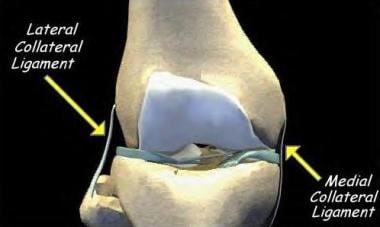
Medial collateral ligament (MCL) and lateral collateral ligament (LCL) injuries of the knee are common. The MCL and LCL provide restraint to valgus and varus angulation of the knee respectively. The MCL has both superficial and deep components. The superficial MCL fibers attach to the medial femoral epicondyle proximally and distally to the medial aspect of the tibia, approximately 4 centimeters distal to the joint line. The deep MCL fibers originate from the medial joint capsule and are attached to the medial meniscus. The LCL is part of a complex of ligaments collectively named the posterolateral corner (PC). The structures in the PC include the LCL, popliteofibular ligament, popliteus ligament, arcuate ligament, short lateral ligament, and posterolateral joint capsule. The LCL is separated from the lateral meniscus by a fat pad (see Image 1).

Pathophysiology

Injuries to the MCL and LCL are caused primarily by valgus and varus stress to the knee joint, respectively. Injuries also can occur to both ligaments with excessive lateral rotation of the knee.

Frequency

United States

The annual incidence of acute knee injury in the United States is estimated to be 300 cases per 100,000 population. Collateral ligament injuries account for 25% of patients presenting to emergency rooms with acute knee injury. Peak incidence of collateral ligament injuries occurs in adults aged 20-34 years. The National Collegiate Athletic Association (NCAA) injury surveillance system reported 2.1 medial or lateral collateral injuries per 1000 player exposures in games across all NCAA sports over a year. Even noncontact sports such as gymnastics and swimming can lead to collateral ligament injuries.

Mortality/Morbidity

Most individuals with MCL and LCL injuries can be treated successfully with conservative methods. Severe injuries may require surgical intervention and tend to have good outcomes.

Race

No racial predilection is known for MCL and LCL injuries.

Sex

Unlike anterior cruciate ligament (ACL) injuries, which occur at a higher rate in women, LCL and MCL injuries occur at an equal rate in men and women.

Age

Age patterns are bimodal, with highest incidence rates at age 20-34 years and 55-65 years. MCL and LCL injuries can occur in persons of any age.


History

Listen to the patient's description of the injury event. The force vector of injury to the knee indicates the most likely site of pathology. For example, a football player who complains of medial knee pain after a valgus stress on the knee is likely to have an injury to the MCL. Have the patient use the uninjured knee to explain precisely what he or she was doing when the incident occurred.

  • MCL injury
    • Patients commonly have had recent excessive valgus force applied to a partially flexed knee (eg, clipping injury in football).
    • Most patients are able to continue ambulating after an acute injury.
    • Pain and stiffness are localized to the medial knee.
    • Erythema may appear after several days.
    • The location of pain and swelling can be good indicators for what structure(s) may be damaged in the knee.
    • Instability or mechanical symptoms (eg, a locking or popping sensation) are uncommon.
  • LCL injury
    • The patient commonly reports a history of varus force applied to the knee.
    • Most patients are able to continue ambulating after an acute injury.
    • Pain and stiffness are localized to the lateral knee.
    • Erythema may appear after several days.
    • Swelling is often present.
    • Instability or mechanical symptoms (eg, a locking or popping sensation) are uncommon.

Physical

Recognize that collateral ligament injuries often are seen in association with injury to other knee structures. A comprehensive musculoskeletal knee examination should be completed to direct further diagnostic testing and therapeutic interventions. A recent systematic review of the available literature revealed no articles that adequately assessed the diagnostic sensitivity and specificity of the physical examination in detecting medial and lateral collateral ligamentous injuries.

  • MCL injury
    • Palpate with the knee in 25-30° of flexion.
    • Tenderness may be noted anywhere along the course of the MCL.
    • Isolated tenderness at the proximal or distal insertion sites may indicate an avulsion-type injury.
    • Swelling often is present and should alert the examiner to possible intra-articular injury.
  • LCL injury
    • Palpate with the knee in 20° of flexion.
    • Tenderness may be noted anywhere along the course of the LCL.
    • Isolated tenderness at the proximal of distal insertion sites may indicate an avulsion-type injury.
    • Swelling is common.
  • Evocative testing of collateral ligaments
    • Valgus stress testing of the MCL
      • The patient is in the supine position with the knee flexed 25-30°. The examiner places one hand on the lateral knee and grasps the medial ankle with other hand. Then the knee is abducted. Pain and excessive laxity indicate stretching or tearing of the MCL.
      • Perform the same technique as above with the knee extended. If excessive knee joint laxity and pain are still noted, injury to the anterior cruciate ligament also may be present.
    • Varus stress testing of the LCL
      • The patient is in the supine position with the knee flexed 20-25°. The examiner places one hand on the medial knee and grasps the lateral ankle with other hand. The knee is adducted. Pain and excessive laxity indicate injury to the LCL.
      • Then perform the same technique as above with the knee extended. If pain and laxity are still present, injury to the posterior capsule may be present.
  • Injury severity
    • Grade I - Less than 5 cm laxity (partial tear)
    • Grade II - From 5-10 cm laxity
    • Grade III - More than 10 cm laxity (complete tear)
  • Physical examination under general anesthesia may be indicated if the patient is guarding due to pain symptoms.

Causes

  • Injury of the MCL/LCL may be caused by the following:
    • Trauma
      • Acute varus or valgus stress on the knee joint
      • Sports related (younger population)
      • Falls (elderly)
      • Other trauma
    • Overuse syndromes (eg, swimmers who use breaststroke may have repetitive stretching of MCL leading to injury)


Patellofemoral Syndrome
Pes Anserinus Bursitis
Rheumatoid Arthritis

Other Problems to be Considered

Osteochondral fracture
Tibial plateau fracture
Extensor mechanism rupture
Osteonecrosis of the femoral epicondyle
Osteonecrosis of the tibial condyle
Inflammatory conditions (systemic disease)


Lab Studies

  • Laboratory studies usually are not indicated for the diagnosis of an MCL or LCL injury.

Imaging Studies

  • Diagnosis is usually clinical.
  • Plain films in patients with suspected knee ligamentous injuries should include anteroposterior, lateral, intercondylar notch, and sunrise views. Avulsion fractures are often noted in knee ligament injuries. Indications for plain knee radiographs in suspected knee ligamentous injuries (Pittsburgh decision rules) are blunt trauma or a fall with one of the following criterion: (1) unable to walk 4 weight-bearing steps or (2) age older than 50 years or younger than 12 years.
  • MRI is helpful for ruling out other soft tissue injuries (eg, anterior or posterior cruciate ligament tears, meniscus injury). MRI is very sensitive for tears of the collateral ligaments; however, it is not reliable for differentiating grades of injury and tends to underestimate the degree of injury.
    • The MCL can usually be visualized in its entirety in the coronal plane. A partial tear of the MCL is seen on MRI as an area of increased signal intensity on T2-weighted images, representing edema. The ligament may irregular. A complete tear of the MCL is marked by edema at the rupture site and retraction of the free ends.
    • The LCL is best visualized on coronal images. It tends to be of low signal intensity and with uniform thickness. Partial tears are characterized by edema. A complete LCL tear may be associated with a small avulsion of the styloid process of the fibular head and marked edema.

Procedures

  • Arthrocentesis of the knee may be indicated to rule out hemarthrosis if an effusion is present.


Rehabilitation Program

Physical Therapy

The type of physical therapy (PT) treatment indicated for an MCL injury is dependent upon the severity of the injury. Recommendations for treatment include the following:

  • Grade I: Compression, elevation, and cryotherapy are recommended. Short-term use of crutches may be indicated, with weight-bearing as tolerated (WBAT) ambulation. Early ambulation is recommended.
  • Grade II: A short-hinged brace that blocks 20° of terminal extension but allows full flexion should be used. The patient may ambulate WBAT. Closed-chain exercises allow for strengthening of knee musculature without putting stress on the ligaments.
  • Grade III: The patient initially should be non–weight-bearing (NWB) on the affected lower extremity. A hinged braced should be used with gradual progression to full weight-bearing (FWB) over 4 weeks. Grade III injuries may require 8-12 weeks to heal.
  • All MCL injuries should be treated with early range of motion (ROM) and strengthening of musculature that stabilizes the knee joint.
  • Conservative measures usually are adequate, but, if the patient fails to progress with treatment, a meniscal or cruciate ligament tear is suggested.

  • LCL injuries heal more slowly than MCL injuries, due to the difference in collagen density. Recommendations for treatment of LCL injuries include the following:

  • Grades I and II: These injuries are treated according to a regimen similar to that for MCL injuries of the same severity. A hinged brace is used for 4-6 weeks.
  • Grade III: Severe LCL injuries typically are treated surgically due to rotational instability since they usually involve the posterolateral corner of the knee. Patients may require bracing and physical therapy for up to 3 months to prevent later instability.

Surgical Intervention

Most patients with injury to the collateral ligaments can be treated effectively with conservative measures. Grade III LCL tears usually involve the posterolateral complex and are associated with instability. These patients do require surgical repair. Surgical treatment for isolated injuries of the MCL and LCL is a controversial topic. The treatment plan should be based partially on the patient's preinjury level of activity and motivational factors. For example, a young competitive swimmer may want surgery, followed by a comprehensive rehabilitation program to accelerate the time to adequate functional recovery. A new technique for repair of severe MCL injuries using autogenous hamstring tendons has recently been proposed.

Consultations

An orthopedic surgery consultation is advised for individuals with severe ligament injury.


The goal of pharmacotherapy is to reduce morbidity.

Drug Category: Nonsteroidal anti-inflammatory drugs

Have analgesic, anti-inflammatory, and antipyretic activities. Their mechanism of action is not known, but they may inhibit cyclo-oxygenase activity and prostaglandin synthesis. Other mechanisms may exist as well, such as inhibition of leukotriene synthesis, lysosomal enzyme release, lipoxygenase activity, neutrophil aggregation, and various cell-membrane functions.

Drug NameIbuprofen (Motrin, Ibuprin)
DescriptionDOC for patients with mild to moderate pain. Inhibits inflammatory reactions and pain by decreasing prostaglandin synthesis.
Adult Dose400 mg PO q4-6h prn; not to exceed 2400 mg/d; take with food
Pediatric Dose4-10 mg/kg PO q6-8h prn; not to exceed 50 mg/kg/d; take with food
ContraindicationsDocumented hypersensitivity; history of GI bleeding
InteractionsCoadministration with aspirin increases risk of inducing serious NSAID-related side effects; probenecid may increase concentrations and, possibly, toxicity of NSAIDs; may decrease effect of hydralazine, captopril, and beta-blockers; may decrease diuretic effects of furosemide and thiazides; monitor PT closely (instruct patients to watch for signs of bleeding); may increase risk of methotrexate toxicity; phenytoin levels may be increased when administered concurrently
PregnancyB - Usually safe but benefits must outweigh the risks.
PrecautionsCategory D in third trimester of pregnancy; caution in congestive heart failure, hypertension, and decreased renal and hepatic function; caution in anticoagulation abnormalities or during anticoagulant therapy

Drug NameCelecoxib (Celebrex)
DescriptionPrimarily inhibits COX-2. COX-2 is considered an inducible isoenzyme, induced by pain and inflammatory stimuli. Inhibition of COX-1 may contribute to NSAID GI toxicity. At therapeutic concentrations, COX-1 isoenzyme is not inhibited; thus, incidence of GI toxicity, such as endoscopic peptic ulcers, bleeding ulcers, perforations, and obstructions, may be decreased when compared with nonselective NSAIDs. Seek lowest dose for each patient.
Neutralizes circulating myelin antibodies through anti-idiotypic antibodies; down-regulates pro-inflammatory cytokines, including INF-gamma; blocks Fc receptors on macrophages; suppresses inducer T and B cells and augments suppressor T cells; blocks complement cascade; promotes remyelination; may increase CSF IgG (10%).
Has a sulfonamide chain and is primarily dependent on cytochrome P450 enzymes (a hepatic enzyme) for metabolism.
Adult Dose200 mg/d PO qd; alternatively, 100 mg PO bid
Pediatric DoseNot recommended
ContraindicationsDocumented hypersensitivity
InteractionsCYP450 2C9 substrate; coadministration with fluconazole may cause increase in celecoxib plasma concentrations because of inhibition of celecoxib metabolism; coadministration of celecoxib with rifampin may decrease celecoxib plasma concentrations
PregnancyC - Safety for use during pregnancy has not been established.
PrecautionsMay cause fluid retention and peripheral edema; caution in compromised cardiac function, hypertension, conditions predisposing to fluid retention; caution in severe heart failure and hyponatremia because may deteriorate circulatory hemodynamics; NSAIDs may mask usual signs of infection; caution in the presence of existing controlled infections; evaluate therapy when symptoms or lab results suggest liver dysfunction

Drug Category: Analgesics, miscellaneous

Pain control is essential to quality patient care. Analgesics ensure patient comfort, promote pulmonary toilet, and have sedating properties, which are beneficial for patients who have sustained trauma or have sustained injuries.

Drug NameTramadol (Ultram)
DescriptionInhibits ascending pain pathways by binding to mu-opiate receptors in CNS, thus altering perception of and response to pain. Inhibits also reuptake of norepinephrine and serotonin.
Adult Dose50 mg/d PO initially; gradually increase by 50 mg/d q3d to 50-100 mg PO q4-6h prn; not to exceed 400 mg/d
Pediatric DoseNot established
ContraindicationsDocumented hypersensitivity; opioid-dependent patients; concurrent use of MAOI or within 14 days; use of SSRIs, TCAs, opioids, and acute alcohol intoxication
InteractionsDecreases carbamazepine effects significantly; cimetidine increases toxicity, risk of serotonin syndrome with coadministration of antidepressants
PregnancyC - Safety for use during pregnancy has not been established.
PrecautionsCan cause dizziness, nausea, constipation, sweating, and pruritus; additive sedation with alcohol and TCAs; abrupt discontinuation can precipitate opioid withdrawal symptoms; adjust dose in liver disease, myxedema, hypothyroidism, and hypoadrenalism; pregnancy and breastfeeding; seizure; and development of tolerance or dependency with extended use


Further Inpatient Care

  • Depending on each individual case and the complexity of LCL injuries that require surgery, patients may or may not need inpatient care. If the patient requires hospitalization, education should be completed prior to dismissal. Physical therapy may be ordered to complete crutch and stair training to ensure patient's safety upon return home.

Further Outpatient Care

  • Patients who undergo surgery for grade III LCL injuries are referred later to outpatient PT for rehabilitation. The process of recovery and rehabilitation may take up to 3 months. Less severe injuries of the MCL and LCL are also commonly referred to outpatient PT treatment (see Physical Therapy).

Complications

  • Peroneal nerve injuries can occur with LCL injuries.

Prognosis

  • Most patients have excellent outcomes.

Patient Education

  • Depending on their age and activity level, patients may need education and training in the use of the most appropriate assistive device (eg, crutches, walker). Education is important throughout the patient's entire recovery. Proper treatment strategies and a home exercise program to increase knee joint stability further and avoid recurrence are essential elements of patient education.
  • For excellent patient education resources, visit eMedicine's Foot, Ankle, Knee, and Hip Center. Also, see eMedicine's patient education articles Knee Injury and Knee Pain.


Medical/Legal Pitfalls

  • Failure to complete a thorough examination and rule out cruciate ligament and meniscal tears in the presence of a collateral ligament injury is an important medical concern.


Media file 1:  Anatomy: The medial and lateral collateral ligaments of the knee. Courtesy of Randale Sechrest, MD, CEO, Medical Multimedia Group.

Click to see larger pictureClick to see detailView Full Size Image
Media type:  Photo


  • Crotty JM, Monu JU, Pope TL Jr. Magnetic resonance imaging of the musculoskeletal system. Part 4. The knee. Clin Orthop. Sep 1996;(330):288-303. [Medline].
  • Dugan SA. Sports-Related Knee Injuries in Female Atheletes: What Gives?. Arch Phys Med Rehabil. 2005;84(2):122-130.
  • El-Dieb A, Yu JS, Huang GS, Farooki S. Pathologic conditions of the ligaments and tendons of the knee. Radiol Clin North Am. Sep 2002;40(5):1061-79. [Medline].
  • Fu FH, Harner CD, Johnson DL, et al. Biomechanics of knee ligaments: basic concepts and clinical application. Instr Course Lect. 1994;43:137-48. [Medline].
  • Hastings DE. The non-operative management of collateral ligament injuries of the knee joint. Clin Orthop. Mar-Apr 1980;(147):22-8. [Medline].
  • National Collegiate Athletic Association. NCAA Injury Surveillance System. NCAA. 1999-2000.
  • Pimentel L. Orthopedic trauma: office management of major joint injury. Med Clin North Am. Mar 2006;90(2):355-82.
  • Quarles JD, Hosey RG. Medial and lateral collateral injuries: prognosis and treatment. Prim Care. Dec 2004;31(4):957-75, ix.
  • Strayer RJ, Lang ES. Evidence-based emergency medicine/systematic review abstract. Does this patient have a torn meniscus or ligament of the knee?. Ann Emerg Med. May 2006;47(5):499-501.
  • Swenson TM, Harner CD. Knee ligament and meniscal injuries. Current concepts. Orthop Clin North Am. Jul 1995;26(3):529-46. [Medline].
  • Yawn BP, Amadio P, Harmsen WS, et al. Isolated acute knee injuries in the general population. J Trauma. Apr 2000;48(4):716-23. [Medline].
  • Yoshiya S, Kuroda R, Mizuno K. Medial collateral ligament reconstruction using autogenous hamstring tendons: technique and results in initial cases. Am J Sports Med. Sep 2005;33(9):1380-5.
  • Young JL, Olsen NK, Press JM. Musculoskeletal disorders of the lower limbs. In: Braddom RL, Buschbacher RM, eds. Physical Medicine and Rehabilitation. 1st ed. Philadelphia, Pa: WB Saunders; 1996:. 783-812.

Medial Collateral and Lateral Collateral Ligament Injury excerpt

Article Last Updated: Dec 21, 2006