| Patient Education |
|
Click here for patient education.
|
|
You are in: eMedicine Specialties >
Physical Medicine and Rehabilitation > MUSCULAR DYSTROPHY
Limb-Girdle Muscular Dystrophy
Article Last Updated: Dec 6, 2006
AUTHOR AND EDITOR INFORMATION
Section 1 of 11
Author: Vinod Sahgal, MD, MS, Chairman, Department of Physical Medicine and Rehabilitation Services, The Cleveland Clinic Foundation; Professor, Department of Physical Medicine and Rehabilitation, Ohio State University
Vinod Sahgal is a member of the following medical societies: American Academy of Neurology, American Academy of Physical Medicine and Rehabilitation, American Congress of Rehabilitation Medicine, American Medical Association, and American Spinal Injury Association
Coauthor(s):
Steven Reger, PhD, CP, Professor, Department of Industrial and Manufacturing Engineering, Cleveland State University; Director of Rehabilitation Technology, Department of Physical Medicine and Rehabilitation, Cleveland State University;
Suneet Sahgal, MD, Staff Physician, Department of Physical Medicine and Rehabilitation, Northwestern University Medical School
Editors: Elizabeth A Moberg-Wolff, MD, Associate Professor, Department of Physical Medicine and Rehabilitation, Medical College of Wisconsin; Consulting Staff, Department of Physical Medicine and Rehabilitation, Children's Hospital of Wisconsin; Francisco Talavera, PharmD, PhD, Senior Pharmacy Editor, eMedicine; Kat Kolaski, MD, Assistant Professor, Departments of Orthopedics and Pediatrics, Wake Forest University School of Medicine; Kelly L Allen, MD, Consulting Staff, Department of Physical Medicine and Rehabilitation, Lourdes Regional Rehabilitation Center, Our Lady of Lourdes Medical Center; Denise I Campagnolo, MD, MS, Director of Multiple Sclerosis Clinical Research and Staff Physiatrist, Barrow Neurology Clinics, St. Joseph's Hospital and Medical Center; Investigator for Barrow Neurology Clinics; Director, NARCOMS Project for Consortium of MS Centers, Phoenix
Author and Editor Disclosure
Synonyms and related keywords:
limb-girdle muscular dystrophy, Leyden-Mobius muscular dystrophy, pelvofemoral muscular dystrophy, scapulohumeral muscular dystrophy, LGMD, limb girdle dystrophy, limb-girdle dystrophy, limb girdle muscular dystrophy, dystrophia muscularis progressiva
Background
The earliest descriptions of limb-girdle weakness are ascribed to Leyden and Möbius in 1876 and 1879, respectively. They described adult patients with a pelvic and femoral distribution of weakness and atrophy with a benign course. In 1884, Erb characterized a juvenile form of proximal muscle weakness. Erb's patient had only shoulder-girdle weakness and atrophy, with sparing of other muscles of the body and a benign disease course compared with that described by Duchenne in the 1860s. Duchenne, a French physician, initially described a condition of progressive lethal wasting of degenerative skeletal muscle, which was later referred to as Duchenne muscular dystrophy. At that time, the differentiation between the spinal muscular atrophies and weakness associated with central nervous system disorders and primary muscle disease had not been established. In 1891, Erb put forward the concept of muscular dystrophies as a primary degeneration of muscle and coined the term "dystrophia muscularis progressiva." Erb's description was followed by various attempts at classifying these dystrophic disorders. In 1909, Batten classified primary muscle disease into the following 7 categories, which are still used today:
- Simple atrophy (Leyden, 1876; Möbius, 1879)
- Duchenne pseudohypertrophic variety
- Erb juvenile weakness
- Fascioscapulohumeral dystrophy (Landouzy, 1884)
- Distal myopathy (Gower, 1902; Spiller, 1907)
- Myotonic dystrophy
- Mixed form
Between 1909 and 1954, many individual case reports of primary muscle disease with a limb-girdle distribution of weakness were published. In 1954, when Walton and Nattrass reported 105 cases of limb-girdle weakness associated with many other disorders, the nosological entity of limb-girdle dystrophy was formally established. Walton and Nattrass described the disease as a progressive muscle weakness with atrophy involving predominantly proximal muscles (eg, pelvis, shoulder). They described the disease as having a variable age of onset in the late first, second, third, fourth, or fifth decade of life; a slow clinical progression; and an autosomal recessive or autosomal dominant form of inheritance. The development of sophisticated diagnostic tools of histology, histochemistry, ultrastructure, electrodiagnosis, and genetic studies has since shown that the entity, as originally described, is composed of a variety of neuromuscular disorders (eg, spinal muscular atrophy, polymyositis, endocrine disorders, metabolic conditions, congenital myopathies). Since the original descriptions of the condition, reports of many sporadic cases have been published with this pattern of muscle weakness associated with many other disorders. Thus, the concept of limb-girdle muscular dystrophy (LGMD) as a nosological entity was challenged, and now it is fair to consider it a symptom complex that consists of at least 4 disorders with varied inheritance patterns and etiologies. Therefore, importantly, the clinical features, the inheritance pattern, and the exclusion of other entities should define the disorders of LGMD.
Pathophysiology
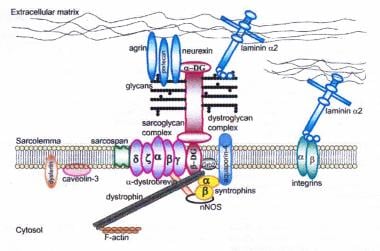
Molecular genetics of LGMD Skeletal muscle consists of 2 major components: the sarcolemma and the sarcomeres. The sarcolemma is the sheath that covers the sarcomeres; it is composed of the plasma and basement membranes and the reticular lamina, which contains collagen. The sarcomeres represent the contractile element, which is composed of actin, myosin, and Z-band proteins. These proteins, like all others, are genetically coded and have a specific structure and distribution. Recent advances in molecular genetics have helped discover significant information on the relationship between muscle biology and clinical neuromuscular diseases. This is very well exemplified in the shift from descriptive classifications of neuromuscular diseases to molecular pathobiological classifications of neuromuscular diseases. This concept is best observed in regard to our understanding of the very heterogeneous LGMD syndromes. These syndromes are now classified on the basis of at least 15 identified genes—5 autosomal dominant and 10 autosomal recessive. The 5 dominant genes are associated with the components of sarcomeres. The 10 recessive genes are associated with the plasma basement membrane and the adjacent reticular lamina, which contains the fibrillary collagen. See the descriptions of each type of LGMD in the History section.
Frequency
United States
Exact figures are not available. The frequency of LGMD in the general population cannot be estimated because of the heterogenous nature of this group of disorders (see Background).
Mortality/Morbidity
LGMD is associated with low mortality and morbidity.
Race
No racial predilection is described.
Sex
LGMD may show an autosomal recessive or sporadic method of inheritance.
Age
Some forms of LGMD dramatically affect young adults, while other types progress so slowly that they are not detected until much later in life.
History
Autosomal dominant LGMDThe classification of these relatively uncommon disorders ranges from LGMD type 1A to LGMD type 1F. LGMD type 1A This is an adult-onset, slowly progressive muscle atrophy with weakness in a limb-girdle distribution, which, in addition, has pharyngeal involvement leading to nasal speech. These patients do not develop any contractures, muscle hypertrophy, or cardiac involvement. Creatine kinase (CK) levels are normal. The inheritance pattern is autosomal dominant. The protein product has been identified as myotilin, which is related to the sarcomere. The gene site locus is 5q31. Even though the protein product has been identified, no direct relationship has been established between the amount of protein and the severity of the disease. The subcellular localization of this protein is on the Z-line (Hauser, 2000; Hauser, 2002; Salmikangas, 2003). LGMD type 1B This form is characterized by symmetrical proximal lower limb weakness, followed by upper limb involvement. The disease begins in childhood. Contractures are rare and late. Cardiac involvement is common, manifesting as syncopal episodes, bradycardia, or both, and requiring pacemaker implantation. In late stages, these patients may develop dilated cardiomyopathy. Patients may die of sudden cardiac death. The CK level ranges from normal to moderately elevated. The clinical course is one of slow progression. The locus of this myopathy has been mapped to 1q11-21. The protein product of this genetic variation is lamina A/C. The subcellular localization of this protein is unknown (Muchir, 2000). LGMD type 1C This type is a disorder of childhood-onset proximal muscle weakness, myalgia, and muscle cramps. Muscle rippling to percussion is a unique feature of this syndrome. The disease has slow progression and is not associated with contractures. The CK level is always elevated. The gene location is 3p25, and the gene product is caveolin 3. Caveolin 3 is a muscle-specific protein related to the caveolae, which are the invaginations of the plasma membrane. Mutation of the caveolin 3 gene (CAV3) causes this disorder (Merlini, 2002). LGMD type 1D This is adult-onset limb-girdle dystrophy is very rare. Features are proximal weakness with cardiac conduction defects and, later, dilated cardiomyopathy. The gene site for this rare disorder seems to be 6q23. The subcellular location and protein product are unknown (Messina, 1997). LGMD types 1E and 1F These dominantly inherited LGMDs are of the adult-onset type and are not associated with contractures. The clinical course is one of slow progression, and the CK level is normal. The gene site is 7q, and the subcellular location and protein product are unknown (Speer, 1999).
Autosomal recessive LGMDThese are generally childhood forms of LGMD that affect both males and females in the same sibship. Onset is usually in the first decade of life. In general, the course of disease is one of gradual progression over years. Distribution of muscle weakness is typically in the pelvis (80-90% of cases), and later in life, involvement of the shoulder girdle is noted in approximately 30% of cases. Hypertrophy of the calves is absent, in contrast to other forms of muscular dystrophy. A review of published case reports shows that nearly 70% of involved patients were ambulatory when aged 25-40 years. In all the cases, contractures of the hips were present. Educational achievements, intellectual level, or vocational status of patients was not mentioned. The incidence of cardiac and respiratory involvement reportedly was rare, although it has been reported by Mascarenhas et al and Gigliotti et al. Scoliosis occurred rarely, but lumbar lordosis was present in as many as 70-80% of patients. The inheritance pattern is strongly autosomal recessive with consanguinity, thus a positive family history often is reported. The various types range from type 2A to type 2J. LGMD type 2A (calpin 3 myopathy) The onset of this childhood form of LGMD is in the first decade of life (9.7 ±3 y). The distribution of muscle weakness is predominantly proximal (pelvic and shoulder girdle). The disease progresses slowly, with loss of ambulation at age 38.5 ±2.1 years. Muscle atrophy is a prominent feature. Cardiac involvement is not described, and the CK level is only moderately elevated. The locus of the culprit gene is on 15q15, and the protein product is calpin 3 (Richard, 1995; Guyon, 2003). LGMD type 2B (dysferlin myopathy) This form has a variable clinical presentation. The onset is in the juvenile years, and developmental milestones are normal. The distribution of weakness is mostly in the lower extremities distally (ie, anterior compartment), with the Miyoshi form showing posterior distribution. The scapular musculature is relatively preserved early, but, later, atrophy of the forearms occurs. CK levels are markedly elevated, and cardiac involvement has been reported. The mutation is found to lie across a large gene site. Immunohistochemical studies showed deficiency of dysferlin in the sarcolemma. The gene site is 2p13. The protein can be assayed in blood samples using commercially available monoclonal antibodies. The findings from blood studies complement the findings from muscle studies (Bansal, 2003; Liu, 1998; Matsuda, 2001). LGMD types 2C, 2D, 2E, and 2F (sarcoglycanopathies) These 4 disorders have many clinical features in common. The first is age of onset, which varies from early childhood to adulthood. The clinical picture of these disorders varies from mild to severe. Persons with the severe forms tend to lose the ability to walk before age 10 years, while persons with the mild forms maintain the ability to walk late into adulthood. Considerable intergenerational and intragenerational variability exists in the clinical course. Among LGMD patients, 20-25% develop one of these types. These patients develop severe lumbar lordosis and contractures of the Achilles tendons. Muscle hypertrophy is common, and CK levels are very high. The rate of cardiac conduction defects and dilated cardiomyopathy is 30%. Experimental work in animals suggests that disintegration of the smooth muscle sarcoglycan complex occurs, which results in coronary artery constriction and leads to myocardial ischemia. The mutations are at 13q12 for type C, 17q21 for type D, 4q12 for type E, and 5q33-34 for type F. Sarcoglycanopathy has been reported. The subcellular localization is the sarcolemma. The gene product is 2, B & S sarcoglycan. Seventy-seven distinct pathogenic mutations have been found: 41 in LSG, 20 in BSG, 10 in 2SG, and 6 in 8SG (Noguchi, 1995; Roberds, 1994; Lim, 1995; Nigro, 1996). LGMD type 2G This form has a childhood and juvenile age of onset. It progresses slowly and is characterized by anterior tibial weakness with foot drop. The CK level is always elevated to moderate-to-high levels. Cardiac involvement may or may not occur. The mutation for this disorder is at 17q11-12, and the protein is telethonin, with a subcellular localization at the Z-disc product (Moreira, 2000). LGMD type 2H The onset for this disorder is in the juvenile and young-adult age group. It is characterized by fatigability without muscle weakness or hypertrophy. The CK level is almost always elevated. The locus of the mutation is 5q31-34,and the protein product is TRIM (tripartite motif) 32, which has cytosolic localization (Frosk, 2002). LGMD type 2I This type has a very variable age of onset (childhood, juvenile, adult). The upper extremities are preferentially involved, with upper arm weakness and atrophy. The prevalence of cardiac and respiratory involvement is high. The clinical course can vary from very fast (rarely) to slow (generally). The gene mutation locus is 19q13.3, and the protein product is FKRP (fukutin-related protein). The subcellular localization is the Golgi apparatus (Brockington, 2001). LGMD type 2J This is the last of the recessively inherited LGMDs, and it also has a variable age of onset and slow progression. The CK level is mildly to moderately elevated. The gene mutation locus is on 2q, and the protein product is titlin, which is located on the sarcomere (Hackman, 2002).
Pelvifemoral atrophy (Leyden-Möbius)The Leyden-Möbius variant of LGMD is the most heterogeneous of all limb-girdle dystrophies. Roughly 60-70% of cases are described as sporadic, while only a few cases are reported as familial. This syndrome is characterized by symmetric or asymmetric involvement of the pelvic girdle. The age of onset is later in life, during the second to sixth decades. The progression of the disease is variable, but most reports indicate the progress is slow. In a significant number of cases, the progression is so slow that it gives the appearance of clinical arrest. The disability experienced by the patients is mild, with several patients continuing to ambulate well into their 70s. Intellectual deterioration or significant cardiac or respiratory involvement does not seem to occur. The survival rate associated with this disease is well into the seventh decade of life. CK values vary from normal to significantly elevated. Genetic studies have not revealed an associated abnormal gene.
Scapulohumeral dystrophy (Erb)As the name indicates, this form mainly involves the upper extremities. It appears in some cases to have an autosomal recessive inheritance pattern. This disorder starts later in life (second to the fifth decades), and the disease is often so benign that years may elapse before it is diagnosed. Weakness is generally asymmetric and may spare the deltoid, supraspinatus, and infraspinatus muscles. Not until very late in life may the lower extremities show signs of involvement. The progression of the disease is very slow, and patients have a normal life expectancy. The disability experienced by patients is fairly minimal, although frozen shoulder syndrome may significantly alter function if it is bilateral. Intellectual deterioration and cardiac involvement are rare.
Late-onset autosomal dominant limb myopathyThis syndrome is documented in several families with an onset of weakness beginning in the third to the fifth decades of life. The course of the disease is benign, with upper and lower extremity weakness causing little functional impairment. Patients with this type of dystrophy maintain their ability to ambulate well into their sixth and seventh decades of life. This syndrome affects males and females. Neither intellectual deterioration nor significant cardiac involvement is noted. Schneiderman et al reported a family with 16 members in 3 generations who also had the Pelger-Huët nuclear anomaly (ie, the bilobed nucleus of the neutrophils). Bacon and Smith described another family with 6 affected members in 2 generations, all of whom had the late-onset type (third decade of life) with a benign course. De Coster et al reported 9 members of one family, all males, over 3 generations who also exhibited these symptoms. In 1951, Shy and McEachren described 12 cases of late-onset myopathy with a benign course and age of onset in the sixth and seventh decades of life, and they called it menopausal myopathy. A collection of sporadic cases manifesting with the same clinical picture has been reported. The CK levels in these cases generally ranged from normal to mildly elevated, and, again, no cardiac involvement was described. The disability experienced by these patients was minimal. In the familial cases, the abnormal gene was linked to band 5q22.3-31.3 and the linkage to chromosome 15 was excluded. This finding suggests that this entity is clinically and genetically different from the autosomal recessive varieties. Even though the above categories account for most patients, a minority of patients first described by Bramwell in 1922 exhibited weakness involving only the quadriceps muscle. Denny-Brown (1939), Shy and McEachren (1951), and Walton (1956) described several additional sporadic cases. van Wijngaarden et al (1968) and Espir and Matthews (1974) described a group of familial cases of quadriceps myopathy in which both sexes were affected. The weakness started in the third decade of life, and patients continued to ambulate well into their 60s. These authors considered such cases to be a limited presentation of LGMD.
Physical
The clinical features of this group of disorders are described in the specific subsections listed in History. LGMD is suggested in patients who are toe-walkers and who have increased lumbar lordosis, forward pelvic tilt, and flexion and abduction of the hips. However, in the upper extremities, no typical features (eg, winging of the scapula) are present. Muscle hypertrophy is not a characteristic of the affected muscles.
Causes
LGMD is an inherited disorder, with both autosomal recessive and autosomal dominant forms reported.
Becker Muscular Dystrophy
Other Problems to be Considered
Acute polio Chronic inflammatory myopathies Malignancy Metabolic and congential myopathies Mixed connective-tissue disease Polyarteritis Primary lateral sclerosis Rheumatoid arthritis Steroid-induced myopathy Duchenne muscular dystrophy: Duchenne or Becker dystrophies tend to manifest in childhood with a male predominance, calf hypertrophy, scoliosis, and marked elevation of CK levels. Sex-linked recessive inheritance and the demonstration of absence or alteration of dystrophin confirm the diagnosis of these disorders. Approximately 60% of cases are sporadic; thus, muscle biopsy is an important diagnostic tool. Scleroderma, polymyositis, and dermatomyositis: Differentiation from scleroderma, polymyositis, and dermatomyositis may be made by their clinical courses, which are often characterized by more rapid progression, involvement of skin and neck muscles, and dysphagia. Polymyositis: Electromyography (EMG) in patients with polymyositis reveals polyphasic and fibrillation potentials, as well as myopathic potentials and positive sharp waves. A clinical response to steroids solidifies the diagnosis of polymyositis. Chronic spinal muscular atrophy: This is another entity that can have proximal weakness and elevated CK levels; however, neurogenic changes seen during EMG may include fibrillation and fasciculation potentials and a reduced recruitment pattern, as well as giant action potentials. Muscle biopsy results showing target fibers and group atrophy with angular fibers also help confirm this diagnosis. Metabolic and congenital myopathies (eg, central core disease, nemaline centronuclear myopathy, congenital fiber-type disproportion): These may appear clinically similar to LGMD syndrome, but all of these conditions have typical diagnostic muscle biopsy findings that show central cores, nemaline rods, centronuclear fibers of congenital fiber-type disproportions, and sarcoplasmic body myopathy. Onset is also generally at an early age, and a more diffuse distribution of weakness occurs. In summary, evaluation of a patient with LGMD syndrome must take into consideration an accurate clinical history with special emphasis on family history; a detailed physical examination; laboratory investigation including CK, EMG, and, possibly muscle biopsy, molecular genetic studies, and an evaluation of the absence or alteration of dystrophin.
Lab Studies
- The single biochemical abnormality in LGMD syndrome is the elevation of the CK level. The CK elevation in the recessively inherited varieties is significantly higher than in the rest of the spectrum of LGMDs (eg, dominantly inherited, Erb dystrophy, pelvifemoral variety). However, the CK level is usually significantly lower than in patients with Duchenne or Becker dystrophy. Individuals with Duchenne or Becker dystrophy may have elevated creatine in the urine, but they do not have myoglobinuria.
Other Tests
- EMG abnormalities are atypical, and EMG is more useful to exclude other disorders in the differential. Nerve conduction velocities do not show abnormalities in cases of LGMD. Repetitive stimulation produces good post-tetanic potentiation and no myasthenic response. Rarely, EMG of a single fiber may reveal a mild decrease in fiber density and increased jitter, but the most consistent finding is normal fiber density.
Procedures
- Muscle biopsy findings are characterized by necrotic fibers with endomysial perivascular or perimysial mononuclear infiltration.
Histologic Findings
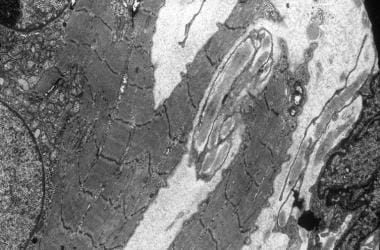
Hematoxylin and eosin stain and trichrome stain show a most striking predilection toward large fiber size (see Image 1). These large fibers show splitting (see Image 2) and can be 3-4 times the size of the normal fiber. The splitting of fibers produces the false appearance of grouping and angulation without a large group of atrophic fibers. Frequently, ring fibers and cytoplasmic masses are also observed (see Image 3). Some fibers are characterized by profuse internal nuclei (see Image 4). The myoarchitecture shows evidence of necrosis and basophilia (see Image 5). Increases in endomysial fibrous tissue are noted, without significant evidence of cellular response. The histochemistry of the muscle biopsy specimens generally shows a predominance of type I fibers and a reduction of type IIB fibers. Because splitting is a common feature of this disease, the split fibers are shown to belong to the same fiber type and give an appearance of fiber-type grouping (see Image 6). Ultrastructure examination shows nonspecific changes consisting of Z-band spreading, mitochondrial abnormalities with inclusions as central nuclei, and disruption of the A and I bands (see Image 7).
Rehabilitation Program
Physical Therapy
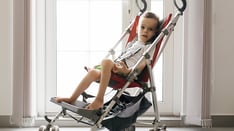
The natural history of LGMD is one of gradual progression over years, with life expectancy beyond the fifth and sixth decades of life. The age of onset of the disease varies from childhood to adult life. Considering these significant differences, the goals of management must vary. With childhood onset, especially during the growth period, the goal of therapy is aggressive prevention of contractures at the hip and shoulder girdle, via stretching. Exercise program Very few studies detail the effectiveness of an exercise regimen in limb-girdle syndrome. Given the slowly progressive nature of the disease, the prudent approach to exercise therapy is to prescribe active-assistive and resistive movements and preserve and maintain muscle strength in the pelvic and shoulder girdle musculature. This therapy can prevent the rapid development of orthopedic deformities of hyperlordosis, pelvic forward rotation, and flexion/abduction contracture. In spite of the active exercise regimen, some patients need taping, orthotic devices, and surgical interventions because of increasing pelvic deformity, hip flexion contractures, and equinus deformity. The exercise regimen should be monitored clinically by watching for the development of leg cramps while biochemical measurements of myoglobinuria, creatinuria, and/or CK (ie, for elevation) are performed. See Surgical Intervention. The active-assistive and resistive exercise regimen also provides hemodynamic stability and avoids hemodynamic decompensation from immobility and cardiomyopathy. Wheelchair prescription If the patient becomes nonambulatory, wheelchair mobility is essential. The wheelchair should complement the patient's lifestyle, providing comfort, safety, and functionality. Because of the functional weakness and contractures in the upper and lower extremities of patients with limb-girdle dystrophy, special attention should be given to the frame, seat, backrest, front rigging, rear wheels, and casters. An accessible home and work environment and personal or public transportation with safe restraint systems for the wheelchair are also important. See Further Outpatient Care.
Occupational Therapy
Similar treatment programs, especially focusing on the shoulder, should be instituted in the upper extremities. The maintenance of active range of motion and strength results in independence in performance of activities of daily living such as dressing, oral/facial hygiene, homemaking, and preparation for work.
Recreational Therapy
Because of the lifelong impact of LGMD, adaptations to allow avocational pursuits are essential and the role of recreational or child-life therapists is important.
Surgical Intervention
Patients who develop an equinus foot deformity can benefit from tendon-lengthening surgery and/or knee-ankle-foot orthoses or ankle-foot orthoses to maintain mobility. A surgical approach has been attempted to correct the flexion contractures and scoliosis only in persons with Duchenne dystrophy. Results have been conflicting because, after surgery, patients often are unable to maintain their ambulatory status. These surgical approaches have been tried sparingly in cases of LGMD, and no control studies have been conducted; however, in a few isolated reports, good results in the maintenance of ambulation have been reported after surgery. In exceptional cases of shoulder-girdle involvement, the patient may benefit from scapulopexy (attaching the inner border of the scapula to the fourth rib using either Mersilene tape or fascia lata). The goal of these interventions is to maintain ambulation and shoulder-girdle function for as long as possible.
No medication is used for the specific treatment of LGMD.
Further Outpatient Care
- Wheelchair prescription
- The object of a wheelchair prescription is to extend the functional mobility of the patient, while secondarily providing exercise and postural stability that may delay loss of strength and prevent deformity. This requires specific attention to all components of the chair to keep it as lightweight, durable, and functional as possible.
- Early after the onset of LGMD, the use of a lightweight manual wheelchair can be beneficial to extend the patient's range of travel, even while he or she is still ambulatory. The operating environment, abilities of the user, and progression of the disease must be considered, with careful selection of seat width, seat height, and push rim location relative to the shoulder and arm position of the user. Properly adjusted height-of-the-arm supports can also prolong self-implemented pressure relief (push-up) function using glenohumeral depression with the elbows anchored on the armrest.
- Later, as the disease progresses, particular attention may focus on power mobility with tilt-in-space function to provide independence in the face of poor upper extremity control and loss of independence stance. Off-the-shelf modular components or a custom-contoured wheelchair seat and back inserts may be used.
- The use of head and neck supports also may become necessary.
Complications
- Contractures
- Scoliosis
- Pulmonary problems
Prognosis
- In this group of disorders, the mortality ascribed to the disease and/or the complications thereof is negligible. However, the prognosis with regard to mobility, self-care, and maintenance of the ability to work is dependent on the aggressive, goal-directed management described in various subsections of this article.
Medical/Legal Pitfalls
- Considering LGMD is important when confronted with concurrent situations such as spinal cord injuries, peripheral neuropathies, and metabolic or drug-induced myopathies.
| Media file 1:
Hematoxylin and eosin stain. Note the variation in fiber size. Necrotic fiber is shown with many nuclei (magnification 250X). |
 | View Full Size Image | |
Media type: Photo
|
| Media file 2:
Marked endomysial fibrosis with atrophic and hypertrophic fibers. |
 | View Full Size Image | |
Media type: Photo
|
| Media file 3:
Hematoxylin and eosin stain. Note the splitting of the fiber. |
 | View Full Size Image | |
Media type: Photo
|
| Media file 4:
Gomori trichrome stain. Note the variation in fiber size and subsarcolemmal vacuoles, central nuclei, and subsarcolemmal collection of trichrome-positive material. |
 | View Full Size Image | |
Media type: Photo
|
| Media file 6:
Electron micrograph showing abnormal mitochondria, a large lysosomal body, and a central nucleus. |
 | View Full Size Image | |
Media type: Photo
|
| Media file 7:
Electron micrograph showing mitochondria with paracrystaline inclusions and lamellar bodies |
 | View Full Size Image | |
Media type: Photo
|
| Media file 8:
Electron micrograph showing streaming of band Z and splitting of the muscle fiber. A central nucleus is surrounded by a collection of small mitochondria. |
 | View Full Size Image | |
Media type: Photo
|
| Media file 9:
Trichrome stain. Note variation in fiber size. Necrotic fiber giant fibers and cytoplasmic inclusions. |
 | View Full Size Image | |
Media type: Photo
|
- Bönnemann CG, Modi R, Noguchi S, et al. Beta-sarcoglycan (A3b) mutations cause autosomal recessive muscular dystrophy with loss of the sarcoglycan complex. Nat Genet. Nov 1995;11(3):266-73. [Medline].
- Bacon PA, Smith B. Familial muscular dystrophy of late onset. J Neurol Neurosurg Psychiatry. Feb 1971;34(1):93-7. [Medline].
- Bansal D, Miyake K, Vogel SS, et al. Defective membrane repair in dysferlin-deficient muscular dystrophy. Nature. May 8 2003;423(6936):168-72. [Medline].
- Batten FE. The myopathies or muscular dystrophies. Q J Med. 1910;3:313.
- Beckmann JS, Richard I, Hillaire D, et al. A gene for limb-girdle muscular dystrophy maps to chromosome 15 by linkage. C R Acad Sci III. 1991;312(4):141-8. [Medline].
- Ben Hamida M, Fardeau M. Severe autosomal recessive limb-girdle muscular dystrophies frequent in Tunisia. In: Angelini C, Danieli GA, Fontanari D, eds. Muscular Dystrophy Research: Advances and New trends. Amsterdam:. Excerpta Medica;1980:143-6.
- Bohan A, Peter JB. Polymyositis and dermatomyositis (second of two parts). N Engl J Med. Feb 20 1975;292(8):403-7. [Medline].
- Bohan A, Peter JB. Polymyositis and dermatomyositis (first of two parts). N Engl J Med. Feb 13 1975;292(7):344-7. [Medline].
- Boulogne D. Recherches sur la paralysie, musculaire psudohypertrophyic, on Paralysé myosclerozyic. Selections translated in Brody IA, ed. Neurologic Classic 1973. Arch Gen Med. 1868;11:5, 179, 305, 421, 552.
- Bradley WG. The limb girdle syndromes. In: Vinken PJ, Bruyn GW, eds. Handbook of Clinical Neurology. Vol 40. Amsterdam:. Elsevier Science;1979:433-69.
- Bramwell E. Observations on myopathy. Proc R Soc Med. 1922;16:1.
- Brockington M, Yuva Y, Prandini P, et al. Mutations in the fukutin-related protein gene (FKRP) identify limb girdle muscular dystrophy 2I as a milder allelic variant of congenital muscular dystrophy MDC1C. Hum Mol Genet. Dec 1 2001;10(25):2851-9. [Medline].
- Brooke MH. Congenital Fiber type dysproportion. In: Kakulas BA, ed. Clinical Studies in Myology. Amsterdam:. Excerpta Medica;1973:147-59.
- De Coster W, De Reuck J, Thiery E. A late autosomal dominant form of limb-girdle muscular dystrophy. A clinical, genetic, and morphological study. Eur Neurol. 1974;12(3):159-72. [Medline].

- Denny-Brown D. Myopathic weakness of quadriceps. Proc R Soc Med. 1939;32:867.
- Erb W. Ueber die "Juvenile Form" der progressiven Muskelatrophie ihre Beziehungen zur sogenannten Pseudohypertrophie der Muskeln. Dtsh Archiv Klin Med. 1884;34:467.
- Erb W. Dystrophia muscularis progressiva. Klinische und pathologisch anatomische Studien. Dtsch Nervenh. 1891;1:13.
- Espir ML, Matthews WB. Hereditary quadriceps myopathy. J Neurol Neurosurg Psychiatry. Dec 1973;36(6):1041-5. [Medline].
- Frosk P, Weiler T, Nylen E, et al. Limb-girdle muscular dystrophy type 2H associated with mutation in TRIM32, a putative E3-ubiquitin-ligase gene. Am J Hum Genet. Mar 2002;70(3):663-72. [Medline].
- Gigliotti F, Pizzi A, Duranti R, et al. Control of breathing in patients with limb girdle dystrophy: a controlled study. Thorax. Sep 1995;50(9):962-8. [Medline].
- Gordon ES, Hoffman EP. The ABC''s of limb-girdle muscular dystrophy: alpha-sarcoglycanopathy, Bethlem myopathy, calpainopathy and more. Curr Opin Neurol. Oct 2001;14(5):567-73. [Medline].
- Gower ER. A lecture on myopathy and a distal form. Br Med J. 1902;2:89.
- Guyon JR, Kudryashova E, Potts A, et al. Calpain 3 cleaves filamin C and regulates its ability to interact with gamma- and delta-sarcoglycans. Muscle Nerve. Oct 2003;28(4):472-83. [Medline].
- Hackman P, Vihola A, Haravuori H, et al. Tibial muscular dystrophy is a titinopathy caused by mutations in TTN, the gene encoding the giant skeletal-muscle protein titin. Am J Hum Genet. Sep 2002;71(3):492-500. [Medline].
- Hauser MA, Horrigan SK, Salmikangas P, et al. Myotilin is mutated in limb girdle muscular dystrophy 1A. Hum Mol Genet. Sep 1 2000;9(14):2141-7. [Medline].
- Hauser MA, Conde CB, Kowaljow V, et al. Myotilin mutation found in second pedigree with LGMD1A. Am J Hum Genet. Dec 2002;71(6):1428-32. [Medline].
- Hausmanowa-Petrusewicz I, Jedrzejowska H. Correlation between electromyographic findings and muscle biopsy in ccases of neuromuscular diseease. J Neurol Sci. May 1971;13(1):85-106. [Medline].
- Hayward M. Electrodiagnosis of the muscular dystrophies. Br Med Bull. May 1980;36(2):127-32. [Medline].
- Jackson CE, Strehler DA. Limb-girdle muscular dystrophy: clinical manifestations and detection of preclinical disease. Pediatrics. Feb 1968;41(2):495-502. [Medline].
- Karpati G, Carpenter S, Nelson RF. Type I muscle fibre atrophy and central nuclei. A rare familial neuromuscular disease. J Neurol Sci. May 1970;10(5):489-500. [Medline].
- Kirby RL. Principles of wheelchair design and prescription. Prin Neuro Rehabil. 1997;465-81.
- Kuitunen P, Rapola J, Noponen AL, Donner M. Nemaline myopathy. Report of four cases and review of the literature. Acta Paediatr Scand. May 1972;61(3):353-61. [Medline].
- Landouzy L, Dejerine J. De La myopathic atrophique – progressive (myopathic heriditaire debutant dansleufavec, Par la free saus alteration du systeme nerveux). Services Alad Sci. 1884;53:98.
- Leyden E. Klinik der Ruckenmarks-Krankheiten. Vol 2. Berlin:. Hirschwalk;1876:531.
- Lim LE, Duclos F, Broux O, et al. Beta-sarcoglycan: characterization and role in limb-girdle muscular dystrophy linked to 4q12. Nat Genet. Nov 1995;11(3):257-65. [Medline].
- Liu J, Aoki M, Illa I, et al. Dysferlin, a novel skeletal muscle gene, is mutated in Miyoshi myopathy and limb girdle muscular dystrophy. Nat Genet. Sep 1998;20(1):31-6. [Medline].
- Möbius PJ. Ueber die hereditaren nervenkrankheiten. Volkmanns Samml Klin Notiz. 1879;171:1505.
- Mascarenhas DA, Spodick DH, Chad DA, et al. Cardiomyopathy of limb-girdle muscular dystrophy. J Am Coll Cardiol. Nov 1 1994;24(5):1328-33. [Medline].
- Mastaglia FL, Walton JN. Histological and histochemical changes in skeletal muscle from cases of chronic juvenile and early adult spinal muscular atrophy (the Kugelberg- Welander syndrome). J Neurol Sci. Jan 1971;12(1):15-44. [Medline].
- Matsuda C, Hayashi YK, Ogawa M, et al. The sarcolemmal proteins dysferlin and caveolin-3 interact in skeletal muscle. Hum Mol Genet. Aug 15 2001;10(17):1761-6. [Medline].
- Merlini L, Carbone I, Capanni C, et al. Familial isolated hyperCKaemia associated with a new mutation in the caveolin-3 (CAV-3) gene. J Neurol Neurosurg Psychiatry. Jul 2002;73(1):65-7. [Medline].
- Messina DN, Speer MC, Pericak-Vance MA, et al. Linkage of familial dilated cardiomyopathy with conduction defect and muscular dystrophy to chromosome 6q23. Am J Hum Genet. Oct 1997;61(4):909-17. [Medline].
- Minetti C, Sotgia F, Bruno C, et al. Mutations in the caveolin-3 gene cause autosomal dominant limb-girdle muscular dystrophy. Nat Genet. Apr 1998;18(4):365-8. [Medline].
- Moreira ES, Wiltshire TJ, Faulkner G, et al. Limb-girdle muscular dystrophy type 2G is caused by mutations in the gene encoding the sarcomeric protein telethonin. Nat Genet. Feb 2000;24(2):163-6. [Medline].
- Morgan-Hughes JA, Brett EM, Lake BD, Tome FM. Central core disease or not? Observations on a family with a non- progressive myopathy. Brain. Sep 1973;96(3):527-36. [Medline].
- Moser Von H, Wiesmann U, Richterich R, Rossi E. Progressive muskeldystrophie, Viii Haufigkeit, Klinik und Genetik der Typen I und II. Schweiz Med Wochenschr. 1966;96:169, 205.
- Muchir A, Bonne G, van der Kooi AJ, et al. Identification of mutations in the gene encoding lamins A/C in autosomal dominant limb girdle muscular dystrophy with atrioventricular conduction disturbances (LGMD1B). Hum Mol Genet. May 22 2000;9(9):1453-9. [Medline].
- Munsat TL, Woods R, Fowler W, Pearson CM. Neurogenic muscular atrophy of infancy with prolonged survival. The variable course of Werdnig-Hoffmann Disease. Brain. Mar 1969;92(1):9-24. [Medline].
- Nigro V, de Sá Moreira E, Piluso G, et al. Autosomal recessive limb-girdle muscular dystrophy, LGMD2F, is caused by a mutation in the delta-sarcoglycan gene. Nat Genet. Oct 1996;14(2):195-8. [Medline].
- Noguchi S, McNally EM, Ben Othmane K, et al. Mutations in the dystrophin-associated protein gamma-sarcoglycan in chromosome 13 muscular dystrophy. Science. Nov 3 1995;270(5237):819-22. [Medline].
- Palenzuela L, Andreu AL, Gàmez J, et al. A novel autosomal dominant limb-girdle muscular dystrophy (LGMD 1F) maps to 7q32.1-32.2. Neurology. Aug 12 2003;61(3):404-6. [Medline].
- Richard I, Broux O, Allamand V, et al. Mutations in the proteolytic enzyme calpain 3 cause limb-girdle muscular dystrophy type 2A. Cell. Apr 7 1995;81(1):27-40. [Medline].
- Roberds SL, Leturcq F, Allamand V, et al. Missense mutations in the adhalin gene linked to autosomal recessive muscular dystrophy. Cell. Aug 26 1994;78(4):625-33. [Medline].
- Sahgal V, Solomon R. Metabolic response to exercise and muscle disease. Compr Ther. Jan 1986;12(1):31-8. [Medline].
- Sahgal V, Sahgal S. Department of Neurology, Northwestern University Medical School, Chicago, Illinois. Acta Neuropathol (Berl). Mar 31 1977;37(3):225-30. [Medline].
- Salmikangas P, van der Ven PF, Lalowski M, et al. Myotilin, the limb-girdle muscular dystrophy 1A (LGMD1A) protein, cross-links actin filaments and controls sarcomere assembly. Hum Mol Genet. Jan 15 2003;12(2):189-203. [Medline].
- Schneiderman LJ, Sampson WI, Schoene WC, Haydon GB. Genetic studies of a family with two unusual autosomal dominant conditions: muscular dystrophy and Pelger-Huet anomaly. Clinical, pathologic and linkage considerations. Am J Med. Mar 1969;46(3):380-93. [Medline].
- Shah A, Sahgal V, Sahgal S, et al. Mitochondrial cytochemistry in experimental myopathies. J Submicrosc Cytol. Oct 1985;17(4):509-15. [Medline].
- Shah A, Sahgal V, Sahgal S, et al. Variability of mitochondrial cytochemistry in human neuromuscular diseases. J Submicrosc Cytol Pathol. Apr 1988;20(2):287-95. [Medline].
- Shapiro F, Specht L. The diagnosis and orthopaedic treatment of inherited muscular diseases of childhood. J Bone Joint Surg Am. Mar 1993;75(3):439-54. [Medline].
- Shy GM, McEachern D. The clinical features and response to cortisone of menopausal muscular dystrophy. J Neurol Neurosurg Psychiatry. May 1951;14(2):101-7. [Medline].
- Speer MC, Yamaoka LH, Gilchrist JH, et al. Confirmation of genetic heterogeneity in limb-girdle muscular dystrophy: linkage of an autosomal dominant form to chromosome 5q. Am J Hum Genet. Jun 1992;50(6):1211-7. [Medline].
- Speer MC, Vance JM, Grubber JM, et al. Identification of a new autosomal dominant limb-girdle muscular dystrophy locus on chromosome 7. Am J Hum Genet. Feb 1999;64(2):556-62. [Medline].
- Spiller WG. Myopathy of the distal type and its relation to the neuroforamin of muscular atrophy (Charcot Marie Tooth Type). J Neur Med Dis. 1907;34-14.
- Stalberg E. Single fibre electromyography in muscular dystrophy. In: Hausmanowa-Petrusewicz I, Jedrezejowska H, eds. Structure and Function of Normal and Diseased Muscle and Peripheral Nerve. Polish Medical Publishers;1974:185-190.
- Stedman HH. Molecular approaches to therapy for Duchenne and limb-girdle muscular dystrophy. Curr Opin Mol Ther. Aug 2001;3(4):350-6. [Medline].
- Vignos PJ Jr, Watkins MP. The effect of exercise in muscular dystrophy. JAMA. Sep 12 1966;197(11):843-8. [Medline].
- Walton JN, Nattrass FJ. On the classification, natural history and treatment of the myopathies. Brain. 1954;77(2):169-231. [Medline].
- Walton JN. Two cases of myopathy limited to the quadriceps. J Neurol Neurosurg Psychiatry. May 1956;19(2):106-8. [Medline].
- van Wijngaarden GK, Hagen CJ, Bethlem J, Meijer AE. Myopathy of the quadriceps muscles. J Neurol Sci. Sep-Oct 1968;7(2):201-6. [Medline].
Limb-Girdle Muscular Dystrophy excerpt Article Last Updated: Dec 6, 2006
|