AUTHOR AND EDITOR INFORMATION
Section 1 of 12
Author: Patrick M Foye, MD, FAAPMR, FAAEM, Associate Professor of Physical Medicine and Rehabilitation, Co-Director of Musculoskeletal Fellowship, Co-Director of Back Pain Clinic, Director of Coccyx Pain (Tailbone Pain, Coccydynia) Service, University of Medicine and Dentistry of New Jersey, New Jersey Medical School
Patrick M Foye is a member of the following medical societies: American Academy of Physical Medicine and Rehabilitation, American Association of Neuromuscular and Electrodiagnostic Medicine, Association of Academic Physiatrists, and International Spine Intervention Society
Coauthor(s):
Todd P Stitik, MD, Professor, Department of Physical Medicine and Rehabilitation, Acting Director of Sports Medicine, UMDNJ-New Jersey School of Medicine; Lead Physician, Practice Medical Director of University Hospital PM & R Clinic
Editors: Robert L Sheridan, MD, Assistant Chief of Staff, Chief of Burn Surgery, Shriners Burns Hospital; Associate Professor of Surgery, Department of Surgery, Division of Trauma and Burns, Massachusetts General Hospital and Harvard Medical School; Francisco Talavera, PharmD, PhD, Senior Pharmacy Editor, eMedicine; Richard Salcido, MD, Chairman, Erdman Professor of Rehabilitation, Department of Physical Medicine and Rehabilitation, University of Pennsylvania School of Medicine; Kelly L Allen, MD, Consulting Staff, Department of Physical Medicine and Rehabilitation, Lourdes Regional Rehabilitation Center, Our Lady of Lourdes Medical Center; Rene Cailliet, MD, Professor-Chairman Emeritus, Department of Rehabilitation Medicine, University of Southern California School of Medicine; Former Director, Department of Rehabilitation Medicine, Santa Monica Hospital Medical Center
Author and Editor Disclosure
Synonyms and related keywords:
de Quervain disease, stenosing tenosynovitis, first dorsal compartment tenosynovitis, washer woman's sprain
Background
De Quervain disease is caused by stenosing tenosynovitis of the first dorsal compartment of the wrist. The first dorsal compartment at the wrist includes the tendons of the abductor pollicis longus (APL) and the extensor pollicis brevis (EPB). Patients with this condition usually report pain at the dorsolateral aspect of the wrist with referral of pain toward the thumb and/or lateral forearm. This condition responds well to nonsurgical treatment.
Pathophysiology
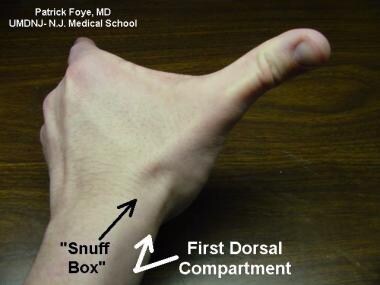
The first dorsal compartment at the wrist includes the tendon sheath that encloses the APL and EPB tendons at the lateral border of the anatomical snuffbox. Inflammation at this site commonly is seen in patients who use their hands and thumbs in a repetitive fashion. Thus, de Quervain tenosynovitis can occur as a result of cumulative (repetitive) microtrauma. Inflammation also may occur after an isolated episode of acute trauma to the site.
Frequency
United States
This condition is relatively prevalent, especially among individuals who perform repetitive activities using their hands (eg, certain assembly line workers, secretaries).
Mortality/Morbidity
Mortality is not associated with this condition. Some morbidity may occur as the patient experiences progressive pain with associated limitation in activities requiring use of the affected hand.
Race
No correlation exists between incidence of de Quervain tenosynovitis and any particular race.
Sex
Although this condition is seen commonly in both females and males, de Quervain tenosynovitis appears to be significantly more common in women. Some sources even quote a female-to-male ratio as high as 8:1. Interestingly, many women suffer from de Quervain tenosynovitis during pregnancy or the postpartum period.
Age
De Quervain tenosynovitis is much more common in adults than in children.
History
The patient typically reports localized pain at the dorsolateral aspect of the wrist.
- Occasionally, the patient's history may indicate isolated acute trauma to the involved site.
- More commonly, history includes chronic repetitive activities using the involved hand or thumb.
- Inquire about specific repetitive activities that may have contributed to onset of symptoms. Examples include work activities (eg, computer use, materials handling) or recreational activities (eg, knitting, golf, racket sports).
- Thorough understanding of ergonomics of precipitating activities contributes to making an accurate diagnosis and forms the basis for necessary ergonomic interventions.
- Ask about how symptoms limit the patient's ability to perform vocational or avocational activities.
Physical
The most classic finding in de Quervain tenosynovitis is a positive Finkelstein test.
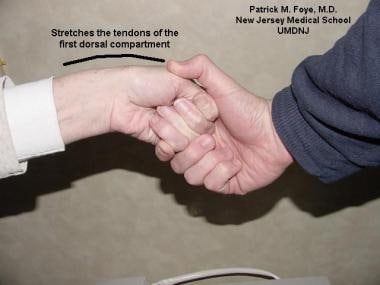
- Perform the Finkelstein test by having the patient make a fist with the thumb inside the fingers. The clinician then applies passive ulnar deviation of the wrist to reproduce the chief complaint of dorsolateral wrist pain.
- Perform the Finkelstein test bilaterally to compare with the uninvolved side.
- Carefully access the first carpometacarpal (CMC) joint, since pathology at this site can cause a false-positive Finkelstein test.
- Look for swelling at the first dorsal compartment of the wrist.
- Sensory examination specifically includes careful evaluation in distributions of the median and radial nerves, since either of these could cause pain/dysesthesias radiating into the thumb.
- Since cervical radiculopathy also can cause thumb pain/dysesthesias, evaluation includes assessment for upper limb strength, muscle stretch reflexes, sensation, and provocative neck maneuvers (eg, Spurling test to assess for cervical root impingement).
- Since some cases of dorsolateral forearm pain are caused by lateral epicondylitis, evaluate for point tenderness in the region of the lateral epicondyle at the elbow.
- De Quervain tenosynovitis may be associated with rheumatoid arthritis in some cases; therefore, assess the hands for rheumatologic deformities and malalignment.
Causes
Minor cumulative (ie, repetitive) trauma commonly contributes to development of de Quervain tenosynovitis. Activities that may cause repetitive trauma to the wrist include factory work, secretarial duties, golfing, or racket sport playing. Other factors that may contribute to development of de Quervain tenosynovitis include the following:
- Isolated acute trauma
- Association with rheumatoid arthritis
Carpal Tunnel Syndrome
Cervical Disc Disease
Other Problems to be Considered
Dorsal ganglion at the wrist
Osteoarthritis at first CMC joint
Kienbock disease (ie, osteonecrosis of the lunate)
Degenerative arthritis at the radioscaphoid joint
Cervical radiculopathy, particularly at C5 or C6 nerve root
Carpal tunnel syndrome (ie, median nerve compression within the wrist)
Cheiralgia paresthetica or neuropathy of the radial sensory nerve (ie, superficial radial nerve) at the wrist
Scaphoid fracture characterized by tenderness at the floor of the anatomical snuffbox
Intersection syndrome, which is tenosynovitis where the tendons of the first dorsal compartment (ie, extensor pollicis brevis, abductor pollicis longus) cross over the tendons of the second dorsal compartment (ie, extensor carpi radialis longus, extensor carpi radialis brevis), characterized by pain and swelling in the distal dorsoradial forearm: The pain of intersection syndrome is less lateral than that of de Quervain tenosynovitis and may be associated with swelling (Hanlon, 1999).
Lab Studies
- No lab studies support the diagnosis of de Quervain tenosynovitis. The clinician may consider serological testing for rheumatoid arthritis (ie, checking serum rheumatoid factor) if the patient has no history of either acute or repetitive trauma or other risk factors.
Imaging Studies
- As a rule, no imaging studies are required for diagnosing this condition.
- If sufficient history of acute trauma exists, x-rays of the wrist are indicated to assess for fracture.
- If suggestion of fracture or osteonecrosis exists despite negative x-rays, further imaging studies can be pursued (eg, 3-phase bone scan). Triple-phase scintigraphy includes the following:
- Phase 1: Flow phase (radionuclide angiography)
- Phase 2: Blood pool phase (soft tissue scintigraphy)
- Phase 3: Late phase (skeletal bone scintigraphy)
- After a fracture, phase 1 and phase 2 may show increased flow and pooling, but these findings are due only to local inflammation, which is not specific for fracture. Thus, increased uptake in phase 3 is the most important feature for diagnosis of a fracture, and this indicator may remain positive for months.
- For fracture at the scaphoid, the 3-phase bone scan is believed to have a sensitivity of 100%, and many research studies use this test as the criterion standard for diagnosis of de Quervain tenosynovitis, although, in clinical practice, bone scan is needed only if the plain x-rays are negative.
Procedures
- No other diagnostic procedures are needed in most cases.
Rehabilitation Program
Physical Therapy
Various forms of physical therapy (PT) or occupational therapy (OT) may be used in treatment of patients with de Quervain tenosynovitis. In the acute stage, the therapist may use cryotherapy (eg, cold packs, ice massage) to reduce the inflammation and edema. Local inflammation also can be treated with topical corticosteroids (eg, hydrocortisone), which are driven into the subcutaneous tissues using ultrasound (ie, phonophoresis) or electrically charged ions (ie, iontophoresis).
PT or OT also may be indicated for individuals who have undergone surgical correction at the first dorsal compartment. Once the patient has recovered, the goals of therapy are to strengthen and regain range of motion (ROM) at the thumb, hand, and wrist.
Occupational Therapy
An occupational therapist can perform assessment of activities of daily living (ADL) to help determine possible precipitating factors and suggest activity modifications. Although off-the-shelf orthotics devices usually are adequate, sometimes a custom-made thumb spica can be fabricated by a trained occupational therapist.
Medical Issues/Complications
Please see corticosteroid injection for de Quervain tenosynovitis, which includes a discussion of potential complications.
Surgical Intervention
For severe unresponsive cases in which injections, splinting, and ergonomic modification of activities have failed, a referral for surgical treatment to decompress the first dorsal compartment is needed.
Consultations
Clinicians who are inexperienced or uncomfortable with performing corticosteroid injections for de Quervain tenosynovitis can refer the patient to a musculoskeletal physiatrist or other physician skilled in these procedures.
Other Treatment
Using a thumb spica splint or performing local corticosteroid injection can be very effective.
- Splinting with a thumb spica can be helpful. Unlike a typical wrist splint, a spica has a component that wraps around the thumb to provide some degree of immobilization at the first CMC joint, but, classically, it leaves the interphalangeal joint free.
- Corticosteroid injection for de Quervain tenosynovitis
- Mix 40 mg (1 mL) of corticosteroid with a few milliliters of local anesthetic.
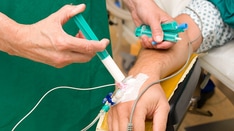
- Inject mixture into the tendon sheath of the first dorsal compartment.
- Take care to avoid injecting directly into the tendons since direct injection can cause weakening and potential rupture.
- Avoid injecting within the very superficial layer of the subcutaneous tissue because of the possibility of skin depigmentation, which is particularly noticeable in dark-skinned individuals.
- Inform the patient that the procedure may cause mild transient increase in local tenderness until the corticosteroid begins to have a noticeable therapeutic effect within a few days.
- Evaluate the patient immediately for sensation at the first web space of the hand to assess for any anesthetic effect to the superficial radial nerve.
- If sensory deficit is present, reassure the patient that the deficit is usually transient and should most likely resolve within a few hours.
- An orthopedic study compared different techniques for corticosteroid injections for de Quervain disease in 38 hands of 36 patients (Sawaizumi, 2006).
- Half of the patients received corticosteroid injections made at a single point immediately above the indurated tendon sheath in the first dorsal compartment. The other half of patients received injections at 2 points (each point receiving half of the therapeutic injectate volume) that corresponded with the paths of the extensor pollicis brevis (EPB) tendon and the abductor pollicis brevis (APB) tendon.
- Repeat injections, for those receiving them, were performed after a 2-week interval, with no significant difference in the number of repeat injections between the groups.
- Comparing the 1-point injection and the 2-point injection, the outcomes were, respectively, excellent in 50% versus 75%, good in 28% versus 25%, and fair in 22% versus 0%. Thus, the 2-point injections seemed to be superior to the 1-point injections.
- A prospective study of 103 patients found suprafibrous injection with corticosteroids to be easier than intrasynovial injection and to have the same effects (Apimonbutr, 2003).
- Several potential complications of injection must be taken into account. They include the following:
- Bleeding or bruising can occur, especially in individuals with bleeding disorders or in patients taking anticoagulants.
- Infection at the injection site is rare but possible. Minimize risk through use of sterile technique for the procedure.
- In patients with diabetes, transient elevation of blood glucose level may occur after corticosteroid injection.
- Allergic reactions to injected medications are rare but possible.
- Given the proximity to the superficial radial nerve, injection at this site may cause transient anesthesia at the first web space of the dorsal hand. Lack of sensation at the site generally resolves within a few hours unless significant direct needle trauma was delivered to the radial nerve, which is a rare complication that could result in persistent pain within the distribution of that nerve (cheiralgia paresthetica).
- Skin hypopigmentation can occur, particularly if injection is performed within superficial layers of the skin, rather than within the tendon sheath alone.
- Tendon weakening and rupture is rare but possible.
- Cheiralgia paresthetica and linear atrophy have been observed as a complication of local steroid injection as a treatment for de Quervain tenosynovitis. This rare complication is thought to result from lymphatic spread of the steroid (Chodoroff, 1985).
For this musculoskeletal condition, medications serve primarily to decrease pain and inflammation. The most commonly used medications are oral nonsteroidal anti-inflammatory drugs (NSAIDs) and focal corticosteroid injection in conjunction with the rest of the rehabilitation plan.
Drug Category: Nonsteroidal anti-inflammatory drugs
Oral NSAIDs may decrease pain and inflammation. Various oral NSAIDs may be used; although, none holds a clear distinction as the DOC. The choice of NSAID is largely a matter of convenience (eg, how frequently doses must be taken to achieve adequate analgesic and anti-inflammatory effects) and cost. Many NSAIDs are available either with or without a prescription.
| Drug Name | Ibuprofen (Motrin, Advil, Nuprin, Rufen) |
| Description | DOC for patients with mild to moderate pain. Inhibits inflammatory reactions and pain possibly by decreasing prostaglandin synthesis. |
| Adult Dose | 200-800 mg PO tid/qid |
| Pediatric Dose | <6 months: Not established 6 months to 12 years: 4-10 mg/kg/dose PO tid/qid >12 years: Administer as in adults |
| Contraindications | Documented hypersensitivity, peptic ulcer disease, recent GI bleeding or perforation, renal insufficiency, or high risk of bleeding |
| Interactions | Coadministration with aspirin increases risk of inducing serious NSAID-related side effects; probenecid may increase concentrations and, possibly, toxicity of NSAIDs; may decrease effect of hydralazine, captopril, and beta-blockers; may decrease diuretic effects of furosemide and thiazides; monitor PT closely (instruct patients to watch for signs of bleeding); may increase risk of methotrexate toxicity; phenytoin levels may be increased when administered concurrently |
| Pregnancy | D - Unsafe in pregnancy
|
| Precautions | Avoid coadministration of other NSAIDs to minimize side effects; special caution in patients on anticoagulants or systemic corticosteroids, with bleeding disorder, or significant alcohol use; avoid during third trimester of pregnancy (potential risk of affecting closure of ductus arteriosus); caution in patients with history of GI bleed, hypertension, CHF, and in elderly patients; please see manufacturer's product information for further details |
Drug Category: Corticosteroids
In contrast to widespread systemic distribution of oral anti-inflammatory drug, a local corticosteroid injection can achieve focal placement of a potent anti-inflammatory agent at the site of maximal tenderness or inflammation. A variety of corticosteroid preparations are available. Mix corticosteroid with local anesthetic agent prior to injection.
| Drug Name | Methylprednisolone (Depo-Medrol) |
| Description | Decreases inflammation by suppressing migration of polymorphonuclear leukocytes and reversing increased capillary permeability. |
| Adult Dose | 20-40 mg of methylprednisolone intralesionally, either 0.5 or 1 mL, respectively, of 40 mg/mL solution; may be mixed with a few mL of lidocaine or other local anesthetics |
| Pediatric Dose | Not established |
| Contraindications | Documented hypersensitivity; never inject corticosteroids into or through a site of suspected infection |
| Interactions | No medication interactions are reported for this route of administration |
| Pregnancy | C - Safety for use during pregnancy has not been established.
|
| Precautions | Local injection of corticosteroids in a diabetic patient can sometimes cause transient elevation of blood glucose levels |
Further Outpatient Care
- Have the patient return for reevaluation in approximately 2-4 weeks after corticosteroid injection.
- At the time of the follow-up visit, assess for therapeutic response to the injection and evaluate for any complication or further treatment needs.
- Instruct the patient to contact his/her physician sooner if significant progression of symptoms is noted or if local signs of infection are present at the injection site.
In/Out Patient Meds
Deterrence
- The patient may need to avoid certain repetitive activities of the wrist or thumb until adequate rehabilitation has been achieved.
Complications
Prognosis
- Most patients with de Quervain tenosynovitis respond very well to nonsurgical treatment (eg, corticosteroid injection, splinting, physical therapy, occupational therapy).
- For severe unresponsive cases despite injections, refer for surgical treatment to decompress the first dorsal compartment.
Patient Education
- As with any injection, educate the patient to watch for signs or symptoms of local infection at the injection site.
- Instruct diabetic patients that they may experience transient increase in blood glucose levels with corticosteroid injection.
- Educate patients that symptomatic improvement from corticosteroid injection usually is observed a few days after injection. Patients should understand that they may experience transient mild increase in symptoms during the time when the local anesthetic has worn off, but steroids have not begun to demonstrate noticeable therapeutic effect.
- For excellent patient education resources, visit eMedicine's Hand, Wrist, Elbow, and Shoulder and Sprains and Strains Center. Also, see eMedicine's patient education articles Repetitive Motion Injuries and Sprains and Strains.
Medical/Legal Pitfalls
- Complications are possible with any injection. The patient needs to understand potential risks prior to giving informed consent for injection.
Debra Ibrahim, 4th year medical student, New York College of Osteopathic Medicine, Class of 2008, assisted with the 2007 revision of this manuscript.
| Media file 1:
The first dorsal compartment at the wrist includes the tendon sheath that encloses the abductor pollicis longus and the extensor pollicis brevis tendons at the lateral border of the anatomical snuffbox. |
 | View Full Size Image | |
Media type: Photo
|
| Media file 2:
The Finkelstein test is performed by having the patient make a fist with the thumb inside the fingers. The clinician then applies ulnar deviation of the wrist to reproduce the presenting symptoms of dorsolateral wrist pain. |
 | View Full Size Image | |
Media type: Photo
|
- Apimonbutr P, Budhraja N. Suprafibrous injection with corticosteroid in de Quervain's disease. J Med Assoc Thai. Mar 2003;86(3):232-7. [Medline].
- Breen TF. Wrist and hand. In: Orthopaedics in Primary Care. 3rd ed. Baltimore, Md:. Lippincott Williams & Wilkins;1998:99-138.
- Brinker MR, Miller MD. The adult wrist. In: Fundamentals of Orthopaedics. Philadelphia, Pa:. WB Saunders;1999:179-95.
- Chodoroff G, Honet JC. Cheiralgia paresthetica and linear atrophy as a complication of local steroid injection. Arch Phys Med Rehabil. Sep 1985;66(9):637-9.
- Geiringer SR. Tendon sheath and insertion injections. In: Physiatric Procedures in Clinical Practice. Philadelphia, Pa:. Hanley & Belfus;1995:44-8.
- Green SM. Nonsteroidal anti-inflammatories. In: Tarascon Pocket Pharmacopoeia 2000. Loma Linda, Calif:. Tarascon Publishing;2000:11-2.
- Hanlon DP, Luellen JR. Intersection syndrome: a case report and review of the literature. J Emerg Med. Nov-Dec 1999;17(6):969-71. [Medline].
- Lennard TA. Fundamentals of procedural care. In: Physiatric Procedures in Clinical Practice. Philadelphia, Pa:. Hanley & Belfus;1995:1-13.
- McGee DJ. Forearm, wrist, and hand. In: Orthopedic Physical Assessment. 2nd ed. Philadelphia, Pa: WB Saunders; 1992:. 198-215.
- Sawaizumi T, Nanno M, Ito H. De Quervain''s disease: efficacy of intra-sheath triamcinolone injection. Int Orthop. Jun 8 2006.
- Schned ES. DeQuervain tenosynovitis in pregnant and postpartum women. Obstet Gynecol. Sep 1986;68(3):411-4. [Medline].
- Snider RK. Hand and wrist. In: Essentials of Musculoskeletal Care. 2nd ed. Rosemont, Ill:. American Academy of Orthopedic Surgeons;1997:160-263.
- Strakowski JA, Wiand JW, Johnson EW. Upper limb musculoskeletal pain syndromes. In: Physical Medicine and Rehabilitation. 1st ed. Philadelphia, Pa:. WB Saunders;1996:756-82.
De Quervain Tenosynovitis excerpt Article Last Updated: Nov 21, 2006
|