Continually Updated Clinical Reference
 
 
  All Sources     eMedicine     Medscape     Drug Reference     MEDLINE
 
eMedicine - Bowel Management : Article by

Quick Find
Authors & Editors
Introduction
Clinical
Differentials
Workup
Treatment
Medication
Follow-up
Miscellaneous
References

Related Articles
Brown-Sequard Syndrome

Central Cord Syndrome

Multiple Sclerosis

Myelomeningocele

Spinal Cord Injury and Aging


Patient Education
Click here for patient education.


Author: Ramon S Lansang Jr, MD, Consulting Staff, Department of Orthopedics, Charleston Area Medical Center

Ramon S Lansang, Jr, is a member of the following medical societies: American Academy of Pediatrics, American Academy of Physical Medicine and Rehabilitation, and American Medical Association

Editors: Teresa L Massagli, MD, Residency Director, Professor, Department of Rehabilitation Medicine and Pediatrics, University of Washington School of Medicine; Francisco Talavera, PharmD, PhD, Senior Pharmacy Editor, eMedicine; Richard Salcido, MD, Chairman, Erdman Professor of Rehabilitation, Department of Physical Medicine and Rehabilitation, University of Pennsylvania School of Medicine; Kelly L Allen, MD, Consulting Staff, Department of Physical Medicine and Rehabilitation, Lourdes Regional Rehabilitation Center, Our Lady of Lourdes Medical Center; Consuelo T Lorenzo, MD, Consulting Staff, Department of Physical Medicine and Rehabilitation, Alegent Health Care, Immanuel Rehabilitation Center

Author and Editor Disclosure

Synonyms and related keywords: neurogenic bowel management

Background

Neurogenic bowel dysfunction is common. This condition encompasses both medical consequences and quality of life issues. Neurogenic bowel dysfunction is common in patients with spinal cord injury (SCI), amyotrophic lateral sclerosis, spina bifida, multiple sclerosis, and diabetes mellitus. Other neurologic conditions such as stroke, traumatic brain injury, and brain tumors may secondarily cause abnormal bowel function, mostly in the form of constipation and incontinence.

Pathophysiology

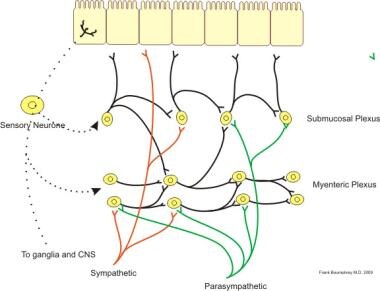
Important neural pathways include parasympathetic, sympathetic, and somatic innervation to the colon, rectum, and anus. The intrinsic nervous system, also known as the enteric nervous system, is composed of the submucosal (ie, Meissner) and myenteric (ie, Auerbach) plexuses, which largely regulate segment-to-segment movement of the GI tract. The vagus nerve innervates the upper segments of the GI tract up to the splenic flexure. The pelvic splanchnic nerves (nervi erigentes) carry parasympathetic fibers from the S2-S4 spinal cord levels to the descending colon and rectum. The hypogastric nerve sends out sympathetic innervation from the L1, L2, and L3 spinal segments to the lower colon, rectum, and sphincters. The pudendal nerve (S2-S4) provides somatic innervation to the external anal sphincter and pelvic floor.
A spinal cord lesion above the conus medullaris is considered an upper motor neuron lesion and manifests as underactive propulsive peristalsis, overactive segmental peristalsis, or rectal distention. A lesion at the level of the conus medullaris, cauda equina, or inferior splanchnic nerve is considered a lower motor neuron lesion and leads to colonic slowing, resulting in constipation, fecal incontinence, and difficulty with emptying.

Frequency

United States

An estimated 4.4 million individuals in the United States have constipation. Fecal incontinence and fecal impaction occur in 0.3-5% of the general population. Difficulty with evacuation of feces may be higher in hospitalized patients and older individuals, estimated to be in the range of 10-50%. No good study of incidence of neurogenic bowel problems by specific cause has been conducted.

Mortality/Morbidity

Minimal to moderate morbidity can be associated with neurogenic bowel disease.

Race

No racial predilection is reported for this condition.

Sex

No known sexual preponderance is reported for this condition.

Age

Age of incidence is variable.


History

  • Establish history of premorbid bowel function and patterns, including frequency, timing, consistency of stools, eating and dietary habits, use of bowel medications and/or digital stimulation, and the presence of GI disease.
  • Determine history of prior neurologic insult and whether the injury is upper motor or lower motor neuron to anticipate symptomatology and clinical findings.
  • Assess impact of bowel symptoms that affect the patient's ability to perform activities of daily living and continue social and work responsibilities.
  • Symptoms can include the following:
    • Loss of voluntary control over defecation, known as fecal incontinence
    • Difficulty with evacuation
    • Associated neurologic bladder symptoms
    • Associated symptoms of autonomic dysreflexia in patients with spinal cord lesions at T6 and above

Physical

  • The external anal sphincter is normally puckered. Lower motor neuron impairment is manifested by flattening or scalloping.
  • Anocutaneous reflex: Stimulation with pinprick in the perianal region leads to visible reflexive anal contraction. Anocutaneous reflex is normally present if S2, S3, S4 reflex arc is intact. This reflex does not correlate with internal sphincter function.
  • Sensory examination tests the integrity of sacral dermatomes to light touch and pinprick.
  • Rectal examination: Assess the tone of the external sphincter by digital examination. Use this examination to assess the bulbocavernosus reflex. Acute complete spinal cord lesions and lower motor neuron impairment is manifested by reduced or absent tone. Rectal sensation usually is absent in lesions above L3.
  • Bulbocavernosus reflex: Squeezing the glans penis or clitoris (or applying traction on an indwelling catheter) results in palpable rectal contraction. This reflex is normally present in most patients. The reflex is brisk with upper motor neuron lesions and is absent in lower motor neuron lesions or spinal shock.


Brown-Sequard Syndrome
Central Cord Syndrome
Multiple Sclerosis
Myelomeningocele
Spinal Cord Injury and Aging

Other Problems to be Considered

GI neoplasm
Gallstone ileus
Intestinal adhesions causing obstruction
Volvulus
Intussusception


Lab Studies

  • Endoscopic studies include rectosigmoidoscopy, anoscopy, and colonoscopy to visualize anatomical abnormalities or lesions. Endoscopy has the limitation that it cannot assess the function of the GI tract.

Imaging Studies

  • Appropriate studies include flat plate, both supine and upright, barium enema, and defecography. These tests all provide visualization of structural defects, identification of abnormal air patterns, and kinetics of defecation. Use serial radiographic studies for evaluation of colonic transit time after the patient has ingested radiopaque beads with food.

Other Tests

  • Manometry by kymography and/or catheter use measures pressure and volume changes by intraluminal balloons and catheter, respectively. These tests help determine anorectal pressures and colonic migratory contractions.
  • The saline infusion continence test quantitatively determines continence to liquid after rectal saline infusion.
  • Electromyography determines the state of innervation of the rectal muscles by their respective motor nerves.


Rehabilitation Program

Physical Therapy

In general, an improvement in mobility and activity levels in affected individuals improves the potential of lessening constipation and fecal impaction.

Occupational Therapy

Occupational therapists work hand in hand with nurses to improve toileting and transfer techniques, with the goal of improving independence and thereby potentially lessening fecal incontinence.

Medical Issues/Complications

  • Fecal contents are propelled in the large intestine by periodic mass movements, as opposed to the more continuous peristalsis of the small intestine. One predictable mass movement is the gastrocolic reflex, which occurs in association with filling of the stomach. The rectum stores stool until it is full. Then reflex relaxation of the usually tonically contracted internal sphincter occurs. In response to the impending bolus of stool, the external sphincter contracts until voluntarily relaxed to permit defecation.
  • Impairment of rectal sensation, sphincter function, or altered colonic motility can result in incontinence. Bowel emptying programs are designed to empty the rectum before reflex relaxation of the internal sphincter occurs.
  • Recommend a program of regular emptying to minimize fecal impaction and incontinence. Have a fixed schedule for bowel training, which in most cases of SCI is every other day. Although no convincing evidence supports bowel programs in stroke patients, the recommendation is to implement them in patients who have had persistent constipation and bowel incontinence.
  • Between scheduled emptyings, most patients should make use of stool softeners, ideally with fiber to increase the bulk of the stools, which in turn leads to better defecatory response.
  • Other means of triggering the defecation reflex include digital stimulation, rectal stimulant suppository, enemas, or a combination of these techniques.
  • Pharmacologic options include use of colonic stimulants (eg, bisacodyl), hyperosmolar agents (eg, sodium bisphosphonate), bulking agents (eg, psyllium), and stool softeners (eg, docusate sodium).
  • Fecal impaction occurs in almost 80% of patients with SCI and can lead to bowel distention, which, if left untreated, could lead to perforation and even death.
  • Gastroesophageal reflux results from chronic overdistention.
  • Diverticulosis results from chronic overdistention of the bowel, as well as from increased intraluminal pressures brought on by fecal impaction.
  • Rectal prolapse occurs from repeated passage of large hard stools in patients with weakened anorectal mechanism, especially in cases of lower motor neuron lesions.
  • Hemorrhoids result from repeated passage of hard large stools as a result of constipation and can lead to chronically high pressures in the anorectal marginal veins. Occurrence of hemorrhoids has been reported to be as high as 76% in one study.

Surgical Intervention

  • Bowel perforation is a surgical emergency resulting from fecal impaction with eventual distention, then perforation. Refer the patient immediately for surgical intervention if clinical and radiologic findings suggest bowel rupture.
  • Consider muscle transposition with innervated adductor longus, gluteus maximus, or other free muscle grafts to replace the puborectalis sling. Use this technique in patients with incomplete motor lesions with some sensation. This technique can lead to some degree of restoration of fecal continence.
  • In patients with rectal dyssynergia, consider myotomy since incomplete relaxation of the internal anal sphincter leads to functional outlet obstruction and may cause dysreflexia in susceptible patients.
  • Colostomy/ileostomy may be considered in highly refractory cases or when stool incontinence complicates other problems such as pressure sore management.
  • Appendicocecostomy (antegrade continence enema [ACE] procedure): The appendix is used as a conduit between the skin and cecum. Enema fluid can be introduced using a catheter. This procedure is used in chronic refractory neurogenic bowel when there is insufficient rectal tone to allow use of rectal enemas. Appendicocecostomy is used most often in children with spina bifida.

Consultations

Consider consultation with a gastroenterologist, surgeon, or both in recalcitrant cases or in cases in which complications are suggested or have been observed.

Other Treatment

  • Biofeedback and behavioral training are of benefit to improve sensory and motor awareness in patients with incomplete neurogenic bowel lesions, especially in children.
  • Other options to relieve symptoms include a pulse irrigation evacuation system using intermittent rapid pulses of warm water to break up stool impactions and stimulate peristalsis. Some clinicians also advocate use of a bowel management tube with attached balloon and subsequent administration of saline enema for fecal evacuation in children with neurogenic bowel dysfunction. The balloon helps to provide anal occlusion to retain the enema fluid in persons with weak or absent anal sphincter function.


Drugs used for management of neurogenic bowel dysfunction include laxatives and stool softeners aimed at stimulating peristalsis with subsequent loosening and expelling of feces.

Drug Category: Colonic stimulants

These agents are used to promote peristalsis.

Drug NameBisacodyl (Dulcolax, Bisac Evac, Bisco-Lax)
DescriptionColonic laxative stimulant in the form of tablets or suppositories. Mechanism of action is direct stimulation of colonic mucosa to produce peristalsis. Used for relief of constipation and irregularity. Comes in 10-mg tab or supp.
Adult Dose2-3 tab/d PO or 1 supp/d PR
Pediatric Dose<6 years: Not established
6-12 years: 1 tab/d PO or 1 pediatric supp/d PR
>12 years: 2-3 tab/d PO or 1 supp/d PR
ContraindicationsDocumented hypersensitivity; acute surgical abdomen, appendicitis, rectal bleeding, gastroenteritis, and intestinal obstruction
InteractionsDecreases effects of warfarin and antacids
PregnancyB - Fetal risk not confirmed in studies in humans but has been shown in some studies in animals
PrecautionsNot recommended with abdominal pain, nausea, or vomiting; caution in ulceration of colon and during pregnancy or breastfeeding

Drug NameSenna (Senokot)
DescriptionNatural vegetable derivative that causes neuroperistaltic stimulation. Comes in tab, syrup, and in combination with docusate sodium (Senokot-S).
Adult Dose2 tab/d to 4 tab PO bid or 1 tsp/d to 2 tsp PO bid
Pediatric Dose<2 years: Not established
2-6 years: 1/2 tab/d to 1 tab PO bid or 1/4 tsp/d to 1/2 tsp PO bid
6-12 years: 1 tab/d to 2 tab PO bid or 1 tsp/d to 2 tsp/d PO
ContraindicationsDocumented hypersensitivity; nausea, vomiting, GI bleeding, appendicitis, congestive heart failure, fecal impaction, and appendicitis
InteractionsDecreases effects of anticoagulants
PregnancyB - Fetal risk not confirmed in studies in humans but has been shown in some studies in animals
PrecautionsExcessive use may lead to electrolyte imbalance, osteomalacia, steatorrhea, cathartic colon, abdominal pain, nausea, and vomiting

Drug Category: Hyperosmolar agents

Short-term treatment of constipation.

Drug NameSodium phosphate (Fleet enema)
DescriptionAction is as purgative and laxative used in constipation and as bowel cleansing regimen in preoperative patients.
Adult DoseLaxative: 4 tsp PO
Purgative: 3 tbsp PO
Pediatric Dose<5 years: Not established
5-10 years: 1 tsp PO
10-12 years: 2 tsp PO
>12 years: Administer as in adults
ContraindicationsDocumented hypersensitivity; hypernatremia, hyperphosphatemia, renal failure, hypocalcemia, and fecal impaction
InteractionsDo not administer with aluminum, magnesium antacids, or sucralfate
PregnancyC - Fetal risk revealed in studies in animals but not established or not studied in humans; may use if benefits outweigh risk to fetus
PrecautionsAvoid in congestive heart failure because of its osmotic nature; caution in impaired renal and cardiac function; Milk of Magnesia is similar agent

Drug Category: Bulking agents

Absorb water in intestine to form viscous liquid that promotes peristalsis and reduces transit time.

Drug NamePsyllium (Metamucil, Citrucel)
DescriptionContains natural fiber that acts to increase content of feces and, at the same time, promotes bacterial growth. Main indication is in chronic constipation, irritable bowel syndrome, and bowel management in cases of patients with hemorrhoids.
Adult Dose1 tsp/dose PO qd/bid; should be mixed with at least 8 oz of water to prevent choking
Pediatric Dose<6 years: Not established
6-12 years: 0.5 tsp/dose PO qd/bid
>12 years: Administer as in adults
ContraindicationsDocumented hypersensitivity; fecal impaction, intestinal obstruction, or undiagnosed abdominal pain
InteractionsMay decrease absorption and effects of salicylates, nitrofurantoin, tetracyclines, and diuretics
PregnancyC - Fetal risk revealed in studies in animals but not established or not studied in humans; may use if benefits outweigh risk to fetus
PrecautionsAvoid inhalation of airborne dust; caution in intestinal adhesions, ulcers, or stenosis

Drug Category: Stool softeners

Help keep stools soft for easy natural passage.

Drug NameDocusate sodium (Colace, Surfak)
DescriptionSurface-active agent used in painful anorectal conditions and cardiac conditions where maximum ease of stool passage desirable. Therevac mini-enema is a combination of glycerin and docusate sodium in polyethylene glycol base. Has been shown to produce more rapid results than a bisacodyl suppository. Available in 100 mg cap, 20 mg/5 mL syrup, and 200 mg/5 mL microenema.
Adult Dose50-200 mg/d PO
Pediatric DoseInfants and children <3 years: 10-40 mg/d PO
3-6 years: 20-60 mg/d PO
6-12 years: 40-120 mg/d PO
ContraindicationsDocumented hypersensitivity, nausea, vomiting, or acute abdominal pain
InteractionsDecreases effects of warfarin and increases effects of phenolphthalein
PregnancyC - Fetal risk revealed in studies in animals but not established or not studied in humans; may use if benefits outweigh risk to fetus
PrecautionsProlonged use of medication may result in electrolyte imbalance

Drug Category: Osmotic agents

Promote bowel movement by osmotic action that holds water in small intestine and colon.

Drug NamePolyethylene glycol (PEG) solution (Miralax)
DescriptionFor treatment of occasional constipation. In theory, less risk of dehydration or electrolyte imbalance with isotonic PEG compared with hypertonic sugar solutions. The laxative effect is generated because PEG is not absorbed and continues to hold water by osmotic action through the small bowel and the colon, resulting in mechanical cleansing.
Supplied with measuring cap marked to contain 17 g of laxative powder when filled to indicated line. May require 2-4 d (48-96 h) to produce bowel movement.
Adult DoseDissolve 17 g in 8 oz of water and drink daily prn for up to 2 wk
Pediatric DoseNot established
ContraindicationsDocumented hypersensitivity; colitis; ileus; megacolon; bowel perforation; gastric retention; GI obstruction
InteractionsMay decrease absorption of oral medications, thereby reducing effectiveness
PregnancyC - Fetal risk revealed in studies in animals but not established or not studied in humans; may use if benefits outweigh risk to fetus
PrecautionsCaution in ulcerative colitis or hot loop polypectomy; not for use > 2 wk

Drug Category: Opioid antagonist

Consider using a peripherally selective opioid antagonist to treat constipation in patients who have advanced illness requiring chronic opioid analgesia and who are unresponsive to laxatives.

Drug NameMethylnaltrexone (Relistor)
DescriptionPeripherally acting mu-opioid receptor antagonist. Selectively displaces opioids from mu-opioid receptors outside CNS, including those located in GI tract, thereby decreasing constipating effects. Indicated for opioid-induced constipation in patients with advanced illness receiving palliative care, when response to laxatives has not been sufficient. Available as a 12-mg/0.6 mL injectable solution for subcutaneous use.
Adult DoseUsually administered as 1 dose qod prn; not to exceed 1 dose/24 h
<38 kg: 0.15 mg/kg SC (round dose to nearest 0.1 mL)
38-61 kg: 8 mg (0.4 mL) SC
62-113 kg: 12 mg (0.6 mL) SC
>114 kg: 0.15 mg/kg SC (round dose to nearest 0.1 mL)
CrCl <30 mL/min: Reduce dose by 50%
Pediatric DoseNot established
ContraindicationsDocumented hypersensitivity; known or suspected mechanical GI obstruction
InteractionsData limited; none reported
PregnancyB - Fetal risk not confirmed in studies in humans but has been shown in some studies in animals
PrecautionsCommon adverse effects include abdominal pain, flatulence, nausea, dizziness, and diarrhea; discontinue use and contact physician if severe or persistent diarrhea occurs


Further Outpatient Care

  • Recommend annual follow-up visits for patients with SCI or spina bifida; follow-up may be necessary even more frequently for some patients.
  • Include thorough physical examination, including rectal examination, as part of regular follow-up.
  • Perform stool testing for occult blood in patients aged more than 50 years to rule out colorectal cancer.
  • Evaluate for use of devices in patients with SCI.
  • Advise patients that their daily diet should contain 15-30 mg of fiber.
  • Perform other diagnostic workup (eg, radiologic evaluation) when necessary (ie, in cases of fecal impaction or suggestion of perforation).

In/Out Patient Meds

  • Monitor use of appropriate medications.

Transfer

  • Transfer patients with suspected bowel rupture or perforation to medical or surgical care, as well as any patients with rectal prolapse, since these conditions lead to high morbidity rate and are managed best surgically.

Complications

  • Potential complications include secondary occurrence of hemorrhoids, rectal prolapse, intestinal obstruction with subsequent perforation, diverticula, perirectal abscess, and colonic cancer. These complications all can be minimized by proper bowel management, mainly frequent evacuation with maintenance of soft stools through diet and medications.

Prognosis

  • The prognosis depends on the severity, location, and presenting comorbidity factors in patients with SCI.
  • Patients with complete SCI injuries have a less favorable prognosis.

Patient Education

  • Education on the long-term management of bowel dysfunction
  • Patient education on the rationale, goals, and techniques of bowel management
  • Education on the safe use of assistive devices for bowel emptying
  • Efficient techniques used in bowel emptying, digital stimulation, and use of rectal suppository
  • Importance of timing, regularity, and positioning in bowel evacuation
  • Prevention of bowel-related complications such as constipation, hemorrhoids, and impaction


Medical/Legal Pitfalls

  • Failure to identify bowel impaction potentially could lead to bowel perforation.
  • Failure to identify fecal impaction because of the presence of diarrhea may lead to missing the diagnosis of intestinal obstruction.


  • Braddom RL. Physical Medicine and Rehabilitation. Philadelphia, Pa: WB Saunders; 1996:. 555-79.
  • Consortium for Spinal Cord Medicine. Neurogenic Bowel Management in Adults with Spinal Cord Injury. In: Clinical Practice Guidelines. Washington, DC; March 1998:. 1-39.
  • Duncan PW, Zorowitz R, Bates B, et al. Management of Adult Stroke Rehabilitation Care: a clinical practice guideline. Stroke. Sep 2005;36(9):e100-43.
  • Goetz LL, Hurvitz EA, Nelson VS, Waring W 3rd. Bowel management in children and adolescents with spinal cord injury. J Spinal Cord Med. Oct 1998;21(4):335-41. [Medline].
  • Lisenmeyer TA, Stone JM. Neurogenic bladder and bowel dysfunction. In: De Lisa J, ed. Rehabilitation Medicine. Philadelphia, Pa: Lippincott-Raven; 1998:. 1073-106.
  • Menter R, Weitzenkamp D, Cooper D, et al. Bowel management outcomes in individuals with long-term spinal cord injuries. Spinal Cord. Sep 1997;35(9):608-12. [Medline].
  • Puet TA, Jackson H, Amy S. Use of pulsed irrigation evacuation in the management of the neuropathic bowel. Spinal Cord. Oct 1997;35(10):694-9. [Medline].
  • Schiller LR. Fecal Incontinence: Gastrointestinal Disease. Philadelphia, Pa: WB Saunders; 1989:. 317-30.
  • Weingarden SI. The gastrointestinal system and spinal cord injury. Phys Med Rehab Clin North Am. 1992;3(4):765-73.

Bowel Management excerpt

Article Last Updated: May 7, 2008