Background
Upper-extremity amputations largely follow the same basic principles as any other amputation. [1] This article highlights the special considerations involved in acquired amputations at or above the elbow. Below-elbow amputations are discussed in separate articles (see Wrist and Forearm Amputations and Digital Amputations). Although acquired amputations in children are discussed (because pediatric patients deserve special consideration), patients with congenital limb amputations and deficiencies are beyond the scope of this article.
The true frequency of acquired amputation at or above the elbow is unknown. Published estimates of the number and rate of limb amputations, including upper-extremity amputations, vary significantly; totals ranging from 350,000 to 1,000,000 persons with amputations have been cited, as have rates of 20,000-30,000 persons per year for patients undergoing amputation.
Amputation is one of the oldest surgical procedures. Archeologists have uncovered evidence of amputation—congenital and acquired through surgery or trauma—in prehistoric humans. Whereas surgical amputation has evolved significantly since the days of quickly severing a limb from an unanesthetized patient and dipping the stump in boiling oil to achieve hemostasis, modern ideas of amputation and prosthetics were not developed until World Wars I and II. Particularly since the late 20th century, prosthetic research and rehabilitation engineering centers supported by federal funding have disseminated new information regarding biomechanics and prosthetic design.
With the advent of physical and rehabilitative medicine, surgeons now realize that care for a person who has undergone an amputation does not end with the removal of sutures.
As medical technology and surgical techniques are improved in the areas of peripheral vascular disease, diabetes, microsurgery and limb salvage, it is to be expected that the number of amputations will consequently decrease. Ethical questions of "technology over reason" will come to the forefront.
An example of this debate can be observed with the advent of upper-extremity transplantation. Although transplantation offers an attractive alternative to amputation, further discussion is needed to evaluate the risks and benefits of such procedures. Does the functional gain of transplantation justify the use of resources involved and commitment of the patient to lifelong immunosuppressive therapy? [2]
Although the surgical technique of amputation has stabilized and is not likely to undergo radical advances in the near future, prosthetic advances are likely to lead to improvements in function and quality of life of an individual with an amputation. [3] Likewise, much research has focused on gaining a better understanding of the problem of phantom sensation as it relates to the reorganizational changes in the somatosensory system. [4] Many questions remain unanswered.

Indications
Irreparable loss of the blood supply of a diseased or injured upper extremity is the only absolute indication for amputation, regardless of all other circumstances. Severe instances of peripheral vascular disease, traumatic injury, thermal and electrical injury, and frostbite commonly necessitate amputation. [5] The part not only has been rendered useless but is also a threat to the life of the individual because the toxic products of tissue destruction are disseminated systemically.
No injury severity score has been universally accepted as a guide for severe upper-extremity trauma. Much of the decision-making is left to the surgeon. In a study of 10 cases of mangled upper-extremity injuries, Kumar et al compared two scoring systems used for mangled lower-extremity injuries: the mangled extremity severity score (MESS) and the mangled extremity syndrome index (MESI). [6] They found MESI to be more reliable than MESS but noted that a large prospective study would be required to confirm this difference.
Likewise, in individuals with systemic sepsis, amputations are necessary to control an otherwise rampant infection. Occasionally, an injury or condition that does not directly affect a limb's vasculature has disabled the upper extremity to the point where a prosthesis would be functionally superior to the limb. The usual indication for amputation after nerve injury is the development of uncontrolled trophic ulcers in an anesthetic upper extremity.
In a case series that included patients with global brachial plexus avulsion injuries and lack of biologicl shoulder and elbow function, Hruby et al found above-elbow amputation and prosthetic rehabilitation to be beneficial. [7]
Amputation is rarely indicated in persons with quadriplegia, even if the upper extremities have no residual function. Often, the upper extremities help maintain balance when the patient is sitting and serve to distribute the forces of weightbearing over a larger area, thereby minimizing pressure sores.
In general, amputations in the upper extremity are also indicated for persons with malignant tumors without evidence of metastases. Even after metastases appear, amputation may be necessary for local tumor control and to relieve pain when a neoplasm has become ulcerated and infected or has caused a pathologic fracture. [8] In these oncologic cases, the indications for amputation versus a limb salvage procedure are evolving constantly and warrant individual consideration to a degree that is beyond the scope of this article.
Contraindications
The only absolute contraindication for amputation is a situation where sparing a limb or part of a limb would leave the patient better able to function than an amputation would.
Technical Considerations
Anatomy
The elbow joint is composed of the distal end of the humerus and the proximal ends of the radius and the ulna. The humerus contributes the humeral condyle, composed of the trochlea medially from anterior to posterior and the capitulum laterally on the anterior aspect, to the articular surface of the elbow joint. The humeral condyle itself is a rounded, almost tubelike structure that occupies most of the space of the distal end of the humerus and is located centrally. The condyle is covered in articular cartilage and allows the hooking-on of the C-shaped trochlear notch of the ulna and the concave superior aspect of the head of the radius.
The humerus has small indentations just superior to the condyle on the anterior aspect; the radial fossa (laterally) and the coronoid fossa (medially) allow the humerus to accept the head of the radius and the coronoid process of the ulna when the joint is in full flexion.
On the central aspect of the posterior humerus above the trochlea of the humeral condyle is the olecranon fossa, which allows the humerus to accept the olecranon of the ulna when the joint is in extension. The olecranon is the proximal end of the ulna, from which the C-shaped trochlea notch is carved.
For more information about the relevant anatomy, see Elbow Joint Anatomy. For a discussion of anatomy relevant to surgery, refer to individual surgical descriptions in Technique.
Procedural planning
The surgeon faces many challenges over the course of treating an individual by means of amputation. The surgeon must determine the salvageability of a limb, an assessment that is often made quickly in cases of trauma or sepsis. Once the decision to amputate has been made, the level of amputation must be determined (see the image below). The functional limitations of amputation levels and prosthetic designs, as well as the patient's emotional, physical, and vocational background, must be considered carefully, especially with upper-extremity amputations.
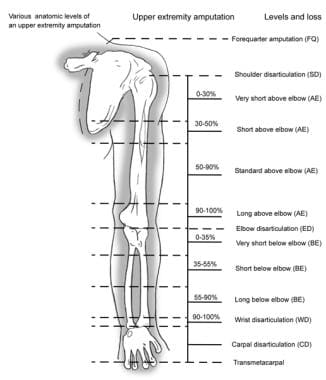 The various levels of an upper extremity amputation.
Thus, the surgeon walks a precarious tightrope. Preservation of length in the upper extremity is paramount, but it often can be achieved only by sacrificing stump viability, appropriate bone coverage and padding, and, occasionally, optimal prosthetic fitting.
The surgical procedure itself has its own risks from anesthesia and cardiovascular collapse, as well as early postoperative infections and pulmonary embolism. Events that occur later, and are perhaps more specific to individuals with amputations, include joint contractures, phantom limb pain, neuroma formation, stump breakdown, and, in children, bony overgrowth. [9]
Unlike some orthopedic patients, individuals with amputations should undergo comprehensive physical and emotional rehabilitation. A person with an amputation is a patient for life. Close coordination with a team of specialists in physiatry or rehabilitative medicine, as well as with a prosthetist, a physical therapist, and a psychologist, is ideal.
The following are major goals of upper-extremity amputation surgery:
-
Preservation of functional length
-
Durable coverage
-
Preservation of useful sensation
-
Prevention of symptomatic neuromas
-
Prevention of adjacent joint contractures
-
Minimization of short- and long-term morbidity
-
Early prosthetic fitting, when applicable
-
Early return of the patient to work and play
Outcomes
Persons who have amputations that are performed at the appropriate level and with proper surgical technique do very well. The complications (see Technique) are generally prevented or successfully managed. A patient's attitude, motivation, and desire before amputation strongly influence the overall outcome after the procedure. However, if proper follow-up care and rehabilitation are not coordinated with a multispecialty team of surgeons, physical therapists, physiatrists, prosthetists, and psychologists, then a less optimal result is inevitable.
Generally, the longer the residual stump, the greater the residual function, with or without a prosthesis. A study examining the outcomes of upper-extremity amputations found that individuals with below-elbow amputations more easily performed two-handed activities than did persons with above-elbow amputations. [10] However, there was no significant difference between the two groups with respect to the performance of activities of daily living. Patients with bilateral above-elbow amputations were more proficient with activities of daily living than they were with two-handed activities.
Rickelt et al retrospectively studied 40 patients who had a forequarter amputation (FQA) for malignant disease of the shoulder girdle. [11] They concluded that FQA may offer the only possibility of cure in locoregional disease such as sarcoma. They added, however, that in patients with axillary metastasis, FQA has no impact on survival, though local control may improve the patient's quality of life. [11]
Flurry et al studied the use of composite free fillet flaps in eight patients to cover proximal humeral and shoulder defects associated with upper-arm traumatic amputations. [12] They found that immediate soft-tissue coverage using composite free fillet flaps from amputated limbs can be successful, with few complications, and can preserve limb length while maximizing available tissue. In addition, the authors noted that including flexor muscle belly adjacent to the vascular pedicles provides additional coverage and a well-vascularized composite flap to aid in prosthetic fitting and comfort.
-
The various levels of an upper extremity amputation.