Overview
Wheelchair seating and mobility is a technical and specialized area of rehabilitation medicine. [1] The unique characteristics of the individual and the current technology must be taken into account in order to choose the best type of mobility assistive equipment (MAE). Successful delivery of a wheelchair and seating system begins with making the determination that the patient has a mobility impairment that requires the use of MAE. A complete understanding of the individual's health condition and associated impairments will direct the provider in assessing optimal positioning and mobility for the patient.
The needs of the patient, as well as those of the caregiver, are paramount. [2, 3, 4] Goals of the seating system include postural support, stability, and pressure distribution. Goals of the mobility system include providing optimal mobility and function. [5, 6, 7]
Equipment and seating are classified as follows:
-
Consumer-level equipment - Designed for the person who requires little postural support and may be using seating and wheeled mobility only in the short-term
-
Complex rehabilitation technology - Equipment designed for long-term users that provides customized seating options to meet an individual’s needs, as well as wheelchair bases with more features and greater adjustability

Terminology, Classification, and Clinical Indicators
Positioning and seating
Positioning is the practice of determining the optimal body position for a client, while the wheelchair seating system is used to maintain that identified position. Seating systems are generally used on manual or power wheelchair bases. All wheelchair mobility bases require a seating system that uniquely meets the needs of the user. The goals of positioning and seating are as follows:
-
To provide adequate support for the client in a seated position
-
To maintain orthopedic alignment and accommodate any fixed asymmetries - Identifying the appropriate support surfaces and angles of placement can normalize muscle tone and inhibit reflexive patterns; this support may be required because of muscle weakness, paralysis, or abnormal muscle tone
-
To provide adequate stability and enhance function - Many clients lack the stability required to maintain an upright posture, owing to muscle weakness, paralysis, abnormal muscle tone, or muscle imbalance
-
To provide adequate pressure distribution and comfort and to increase sitting tolerance - Maintaining a seated position without pressure distribution and pressure relief can lead to pressure ulcer development
Seating systems are composed of primary support surfaces (seats and backs) and secondary supports (including lateral trunk supports, head supports, and pelvic-positioning belts). Support surfaces may be planar, generically contoured, or custom molded to an individual.
Seating systems
Seating systems include sling or rigid bases, on which users typically have cushions or linear, contoured, or molded seating systems. Sling seats, while lighter, tend to hammock and lead to hip adduction and internal rotation. In addition, sling seats provide little pressure relief. A wide variety of cushions are available, which are designed for positioning, pressure distribution/relief, or both. These generally are removable on folding wheelchairs or are used on more than one mobility base. Performance is based on design, materials, and cover.
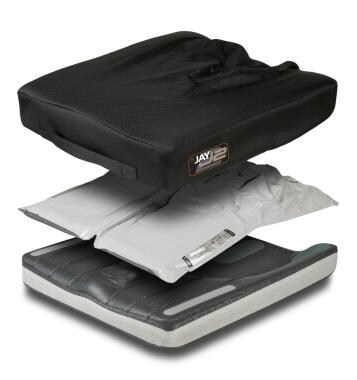 Pressure-relieving cushion with viscous fluid (gel). © Sunrise Medical. Courtesy of Sunrise Medical (https://www.sunrisemedical.com/).
Linear or planar seats are sometimes used in the pediatric market because of their adaptability and growth potential. The surface may be flat or generically contoured. An antithrust seat has a “curb” to prevent forward sliding or migration of the pelvis into a posterior tilt. Molded seats are actually molded to the client’s body and can be used to accommodate significant orthopedic asymmetries, provide maximum pressure distribution, and offer maximum support and stability. However, molded seats do not accommodate growth or other seating changes as readily as the linear and planar variety do and are more costly than many other options.
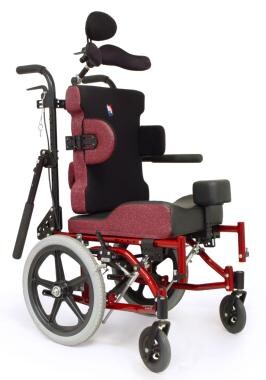 Linear seating system often used in pediatrics. © Sunrise Medical. Courtesy of Sunrise Medical (https://www.sunrisemedical.com/).
Backs
Backs are available in sling, linear, contoured, and molded designs. Lower heights allow more trunk movement and do not interfere with access to the wheels for propelling a manual wheelchair. Higher backs provide more posterior support and the ability to mount lateral and anterior trunk supports, as well as a head support.
Sling backs are the lightest-weight option but can lead to a rounded trunk or kyphotic posture. An adjustable tension type allows for some adjustability as the back can be tightened to provide a mild contour and anterior trunk support, as well as head support if warranted. Off-the-shelf backs are easily removable for folding and are available at various heights.
Linear or planar backs, as with seats, are often used with children for ease of growth. The surface may be flat or have generic contours. A modification of this is the biangular back, which is built in two pieces. The lower section, which is often mounted at a 90º angle to the seat, goes up to the top of the pelvis to support a neutral pelvic tilt. The upper section is angled posteriorly to promote trunk extension. Molded backs, as with molded seats, accommodate significant orthopedic asymmetries and provide maximum pressure distribution, support, and stability.
Secondary supports
Secondary supports can be placed laterally, anteriorly, or posteriorly to the body; they are designed not only to provide support but also to help with alignment and positioning. Lateral supports are generally on the trunk, while hip guides are used to help control the pelvis.
Anterior supports are used to help maintain an upright posture and to promote trunk extension and scapular retraction; they frequently include shoulder straps, shoulder retractors, chest straps, and vests.
Anterior pelvic supports maintain the pelvis in the best functional sitting posture. A level pelvis is optimal but often cannot be achieved in individuals with pelvic obliquity and scoliosis. Pelvic belts are the most commonly used anterior pelvic supports.
Posterior supports include headrests or head supports. Head supports prevent the head from falling rearward, support the head during recline or tilt, and help the client to hold his or her head upright in an aligned position. Neck flexion or hyperextension can lead to drooling, poor swallowing, breathing impairment, and a poor visual field.
Mobility
Mobility bases provide either dependent or independent mobility to a client in the seated position and fall within the following categories:
-
Augmentative mobility devices
-
Dependent mobility bases
-
Manual wheelchairs
-
Power-assist wheels
-
Power-operated vehicles (POVs)
-
Power wheelchairs
Augmentative mobility devices
These devices augment ambulation and include canes, crutches, gait trainers, and walkers.
Dependent-mobility bases
Dependent-mobility bases are propelled or pushed by a caregiver rather than by the client. These include adaptive strollers, transport chairs, and tilt or recline manual wheelchairs. Very young children often use adaptive strollers, to accommodate their small size. These medical strollers can be forward or rear facing and have features such as tilt or recline options. Some are capable of having medical equipment, such as ventilators and oxygen, mounted on them. Adaptive strollers can be used as a backup mobility system because they are lightweight and fold easily. Disadvantages of certain adaptive strollers are minimal seating options, a fixed posterior tilt, and less growth and frame adjustment than manual wheelchairs.
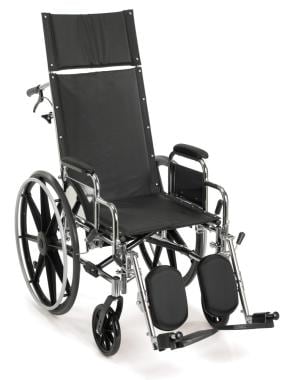 Manual reclining wheelchair. © Sunrise Medical. Courtesy of Sunrise Medical (https://www.sunrisemedical.com/).
Transport chairs are designed for short-distance transport of adults and children (eg, between the car and the waiting room), as the rear wheels are small and not designed for self-propulsion.
Manual wheelchairs with recline and/or tilt-in-space options generally are designed for dependent mobility and positioning. The recline mechanism allows the back to be lowered, increasing the seat-to-back angle, while tilt-in-space maintains the seated angles. Tilt-in-space can be used for anterior and posterior positional changes. Recline and tilt are used for postural control of the trunk and neck (gravity assists), fatigue management, postseizure management, and weight shifting or pressure redistribution to reduce the risk of pressure ulcer development. [8] The recline function may help to facilitate personal care, such as clothing and diaper changes. A change in typical seat-to-back angle may elicit extensor tone and spasms in some clients or can be used to reduce tone. A reclining wheelchair is often used temporarily with orthopedic surgeries to accommodate casts or range limitations.
Manual wheelchairs are categorized by weight and frame adjustments. Manual wheelchairs have multiple functions, from assisting the client with household ambulation to providing mobility to someone who cannot ambulate. A manual wheelchair is required in the following situations:
-
A person has limited mobility and ambulation, is at risk for falling, or has excessive fatigue
-
A person has good functional use of the upper extremities but cannot walk or has lower-extremity weakness
-
A person can use a power wheelchair but needs a manual wheelchair for backup (eg, the power wheelchair is broken, the person is traveling and cannot take a power wheelchair, accessibility problems)
-
Dependent mobility is the primary method of mobility
Standard manual wheelchairs weigh 38-45 pounds and are designed as a dependent-mobility base owing to their weight, limited seating options, and lack of frame adjustments.
Lightweight manual wheelchairs weigh 28-36 pounds and can be used as a dependent- or independent-mobility base. These typically fold side-to-side and include some frame adjustments, which affect center of gravity, seat-to-floor height, seating options, frame growth, and self-propulsion.
Ultralightweight manual wheelchairs weigh 18-30 pounds and include full-frame adjustments. This category is designed to optimize self-propulsion, reduce risk of repetitive stress injuries to the shoulder, and provide durability in a very lightweight frame. Ultralightweights are available in folding and rigid options. Rigid frames are typically the most efficient as they are not only light but also allow more efficient propulsion. Rigid-frame wheelchairs can easily be transported as the back typically folds down and the rear wheels can be removed. Research has demonstrated that ultralightweight chairs are much more durable than lesser categories, which is more cost efficient.
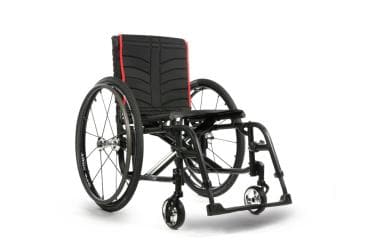 Folding lightweight manual wheelchair. © Sunrise Medical. Courtesy of Sunrise Medical (https://www.sunrisemedical.com/).
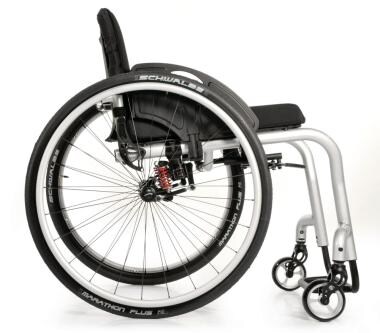 Rigid ultralightweight manual wheelchair. © Sunrise Medical. Courtesy of Sunrise Medical (https://www.sunrisemedical.com/).
Research has also indicated that the optimal rear axle position should line up with the glenohumeral joint. This can be clinically evaluated by having the client drop his or her arm, at which time the tip of the fingers should just reach the axle. [9] Wheelchair propulsion is complex and should be maximized for each wheelchair user. Traditionally, users are taught to use a long forward stroke and then let the arm drop and come back, forming a single loop pattern of movement. This stroke-and-recovery pattern, in combination with the proper frame setup, minimizes risk of shoulder and wrist injuries due to repetitive stress. [10] Repetitive stress injuries may lead to loss of function, including loss of ability to self-propel a manual wheelchair.
Specialized manual wheelchairs include bariatric, pediatric, and dynamic frames. Bariatric frames support larger weight and size dimensions than other frames. A client will not be able to reach the wheels for self-propulsion beyond a certain frame width, however, and large frame widths tend not to fit through standard doorways.
Pediatric frames are designed to accommodate smaller sizes and offer more growth potential. The wheels can be placed either in a forward or reverse configuration to accommodate arm length. A wheelchair with dynamic components allows for movement, including flexion and extension of the hips and knees. Enabling these movements may increase sitting tolerance and calm some clients.
Propulsion
Typical propulsion of a manual wheelchair is performed using a two-handed system. The hand rims are used in a synchronous or asynchronous pattern for mobility. Some clients may be able to use only one hand (eg, hemiplegia), which typically requires a one-arm–drive manual wheelchair. This modification adds significant weight to the wheelchair and may not work well for clients with small hands or a weak grip. [11]
Other propulsion styles may include the use of two feet or one foot and one hand to move about in a manual wheelchair. These propulsion techniques require a lower seat-to-floor height, and typically footrest hangers are removed. Using any form of foot propulsion may cause a posterior pelvic tilt. This can lead to other problems, including sacral pressure, so other propulsion methods may be considered instead.
In a study by Hanks et al of children with spinal cord injury, the results indicated that with regard to manual wheelchair propulsion, upper extremity joint dynamics differ significantly between males and females. The investigators found that when propelling the wheelchair, peak forearm pronation, normalized wrist lateral force, and normalized elbow posterior force were significantly greater in females than in males. In contrast, peak sternoclavicular joint retraction was significantly greater in males. [12]
Power-assist wheelchair systems are now available to assist with propulsion, improve efficiency, and decrease stress on the upper extremities. There are a variety of systems that include battery-powered rear wheels for manual wheelchairs, which are designed to augment self-propulsion. Power-assist wheels add power to each stroke, which, in turn, adds distance and force. Power-assist wheels can also be used to prevent repetitive stress injuries to the shoulder and wrist. Individuals who have difficulties with long distances, ramps, and varied terrain may find this a reasonable alternative to a power wheelchair. Other options also include devices that snap onto the frame of a wheelchair with a fifth wheel that has a motor and assists with propulsion. Some of the newer systems use Bluetooth technology to direct the drive system. There are also motorized attachments that can be placed on the front of the wheelchair to basically turn the wheelchair into a motorized tricycle system.
Power-operated vehicles, also known as scooters, provide powered independent mobility. The client holds a tiller and generally squeezes one lever for forward directional control and another level for reverse directional control. Steering is accomplished by moving the tiller. The seat may pivot for transfers. Scooters can typically be broken down into sections for transport in nonaccessible vehicles, and many clients prefer the appearance of scooters to power wheelchairs.
The tiller requires bilateral upper extremity control and may lead to shoulder fatigue as the arms are unsupported. The client must have the ability to squeeze the levers and sustain compression to maintain scooter movement. Even though power-operated vehicles can be broken down for transport, individual pieces can still be heavy and assembly and disassembly difficult and time consuming. Seating options are limited. Power-operated vehicles have lower speeds, power, and driving range compared with power wheelchairs. The three-wheel style can be tippy, particularly during sharp turns. The four-wheel style is more stable but less maneuverable.
Power wheelchairs are categorized into consumer bases and complex rehab bases. The following are several indications for the use of power wheelchairs:
-
Individuals who have limited household ambulation and are not safe/efficient or fatigue quickly with ambulation - The person cannot use a manual wheelchair because the upper extremities are not strong enough
-
Individuals with poor coordination of the extremities - A person with cerebral palsy may be unable to coordinate safely in another mobility option
-
A person with weakness in all extremities due to quadriplegic spinal cord injury or muscle disorders
-
A person with severe restrictions in range of motion, such as is seen with arthrogryposis or severe arthritis
Research has demonstrated that children as young as 18 months can drive a power wheelchair. Research has also clearly demonstrated that any form of early mobility increases cognitive, visual, and psychosocial development. [13]
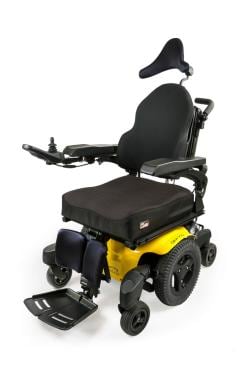 Midwheel-drive power wheelchair with joystick. © Sunrise Medical. Courtesy of Sunrise Medical (https://www.sunrisemedical.com/).
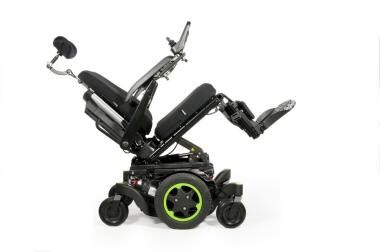 Power wheelchair with power tilt. © Sunrise Medical. Courtesy of Sunrise Medical (https://www.sunrisemedical.com/).
Consumer power wheelchairs are in Medicare Group 1 or Group 2 definitions. This level of power wheelchair is indicated if the client has minimal positioning and pressure-relief needs, can use a joystick, and has moderate speed, power, and range needs. Most of these power wheelchairs have good maneuverability and turning radius.
Consumer power wheelchairs do not support a full array of seating options, key frame adjustments for certain positions (eg, seat-to-back angle adjustment), frame growth, or power seating functions (eg, tilt, recline). No alternative access methods, outside the joystick, are supported, and the base has less suspension than rehab-level power wheelchairs. Suspension helps keep all the wheels on the ground for stability when going up and down inclines or crossing varied terrain and reduces vibration and jarring, which can lead to fatigue, muscle spasms, and/or increased muscle tone in some clients.
Rehab power wheelchairs include Group 2, with power seating and above, per Medicare definitions. This level of power wheelchair is indicated for clients who have moderate to maximum positioning needs, who need frame adjustments to support positioning needs, and who need frame growth.
Rehab power wheelchairs also support power-seating functions, including tilt, recline, elevating leg rests, seat elevators, and standers. Clinical indicators for tilt and recline were discussed earlier. Elevating leg rests are used to accommodate decreased knee flexion and provide passive range of motion at the knees. Elevating leg rests alone will not reduce lower extremity edema. The feet must be above the level of the head to reduce edema, which requires use of elevating leg rests in combination with tilt-in-space.
Seat elevators raise the level of the seat above the power wheelchair base and all seated angles remain the same. Seat elevators extend functional reach and change the seat-to-floor height for transfers to various height surfaces.
Standers bring the client to a partial or full stand from a seated position. The client must have adequate range of motion and be able to safely bear weight and assume an upright position. Use of a stander as a part of a power wheelchair eliminates the need to transfer to a stationary stander and extends functional reach while in the wheelchair.
A wide array of driving methods are also available for clients who are unable to use a standard joystick. These include mini proportional joysticks, head arrays, sip-‘n-puff switches, and fiberoptic switches. Specific access evaluation may be required. Rehab power wheelchair electronics also support control of several features through the driving method: power-seating functions, speed, and assistive technology devices (eg, speech-generating devices). Some electronics send infrared signals to control devices within the home environment (eg, audiovisual equipment, lights), as well as provide computer mouse emulation. For clients with significantly limited motor control, configuring all the control options through the drive control streamlines access.
Rehab power wheelchairs have suspension, increased durability, and increased speed, power, and range. Speed can be important for a client, such as when crossing the street before the traffic signal changes. Power is important if the client needs to traverse varied terrain and ramps. Finally, range is how far the power wheelchair can drive on a charge. A long range is required for very active users, who may drive all over a college campus and throughout their community.
Team Members and Evaluation Setting
Assessment can occur in a number of settings, including a specialty medical clinic, a supplier's office, or a natural environment (eg, classroom, work place). The members of the team depend on the complexity of the individual being evaluated, availability, and funding. Team members can include the following:
-
Physiatrist and other physicians
-
Durable medical equipment (DME) provider (also referred to as rehab technology specialist [RTS], if these credentials have been earned)
-
Physical therapist (PT)
-
Occupational therapist (OTR)
-
Rehabilitation engineer
-
Assistive technology professional (ATP): This is a certification earned through the Rehabilitation Engineering and Assistive Technology Society of North America (RESNA) that may be held by RTSs, PTs, and OTRs. The ATP is a required certification for an RTS who is evaluating a client for a rehab-level power wheelchair funded by Medicare.
-
Seating-and-mobility specialist (SMS): This is also a certification through RESNA that may be held by RTSs, PTs, and OTRs, demonstrating advanced seating-and-mobility skills. This is not currently required by Medicare. [14]
A family-centered approach, in which the client and family are involved in the decision-making process, is a critical element. The end user must be satisfied with the end product to ensure its use. Outcome measures may be used to ensure identified goals are being met and recommended equipment continues to meet the client's needs in the future. The clinic model has the disadvantage of requiring the client to leave his or her natural environment but, at the same time, provides an opportunity for a group of well-qualified personnel to demonstrate and recommend appropriate equipment.
Optimally, the client and family can see and try different equipment options in the clinic, the DME provider's office, or the natural environment (eg, work, home, school). The natural environment provides an opportunity to truly assess how equipment can be used and can identify barriers and their impact on mobility and function.
Seating and Wheelchair Assessment
The seating-and-mobility assessment includes obtaining background information; identifying problems and goals; assessing current function, posture, mobility, and equipment; physical examination; simulation, if possible; and recommendations.
Background information includes basic demographics, medical diagnoses and associated conditions (including if the diagnosis is progressive), height and weight, past or planned surgeries, current therapies, vocation or occupation, leisure activities, family and caregiver involvement, and home and work environments. Certain medical interventions, such as orthopedic surgeries and tone management, can affect seating requirements and functional skills, including the ability to self-propel or use a power wheelchair.
Client and caregiver long- and short-term goals, as well as a problem list, need to be developed. Current level of function includes asking the client and caregivers to describe any bowel and bladder incontinence, feeding issues, respiratory status, vision, hearing, cognitive status, communication, skin integrity, pain, and activities of daily living, including transfers. Medicare specifically requires documentation of mobility-related activities of daily living (MRADLs).
Document current seating and mobility equipment, as well as the client’s posture in the seating system and current independent mobility. For example, “The client is seated in a tilt-in-space manual wheelchair with linear seating system. The client is positioned in a posterior pelvic tilt and the trunk and head are leaning to the left side and forward. The client is unable to propel the dependent-mobility base and has no other functional, independent mobility.” Also document home and vehicle accessibility. If the family vehicle is not accessible, document other available accessible transportation, such as public transportation or an accessible school bus.
Physical examination includes assessment of range of motion, muscle tone, muscle strength, reflexes, motor control, balance, skin integrity, sensation, and any orthopedic asymmetries. Ideally, the client should be evaluated in a supine position and sitting on the edge of a mat table to determine if adequate range of motion is present for positioning in a seating system and to determine where support is required and at what angle. The supplier typically takes measurements at this point.
Seating simulation can be completed in an actual linear or contoured seating simulator, so that parameters identified during the physical examination can be tried and refined before making recommendations. If a simulator is not available, changes can be made or simulated in the current seating system to assess potential success. If a specific cushion is being considered, a loaner cushion of the correct size may be obtained and loaned to the client for several days to ensure that positioning and pressure needs are adequately addressed before a final recommendation is made.
Mobility simulation can be accomplished in several ways. First, any current mobility base could be placed on a mobility simulator, such as the Turtle Trainer. The driving method is placed by the client, and the client remains in his or her own seating system. Another option is to use a power wheelchair from the supplier or a manufacturer and position the client as well as possible (possibly moving his or her personal seating to the power wheelchair temporarily) to assess driving method, understanding, and judgment. Some clients require training to demonstrate their full potential.
Recommendations for seating and mobility equipment should match identified client needs and goals. Whenever possible, several options to meet these criteria should be presented to the team for discussion and a final decision. Documentation should include why less costly seating and mobility options are not appropriate. Documentation requirements vary with the funding source. The supplier can provide the very latest funding requirements, so that documentation is complete and less likely to be denied. Denials do occur, and each funding source has a unique appeals process. Further documentation may be required.
Most third-party payers look to the physician for the medical basis for providing a seating system. The physician is best qualified to document the patient's current medical status, the prognosis for the underlying diagnosis, the medical goals of the seating system, and the implications of improper seating. The physician is also expected to provide information on whether surgery or other medical procedures are planned that may affect positioning. The physician or healthcare professional is often responsible for generating a letter of medical necessity.
Once the equipment is funded, the supplier orders equipment and fabricates or modifies, as necessary. Ideally, team members can participate in the fitting, as many months have often passed and needs may have changed. In addition, even the best recommendations may not turn out as well as expected and may need to be modified at the fitting. The fitting is truly an extension of the evaluation. Follow-up is essential to ensure that client goals continue to be met and that new needs are addressed. Most likely, this seating system and mobility base will eventually need to be replaced.
Components of Wheelchairs - Definitions and Justifications for Documentation
The following definitions and justifications are important:
-
Push handles - These are used by caregivers to assist the client with mobility and propulsion; they can attach to the backrest or the frame; push handles may be height adjustable, which is particularly important when a tilt-in-space wheelchair is being used
-
Back or backrest - This is the back of the seating system and one of the primary support surfaces; the height is determined by the amount of support needed by the client; manual wheelchairs should allow for unrestricted use of the upper extremities if the client self-propels
-
Armrests - These are used to support the upper extremities; if positioned too high, the result is shoulder elevation; if positioned too low, shoulder subluxation may result and the client may lean forward or to the side to reach the armrest; armrests may interfere with self-propulsion and can be removed
-
Wheels - These include the rims, push rims, axles, hubs, some attachment of the axle to the rim (either spokes or mags), tires, and tubes; tires can be pneumatic, semipneumatic, or solid
-
Axle plate - This is the receiver for the axle, connecting the wheels to the frame
-
Axle position - This is the axle's position in relation to the body; a forward position makes the base smaller and the wheels easier to access; however, the wheelchair is more unstable and tippy; in addition, the forward position makes performing a maneuver to bring the wheelchair onto its two back wheels (a "wheelie") easier; a posterior, or reverse, position increases the wheelchair base and makes access to the wheels more difficult; however, the chair tends to be more stable
-
Wheel locks or brakes - Attached to the frame, these block the wheels from moving or turning; some clients require extensions to reach the handle; various styles are available
-
Camber - This is the orientation and angulation of the wheels in relation to the frame; zero camber is straight up and down and provides the narrowest width, but it makes the wheelchair less responsive; positive camber increases the responsiveness of the wheelchair but also increases the width; sports chairs typically have 15° or more of camber
-
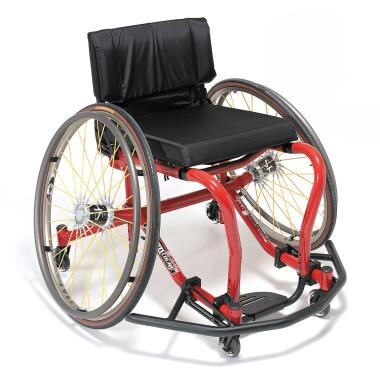 Sports manual wheelchair (for tennis). © Sunrise Medical. Courtesy of Sunrise Medical (https://www.sunrisemedical.com/).
-
Frame - This is the skeletal system of the wheelchair, which supports the seat and provides for wheel attachment via the axle plate; the width of the frame is critical to self-propulsion of a manual wheelchair; a proper-fitting frame allows the individual optimal access to the wheels; a narrow frame is more functional and can more easily negotiate environmental barriers; although growth should be considered in pediatric wheelchair frames, the wheelchair must fit the child
-
Footrest and footplate - These support the lower extremities; shoe holders or straps may need to be incorporated into the footrest and footplate in order to maintain proper foot position, control overall posture, and provide stability
-
Front casters - These are the smaller wheels on the front of the wheelchair; the smaller the wheel, the more responsive the chair; however, smaller wheels tend to cause the ride to be bumpier and can catch on or drop into environmental barriers; bigger wheels tend to be harder to turn, but they fare better outside and on bumpy terrain
-
Seat sling or seating pan - This supports the cushion or seating system

Resources and Funding Guidelines
The latest Medicare regulations are not included in this article, as regulations have been undergoing frequent changes in the last several years. For the latest regulatory information, contact a local supplier and ask what is currently required in terms of visits and documentation.
The wheelchair and seating industry continues to evolve. Experience, economics, and consumer needs drive changes in the industry. More information is readily available through professional groups, such as the Rehabilitation Engineering and Assistive Technology Society of North America (RESNA), the Paralyzed Veterans of America (PVA), the National Registry of Rehabilitation Technology Suppliers (NRRTS), and Access2CRT.org.
For educational offerings in seating and mobility, consider the International Seating Symposium and the RESNA annual conference.
RESNA offers a series of position papers and the RESNA Wheelchair Service Provision Guide, which can be helpful in the elucidation of clinical guidelines and the securing of funding. These can be found at http://www.resna.org/knowledge-center/position-papers-and-provision-guides.
Information on pressure ulcers can be found at the National Pressure Ulcer Advisory Panel’s website: http://www.npuap.org/.
Preservation of Upper Limb Function Following Spinal Cord Injury: A Clinical Practice Guideline for Health-Care Professionals, published by the Paralyzed Veterans of America, includes information on wheelchair configuration and self-propulsion designed to limit the occurrence of repetitive stress injuries. [15]
-
Manual reclining wheelchair. © Sunrise Medical. Courtesy of Sunrise Medical (https://www.sunrisemedical.com/).
-
Rigid ultralightweight manual wheelchair. © Sunrise Medical. Courtesy of Sunrise Medical (https://www.sunrisemedical.com/).
-
Midwheel-drive power wheelchair with joystick. © Sunrise Medical. Courtesy of Sunrise Medical (https://www.sunrisemedical.com/).
-
Power wheelchair with power tilt. © Sunrise Medical. Courtesy of Sunrise Medical (https://www.sunrisemedical.com/).
-
Pressure-relieving cushion with viscous fluid (gel). © Sunrise Medical. Courtesy of Sunrise Medical (https://www.sunrisemedical.com/).
-
Folding lightweight manual wheelchair. © Sunrise Medical. Courtesy of Sunrise Medical (https://www.sunrisemedical.com/).
-
Sports manual wheelchair (for tennis). © Sunrise Medical. Courtesy of Sunrise Medical (https://www.sunrisemedical.com/).
-
Linear seating system often used in pediatrics. © Sunrise Medical. Courtesy of Sunrise Medical (https://www.sunrisemedical.com/).