AUTHOR AND EDITOR INFORMATION
Section 1 of 11
Author: P Mark Glencross, MD, MPH, FACOEM, FAAPMR, Occupational Medicine, Physical Medicine and Rehabilitation, BayCare Corporate Health
P Mark Glencross is a member of the following medical societies: American Academy of Physical Medicine and Rehabilitation, American Association of Neuromuscular and Electrodiagnostic Medicine, American Medical Association, and Massachusetts Medical Society
Coauthor(s):
James P Little, MD, MBA, FAAPMR, Medical Director, Siskin Hospital for Physical Rehabilitation; Chairman, Associate Professor, Department of Physical Medicine, Southern Rehab Group
Editors: Robert L Sheridan, MD, Assistant Chief of Staff, Chief of Burn Surgery, Shriners Burns Hospital; Associate Professor of Surgery, Department of Surgery, Division of Trauma and Burns, Massachusetts General Hospital and Harvard Medical School; Francisco Talavera, PharmD, PhD, Senior Pharmacy Editor, eMedicine; Michael T Andary, MD, MS, Residency Program Director, Associate Professor, Department of Physical Medicine and Rehabilitation, Michigan State University College of Osteopathic Medicine; Kelly L Allen, MD, Consulting Staff, Department of Physical Medicine and Rehabilitation, Lourdes Regional Rehabilitation Center, Our Lady of Lourdes Medical Center; Consuelo T Lorenzo, MD, Consulting Staff, Department of Physical Medicine and Rehabilitation, Alegent Health Care, Immanuel Rehabilitation Center
Author and Editor Disclosure
Synonyms and related keywords:
anserine bursitis, anserine bursitis syndrome, conjoined tendon, breast-stroker's knee, pes anserine bursitis, pes anserinus, pes anserinus tendino-bursitis, pes anserinus tendinobursitis, pes anserinus tendino-bursitis syndrome, PATB, PA
Background
Pes anserine bursitis is an inflammatory condition of the medial knee, especially common in certain patient populations, often coexisting with other knee disorders.
Pathophysiology
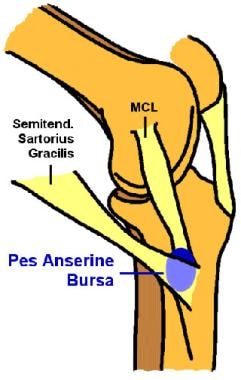
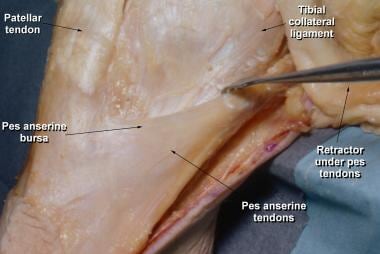
Pes anserinus is the anatomic term used to identify the insertion of the conjoined tendons into the anteromedial proximal tibia. From anterior to posterior, pes anserinus is made up of the tendons of the sartorius, gracilis, and semitendinosus muscles. The term literally means "goose's foot," describing the webbed footlike structure. The conjoined tendon lies superficial to the tibial insertion of the medial collateral ligament (MCL) of the knee.
Moshcowitz initially described pes anserine bursitis in the 1930s as an inflammation of the pes anserine bursa underlying the conjoined tendons of the gracilis and semitendinosus muscles and separating them from the head of the tibia. He defined the condition based on his observation of this type of bursitis in older adults with arthritis. He also described the musculi sartorii bursa between the tendon of the sartorius muscle and the conjoined tendons of the gracilis and semitendinosus, which can communicate with the pes anserine bursa proper. For the most part, both bursae are regarded collectively as the pes anserine bursa. In nonsurgical knees, there is usually no communication between these structures and the knee joint itself.
The sartorius, gracilis, and semitendinosus muscles are primary flexors of the knee. These 3 muscles also influence internal rotation of the tibia and protect the knee against rotary and valgus stress. Theoretically, bursitis results from stress to this area (eg, stress may result when an obese individual with anatomic deformity from arthritis ascends or descends stairs). Pathological studies do not indicate whether symptoms are attributable predominantly to true bursitis, tendonitis, or fasciitis at this site. Furthermore, panniculitis at this location has been described in obese individuals.
The muscles of the pes anserinus (ie, sartorius, gracilis, semitendinosus) are each supplied by different lower extremity nerves (ie, femoral, obturator, tibial, respectively).
Frequency
United States
One clinic reported finding pes anserine bursitis in 41 of 68 patients who were referred for presumed osteoarthritis of the knee. Bursitis in all locations of the body has been reported to account for 0.4% of visits to primary care clinics; however, incidence of bursitis in runners may be as high as 10%, including self-treated cases. In one review of 509 MRIs of symptomatic adult knees suspected of having an internal derangement, evidence of pes anserine bursitis was evident in 2.5%.
Mortality/Morbidity
In a descriptive study of 94 diabetic patients, pes anserine bursitis was reported in 91% of diabetic women and 9% of diabetic men. Among affected women with diabetes, 62% had the disease bilaterally. No subjects in a control group had bursitis without diabetes. Pes anserine bursitis is associated with obesity, and the diabetic patients in the study had greater body mass than the controls on average. Researchers, however, reported that body mass alone did not explain the higher incidence of bursitis among individuals with diabetes.
Race
No racial predilection is reported in the literature.
Sex
Incidence of pes anserine bursitis is higher among obese middle-aged women. Among older individuals with arthritis, a slight preponderance of females over males is noted among patients with pes anserine bursitis arthritis. This prevalence of women may be because of the broader female pelvis and greater angulation of the legs at the knees, placing additional stresses on these structures.
Age
Pes anserine bursitis is most common in young individuals involved in sporting activities and obese middle-aged women. This condition also is common in patients aged 50-80 years who have osteoarthritis of the knees.
History
Pes anserine bursitis can result from acute trauma to the medial knee, athletic overuse, or chronic mechanical and degenerative processes. An occurrence of pes anserine bursitis commonly is characterized by pain, tenderness, and local swelling. Typical findings reported within the subjective examination may include the following:
- Tenderness over the inner knee with pain upon ascending and, possibly, descending stairs
- Pain may be noted when arising from a seated position or at night. Patients typically deny pain with walking on level surfaces.
- Local swelling may be noted.
- Chronic refractory pain in the area during aggravating activities in individuals with arthritis of the knee or in obese females.
- History of athletic activity
- Generally, susceptible persons are involved in any sport that requires side-to-side movement or cutting. Incidence is higher among runners and individuals who play basketball, soccer, and racket sports, in part because of their popularity.
- Pes anserine bursitis also has been reported in swimmers, which occasionally is called breast-stroker's knee, although this term usually refers to MCL strains. MCL pathology may coexist among athletes or other individuals.
Physical
- The hallmark physical finding is pain over the proximal medial tibia at the insertion of the conjoined tendons of the pes anserinus, approximately 2-5 cm below the anteromedial joint margin of the knee.
- The bursa usually is not palpable unless effusion and thickening are present.
- Palpable crepitus consistent with bursitis occasionally is observed.
- With the chronic variant in older adults, usually no pain is experienced with flexion or extension of the knee.
- Local pain is frequently noted in the area of the bursa, but, upon palpation, no pain should be noted at the joint line itself unless other conditions are active. Some researchers report pain along the medial joint line, mimicking a meniscal tear.
- Noticeable bursal swelling is less frequent among elderly patients with concurrent arthritis. Bursitis is found more frequently on the right side than the left, and approximately one third of patients have bilateral involvement.
- In the sports-related variant, symptoms may be reproduced with resisted internal rotation and resisted flexion of the knee.
- Valgus stress may reproduce the symptoms in athletic individuals, making it hard to distinguish from MCL injuries. Typically, painful tenderness in association with MCL injuries is superior and posterior to the pes anserine bursa.
- If swelling can be traced more proximally along the pes anserinus tendons, a formal tendonitis may be present, and a snapping of the pes anserinus tendons can occur.
- An exostosis of the tibia has been described in athletes and may contribute to chronic symptoms.
- Two case reports of large cystic swellings of the bursa that resolved with conservative management have been documented.
Causes
- Degenerative joint disease of the knee frequently is associated with bursitis. Up to 75% of patients with degenerative joint disease may have symptoms of pes anserine bursitis, according to some investigators.
- Obesity is associated with pes anserine bursitis, particularly in middle-aged women.
- Pes planus (ie, flat foot) may predispose patients to this bursitis and other problems in the medial knee.
- Sporting activities that require side-to-side movement or cutting have been associated with pes anserine bursitis.
- Local trauma, exostosis, and tendon tightness may predispose the patient to inflammation.
- Diabetes has been linked with bursitis in one study; however, the extent to which the patient was able to control the diabetes was not documented.
Fibromyalgia
Hamstring Strain
Medial Collateral and Lateral Collateral Ligament Injury
Myofascial Pain
Osteoarthritis
Patellofemoral Syndrome
Prepatellar Bursitis
Stress Fracture
Other Problems to be Considered
- MCL sprain can be excluded by physical examination or, if needed, by magnetic resonance imaging (MRI).
- Medial meniscus injury presents with medial joint line tenderness, knee locking, and/or catching. The McMurray test is positive with valgus stress and external tibial rotation. In older patients, a degenerative medial meniscus may present with insidious onset of medial knee pain.
- Discoid medial meniscus synovial plica syndrome (medial plica) can result in point tenderness and palpable clicking over the medial femoral condyle.
- Parameniscal cysts and dissecting synovial cyst (from another location) can cause swelling in the area.
- Medial ligament syndrome is a poorly defined syndrome described in rheumatology literature as causing pain at the site of insertion of the MCL. Valgus stress exacerbates pain, and the patient may have pain behaviors. The etiology is unknown, but, in some cases, an inflammatory arthropathy, such as ankylosing spondylitis, is present. Medial ligament syndrome is treated with rest, heat, and a small corticosteroid injection.
- Tumors in the region can include villonodular synovitis, osteochondromatosis, and synovial sarcoma. Synovial hemangioma, meniscal cyst, xanthomas, and ganglion cyst also may occur here.
- Degenerative and chronic arthritis frequently involve medial knee structures and are associated with development of pes anserine bursitis, as described above. Inflammatory arthritis, such as gout and chondrocalcinosis, as well as septic arthritis, also can be associated with medial knee pain.
- Of the more than 150 bursae in the body, at least 12 bursae are found in each knee, including the suprapatellar, prepatellar, infrapatellar, adventitious cutaneous bursa, gastrocnemius, semimembranosus, sartorius and anserine bursae, the No-Name-No-Fame bursa, and 3 lateral knee bursae located adjacent to the fibular collateral ligament and popliteus tendon laterally.
- The prepatellar bursa overlies the anterior portion of the patella and can become involved with kneeling and leaning forward (housemaid's knee).
- The superficial infrapatellar bursa lies between the skin and infrapatellar tendon; bursitis here is caused by kneeling or by a direct blow.
- Deep infrapatellar bursitis presents with fluctuance and swelling that obliterate the depression on each side of the patellar tendon overlying the tibial tuberosity. Loss of full flexion and extension generally is observed.
- The adventitious cutaneous bursa may be palpable as a swelling over the tibial tuberosity (adventitial bursae are those formed later in life through degeneration and do not have an endothelial lining).
- Baker cysts arise from the gastrocnemius and/or semimembranosus bursa in the posterior knee. The gastrocnemius bursa lies between the medial head of the gastrocnemius and the joint capsule and communicates with the knee joint. The semimembranosus muscle sends tendon insertions to the posteromedial tibia behind the MCL, and a direct head inserts more posterior and distal as well. These insertions are superior and posterior to the insertion of the conjoined pes anserinus tendons and the pes anserine bursa.
- The No-Name-No-Fame Bursa (referred to by Stuttle) also is called the MCL bursa and is located at the anterior border of the MCL. This bursa may be palpable during knee flexion as a small tender rounded nodule moving into the leading edge of the medial collateral ligament. Pain can be elicited on palpation of the bursa or by briskly extending the knee from a position of 90° flexion.
- Pes anserinus tendonitis may exist exclusively or in conjunction with bursitis. So-called snapping tendonitis of the semitendinosus tendon is usually thought of as distinct from pes anserine bursitis, but some authorities classify it as the same inflammatory disorder.
- Semimembranosus tendonitis also can occur with running or cutting activities. This tendonitis is characterized by swelling over the posteromedial aspect of the knee and tenderness with resisted flexion or valgus strain. An insertional enthesopathy of the semimembranosus muscle also has been described.
- Panniculitis may occur in an obese individual in the medial knee. Pain can be worse at night, as in bursitis.
- Stress fractures of the proximal medial tibia may produce pain in the area of the pes anserine bursa.
- Osteonecrosis (death of subchondral bone of unknown cause) of the femur may present with sudden severe medial compartment knee pain that is constant (day and night). Bone scan shows increased uptake in the femoral condyle.
- Osgood-Schlatter disease is an osteochondroses involving traction apophysitis over the tibial tubercle in adolescent males.
- Sinding-Larsen-Johansson syndrome is a traction apophysitis at the junction of the patella with the patellar tendon.
- Nerve injuries causing medial joint pain include trauma to the saphenous nerve or injury during knee surgery, especially arthroscopy. Pain can be reproduced with Tinel sign. One case report documents distal tibial pain from entrapment of the saphenous nerve caused by pes anserine bursitis. Medial knee pain associated with back pain also could represent an L3-L4 radiculopathy. Electrodiagnostic testing such as electromyography (EMG) and nerve conduction velocity tests may be useful.
- Fibromyalgia has characteristic tender areas or trigger points, one of which includes the medial aspect of the knee.
Lab Studies
- The diagnosis of pes anserinus bursitis usually is made on clinical grounds and further workup is not necessarily indicated. In unusual cases, persistent or suggestive of infection, a further workup can be obtained. Perform a CBC count and erythrocyte sedimentation rate (ESR) in rare cases when infection is suggested. If the bursa or joint is aspirated for this or other reasons, analysis of the fluid may include cell count, fluid appearance, Gram stain, culture, and polarized light microscopy.
- Consider radiography, radionuclide bone scanning, ESR determination, rheumatoid factor values, or other rheumatologic testing if other pathology is suggested.
Imaging Studies
- As a rule, x-ray of the knee is not indicated for bursitis. Arthritis may be observed in older adults. Young athletic patients, in rare cases, may have an exostosis in the metaphyseal area.
- Ultrasonography can aid the physician when diagnosing pes anserine bursitis. Large cystic bursal swellings have been evidenced by ultrasonography and computed tomography (CT) scanning. Recent published reports describe a lack of ultrasound findings in most suspected cases. See Special Concerns for more discussion.
- MRI is the preferred imaging technique to help the clinician confirm the diagnosis.
- With MRI, the pes anserine bursa is observed between the pes anserinus (ie, gracilis, semitendinosus, sartorius tendons) and the upper tibial metaphysis. Axial imaging is important to differentiate the bursa from other medial fluid collections.
- A collection of fluid with low signal intensity is observed on T1-weighted images, and a homogenous increase in signal intensity is observed on T2-weighted images.
- Limited axial and sagittal T2-weighted or T2 gradient-echo sequences usually are adequate for diagnosis. More extensive imaging with additional planes may be required to exclude other clinically relevant possibilities.
- At least one case of chronic pes anserine bursitis manifested as a solid inflammatory synovial mass.
- One report describes tibial erosion under bursitis.
- Pigmented villonodular synovitis with hemosiderin deposits can occur focally in the bursae.
Procedures
- Aspiration of the bursa usually is not required.
Rehabilitation Program
Physical Therapy
Physical therapy is beneficial and often is indicated for patients with pes anserine bursitis. Rest and nonsteroidal anti-inflammatory drugs (NSAIDs) are first-line treatment. Other appropriate means and ideas on the treatment for pes anserine bursitis include the following:
- Ice in foam cups can be applied and rubbed directly on the patient's skin (ice massage) for up to 10 minutes at a time. Other forms of cryotherapy (eg, cold packs) also may be used.
- Ultrasound has been reported to be effective in reducing inflammation associated with pes anserine bursitis.
- Electrical stimulation has been used in other forms of bursitis, although its use has not been documented specifically in pes anserine bursitis.
- Rehabilitative exercise for athletes with significant medial knee stress follows general physiatric principles for knee disorders (stretching and strengthening of the adductor and quadriceps groups [especially the last 30° of knee extension using the vastus medialis muscle] and stretching of the hamstrings). For cases caused by restricted flexibility of muscles/tendons, stretching may promote significant reduction of tension over the bursa.
- Advise older patients and those with chronic pain to avoid muscle atrophy from disuse. Address obesity in cases where it is a contributing factor.
- A small cushion placed between the thighs before sleeping is useful in medial knee bursitis.
- If resective surgery is performed, the knee remains in extension or slight flexion within an immobilizer for 1-2 weeks after surgery. Pursue active range of motion (AROM) until 3 weeks postsurgery and then begin progressive resistive exercises (PREs).
Surgical Intervention
In cases of disability, such as those causing 6-8 weeks of limitation among athletes, some surgeons advocate resection, especially if mature exostosis is present and causing irritation. The operation includes excision of the bursa and any bony exostosis.
Other Treatment
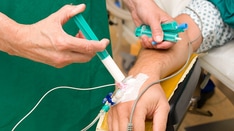
Intrabursal injection with local anesthetics and/or corticosteroids is a second line of treatment. A study found no difference in short-term pain relief afforded by 3-5 mL of 1% lidocaine with or without methylprednisolone. Injection can be directed to the point of maximal tenderness. Take care to avoid injection within the tendons themselves. Occasionally, an area 0.5-1 cm higher than the tendons is injected to include the No-Name-No-Fame bursa (MCL bursa), which also may be a pain generator. Relief is usually immediate but may not be complete.
Repeated lidocaine injections or use of corticosteroids may result in longer lasting relief (from one to several months). Generally use a 22-gauge or 23-gauge needle to inject 1-3 mL of 1% lidocaine and corticosteroid (20-40 mg of triamcinolone, 20-40 mg of methylprednisolone, or 6 mg of betamethasone). If infection is suggested, which is more rare here than in the bursae of the anterior knee, use a larger 19-gauge or 20-gauge needle and a 20-30 mL syringe for aspiration. Patients who do not respond to initial injection rarely respond to repeated bursal injections. Injection of the knee joint itself may be beneficial in recalcitrant cases.
NSAIDs are first-line therapy if appropriate. Injection with anesthetic with or without corticosteroid may be helpful.
Drug Category: Nonsteroidal anti-inflammatory drugs
Have analgesic, anti-inflammatory, and antipyretic activities. Their mechanism of action is not known, but they may inhibit cyclo-oxygenase activity and prostaglandin synthesis. Other mechanisms may exist as well, such as inhibition of leukotriene synthesis, lysosomal enzyme release, lipoxygenase activity, neutrophil aggregation, and various cell-membrane functions.
| Drug Name | Ibuprofen (Motrin, Ibuprin) |
| Description | DOC for patients with mild to moderate pain. Inhibits inflammatory reactions and pain by decreasing prostaglandin synthesis. |
| Adult Dose | 200-400 mg PO q4-6h while symptoms persist; not to exceed 3.2 g/d |
| Pediatric Dose | 200-400 mg PO q4-6h while symptoms persist; not to exceed 3.2 g/d |
| Contraindications | Documented hypersensitivity; peptic ulcer disease, recent GI bleeding or perforation, renal insufficiency, or high risk of bleeding |
| Interactions | Coadministration with aspirin increases risk of inducing serious NSAID-related adverse effects; probenecid may increase concentrations and, possibly, toxicity of NSAIDs; may decrease effect of hydralazine, captopril, and beta-blockers; may decrease diuretic effects of furosemide and thiazides; monitor PT closely (instruct patients to watch for signs of bleeding); may increase risk of methotrexate toxicity; phenytoin levels may be increased when administered concurrently |
| Pregnancy | C - Safety for use during pregnancy has not been established.
|
| Precautions | Category D in third trimester of pregnancy; caution in congestive heart failure, hypertension, and decreased renal and hepatic function; caution in anticoagulation abnormalities or during anticoagulant therapy |
| Drug Name | Naproxen (Naprosyn, Naprelan, Anaprox) |
| Description | For relief of mild to moderate pain; inhibits inflammatory reactions and pain by decreasing activity of cyclo-oxygenase, which results in a decrease of prostaglandin synthesis. |
| Adult Dose | 500 mg PO, followed by 250 mg PO q6-8h; not to exceed 1.25 g/d |
| Pediatric Dose | <2 years: Not established > 2 years: 2.5 mg/kg/dose PO; not to exceed 10 mg/kg/d |
| Contraindications | Documented hypersensitivity; peptic ulcer disease; recent GI bleeding or perforation; renal insufficiency |
| Interactions | Coadministration with aspirin increases risk of inducing serious NSAID-related adverse effects; probenecid may increase concentrations and, possibly, toxicity of NSAIDs; may decrease effect of hydralazine, captopril, and beta-blockers; may decrease diuretic effects of furosemide and thiazides; monitor PT closely (instruct patients to watch for signs of bleeding); may increase risk of methotrexate toxicity; phenytoin levels may be increased when administered concurrently |
| Pregnancy | B - Usually safe but benefits must outweigh the risks.
|
| Precautions | Category D in third trimester of pregnancy; acute renal insufficiency, interstitial nephritis, hyperkalemia, hyponatremia, and renal papillary necrosis may occur; patients with preexisting renal disease or compromised renal perfusion risk acute renal failure; leukopenia occurs rarely, is transient, and usually returns to normal during therapy; persistent leukopenia, granulocytopenia, or thrombocytopenia warrants further evaluation and may require discontinuation of drug |
| Drug Name | Indomethacin (Indocin, Indochron E-R) |
| Description | Rapidly absorbed; metabolism occurs in liver by demethylation, deacetylation, and glucuronide conjugation; inhibits prostaglandin synthesis. |
| Adult Dose | 25-50 mg PO bid/tid 75 mg SR PO bid; not to exceed 200 mg/d |
| Pediatric Dose | 1-2 mg/kg/d divided PO bid/qid; not to exceed 4 mg/kg/d or 150-200 mg/d |
| Contraindications | Documented hypersensitivity; GI bleeding or renal insufficiency |
| Interactions | Coadministration with aspirin increases risk of inducing serious NSAID-related adverse effects; probenecid may increase concentrations and, possibly, toxicity of NSAIDs; may decrease effect of hydralazine, captopril, and beta-blockers; may decrease diuretic effects of furosemide and thiazides; monitor PT closely (instruct patients to watch for signs of bleeding); may increase risk of methotrexate toxicity; phenytoin levels may be increased when administered concurrently |
| Pregnancy | B - Usually safe but benefits must outweigh the risks.
|
| Precautions | Category D in third trimester of pregnancy; acute renal insufficiency, hyperkalemia, hyponatremia, interstitial nephritis, and renal papillary necrosis may occur; increases risk of acute renal failure in patients with preexisting renal disease or compromised renal perfusion; reversible leukopenia may occur, (discontinue if there is persistent leukopenia, granulocytopenia, or thrombocytopenia)
|
Drug Category: Cyclooxygenase-2 inhibitors
Although increased cost can be a negative factor, the incidence of costly and potentially fatal GI bleeds is clearly less with cyclooxygenase (COX)–2 inhibitors than with traditional NSAIDs. Ongoing analysis of cost avoidance of GI bleeds will further define the populations that will find COX-2 inhibitors the most beneficial.
| Drug Name | Celecoxib (Celebrex) |
| Description | Inhibits primarily COX-2. COX-2 is considered an inducible isoenzyme, induced during pain and inflammatory stimuli. Inhibition of COX-1 may contribute to NSAID GI toxicity. At therapeutic concentrations, COX-1 isoenzyme is not inhibited, thus GI toxicity may be decreased. Seek lowest dose of celecoxib for each patient. |
| Adult Dose | 200 mg/d PO qd; alternatively, 100 mg PO bid |
| Pediatric Dose | Not established |
| Contraindications | Documented hypersensitivity |
| Interactions | Coadministration with fluconazole may cause increase in celecoxib plasma concentrations because of inhibition of celecoxib metabolism; coadministration of celecoxib with rifampin may decrease celecoxib plasma concentrations |
| Pregnancy | C - Safety for use during pregnancy has not been established.
|
| Precautions | May cause fluid retention and peripheral edema; caution in compromised cardiac function, hypertension, conditions predisposing to fluid retention; severe heart failure and hyponatremia, because may deteriorate circulatory hemodynamics; NSAIDs may mask usual signs of infection; caution in the presence of existing controlled infections; evaluate symptoms and signs suggesting liver dysfunction or in abnormal liver lab results |
Drug Category: Corticosteroids
Have anti-inflammatory properties and cause profound and varied metabolic effects. Corticosteroids modify the body's immune response to diverse stimuli.
| Drug Name | Triamcinolone (Aristocort, Kenalog, Amcort, Aristospan Intra-articular) |
| Description | Decreases inflammation by suppressing migration of polymorphonuclear leukocytes and reversing capillary permeability. |
| Adult Dose | 20-40 mg intrabursal, usually limited to 3 injections in 12-mo period, at least 30 d apart to minimize risk of complications |
| Pediatric Dose | Not established |
| Contraindications | Documented hypersensitivity; fungal, viral, and bacterial skin infections |
| Interactions | Coadministration with barbiturates, phenytoin, and rifampin decreases effects |
| Pregnancy | C - Safety for use during pregnancy has not been established.
|
| Precautions | Multiple complications (eg, severe infections, hyperglycemia, edema, osteonecrosis, myopathy, peptic ulcer disease, hypokalemia, osteoporosis, euphoria, psychosis, myasthenia gravis, growth suppression) may occur; abrupt discontinuation of glucocorticoids may cause adrenal crisis |
| Drug Name | Methylprednisolone (Depo-Medrol, Solu-Medrol, Medrol) |
| Description | Decreases inflammation by suppressing migration of polymorphonuclear leukocytes and reversing increased capillary permeability. |
| Adult Dose | 20-40 mg intrabursal, usually limited to 3 injections in a 12-mo period, at least 30 d apart to minimize risk of complications |
| Pediatric Dose | Not established |
| Contraindications | Documented hypersensitivity; viral, fungal, or tubercular skin infections |
| Interactions | Coadministration with digoxin may increase digitalis toxicity secondary to hypokalemia; estrogens may increase levels; phenobarbital, phenytoin, and rifampin may decrease levels of methylprednisolone (adjust dose); monitor patients for hypokalemia when taking medication concurrently with diuretics |
| Pregnancy | C - Safety for use during pregnancy has not been established.
|
| Precautions | Hyperglycemia, edema, osteonecrosis, peptic ulcer disease, hypokalemia, osteoporosis, euphoria, psychosis, growth suppression, myopathy, and infections are possible complications of glucocorticoid use |
| Drug Name | Betamethasone (Celestone, Soluspan) |
| Description | Decreases inflammation by suppressing migration of polymorphonuclear leukocytes and reversing increased capillary permeability. |
| Adult Dose | 6 mg intrabursal usually limited to 3 injections in a 12-mo period, at least 30 d apart to minimize risk of complications |
| Pediatric Dose | Not established |
| Contraindications | Documented hypersensitivity; systemic fungal infections |
| Interactions | Effects decrease with coadministration of barbiturates, phenytoin and rifampin; dexamethasone decreases effect of salicylates and vaccines used for immunization |
| Pregnancy | C - Safety for use during pregnancy has not been established.
|
| Precautions | Increases risk of multiple complications, including severe infections; monitor adrenal insufficiency when tapering drug; abrupt discontinuation of glucocorticoids may cause adrenal crisis; hyperglycemia, edema, osteonecrosis, myopathy, peptic ulcer disease, hypokalemia, osteoporosis, euphoria, psychosis, myasthenia gravis, growth suppression, and infections are possible complications of glucocorticoid use |
Further Outpatient Care
- Patients with pes anserine bursitis generally are treated successfully with conservative measures and are recommended to receive outpatient physical therapy (see Physical Therapy section for treatment recommendations).
Prognosis
- Surgical intervention is required only rarely. Rest, administration of NSAIDs, or injection brings about resolution in most cases. Chronic arthritic diseases that frequently accompany bursitis obviously persist, but identification and treatment of pes anserine bursitis can reduce pain significantly. Most athletes return to play sports.
Patient Education
- Patients with pes anserine bursitis need to be educated on the proper means of treatment and, in acute cases, need to allow adequate time to rest.
- Patients need to become educated on the importance of exercise to rebuild the involved muscles to avoid disuse atrophy in older individuals with arthritis. A home exercise program may be provided by the physical therapist.
- For excellent patient education resources, visit eMedicine's Foot, Ankle, Knee, and Hip Center and Arthritis Center. Also, see eMedicine's patient education articles Bursitis, Knee Pain, and Knee Injury.
Medical/Legal Pitfalls
- Clinically, pes anserine bursitis can mimic distal anteromedial knee disorders or internal derangement of the knee, leading to unnecessary surgery.
Special Concerns
- Further clarification of the predisposing conditions is needed, including mechanical causes and specific pathological variants of pes anserine bursitis. Medical literature continues to report underrecognition of this disorder as a cause for medial knee pain in various groups of patients.
- A few recent reports question the frequency of this disorder and its accepted pathophysiology, given the lack of ultrasound findings. In one study, only 3 of 29 patients with suspected pes anserine tendinobursitis were found to have tendinitis on ultrasound images when compared with the uninvolved extremity or healthy controls. In another ultrasound study of diabetic patients, only 4 of 23 patients thought to have pes anserine tendinobursitis syndrome clinically had morphologic ultrasound changes in the pes anserine tendons.
| Media file 1:
Location of pes anserine bursa on the medial knee. MCL is medial collateral ligament. |
 | View Full Size Image | |
Media type: Image
|
- Abeles M. Anserine bursitis. Arthritis Rheum. Jun 1986;29(6):812-3. [Medline].
- Cohen SE, Mahul O, Meir R, Rubinow A. Anserine bursitis and non-insulin dependent diabetes mellitus. J Rheumatol. Nov 1997;24(11):2162-5. [Medline].
- Forbes JR, Helms CA, Janzen DL. Acute pes anserine bursitis: MR imaging. Radiology. Feb 1995;194(2):525-7. [Medline].
- Handy JR. Anserine bursitis: a brief review. South Med J. Apr 1997;90(4):376-7. [Medline].
- Hemler DE, Ward WK, Karstetter KW, Bryant PM. Saphenous nerve entrapment caused by pes anserine bursitis mimicking stress fracture of the tibia. Arch Phys Med Rehabil. Apr 1991;72(5):336-7. [Medline].
- Katzenstein PL, Malemud CJ, Pathria MN, et al. Early-onset primary osteoarthritis and mild chondrodysplasia. Radiographic and pathologic studies with an analysis of cartilage proteoglycans. Arthritis Rheum. May 1990;33(5):674-84. [Medline].
- Larson R, Grana W. In: The Knee: Form, Function, Pathology, and Treatment. 1st ed. WB Saunders Co;1993:327-9.
- Larsson LG, Baum J. The syndrome of anserina bursitis: an overlooked diagnosis. Arthritis Rheum. Sep 1985;28(9):1062-5. [Medline].
- Moskowitz E. Bursitis of sartorius bursa, an undescribed malady simulating chronic arthritis. JAMA. 1937;109:1362.
- Muchnick J, Sundaram M. Radiologic case study. Pes anserine bursitis. Orthopedics. Nov 1997;20(11):1100; 1092-4. [Medline].
- Rennie WJ, Saifuddin A. Pes anserine bursitis: incidence in symptomatic knees and clinical presentation. Skeletal Radiol. 2005;Jul;34(7):395-8.
- Sheon R, Moskowitz R, Goldberg V. In: Soft Tissue Rheumatic Pain: Recognition, Management, and Prevention. 3rd ed. Lippincott William & Wilkins;1996:236-7.
- Unlu Z, Ozmen B, Tarhan S, et al. Ultrasonographic evaluation of pes anserinus tendino-bursitis in patients with type 2 diabetes mellitus. J Rheumatol. Feb 2003;30(2):352-4. [Medline].
- Uson J, Aguado P, Bernad M, et al. Pes anserinus tendino-bursitis: what are we talking about?. Scand J Rheumatol. 2000;29(3):184-6. [Medline].
- Voorneveld C, Arenson AM, Fam AG. Anserine bursal distention: diagnosis by ultrasonography and computed tomography. Arthritis Rheum. Oct 1989;32(10):1335-8. [Medline].
- Windsor RE, Lox D. In: Soft Tissue Injuries: Diagnosis and Treatment. 1st ed. Hanley & Belfus;1997:118-9.
- Zeiss J, Coombs RJ, Booth RL Jr, Saddemi SR. Chronic bursitis presenting as a mass in the pes anserine bursa: MR diagnosis. J Comput Assist Tomogr. Jan-Feb 1993;17(1):137-40. [Medline].
Pes Anserinus Bursitis excerpt Article Last Updated: Mar 28, 2006
|