Background
Primary hyperhidrosis is excessive uncontrollable sweating without any discernible cause. It most commonly involves the axillae, palms, and soles but may also involve the face and groin. [1]
Secondary hyperhidrosis may be caused by endocrine disorders (eg, hyperthyroidism), secretory tumors (eg, pheochromocytoma), sympathetic nervous system disorders, or primary neurologic or psychiatric disorders. See the image below.
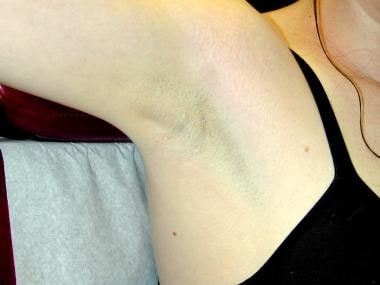 Surgical treatment of axillary hyperhidrosis. Modified Skoog procedure: Preoperative axilla in a healthy young writer with axillary hyperhidrosis. Image courtesy of Richard H S Karpinski, MD.
Signs and symptoms of axillary hyperhidrosis
Patients with axillary hyperhidrosis usually complain of constant or frequent sweating, with streams of wetness running down their sides. Severely affected patients also may have secondary microbial infections.
Hyperhidrosis may require no trigger at all or may be stimulated by emotional situations and/or anxiety.
The problem usually begins with puberty but also may present in mid childhood, especially in Asian populations.
Workup in axillary hyperhidrosis
Diagnosis of axillary hyperhidrosis is essentially from patient history and from visible signs of excessive sweating.
Laboratory testing may play a vital role in excluding secondary hyperhidrosis from causes such as hyperthyroidism, pheochromocytoma, carcinoid or other malignancy, tuberculosis, or adrenal pathology, especially in patients with asymmetrical, late, or atypical onset of symptoms.
Management of axillary hyperhidrosis
Treatments for axillary hyperhidrosis include the following:
-
Dietary restriction
-
Topical antiperspirants – Ten percent to 20% aluminum chloride antiperspirant can be quite effective in mild-to-moderate cases
-
Iontophoresis
-
Sympatholytics, anxiolytics, and sedatives
-
Radiation
-
BOTOX® injections
-
Surgical therapy - Surgical treatment of axillary hyperhidrosis involves resection of the end organ (adenectomy) or interruption of sympathetic innervation to autonomically innervated structures, including sweat glands

Epidemiology
Frequency
The incidence of hyperhidrosis is uncertain, but Adar's study of a young Israeli population reported a prevalence of 0.6-1% for palmar hyperhidrosis; familial involvement was reported in 25% of patients. [2] The incidence of axillary hyperhidrosis is believed to be similar.
Etiology
Etiology of axillary hyperhidrosis is unknown but is related to increased cholinergic sympathetic stimulation of the sweat glands in the axilla. Although the glands invariably become remarkably hypertrophied in this condition, the dramatic glandular growth and oversecretion is believed to be secondary rather than primary; a parallel concept is oxyntic cell hypertrophy in peptic ulcer disease due to vagal hypertonicity.
The observed atrophy of sweat glands in grafted (thus denervated) skin, with reappearance of sweating with reinnervation, led to the conceptual link between sympathetic tone and acinar hypersecretion. Further evidence of the neural control of sweat production comes from the observation that local anesthetic injection transiently stops hypersecretion of sweat as does cholinergic blockade from local injection of botulinum toxin.
While axillary hyperhidrosis almost always begins with puberty, no direct hormonal connection has been suggested.
Several related axillary conditions may be confused with hyperhidrosis.
Axillary bromidrosis (or osmidrosis) is chronic offensive axillary odor; it may be related to apocrine secretions and to chronic bacterial colonization (especially with diphtheroids and micrococci), and antibiotic treatment may be suppressive or curative.
Axillary lymphadenitis is the inflammation and enlargement of underarm lymph nodes.
Axillary hidradenitis is chronic recurring infection of the apocrine sweat glands, manifested by production of repeated boils and sinuses. Once established, the condition may be suppressed, but not cured, by antibiotics. Excision of the involved skin and glands is the only cure; such resections are generally quite disfiguring. The exact cause is unknown, but a hormonal influence appears to be involved.
An axillary breast is the presence in the axilla of subcutaneous breast tissue with or without a nipple.
Pathophysiology
Histology
Bisbal et al have determined that eccrine and apocrine sweat glands are mixed in the axilla, with a proportion of 1:1. [3]
In patients with axillary hyperhidrosis, Morgan and Hughes demonstrated that the apocrine glands are significantly larger and more numerous than those in axillary hidradenitis and in healthy control subjects. [4]
Following a thorough resection of the subcutaneous axillary sweat glands (Skoog procedure), a few eccrine glands remain, and practically no apocrine glands can be found.
Thus it seems that a Skoog adenectomy is essentially an apocrinectomy. This is at odds with the observation that the profuse sweat produced in axillary hyperhidrosis (and stopped by Skoog resection) is clear and odorless; classically, apocrine sweat is described as cloudy and odoriferous, while eccrine sweat is labeled clear and without odor. No one has reconciled these seeming inconsistencies, but the inference is that the clear, odorless, profuse sweating observed in axillary hyperhidrosis comes from the hypertrophied and overactive apocrine glands.
Presentation
Patients with axillary hyperhidrosis usually complain of constant or frequent sweating, with streams of wetness running down their sides. This diathesis wets and ruins clothing and produces social embarrassment or functional problems from skin maceration. Severely affected patients also may have secondary microbial infections. Unlike functional sweating, which may be triggered by exercise, exertion, or high temperature, hyperhidrosis may require no trigger at all or may be stimulated by emotional situations and/or anxiety. Most patients with axillary hyperhidrosis have tried multiple antiperspirants and various medications and often have devised various coping methods involving clothing strategies. Many have consulted various physicians, often to no avail.
Some patients may have unilateral axillary hyperhidrosis or a more severe diathesis on one side than the other. Many patients with axillary hyperhidrosis also are afflicted with palmar, facial, or plantar hyperhidrosis to some degree.
The problem usually begins with puberty but also may present in mid childhood, especially in Asian populations.
A study by Thorlacius et al suggested that with regard to differentiating axillary and palmar hyperhidrosis from physiologically normal sweat production, a gravimetric testing result of 100 mg of sweat/5 min may be an acceptable cut-off point. [5]
Contraindications
As with any invasive treatment of a non—life-threatening condition, the risks of axillary hyperhidrosis surgery need to be low. Any health condition that substantially increases the surgical risk may make a recommendation for such surgery inappropriate.
Pulmonary or cardiac pathology may make thoracic surgery, even endoscopic thoracic surgery, too dangerous for the nature of the problem. Problems with skin circulation (eg, lupus) or situations known to degrade wound healing (eg, steroid treatment, previous radiation therapy, diabetes) may make the risk of surgery unacceptable.
Patients with only (or predominantly) axillary hyperhidrosis probably should not be steered toward endoscopic transthoracic sympathectomy (ETS). Patients with multiple hyperhidrotic sites should strongly consider ETS before Skoog adenectomy.
-
Surgical treatment of axillary hyperhidrosis. Staggered-cross incision of a classic Skoog procedure. Image courtesy of Richard H S Karpinski, MD.
-
Surgical treatment of axillary hyperhidrosis. Karpinski modification of the classic Skoog procedure incision. Image courtesy of Richard H S Karpinski, MD.
-
Surgical treatment of axillary hyperhidrosis. Iodine/starch test: Iodine tincture or Betadine applied and air dried. Image courtesy of Richard H S Karpinski, MD.
-
Surgical treatment of axillary hyperhidrosis. Iodine/starch test: Cornstarch powdered onto dried iodine. Image courtesy of Richard H S Karpinski, MD.
-
Surgical treatment of axillary hyperhidrosis. Iodine/starch test: As sweating begins, iodine and starch react wherever dampened to produce a blue color. Image courtesy of Richard H S Karpinski, MD.
-
Surgical treatment of axillary hyperhidrosis. Iodine/starch test: Further color development (see Image 6). Image courtesy of Richard H S Karpinski, MD.
-
Surgical treatment of axillary hyperhidrosis. Iodine/starch test: An indelible marker outlines the area positive for hyperhidrosis. Image courtesy of Richard H S Karpinski, MD.
-
Surgical treatment of axillary hyperhidrosis. Modified Skoog procedure: Preoperative axilla in a healthy young writer with axillary hyperhidrosis. Image courtesy of Richard H S Karpinski, MD.
-
Surgical treatment of axillary hyperhidrosis. Modified Skoog procedure: Outline of the operative site as estimated by the hair pattern (not by mapping). Image courtesy of Richard H S Karpinski, MD.
-
Surgical treatment of axillary hyperhidrosis. Modified Skoog procedure: Anesthesia is attained by infiltration of local anesthetic. Image courtesy of Richard H S Karpinski, MD.
-
Surgical treatment of axillary hyperhidrosis. Modified Skoog procedure: The transverse incision is made, here exposing the subcutaneous sweat glands. Image courtesy of Richard H S Karpinski, MD.
-
Surgical treatment of axillary hyperhidrosis. Modified Skoog procedure: Through the rather limited incision, dissection is carried to the entire outlined area. The dissection is deep to the glands but superficial to axillary fascia. Image courtesy of Richard H S Karpinski, MD.
-
Surgical treatment of axillary hyperhidrosis. Modified Skoog procedure: In the recess of the incision, the shiny and somewhat striated axillary fascia is visible. In conducting the operation, no part of the dissection should violate this fascia. Image courtesy of Richard H S Karpinski, MD.
-
Surgical treatment of axillary hyperhidrosis. Modified Skoog procedure: Once the flaps are elevated and hemostasis is achieved, the flaps are everted and the layer of the glands snipped off the undersurface of the dermis. Here, the upper portion of the flap has been cleared of sweat glands, while the gland lobules are still visible on the lower portion of the flap. Image courtesy of Richard H S Karpinski, MD.
-
Surgical treatment of axillary hyperhidrosis. The carpet of glandular tissue is seen intact on the left side of the skin flap, while the glands have been resected on the right side of the flap, revealing the underside of the dermis. The axillary fascia is visible as a glistening sheet above the skin flap. Image courtesy of Richard H S Karpinski, MD.
-
Surgical treatment of axillary hyperhidrosis. Modified Skoog procedure: Once the skin flaps are cleared of sweat glands, the dermis should be visible along with the bulbs of many hair follicles. Although not seen clearly in this photo, the fine vessels of the subdermal plexus should be visible under magnification as a network of red vessels. The posture of everting the flap over the surgeon's finger to facilitate gland dissection is demonstrated. Image courtesy of Richard H S Karpinski, MD.
-
Surgical treatment of axillary hyperhidrosis. Modified Skoog procedure: At the completion of gland resection, vascularity of the flaps should show no compromise. Hemostasis should be meticulous. Image courtesy of Richard H S Karpinski, MD.
-
Surgical treatment of axillary hyperhidrosis. Modified Skoog procedure: A drain has been led out through a small incision at the most proximal area dissected. This spot will be the most dependent when the patient is up and about. Image courtesy of Richard H S Karpinski, MD.
-
Surgical treatment of axillary hyperhidrosis. Modified Skoog procedure: The incision has been closed in two layers, and the drain secured with a single suture. The needle end of the drain can be inserted into a Vacutainer red top tube to supply gentle suction once the incision is closed. Image courtesy of Richard H S Karpinski, MD.
-
Surgical treatment of axillary hyperhidrosis. Incision is closed and drain is in place. Image courtesy of Richard H S Karpinski, MD.
-
Surgical treatment of axillary hyperhidrosis. Modified Skoog procedure: The bandage should be padded and should overlie the entire dissected area. The distal portion can be held in place by wrapping the arm, and the proximal portion needs to be attached to the chest so that the dressing acts like a hinge when the arm is abducted. Image courtesy of Richard H S Karpinski, MD.
-
Surgical treatment of axillary hyperhidrosis. Modified Skoog procedure: The completed dressing, in this case using a self-adherent stretchy flexible bandage on top of surgical paper tape and Tegaderm. Image courtesy of Richard H S Karpinski, MD.
-
Surgical treatment of axillary hyperhidrosis. Modified Skoog procedure: Resulting scar at 2 months after surgery. Note the normal texture and appearance of axillary skin and the normal hair pattern. The pink coloration usually is gone at 4-5 months. Image courtesy of Richard H S Karpinski, MD.
-
Surgical treatment of axillary hyperhidrosis. Professor Tord Skoog (1915-1977).