Background
Laser hair removal is one method of treatment for unwanted body hair. Up to 22% of women in North America have excessive or unwanted facial hair, which negatively affects the quality of life for many individuals. [1] Men also feel compelled to rid themselves of unwanted body hair, as dictated by popular culture and appearance anxieties. Body hair may be undesirable to patients for cultural, social, cosmetic, or psychological reasons; unwanted hair can result in feelings of embarrassment or emotional burden that may impede patients' relationships or daily activities. This level of impairment is comparable to that experienced by patients with psoriasis and eczema and eclipses that experienced by patients with acne. [2]
Adequate methods for hair removal have long been in demand; long-term hair removal with minimal adverse effects is the ultimate goal. Laser hair removal has become well established as an effective form of treatment for unwanted body hair.
An estimated 757,808 laser hair removal procedures were performed in the United States in 2020, according to the American Society of Plastic Surgeons, with 84% performed in females. [3] None of the hair removal methods practiced today provides complete or permanent hair removal. This goal will likely be reached with a more complete understanding of anatomy, physiology, hair growth cycles, and laser-tissue interactions, and as more sophisticated technologies emerge.
For news, CME, and expert viewpoints on aesthetic procedures, visit Medscape’s Aesthetic Medicine Resource Center.

History of the Procedure
Numerous methods are successful in temporarily removing hair. [1, 4]
-
Manual plucking
This method is an easy and practical way to remove single hairs and can be utilized by most individuals for clearing small numbers of unwanted hairs. The hair shaft must be long enough to be grasped by tweezers.
Plucking often induces a hair follicle into its active growth phase, or anagen, thus stimulating new hair growth. Additionally, it can create postinflammatory hyperpigmentation, true or pseudofolliculitis, and, very rarely, scarring.
-
Shaving
Although fast and effective for clearing a large surface area of hair, shaving is the most temporary method of hair removal, as it only cuts the hair at the skin surface. As the hair continues to grow, the blunt end of the cut hair is more noticeable because it is thicker than a normal tapered end.
Disadvantages include skin lacerations, potential pyoderma, folliculitis, ingrown hairs, and postinflammatory hyperpigmentation. Many women may not use this method on certain areas of the body because of masculine connotations of shaving the face and neck.
-
Waxing or sugaring [5]
Application of a warmed wax or a sugary paste to areas of hair-bearing skin and then removing it, along with the unwanted hair, is a popular method of hair removal and is commonly performed at salons and spas. This method may be used over large skin surface areas (eg, legs, arms, back) or small controlled areas (eg, face, eyebrow, bikini area). New hair growth appears more slowly than with shaving, as the hair must grow to the level of the skin surface before it appears.
Stripping of the wax or sugar paste from the skin is often unpleasant or painful and may cause adverse effects such as irritant dermatitis, true or pseudofolliculitis, hyperpigmentation, scarring, and thermal burns from hot wax or poor technique.
-
Depilatory preparations
Preparations containing thioglycolates or strontium sulfide are the most widely used chemical depilatories. These agents disrupt the disulfide bonds (especially cysteine) that hold hair cells together, thus dissolving the hair. Like shaving, this method offers only a brief hair-free period, as hair continues to grow from the level of the skin surface.
The major adverse effect is the potential for irritant or allergic contact dermatitis, which may cause significant itching or rash.
-
Chemical bleaching
Bleaching with hydrogen peroxide is an effective method of disguising the presence of hair but does not actually remove hair.
This is particularly effective for individuals with fine but dark and, therefore, noticeable hair on the arms, face, or neck.
-
Electrolytic therapy
Successful electrolysis can achieve permanent hair follicle destruction to some degree in 15-80% of patients. Galvanic electrolysis employs a weak direct current that passes through a negative electrode (anode) inserted in the hair follicle and a positive electrode (cathode) in the form of a wet pad in the patient's hand. Follicular destruction is achieved via the formation of toxic sodium hydroxide (a free radical). Electrothermolysis uses an alternating current that causes direct thermal destruction of the hair follicle. A combination or blend technique of both galvanic electrolysis and electrothermolysis may be used, which is considered by many users to be more effective, more rapidly performed, and with less discomfort. [6]
Each hair must be treated individually and the process is slow and may be painful. Adverse effects include pain, scarring and hypo- or hyperpigmentation.
-
Medicated treatment with eflornithine
Available by prescription only, eflornithine 13.9% cream was approved for topical use by the Food and Drug Administration (FDA) on July 31, 2000. Topical eflornithine may irreversibly inhibit skin ornithine decarboxylase activity, resulting in a reduction in the rate of hair growth. [1] The onset of action may take 4-8 weeks of using the topical cream for unwanted facial hair on the mustache and chin area.
The most common adverse effects of topical eflornithine cream include, but are not limited to, acne, pseudofolliculitis barbae, skin irritation, and rash.
-
Laser hair removal
Since 1996, when photoepilation-using laser technology first became available for use, numerous advances have occurred in laser hair removal, resulting in different types of lasers now available for treatment of excessive hair. Laser hair removal is based on the theory of selective photothermolysis, or selective destruction of the follicular unit, resulting in significant hair reduction in treated areas.
Adverse effects are primarily related to epidermal damage by partial absorption of laser energy by the surrounding skin. This effect has been more pronounced in darker-skinned individuals whose increased skin melanin concentration places them at a higher risk of adverse effects. These adverse effects include blistering, hypo- or hyperpigmentation (see image below), scabbing, or, very rarely, permanent scarring.
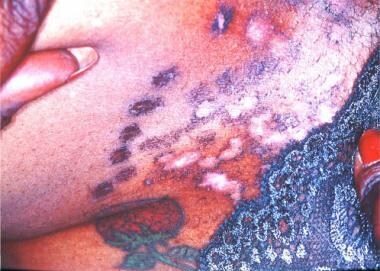 Hyperpigmentation and hypopigmentation following use of inappropriate parameters on a patient with Fitzpatrick phototype IV.

Etiology
Excessive hair growth in men or women may be classified into either hirsutism or hypertrichosis, depending upon the distribution on the body. Other disorders, such as pseudofolliculitis barbae or acne keloidalis nuchae, may be caused by the hair itself, causing ingrown hairs and localized inflammatory reactions that may result in pigmentary disorders, hair loss, and scarring.
Indications
Hirsutism
Hirsutism is defined as an excess of thicker darker hairs in a male pattern of distribution where they are normally thin or absent in the female. [7] Affected areas are those that are stimulated by circulating androgens and include the face, chest, arms, and areolae. This disorder may be caused by several types of endocrine disorders that lead to excessively high androgen levels or by hair follicles that are particularly sensitive to normal levels of androgens. The latter accounts for approximately 95% of all reported cases. An estimated 1 in 20 women of reproductive age are affected by this disorder.
Treatment for excessive hair in hirsutism is not generally required if no clear etiology of the disorder exists and the patient does not find the excessive hair growth objectionable. However, treatment generally relies upon antiandrogen to inhibit the effects of androgens on the skin, such as 5-alpha-reductase inhibitors, spironolactone, or flutamide. [8] Whether choosing to treat medically or with any of the aforementioned methods of hair removal, patients must understand that treatment is long-term and must be continued to maintain low levels of visible hair.
Hypertrichosis
A hair growth pattern in a nonandrogen-dependent pattern is termed hypertrichosis and may involve vellus, terminal, or lanugo type hair. This may be associated with a number of congenital syndromes or occur as an isolated finding. What is considered a normal amount and appearance of body hair can vary widely among different ethnic groups, and treatment should be tailored to the needs or desires of the individual patient. Hypertrichosis may be an unwanted adverse effect of medications such as cyclosporine, minoxidil, and oral and topical corticosteroids that are used to treat other disorders.
Pseudofolliculitis barbae
When hair grows in a curly and tightly coiled pattern, patients may be afflicted with numerous ingrown hairs that may cause skin irritation, papules, and pustules. These may eventually lead to changes in pigmentation and even scarring. Pseudofolliculitis barbae occurs most commonly in the underarm or bikini area with shaving, or, in men, at the lower neck, where coarse facial hair grows. Laser hair removal is effective in treating this disorder by temporarily or permanently removing the hair from the chronically inflamed lesion. Laser treatment leads to resolution and healing of the papular and pustular lesions, dramatically improving skin texture and the associated postinflammatory hyperpigmentation.
Acne keloidalis nuchae
Acne keloidalis nuchae is most commonly seen in African Americans and is characterized by follicular papules and chronic plaques on the occipital area of the scalp. It may often lead to keloidal thickening of the skin and permanent scarring. In early lesions, an entrapped hair is usually in evidence, and early treatment with laser hair removal is most effective at this stage. The entrapped hair acts as a foreign body in the skin and, when chronic, can cause skin changes, decreased hair growth, and scarring of the affected area. The treatment goals with laser hair removal for this disorder are to destroy the impacted hair and cause a delay in new hair growth, thus decreasing further scarring. [9]
Relevant Anatomy
In order to gain a more comprehensive understanding of how laser hair removal procedures work, one must have knowledge of relevant hair microanatomy, physiology, and growth cycles associated with growth of hair on the body.
Hair follicles are found over almost the entire body surface, with the exceptions of the palms of the hands and soles of the feet. Each person has approximately 5 million individual hair follicles. Hair follicles may be straight, wavy, helical, or spiral, and the morphologic features of follicles vary among different anatomic locations and racial backgrounds. White persons typically have thinner hair shafts than persons of Asian or African American backgrounds. The density of hair follicles in a given skin surface area also varies widely among individuals. Hair shape is also highly variable; on cross-section, straight hair tends to be round and wavy or spiral hair is oval. Keep in mind the variations in color, texture, and amount of hair on a given body surface area when deciding upon the need for hair removal procedures.
Types of hair
Adult hair has 2 primary types. Vellus hair can be found over the entire body and appears as soft, fine, short hairs that are nonpigmented or very lightly pigmented and can be all but invisible. Terminal hair is the longer, coarser, and more darkly pigmented hair found on the scalp, underarm area, and groin. Subgroups of terminal hair include those on the scalp, pubic region, and eyebrows. Terminal hair is also found on the androgen-sensitive areas of the body, such as the beard and chest area in males. Although greatly outnumbered by vellus hairs, terminal hairs are more important, as they are responsible for the appearance of hair on the body. They may aid in enhancing a person's image, or they can cause great anguish and distress due to their distribution, length, or texture.
Hair follicle anatomy
Hair follicles are associated with other structures within the skin. As the hair follicles develop, they become associated with developing sebaceous glands, apocrine glands, and erector pili muscles. Together, these structures form the folliculosebaceous-apocrine unit.
Each hair follicle may be divided into 4 histologic divisions, which are (from superficial to deep) the infundibulum, isthmus, stem, and bulb.
-
The infundibulum is the most distal portion of the hair in the follicle, extending from the surface of the skin down to the entrance of the apocrine gland into the follicle.
-
The isthmus of the hair then extends from the apocrine gland entrance to the connection to the sebaceous gland.
-
Still deeper, the stem extends from the sebaceous gland opening to the erector pili muscle attachment. The action of this muscle makes the hair stand erect, causing goose bumps.
-
The bulb of the hair follicle is deep to the attachment of the erector pili muscle and is the site of the follicular matrix. This is the principal site responsible for hair growth and development.
Hair phases
Adult hair has 3 distinct phases of development: anagen, catagen, and telogen. As hairs progress through these phases, they are affected differently by treatment with laser-assisted hair removal.
-
Anagen is the phase in which active hair growth occurs. Follicular matrix cells are actively producing cells that will make up the growing hair. The growing hair consists of all 4 histologic divisions in anagen.
-
In catagen (the regression phase), matrix cells degenerate and the bulb begins to atrophy, causing the hair follicle to shrink.
-
Telogen is the final resting phase of the hair follicle. Growth of the hair has stopped, and the follicle becomes inactive. Now the follicle contains only the superficial components, the infundibulum and the isthmus. During telogen, the hair is released from its attachment to the skin and sloughs away. The process begins again in anagen to form a new hair.
The length of time spent in each phase depends upon the location of the hair. On the scalp, hair follicles spend up to 10 years in anagen, but on the trunk, brow, and limbs, anagen lasts no longer than 6 months. Catagen lasts only 2-3 weeks, and telogen lasts from 3-4 months.
Up to 90% of hairs in a given body location can be in the anagen phase at a given time. This fact becomes important because only hairs in the anagen phase of development are susceptible to injury during a session of laser-assisted hair removal. Thus, multiple treatments are necessary to treat all hair follicles on a given body surface area.
Melanin
Melanin is a biologic pigment that is found in many cells in the body and is primarily responsible for the color of the skin and hair. The primary function of melanin in the skin is to protect it from the harmful effects of sunlight. The amount of melanin in hair and skin varies widely between individuals and races and is determined by the concentration of melanin within the skin. This variability produces a great range of hair darkness, skin color, and tone.
Melanin is the target chromophore, or light-absorbing molecule, for laser treatment and has an absorption spectrum of 250–1200 nm, which spans the entire ultraviolet, visible, and infrared light ranges. Melanin absorbs energy in the form of heat from a pulse of laser light. This heat causes thermal injury to the melanin-containing cell and its surroundings. Ideally, the laser energy is absorbed selectively by the melanocytic hair bulb and matrix, thus destroying the hair follicle and its capacity to regrow, while protecting the surrounding tissue where the melanin concentration is minimal. In persons with darker skin, however, the higher levels of melanin in heavily pigmented skin compete as a chromophore for the laser light. This light is converted to heat and can cause skin blistering or changes in skin pigmentation.
Contraindications
See the list below:
-
Patients with hirsutism may actually have a more serious underlying endocrine disorder. Causes of hirsutism should be avidly sought and treated, if necessary.
-
For patients with chronic or active herpes simplex virus infections, pretreatment with antiviral medications can be initiated, especially when lesions appear in the body area to be treated. Antiviral treatment typically begins 1 day prior to laser treatment and continues for a total of 5-7 days.
-
Patients with a history of hypertrophic scarring or keloid formation should be treated judiciously because of possible problems in healing if skin damage is sustained.
-
Patients taking isotretinoin (Accutane) should stop the medication for 6 months prior to laser hair removal treatment because of skin sensitivity. This issue has been addressed but has not yet been proven in a clinical trial.
-
Laser hair removal may be contraindicated in patients taking photosensitizing drugs activated by ultraviolet A wavelengths. Lasers operating in the visible to infrared spectrum are generally thought to be safe for use with patients taking these medications.
-
Patients with tattoos on the body surface areas selected for laser hair removal should be instructed that the appearance of the tattoo might be affected by the use of laser devices. Treatment may lighten or darken certain pigments of the tattoo.
-
Effective hair removal with laser-assisted devices requires the presence of a hair follicle for photothermolysis to commence. Prior history of recent waxing, plucking, sugaring, electrolysis, or other methods of complete hair removal should be ascertained.
-
Immediate reaction after laser impact (note erythema, mild edema, sizzling of hairs)
-
Hyperpigmentation and hypopigmentation following use of inappropriate parameters on a patient with Fitzpatrick phototype IV.