Background
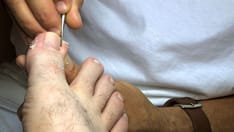
Ingrown toenail (onychocryptosis) is a fairly frequent problem resulting from either growth of nail fold inwards into the nail bed or abnormal embedding of the nail plate into the nail groove, causing significant discomfort. Although often thought to be synonymous, the terms ingrown nail and paronychia refer to different conditions. Both can cause significant discomfort. Ingrown toenails may cause pain with ambulation. See the image below.
Retronychia is a rare variant of ingrown nail in which the nail plate is embedded into the proximal nail fold with subsequent inflammation of the proximal nail fold. [1]

Pathophysiology
Ingrown nails result from an alteration in the proper fit of the nail plate in the usual nail groove. Sharp spicules of the lateral nail margin develop and are gradually driven into the dermis of the nail groove. The nail acts as a foreign body. An inflammatory response occurs in the area of penetration, leading to erythema, edema, purulence, and development of granulation tissue.
The normal distance between the nail groove and the border of the nail is 1 mm. A thin epithelial layer covers the nail groove and protects it from irritation. With an increase in pressure on the nail bed and nail groove, an epidermal breakage occurs, with subsequent inflammation, pain, and infection. [2]
Ingrown nails generally occur as the result of poorly fitted footgear. However, this may be caused by prior trauma to or abnormal shape of the nail margin. [3]
Types of ingrown nail include the following [4] :
-
Neonatal: Occurs as a result of delayed overgrowth of the free nail margin on the tip of the toe and can be managed conservatively (see the first image below)
-
Infantile: Congenital form results from malalignment of the big toenail or as a result of hypertrophy of lateral nail fold
-
Adolescent : Most common cause is a narrow nail bed, resulting in ingrowing distal lateral nail
-
Adult: Most common cause is pressure that causes sharply bent lateral margin of the nail plate
-
Distal embedding from a big toe nail that is too short
-
Retronychia
-
Pincer nail (see second image below)
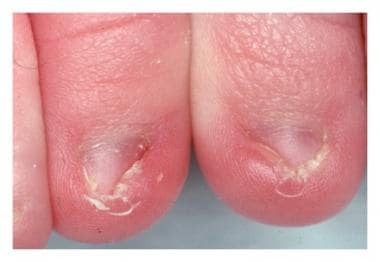 Neonatal ingrown nail. Courtesy of Dermatology Research and Practice (Haneke, E. "Controversies in the Treatment of Ingrown Nails." Dermatology Research and Practice. 2012; 2012:783924).
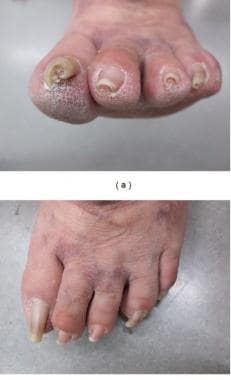 Pincer nail. Courtesy of Dermatology Research and Practice (Haneke, E. "Controversies in the Treatment of Ingrown Nails." Dermatology Research and Practice. 2012; 2012:783924).


Etiology
The following factors are implicated in the development of ingrown nails:
-
Trimming toenails improperly: Cutting the toenail rounded, V shape or too short will cause bulging of the soft tissue and the possibility to leave a nail spur that is difficult to remove, resulting in an inflammatory reaction with pressure necrosis. The proper way to trim the toenail is to cut it straight across beyond the nail bed. [5]
-
Poorly fitting shoes: The nail plate can be forced out of the nail groove by footwear that has a toe box that is too small for the forefoot. The constant pressure on the nail bed and nail groove results in breakage that starts an inflammatory process and eventually results in an ingrown nail.
-
Nail plate abnormality: Increased curvature of the nail plate, as in pincer nail, may develop into an ingrown nail. [5] Deformities that result from prior trauma or underlying bone pathology may predispose to ingrown nails.
-
Excessive sweating: It was noted that ingrown nails are common among teenagers and soldiers, in whom excessive sweating is present, which results in softening of the nail fold. With the participation in sports, nail spicules may develop and can easily pierce the adjacent softened nail fold.
-
Obesity causing deepening of the nail groove
-
Generalized joint hypermobility: Joint hypermobility through changes in foot biomechanics and gate affection increases medial midfoot pressure and loading during walking, and, as the first metatarsophalangeal joint bears the highest pressure, an ingrown toenail in the big toe may develop. [10]
-
Onychomycosis: This infection may result in brittle nails, which may form nail spicules and pierce the adjacent nail fold.
-
Heredity: Some people are genetically predisposed to inwardly curved nails, with distortion of one or both nail margins.
-
Pathological hallux interphalangeal angle (≥14.5): This was correlated with the development of ingrown hallux nail and may act as a predisposing factor. [11]
-
Paronychia with sporangium formation: This was reported to cause an ingrown nail. [12]
-
Hematopoietic stem cell transplantation: Children with hematopoietic stem cell transplantation have a higher incidence of ingrown nails and were found to have the aggressive forms, with more than 50% of patients having nail edge and bilateral great toe involvement, as well as recurrence in 37.5%. [13]
-
Nail consistency: Young male runners who have a hard nail consistency were found to have a higher incidence of ingrown nail. [14]
-
Diabetes: The prevalence of ingrown nails was found to be higher in diabetic patients, suggesting the role of diabetic vasculopathy in the development and evolution of ingrown nails. [15]
Epidemiology
Frequency
United States
Of all nail problems, this is the most common. Toenails are affected much more commonly than fingernails. The lateral margins of the great toe are most frequently affected.
International
In the United Kingdom, 10,000 cases per year have been reported.
In a Korean epidemiological study, a 10-year overall incidence was found to be 307.5 cases per 100,000 persons, with an increasing trend. [16]
Race
No racial predilection is noted.
Sex
Ingrown nail has a reported male-to-female ratio of 3:1. In reported cases of retronychia, a female predominance has been noted. [1] A 2018 epidemiologic study revealed increased incidence and a higher prevalence in females. [16]
Age
The condition is observed in people of all ages but is most common in the second decade of life. Ingrown nails become much more common as children begin bearing weight on their feet and wearing shoes, although congenital onychocryptosis has been described, [17, 18] as have cases in infants. [19]
Prognosis
Prognosis is excellent. Complete healing is expected. In general, mortality is not associated with ingrown nails. Morbidity is chiefly the result of infection of the tissues. If neglected, abscess formation (paronychia) may occur or spread and lead to osteomyelitis, systemic infection, sepsis, or amputation.
Patient Education
For patient education resources, see Ingrown Toenails and Paronychia (Nail Infection).
Another good patient reference is www.familydoctor.org from the American Academy of Family Physicians.
-
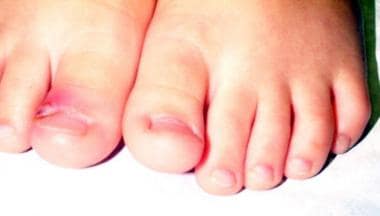
Right great toe paronychia in a 3-year-old child. Courtesy of Ann G. Egland, MD.
-
Preparing for digital block before surgical treatment of paronychia of right great toe. Universal precautions should always be observed. Courtesy of Ann G Egland, MD.
-
Neonatal ingrown nail. Courtesy of Dermatology Research and Practice (Haneke, E. "Controversies in the Treatment of Ingrown Nails." Dermatology Research and Practice. 2012; 2012:783924).
-
Pincer nail. Courtesy of Dermatology Research and Practice (Haneke, E. "Controversies in the Treatment of Ingrown Nails." Dermatology Research and Practice. 2012; 2012:783924).
-
Stage 3 ingrown nail. Courtesy of Wikimedia Commons.
-
Schematic view for cotton wick insertion. Courtesy of Dermatology Research and Practice (Haneke, E. "Controversies in the Treatment of Ingrown Nails." Dermatology Research and Practice. 2012; 2012:783924).
-
Schematic view illustrating taping of the nail. Courtesy of Dermatology Research and Practice (Haneke, E. "Controversies in the Treatment of Ingrown Nails." Dermatology Research and Practice. 2012; 2012:783924).
-
Schematic view illustrating gutter technique. Courtesy of Dermatology Research and Practice (Haneke, E. "Controversies in the Treatment of Ingrown Nails." Dermatology Research and Practice. 2012; 2012:783924).
-
Hypertrophy of the lateral nail fold that partially cover the nail. Courtesy of Dermatology Research and Practice (Haneke, E. "Controversies in the Treatment of Ingrown Nails." Dermatology Research and Practice. 2012; 2012:783924).