Practice Essentials
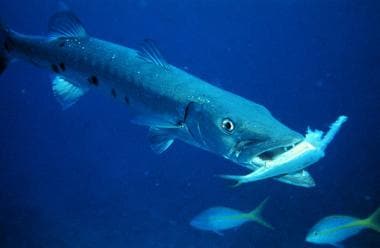
Ciguatera poisoning is the most common nonbacterial fish-borne poisoning in the United States. [1] It is caused by consumption of reef fish contaminated with ciguatoxin, which originates with certain dinoflagellates (ie, algae) associated with coral reef systems and accumulates up the food chain from small herbivorous fish to larger carnivorous fish, such as barracuda (see the image below) and grouper. Contaminated fish have no specific odor, color, or taste, making identification of potential contamination extremely difficult.
See 5 Cases of Food Poisoning: Can You Identify the Pathogen?, a Critical Images slideshow, to help identify various pathogens and symptoms related to foodborne disease.
Signs and symptoms
Ciguatera poisoning is a clinical diagnosis based upon a constellation of symptoms temporally related to ingestion of suspect fish products. Onset of symptoms may be within 15 minutes or as late as 24 hours (rarely) after ingestion of the toxin. Generally, symptoms are noted within 6-12 hours after ingestion of tropical reef fish. Symptoms increase in frequency and severity over the subsequent 4-6 hours. Reported symptoms are numerous but commonly affect 3 major organ systems: GI, neurologic, and cardiovascular.
GI symptoms, which often appear first, may include the following:
-
Abdominal pain
-
Nausea
-
Vomiting
-
Diarrhea
-
Painful defecation
Neurologic symptoms may include the following:
-
Lingual and circumoral paresthesias
-
Painful paresthesias of the extremities
-
Paradoxical temperature reversal (eg, cold objects feel hot and hot objects feel cold; classic symptom)
-
Dental pain (teeth feel loose)
-
Pruritus
-
Arthralgias
-
Myalgias
-
Weakness
-
Ataxia, vertigo
-
Respiratory paralysis
-
Coma
In children, irritability may be the only presenting neurologic symptom.
Cardiovascular findings may reflect the following:
-
Bradycardia
-
Hypotension
-
Pulmonary edema
Other general symptoms include the following:
-
Dysuria
-
Chills
-
Sweating
-
Painful ejaculation
-
Metallic taste
-
Polymyositis
See Presentation for more detail.
Diagnosis
All routine laboratory tests are nonspecific for ciguatera poisoning, but the results may reflect volume depletion from fluid losses. Mild creatine phosphokinase (CPK) and lactate dehydrogenase (LDH) elevations, if present, reflect muscle tissue breakdown.
See Workup for more detail.
Management
Treatment is largely supportive and symptom driven. Medications used to treat ciguatera poisoning include the following:
-
Activated charcoal
-
Antihistamines
-
Amitriptyline
-
Mannitol
-
Analgesics
-
Nonsteroidal anti-inflammatory drugs (NSAIDs)
-
Gabapentin
See Treatment and Medication for more detail.
For related poisoning articles, see Histamine Toxicity from Fish, Shellfish Toxicity, and Seafood Toxicity.

Pathophysiology
Gambierdiscus toxicus is the dinoflagellate most notably responsible for production of ciguatoxin precursors, although other species have been identified more recently. These dinoflagellates, which live on the surfaces of seaweeds and denuded corals, are a primary nutritional source for small herbivorous fish. In turn, these small fish become prey for larger carnivorous fish that are subsequently consumed by humans.
Ciguatoxin (CTX) and other similar toxins are heat stable and lipid soluble; they are unaffected by temperature, gastric acid, or cooking method. The presence of the toxin does not affect the odor, color, or taste of the fish. In humans who eat contaminated fish, the reported attack rate is 73-100%.
Chemists have successfully synthesized specific ciguatoxins, ensuring that a practical supply will be available for future biological applications. [2] Although not completely reliable, an immunoassay and a mouse biologic assay are available for detection of ciguatoxin in affected fish.
CTX produces toxic effects by activation of voltage-dependent sodium channels at the neuromuscular junction. Activation results in membrane hyperexcitability, spontaneous repetitive neurotransmitter release, blockage of synaptic transmission, and depletion of synaptic vesicles. Effects are most pronounced on neuronal, cardiac, and gastrointestinal tissues. Ciguatoxin causes an increase in parasympathetic tone and impairs sympathetic reflexes.
Etiology
Ingestion of sufficient quantities of fish that contain accumulated ciguatoxin produces this syndrome. Fish larger than 2 kg can contain significant amounts of toxin and readily produce toxic effects when ingested. Ciguatera fish poisoning (CFP) is not due to the mishandling of fish and is not prevented by any particular storage, preparation, or cooking methods. [3]
Although more than 400 species of fish have been associated with ciguatera poisoning, the species most frequently implicated include the following: [4, 5]
Sexual transmission of ciguatoxin has been reported. [8] For example, in one case report a man with ciguatera poisoning experienced painful ejaculation and his sexual partner subsequently experienced dyspareunia. [9] Thus, ciguatoxin may be present in the semen of affected men and be capable of producing symptoms. Ciguatoxin may be transmitted to the fetus through the placenta or to infants through breast milk.
Epidemiology
According to the 2020 Annual Report of the American Association of Poison Control Centers' National Poison Data System (NPDS), 108 single exposures to ciguatera were reported. [10] Most ciguatera outbreaks occur in Hawaii and Florida. [11, 12] However, tourists who visit endemic areas (eg, the Caribbean) may not develop symptoms until after returning home. The incidence in travelers to highly endemic areas has been estimated as high as 3 per 100. [13] Additionally, because fish from tropical waters are now available globally, cases are reported across the US mainland. For example, from August 2010-July 2011, 28 cases of ciguatera poisoning were reported in New York City. [14]
Annually, an estimated 50,000 cases of ciguatera poisoning occur worldwide. [8, 15, 16] However, ciguatera poisoning is difficult to track and is thought to be underreported. It is estimated that only 10% of cases are reported to health authorities. [14] Ciguatera is widespread in tropical and subtropical waters, usually between between the latitudes of 35 degrees north and 35 degrees south; it is particularly common in the Pacific and Indian Oceans and the Caribbean Sea. The highest incidences of ciguatera poisoning have been reported in the US Virgin Islands (1200 per 100,000), French Polynesia (1400 per 100,000) and Cook Islands (1760 per 100,000). [17]
The incidence and geographic distribution of ciguatera poisoning are increasing due to climate change. [18] Newly recognized areas of risk include the Canary Islands, the eastern Mediterranean, and the western Gulf of Mexico. [13] G toxicus, which produces ciguatera toxin, tends to proliferate on dead coral reefs. The risk of ciguatera is likely to increase as more coral reefs die or are jeopardized as a result of environmental factors, construction, and nutrient run-off. [17] One study of the impact of climate changes on ciguatera-producing organisms has suggested that elevation of sea surface temperatures may expand the band of concern above and below the 35th degree parallels. [19] Ironically, it also suggested that some areas may become too warm for the dinoflagellates to flourish.
Prognosis
The prognosis is excellent. A small longitudinal cohort study from Miami revealed that all 12 patients were back to baseline on all neuropsychological studies by 6 months. [20] However, a person who has contracted ciguatera poisoning may develop an extreme sensitivity to any further ciguatera exposure.
Bradycardia, hypotension, and T-wave abnormalities may occur in relation to the amount of ingested ciguatoxin. Cardiovascular symptoms often occur within 2-5 days of ingestion and usually resolve within 5 days. Pulmonary edema and chronic fatigue syndrome have been reported.
Premature labor and spontaneous abortion have been reported in mothers with ciguatera poisoning, as have effects on the fetus and newborn child through placental and breast milk transmission.
Ciguatera poisoning is seldom lethal. The mortality rate is < 0.1% but varies according to the toxin dose and availability of medical care to manage complications. [13] Rates as high as 20% have been reported. The 2020 Annual Report of the American Association of Poison Control Centers' NPDS reported 32 minor outcomes, 34 moderate outcomes, and no major outcomes or deaths. [10] Death usually is attributed to cardiovascular depression, respiratory paralysis, or hypovolemic shock. Risk factors identified in fatalities include consumption of large amounts of viscera and head, G toxicus, and consumption of reef fish collected after storms. [17]
Morbidity from ciguatera poisoning may be high, and symptoms may be prolonged. Children appear to be affected more severely and are involved more often in life-threatening cases. Most morbidity is neurologic. Neurologic symptoms resolve after 1-2 weeks, but pain, paresthesia, pruritus, and weakness may persist for several weeks. Symptoms increase following ingestion of animal proteins. Chronic symptoms may occur and may result in permanent nerve damage.
Patient Education
Patients who have experienced ciguatera poisoning should be advised that they may develop an extreme sensitivity to any further exposure to ciguatera. They should be instructed to refrain from eating fish from areas where ciguatera poisoning is endemic. Toxin concentration in the head, viscera, and roe suggest avoiding consumption of these parts. Commercial products are sold to detect ciguatoxin in fish during home preparation, but the reliability of these consumer products has not been validated.
-
Barracuda.
-
Grouper.
-
Snapper.