| Patient Education |
|
Click here for patient education.
|
|
You are in: eMedicine Specialties >
Pediatrics: Surgery > Otolaryngology
Cholesteatoma
Article Last Updated: Mar 7, 2008
AUTHOR AND EDITOR INFORMATION
Section 1 of 11
Author: Peter S Roland, MD, Professor, Department of Neurological Surgery, Professor and Chairman, Department of Otolaryngology-Head and Neck Surgery, Director of Clinical Center for Auditory, Vestibular and Facial Nerve Disorders, Chief of Pediatric Otology, University of Texas Southwestern Medical Center; Adjunct Professor of Communicative Disorders, School of Human Development
Peter S Roland is a member of the following medical societies: Alpha Omega Alpha, American Academy of Otolaryngic Allergy, American Academy of Otolaryngology-Head and Neck Surgery, American Auditory Society, American Laryngological Rhinological and Otological Society, American Neurotology Society, American Otological Society, North American Skull Base Society, and Society of University Otolaryngologists-Head and Neck Surgeons
Editors: Orval Brown, MD, Director of Otolaryngology Clinic, Professor, Department of Otolaryngology-Head and Neck Surgery, University of Texas Southwestern Medical Center at Dallas; Mary L Windle, PharmD, Adjunct Assistant Professor, University of Nebraska Medical Center College of Pharmacy, Pharmacy Editor, eMedicine.com, Inc; John E McClay, MD, Assistant Professor, Department of Otolaryngology, Division of Pediatric Otolaryngology, Children's Medical Center, University of Texas Southwestern Medical School; Paul D Petry, DO, FACOP, FAAP, Consulting Staff, Freeman Pediatric Care, Freeman Health System; Maureen Strafford, MD, Arnold P Gold Foundation Associate Professor, Departments of Anesthesiology and Pediatrics, Tufts University and Tufts-New England Medical Center
Author and Editor Disclosure
Synonyms and related keywords:
cholesteatoma, keratoma, middle ear cholesteatoma, primary cholesteatoma, primary acquired cholesteatoma, secondary cholesteatoma, secondary acquired cholesteatoma, otorrhea, tympanic membrane perforation, TM perforation, temporal bone, squamous epithelium, congenital cholesteatoma, scutal erosion, labyrinthine fistula
Background
For decades, cholesteatoma has been recognized as a destructive lesion of the skull base that can erode and destroy important structures within the temporal bone. Its capacity for CNS complications, such as brain abscess and meningitis, make it a potentially fatal lesion. History Although Cruveilhier first described cholesteatoma in 1829, Müller first named the lesion in 1858. Throughout the early half of the 20th century, cholesteatoma was managed by exteriorization. The mastoid air cells were exenterated, the posterior external auditory canal was removed, and the opening into the resulting cavity was enlarged to ensure adequate air exchange and to make visual inspection simple. During the 1950s and 1960s, the House Otologic Group developed a new approach. The group attempted to leave the basic underlying anatomic structure of the ear and temporal bone intact, principally by preserving the canal wall. These aggressive attempts to conserve the normal anatomy of the ear created great controversy. Surgeons tended to align themselves with either the old "canal wall down" (ie, open cavity)1 philosophy or with the new "canal wall up" (ie, closed cavity) philosophy.2 Throughout the last 2 decades, otologic surgeons have migrated to an intermediate position. Most otologic surgeons in the United States now perform both techniques, selecting a particular operation based on the individual circumstances of each patient.
Pathophysiology
A cholesteatoma consists of squamous epithelium that is trapped in the skull base. Squamous epithelium trapped within the temporal bone (ie, middle ear or mastoid) can expand only at the expense of the bone that surrounds and contains it. Consequently, complications associated with a growing cholesteatoma can include injury to any of the structures normally found within the temporal bone. Occasionally, a cholesteatoma escapes the confines of the temporal bone and skull base. Extratemporal complications can occur in the neck, CNS, or both. Occasionally, a cholesteatoma fills with keratinous debris and reaches a size within the cranium sufficient to distort normal brain function and produce mass effects and CNS dysfunction. Bony erosion occurs by 2 principal mechanisms. Pressure effects produce bony remodeling, which occurs regularly throughout the normal skeleton. Enzymatic activity at the margin of the cholesteatoma enhances osteoclastic activity, which greatly increases the speed of bone erosion. These osteolytic enzymes appear to increase when a cholesteatoma becomes infected.
Frequency
United States
The incidence is unknown, but a cholesteatoma is a relatively common reason for otologic surgical procedures that occur on a weekly basis in children's hospitals.
Mortality/Morbidity
Death from intracranial complications of cholesteatoma is now uncommon because of earlier recognition, timely surgical intervention, and supportive antibiotic therapy. Cholesteatoma remains a relatively common cause of permanent, moderate, conductive hearing loss.
History
- The hallmark symptom of cholesteatoma is either unremitting (or frequently recurrent) painless discharge from the ear (ie, otorrhea).
- Hearing loss is also a common symptom of cholesteatoma. Large cholesteatomas fill the middle ear space with desquamated epithelium with or without associated mucopurulent discharge. Associated ossicular damage also can produce or magnify a conductive loss.
- Dizziness is a relatively uncommon symptom of cholesteatoma but occurs if bony erosion produces a labyrinthine fistula or if the cholesteatoma lies directly on the footplate of stapes. Dizziness is a worrisome symptom because it may presage the development of more serious complications.
- Occasionally, cholesteatoma presents initially with the symptoms of CNS complications, sigmoid sinus thrombosis,3 epidural abscess, or meningitis.
Physical
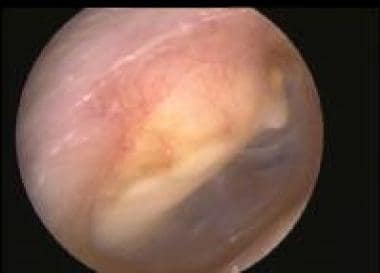
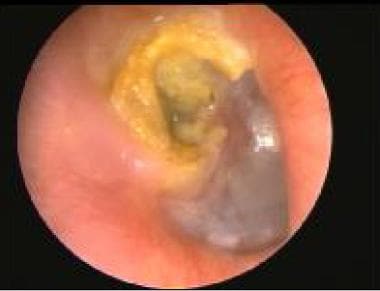
- Upon physical examination, the most common signs of cholesteatoma are drainage and granulation tissue that are unresponsive to antimicrobial therapy.
- Tympanic membrane (TM) perforation commonly accompanies cholesteatoma, as evidenced by its presence in more than 90% of patients.
- Congenital cholesteatomas are the exception.
- Occasionally, a cholesteatoma produced by surgical implantation of squamous epithelium presents prior to disruption of the TM.
- Quite frequently, the only finding upon physical examination is a canal filled with mucopus and granulation tissue.
- Occasionally, by using ototopical antibiotic drops, limiting the infection and resolving the granulation tissue is possible.
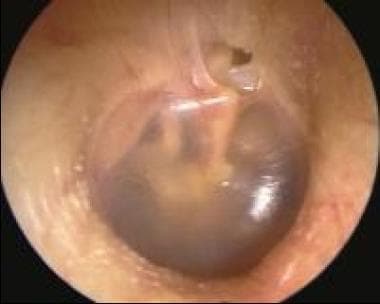
- When the ototopical therapy is successful, the surgeon often can observe the deep tympanic retraction pocket in the pars flaccida (the portion of the TM superior to the short process of the malleus) or posterior quadrant, the collection of squamous epithelium, or the absent TM.
- Very rarely, a cholesteatoma is initially identified on the basis of one of its complications.
- This situation occasionally occurs in children.
- An infection associated with the cholesteatoma can erupt through the inferior mastoid cortex and present as an abscess in the neck.
- Occasionally, cholesteatoma initially manifests with the signs of central nervous complications, sigmoid sinus thrombosis, epidural abscess, or meningitis.
Causes
The etiology of cholesteatoma varies, and at least 3 types are identified with different pathophysiologies.
- Congenital cholesteatoma as a consequence of squamous epithelium trapped within the temporal bone during embryogenesis4
- Congenital cholesteatoma is usually found in the anterior mesotympanum or in the peri eustachian tube area.
- They are most commonly identified in early childhood (ie, age 6 mo to 5 y).
- As congenital cholesteatomas expand, they can obstruct the eustachian tube, thus producing chronic middle ear fluid and conductive hearing loss.
- They can also produce conductive hearing loss by expanding posteriorly to encase the ossicular chain.5
- Unlike other forms of cholesteatoma, congenital cholesteatomas are most commonly identified behind an intact and normal-appearing TM.
- Primary acquired cholesteatoma caused by TM retraction
- The classic primary acquired cholesteatoma is a result of increasingly severe medial retraction of the pars flaccida into the epitympanum.
- As this process continues, the lateral wall of the epitympanum (ie, scutum) is slowly eroded, producing an ever-larger defect in the lateral wall of the epitympanum.
- The medially retracting TM continues to pass over the heads of the ossicles into the posterior epitympanum. Ossicular destruction is common.
- If the cholesteatoma passes posteriorly through the aditus ad antrum into the mastoid, erosion of the tegmen mastoideum with exposure of the dura and/or erosion of the lateral semicircular canal with deafness and vertigo can result.
- A second type of primary acquired cholesteatoma arises when the posterior quadrant of the TM is retracted into the posterior middle ear.
- The drum initially adheres to the long process of the incus.
- As retraction continues medially and posteriorly, squamous epithelium envelops the superstructure of the stapes and retracts into the sinus tympani.
- Primary acquired cholesteatomas arising from the posterior TM are likely to produce facial nerve injury and destruction of the stapedial superstructure. Surgical removal from the sinus tympani can be challenging.
- Secondary acquired cholesteatoma as a direct consequence of injury to the TM
- Injury to the TM can be a perforation that occurs as a result of acute otitis media or trauma, or it can be caused by surgical manipulation of the drum.
- Posterior marginal perforations are the type most likely to result in cholesteatoma formation.
- Although considered unlikely to produce cholesteatomas, central perforations occasionally can result in cholesteatoma formation.
- A procedure as simple as the insertion of tympanostomy tubes can implant squamous epithelium into the middle ear and ultimately produce a cholesteatoma.
- Any deep retraction pocket can result in cholesteatoma formation, if the retraction pocket becomes deep enough to trap desquamated epithelium.
Other Problems to be Considered
Tympanosclerosis Middle ear osteoma Chronic suppurative otitis media
Lab Studies
- No laboratory diagnostic tests are generally necessary.
Imaging Studies
- Some surgeons believe that any patient with a cholesteatoma scheduled for surgical intervention should have a preoperative CT scan. These surgeons believe that useful information is obtained in every circumstance and, consequently, that the expense and radiation exposure is always justified. The imaging modality of choice is a CT scan without intravenous contrast. CT scans can reveal the following subtle bony defects:
- Scutal erosion
- Labyrinthine fistula
- Defects in the tegmen
- Details of ossicular involvement
- Details of ossicular erosion or discontinuity
- Anomalies, erosion, or invasion of the facial nerve canal
- CT scanning cannot always distinguish between granulation tissue and cholesteatoma.
- Even technically excellent, fine-cut CT scans cannot always determine the full extent of disease.
- The surgeon, therefore, cannot always predict which operative course is required.
- Both the operating surgeon and the patient must understand these limitations of the preoperative assessment and must prepare for intraoperative surprises.
- Other surgeons reserve preoperative imaging for only special cases and are comfortable performing surgery without preoperative imaging. These surgeons are likely to request a preoperative CT scan in the following circumstances:
- Doubtful diagnosis
- The diagnosis may be in doubt among individuals with only small attic retractions upon physical examination.
- CT scanning may distinguish between shallow retractions without soft tissue extension into the epitympanic space and an extensive soft tissue mass with bony erosion.
- CT scanning can be helpful in individuals who already have had tympanomastoid surgery. In this group of patients, a white mass behind the TM can represent tympanosclerosis, cartilage deliberately placed at a previous operation, or recurrent cholesteatoma. CT scanning frequently helps determine which.
- Patient who adamantly wishes to avoid surgery
- Poor surgical candidates or patients who, for other reasons, wish to avoid an operation, can be better advised regarding the risks of nonsurgical management on the basis of CT scanning.
- Information from a CT scan may help a surgeon advise the patient and parents and/or caregivers that the presence of extensive disease, labyrinthine fistula, encroachment on the fallopian canal, and involvement of the oval window niche increase the risk of expectant management.
- If ossicular involvement is apparent on preoperative CT scans, then parents can be counseled that ossicular removal may be necessary and that a significant postoperative conductive hearing loss should be expected.
- Indeterminate underlying anatomy and unclear extent of disease as the result of previous surgery
- Reasonable expectation of congenital anomalies (eg, atresia, craniofacial anomalies)
- Suspected complications
- MRI is useful when the following very specific problems involving surrounding soft tissues are expected:
- Dural involvement invasion and/or inflammation
- Subdural or epidural abscess
- The presence of herniated brain into the mastoid cavity
- Inflammation of the membranous labyrinth or facial nerve
- Intracranial invasion
- Sigmoid sinus thrombosis
- Meningitis
Other Tests
- Audiometry
- In most circumstances, perform audiometry prior to surgery and include air and bone conduction and speech discrimination testing.
- Infrequently, a serious complication of cholesteatoma requires urgent surgery; in these patients, audiometric testing can be omitted.
Histologic Findings
The histology of surgically removed cholesteatoma specimens demonstrates typical squamous epithelium. The histology is indistinguishable from sebaceous cysts or keratomas removed from any other portion of the body.
Medical Care
Medical therapy is not a viable treatment for cholesteatoma. Patients who refuse surgery or those with a medical condition that makes a general anesthetic too hazardous should have the ear cleaned regularly, usually over 2-3 months. Regular cleaning can help control infection and may slow growth, but it does not stop further expansion or eliminate risk. The mainstay of antimicrobial therapy should be topical, but systemic therapy is occasionally a helpful adjunct.
Surgical Care
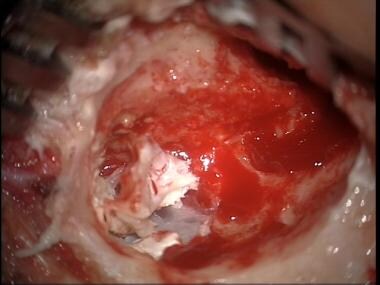
Surgical therapy consists of removal of the cholesteatoma. As mentioned in History, 2 types of operations are commonly used for the management of cholesteatoma. The open cavity (ie, canal wall down) technique was used exclusively until the House Otologic Group introduced the closed cavity (ie, canal wall up) technique. Various factors are considered in determining which procedure is best in a given circumstance.
Sometimes, this decision cannot be made until the operation has begun and a clear vision of the extent of disease has been obtained. Open cavity operations have the highest probability of permanently ridding the patient of cholesteatoma. Closed cavity procedures have the advantage of maintaining a normal appearance but have a higher risk of persistent or recurrent cholesteatoma. The risk of persistence is sufficient to cause most surgeons to advise an obligatory "second look" tympanomastoidectomy 6-12 months following the initial operation.6 During the second look, traces of residual disease frequently can be removed prior to the development of either complications or massive recurrence.
- In some circumstances, the surgeon is fairly sure preoperatively which operation (closed or open cavity) to perform, especially in the following situations:7
- If the patient has had several episodes of the cholesteatoma and wishes to avoid future operations, the open cavity technique is most applicable.
- For patients who are unwilling or unable to return for a second look procedure, an open cavity operation is safer.
- A large meatoplasty is simply unacceptable under any circumstance for some patients. These patients can be treated with a closed technique if they understand that disease recurrence is more likely and that they may require multiple serial surgical procedures.
- Some congenital anomalies are known to be associated with a lifelong history of eustachian tube dysfunction. In some individuals, previous surgical procedures have irreversibly injured the eustachian tube. In such individuals, an open cavity operation often is best.
- Frequently reserving management decisions regarding the canal wall until the operation has begun and a better understanding of the extent of disease has been obtained is best. Some intraoperative findings favor an open technique:
- Sinus tympani is involved.
- Medial end of the canal wall is involved, with the cholesteatoma wedged laterally between the heads of the ossicles in the epitympanum and medial canal wall.
- Ostitis or irremovable cholesteatoma in the area around the opening to the Eustachian tube or in the most inferior portions of the middle ear space often calls for a true radical mastoidectomy.
- Although small defects in the canal wall are readily repaired, larger defects are harder to repair; usually, simply converting the operation to an open cavity technique is best.
- Labyrinthine fistula is present. If the cholesteatoma matrix is left over the fistula so as not to expose it, then the canal must be removed. Otherwise, epithelium is trapped within the mastoid cavity, which simply results in cholesteatoma recurrence. If the cholesteatoma matrix is removed from the fistula, some surgeons are comfortable leaving the canal wall up.
- In the United States, most surgical procedures for cholesteatoma now are performed through an incision behind the ear combined with an incision in the external auditory canal, but the procedure can be performed through an extended incision starting in the canal alone.
- Regardless of which technique is used, all air cells should be removed. If ossicles are involved, they must be removed to avoid recurrence.8 The ossicular chain can be reconstructed either at the end of the primary procedure or as part of a secondary operation.
- The TM is usually reconstructed. If a closed cavity technique is used, replace missing bone with a cartilage graft. If an open cavity procedure is selected, create a large meatoplasty to allow adequate air circulation into the cavity that remains consequent to removal of the posterior canal wall.
- Consult a surgical atlas for a step-by-step description of the various surgical procedures.
Consultations
- Consultation with an otolaryngologist is mandatory.
- Rarely, advice from a neurosurgeon is required to help manage an intracranial consultation.
Drug therapy is not currently a component of the standard of care for this condition. When the cholesteatoma becomes infected, infection can be extremely difficult to eradicate. Because the cholesteatoma has no blood supply, systemic antibiotics cannot be delivered to the center of the cholesteatoma. Topical antibiotics can often surround a cholesteatoma, penetrating a few millimeters toward its center and suppressing infection; however, a large infected cholesteatoma resists any type of antimicrobial therapy. Consequently, otorrhea either persists or recurs despite frequent aggressive treatment with antibiotics.
Further Outpatient Care
- Observe each patient with cholesteatoma for many years.
- Recurrence can occur long after the initial surgical excision.
- Include semiannual or annual evaluations in follow-up care, even in the otherwise asymptomatic patient.
- Patients who have undergone open cavity procedures may require follow-up care as often as every 3 months for canal cleaning. In contrast, some patients require cleaning only once per year. How frequently these patients require cleaning to keep the canal free of desquamated epithelium and cerumen soon becomes apparent.
- Patients who have had closed cavity operations generally require a second look procedure 6-9 months after the original operation.
- Once the second look incisions are healed, regular follow-up care at 6- to 12-month intervals is necessary to ensure against persistent recurrence of cholesteatoma.
Complications
- Various complications are possible from cholesteatoma and cholesteatoma surgery. The most feared complication is facial nerve paralysis. The incidence of permanent facial nerve injury following cholesteatoma surgery is not entirely certain but appears to be approximately 1% or less. Incidence is probably considerably less than 1% in the hands of experienced otologists who perform the operation regularly. Whether facial nerve monitoring helps reduce the risk of postoperative facial nerve injury is controversial.
- A 1-2% chance of total neurosensory hearing loss is associated with cholesteatoma removal. A cholesteatoma that has produced a labyrinthine fistula or that lies directly over the footplate is more likely to produce permanent neurosensory loss.9
- Many patients have alteration of taste on the anterior ipsilateral tongue for weeks after an otologic procedure. However, this condition usually resolves within a few months after surgery.
- Long-term balance disturbance can occur because of labyrinthine or middle ear injury but is uncommon (occurring in <1% of patients).
- In approximately 10-15% of patients, the graft fails, and a permanent TM perforation follows tympanomastoidectomy for removal of cholesteatoma. Such perforations frequently can be eliminated by surgical treatment.
- Depending on the procedure, approximately 5-30% of operations are unsuccessful, and cholesteatoma persistence or recurrence manifests at some point in the postoperative period. Persistence may appear as early as 5-6 months postoperatively or may be delayed for many years. Consequently, close follow-up care is important.
Prognosis
- Elimination of cholesteatoma is almost always possible. However, multiple operations may be required. Because surgery is generally successful, complications from uncontrolled cholesteatoma growth are now relatively uncommon.
Medical/Legal Pitfalls
- The principal medicolegal pitfall is failure to diagnose. Failure to diagnose a cholesteatoma is one of the more common causes for claims against a pediatrician. Cholesteatomas grow slowly, and if significant hearing loss has occurred, supporting a claim that the cholesteatoma must have been present for a long period of time is easy. If the ear has been examined frequently in the recent past, parents often believe that the diagnosis should have been made earlier. This common situation can be avoided by maintaining excellent documentation of the otologic examination with a complete description of findings and by referral if in doubt.
Special Concerns
- The routine use of facial nerve monitoring remains controversial.
- A survey of practicing otologists performed in 1990 demonstrated that most experienced otologists do not believe that facial nerve monitoring is obligatory. Many experienced otologists use it only occasionally. Facial nerve monitoring requires experience and is unlikely to provide meaningful protection to an inexperienced operator.
- Conversely, some surgeons believe that predicting in which individuals the facial nerve is at risk is impossible. Consequently, these surgeons believe monitoring should be performed in every patient. These surgeons view monitoring as a precaution, much like ECG monitoring, that potentially may be useful in any given situation.
- A large percentage of surgeons do not use facial nerve monitoring for all patients. Instead, these surgeons monitor only selected individuals, including those undergoing revision operations, those who have had perioperative facial nerve weakness, and those whose imaging studies demonstrate facial nerve anomalies.
| Media file 1:
A typical audiogram demonstrating bilateral conductive hearing loss, which may be observed in an individual with a cholesteatoma. |
 | View Full Size Image | |
Media type: Graph
|
| Media file 2:
The photo exhibits a large meatoplasty performed as part of an open cavity (canal wall down) mastoidectomy. A similar meatoplasty usually is necessary if a clean, dry, problem-free cavity is to be maintained. |
 | View Full Size Image | |
Media type: Photo
|
| Media file 3:
An unenhanced CT scan demonstrating that the posterior canal wall has been eroded and the external auditory canal has filled with cholesteatoma, pus, and debris. Surprisingly, the middle ear appears relatively free of disease, a characteristic of primary acquired cholesteatomas. |
 | View Full Size Image | |
Media type: CT
|
- Roland PS, Meyerhoff WL. Open-cavity tympanomastoidectomy. Otolaryngol Clin North Am. Jun 1999;32(3):525-46. [Medline].
- Graham MD, Delap TG, Goldsmith MM. Closed tympanomastoidectomy. Otolaryngol Clin North Am. Jun 1999;32(3):547-54. [Medline].
- Manolidis S, Kutz JW Jr. Diagnosis and management of lateral sinus thrombosis. Otol Neurotol. Sep 2005;26(5):1045-51. [Medline].
- Kazahaya K, Potsic WP. Congenital cholesteatoma. Curr Opin Otolaryngol Head Neck Surg. Oct 2004;12(5):398-403. [Medline].
- Potsic WP, Korman SB, Samadi DS, Wetmore RF. Congenital cholesteatoma: 20 years' experience at The Children's Hospital of Philadelphia. Otolaryngol Head Neck Surg. Apr 2002;126(4):409-14. [Medline].
- Dawes PJ, Leaper M. Paediatric small cavity mastoid surgery: second look tympanotomy. Int J Pediatr Otorhinolaryngol. Feb 2004;68(2):143-8. [Medline].
- De la Cruz A, Fayad JN. Detection and management of childhood cholesteatoma. Pediatr Ann. Jun 1999;28(6):370-3. [Medline].
- Dornhoffer JL, Colvin GB, North P. Evidence of residual disease in ossicles of patients undergoing cholesteatoma removal. Acta Otolaryngol. Jan 1999;119(1):89-92. [Medline].
- Busaba NY. Clinical presentation and management of labyrinthine fistula caused by chronic otitis media. Ann Otol Rhinol Laryngol. May 1999;108(5):435-9. [Medline].
- Anderson J, Caye-Thomasen P, Tos M. A comparison of cartilage palisades and fascia in tympanoplasty after surgery for sinus or tensa retraction cholesteatoma in children. Otol Neurotol. Nov 2004;25(6):856-63. [Medline].
- Bennett M, Warren F, Jackson GC, Kaylie D. Congenital cholesteatoma: theories, facts, and 53 patients. Otolaryngol Clin North Am. Dec 2006;39(6):1081-94. [Medline].
- Chadha NK, Jardine A, Owens D, et al. A multivariate analysis of the factors predicting hearing outcome after surgery for cholesteatoma in children. J Laryngol Otol. Nov 2006;120(11):908-13. [Medline].
- Golz A, Goldenberg D, Netzer A, et al. Cholesteatomas associated with ventilation tube insertion. Arch Otolaryngol Head Neck Surg. Jul 1999;125(7):754-7. [Medline].
- Kemppainen HO, Puhakka HJ, Laippala PJ, et al. Epidemiology and aetiology of middle ear cholesteatoma. Acta Otolaryngol. 1999;119(5):568-72. [Medline].
- Migirov L, Duvdevani S, Kronenberg J. Otogenic intracranial complications: a review of 28 cases. Acta Otolaryngol. Aug 2005;125(8):819-22. [Medline].
- Ottaviani F, Neglia CB, Berti E. Cytokines and adhesion molecules in middle ear cholesteatoma. A role in epithelial growth?. Acta Otolaryngol. 1999;119(4):462-7. [Medline].
- Semaan MT, Megerian CA. The pathophysiology of cholesteatoma. Otolaryngol Clin North Am. Dec 2006;39(6):1143-59. [Medline].
- Thompson JW. Cholesteatomas. Pediatr Rev. Apr 1999;20(4):134-6. [Medline].
- Tierney PA, Pracy P, Blaney SP, Bowdler DA. An assessment of the value of the preoperative computed tomography scans prior to otoendoscopic 'second look' in intact canal wall mastoid surgery. Clin Otolaryngol Allied Sci. Aug 1999;24(4):274-6. [Medline].
Cholesteatoma excerpt Article Last Updated: Mar 7, 2008
|