Practice Essentials
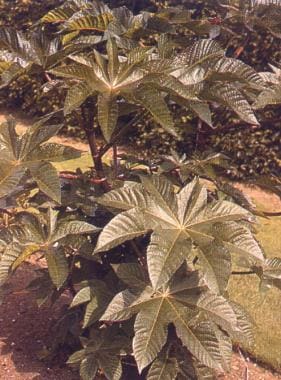
Ricin is a toxin contained in the seeds (beans) of the castor oil plant (Ricinus communis). The plant is found primarily in Asia and Africa but has taken root in all temperate and subtropical regions around the world and is widely grown as a garden ornamental. See the image below.
Ricin is present in all parts of the plant but is most highly concentrated in the beans or seeds. The beans are covered by a hard, relatively impervious outer shell that must be chewed or broken in some way in order for the toxalbumin to be released and, thus, present a toxic hazard. In addition, castor beans are notably antigenic and may cause severe cutaneous hypersensitivity and systemic reactions.
Although castor beans are an uncommon cause of poisoning, they remain a concern because their toxin is among the most lethal naturally occurring toxins known today, is easily accessible, is inexpensive, and is easy to prepare; hence, it is attractive to terrorists. The Centers for Disease Control and Prevention (CDC) classification scheme for major biological agents that terrorists could use to harm civilians categorizes ricin as a category B agent (ie, second highest priority) because it is moderately easy to disseminate while causing moderate-to-high morbidity in humans. [1]
Ricin has documented use in politically motivated assassination. Indeed, ricin has been used for homicidal purposes for centuries, although it has never been released or used in battle as a biological weapon of war. [1, 2]
Although ricin is not the ideal biologic warfare agent, it remains a threat. It would not be the agent of choice for an aerosol attack but remains a major concern as a food and water contaminant. With the increasing number of biologic threats, hoaxes, and “how-to” Internet resources available, this threat has the potential to become reality. Therefore, it is essential for physicians to be familiar with the diagnosis and treatment of poisonings due to ricin.
Exposure to ricin can result in toxicity or allergic reactions. Clinical manifestations of ricin toxicity depend on the route of exposure—that is, respiratory (inhaled aerosol), gastrointestinal (GI [ingested]), parenteral (injected), or dermal (absorption)—and on the delivered dose.
For example, ingestion can produce delayed gastroenteritis, which may be severe and hemorrhagic. Other complications of ricin toxicity include severe multisystem organ damage; shock, disseminated intravascular coagulation (DIC), seizures, coma, and death.
Treatment of ricin exposure is supportive; no antidote or approved vaccine is available. (See Treatment.)
See 11 Common Plants That Can Cause Dangerous Poisonings, a Critical Images slideshow, to help identify plant reactions and poisonings.
For patient education resources, see the First Aid and Injuries Center, as well as Biological Warfare, Ricin, and Personal Protective Equipment.

Background
In attempting to evaluate and discuss agents that can be used as weapons of mass destruction (WMDs), a key question to consider is, What can cause a maximum cre dible event? (A maximum credible event is one that could cause a large loss of life in addition to disruption, panic, and an overwhelming use of civilian healthcare resources.)
For an agent to be considered capable of causing a maximum credible event, it should be highly lethal, inexpensively and easily producible in large quantities, stable in aerosol form, and readily dispersible (1-5 µm in size). The ideal agent also is communicable from person to person and has no treatment or vaccine.
When these criteria are applied to ricin, the use of this agent as a WMD appears limited; nevertheless, the risk should not be underestimated. Indeed, ricin is produced easily and inexpensively; is highly toxic; can be disseminated as an aerosol, by injection, or as a food and water contaminant; is stable in aerosolized form, and has no treatment or approved vaccine. However, a considerably larger amount of ricin would be needed to produce the desired effect of a WMD than would be needed with a living replicating biologic agent or a chemical weapon.
For example, the amount of ricin necessary to cover a 100-km2 area and cause 50% lethality, assuming an aerosol toxicity of 3 µg/kg and optimum dispersal conditions, is approximately 4 metric tons, whereas only 1 kg of Bacillus anthracis is required to yield the same effects. Ricin, however, would have efficacy as a disabling agent. Its use as a food and water contaminant easily could incapacitate many and overwhelm local healthcare resources.
Pathophysiology and Etiology
Ricin is composed of two hemagglutinins and two toxins, in a structure resembling those of botulinum toxin, cholera toxin, diphtheria toxin, tetanus toxin, and insulin. The toxins are dimers comprising a 32-kd A chain and a 34-kd B chain, which are polypeptides joined by a disulfide bond. The B chain binds to cell surface glycoproteins and affects entry into the cell by an unknown mechanism. The A chain acts on the 60S ribosomal subunit and prevents the binding of elongation factor-2; this inhibits protein synthesis and leads to cell death. [3]
Castor beans are commonly encountered as ornamental items (eg, in prayer beads, bracelets, or necklaces) or in maracas. They are also used in the production of castor oil, a brake and hydraulic fluid constituent. The aqueous phase of the production process, termed the “waste mash,” contains 5-10% ricin. Extracting this 66-kd toxin is not difficult and is readily accomplished by means of chromatography, a common undergraduate chemistry skill. Castor beans are legal to possess and easily obtained through the Internet. Possession of ricin toxin requires registration with the CDC or United States Department of Agriculture (USDA). [4]
Epidemiology
United States statistics
Castor bean ingestions are extremely uncommon. In 2019, the American Association of Poison Control Centers (AAPCC) recorded 197 cases of single exposures to toxalbumins (a class of toxic agents that includes both ricin and abrin, the toxin from jequirity beans). [5] Of those patients, 71 were treated in a health care facility. Despite the fact that mastication of just one seed liberates enough ricin to kill a child, only 1 death was reported, and only 1 case was considered to have a major adverse outcome. [5] Gastrointestinal absorption of the toxin is poor, [6] which is probably the explanation for the favorable outcomes.
Cases of suicide by intravenous injection of castor bean extract have been reported. [7]
Attempts to weaponize ricin have a long history. The United States tested ricin for military application during World War I. One 1918 report stated: "These experiments show...easily prepared preparations of ricin can be made to adhere to shrapnel bullets...there is no loss in toxicity of firing...every wound inflicted by a shrapnel bullet coated with ricin would produce a serious casualty..." [8]
Between 1991 and 1997, three criminal cases were related to ricin. In 1991 in Minnesota, four members of the Patriots Council, an extremist group that held antigovernment and antitax ideals and advocated the overthrow of the US government, were arrested for plotting to kill a US marshal with ricin. [9] The ricin was produced in a home laboratory. They planned to mix the ricin with the solvent dimethyl sulfoxide (DMSO) and then smear it on the door handles of the marshal’s vehicle. The plan was discovered, and the four men were convicted.
In 1995, a man entered Canada from Alaska on his way to North Carolina. [9] Canadian custom officials stopped the man and found him in possession of several guns, $98,000, and a container of white powder, which was identified as ricin. Finally, in 1997, a man shot his stepson in the face. Investigators discovered a makeshift laboratory in his basement and found agents such as ricin and nicotine sulfate.
In 2003, ricin was found in US Senator Bill Frist’s office, and, in January of that same year, individuals connected to Al Qaeda were arrested in a London apartment while trying to manufacture ricin. [10] In February 2008, a man was poisoned in a hotel room in Las Vegas, Nevada. In separate incidents during 2013, ricin-tainted letters were sent to US Senator Roger Wicker, US President Barack Obama, the US Central Intelligence Agency, Fairchild Air Force Base, and US Federal Judge Fred Van Sickle. [11]
International statistics
In 1978 a Bulgarian dissident named Georgi Markov was assassinated on a street in London when a small pellet containing ricin was injected into his thigh. The highly publicized case of Markov illustrates the rapidly fatal nature of parenteral exposure. [12] Markov, an exiled Bulgarian broadcaster, was waiting for a bus when he was jabbed with an umbrella in the lower extremity. He then developed severe gastroenteritis and high fevers and died 3 days later.
At autopsy, a 1.5-mm metallic sphere was found at the wound site. [12] It had two tiny holes and could hold a volume of 0.28 mL. No toxin was isolated. Because of the small volume available and the rapid demise of the patient, ricin was believed to be the only capable inciting agent. The British government Chemical Defense Establishment at Porton Down recreated the scenario by injecting a pig with a similar dose of ricin. The pig died in a similar manner 26 hours later. [12] The ricin theory as the agent of death in the Markov case was given additional validation when ricin was recovered from a pellet used in another murder under similar circumstances. [13]
In December 2002, six terrorist suspects were arrested in Manchester, England; their apartment was serving as a “ricin laboratory.” [9] Among them was a 27-year-old chemist who was producing the toxin. Later, on January 5, 2003, British police raided two residences around London and found traces of ricin, which led to an investigation of a possible Chechen separatist plan to attack the Russian embassy with the toxin; several arrests were made. [14]
Prognosis
Although studies are limited and accurate statistics are not known, the prognosis for patients who develop symptoms appears to be generally good with appropriate supportive care. Fatalities have occasionally been reported after ingestion of chewed castor beans. Chewing and swallowing as little as 1 bean may produce death in a child; however, swallowing an intact bean without chewing is unlikely to cause serious sequelae.
Mortality and morbidity depend on the route and amount of exposure. Very little actual human data exist regarding the toxicity of specific dosages, but some information may be extracted from studies on nonhuman primates and mammals.
For gastrointestinal (GI) exposure, the lethal dose for 50% of the exposed population (LD50) is 30 µg/kg in rodents. Ricin’s lethality is diminished when ingested. Castor bean ingestions were once considered fatal, but multiple case reports prove otherwise. Many documented cases are related to ingestions of multiple seeds and voluntary ingestion of ricin without fatality. If ingested in sufficient amounts, ricin can cause severe gastroenteritis, GI hemorrhage, and hepatic, splenic, and renal necrosis. Death may occur from circulatory collapse.
For aerosol exposure, the LD50 for rodents is 3 µg/kg. Aerosol exposure causes weakness, fever, cough, and pulmonary edema within 18-24 hours and severe respiratory distress and death within 36-72 hours. In rodents, aerosol exposure is characterized by necrotizing airway lesions causing tracheitis, bronchitis, bronchiolitis, and interstitial pneumonia with perivascular and alveolar edema.
Parenteral exposure can be rapidly fatal, with an LD50 similar to that of aerosol exposure. When injected, ricin can cause severe local necrosis of muscle and regional lymph nodes, along with organ involvement and death.
Dermal exposure to ricin is of little concern, because the amount absorbed is insignificant. To be absorbed dermally, ricin must be enhanced with a strong solvent such as DMSO. Absorption would depend on the type of solvent and length of exposure, but for the most part, the dose of ricin from dermal exposure probably is too low to produce toxicity.
-
Castor bush.
-
Castor beans.