Continually Updated Clinical Reference
 
 
  All Sources     eMedicine     Medscape     Drug Reference     MEDLINE
 
eMedicine - Ebstein Malformation: Surgical Perspective : Article by

Quick Find
Authors & Editors
Introduction
Indications
Relevant Anatomy
Contraindications
Workup
Treatment
Complications
Outcome and Prognosis
Future and Controversies
Multimedia
References


Patient Education
Heart Center

Circulatory Problems Center

Tetralogy of Fallot Overview

Tetralogy of Fallot Causes

Tetralogy of Fallot Symptoms

Tetralogy of Fallot Treatment

Palpitations Overview

Ventricular Septal Defect Overview

Atrial Fibrillation Overview

Congestive Heart Failure Overview

Pleurisy Overview

High Blood Pressure Overview


Author: Mark Plunkett, MD, Associate Clinical Professor of Surgery, David Geffen School of Medicine at UCLA; Director, Cardiothoracic Fellowship Program, Department of Surgery, University of California at Los Angeles Medical Center

Mark Plunkett is a member of the following medical societies: American College of Surgeons, American Heart Association, American Medical Association, California Medical Association, International Society for Heart and Lung Transplantation, and New York Academy of Sciences

Coauthor(s): Hillel Laks, MD, Professor and Chief of Cardiothoracic Surgery, Director of the Heart, Lung and Heart-Lung Transplant Programs, University of California at Los Angeles School of Medicine

Editors: Daniel S Schwartz, MD, FACS, Clinical Assistant Professor of Cardiothoracic Surgery, New York University School of Medicine; Consulting Staff, Department of Surgery, Division of Thoracic Surgery, North Shore University Hospital/Long Island Jewish Medical Center; Mary L Windle, PharmD, Adjunct Assistant Professor, University of Nebraska Medical Center College of Pharmacy, Pharmacy Editor, eMedicine.com, Inc; Mary C Mancini, MD, PhD, Director of Cardiothoracic Transplantation, Professor, Department of Surgery, Louisiana State University Health Sciences Center; Daniel Rauch, MD, FAAP, Director, Pediatric Hospitalist Program, Associate Professor, Department of Pediatrics, New York University School of Medicine; John Kupferschmid, MD, Director of Congenital Heart Surgery, Department of Surgery, Methodist Children's Hospital at San Antonio

Author and Editor Disclosure

Synonyms and related keywords: Ebstein malformation, Ebstein's malformation, Ebstein's disease, Ebstein's anomaly, Ebstein disease, Ebstein anomaly, congenital cardiac defect, congenital heart defect, congenital cardiac malformation, congenital heart disease, tricuspid valve, tricuspid valve abnormality, tricuspid valve repair

Ebstein malformation is a rare congenital cardiac defect. The primary pathologic finding is abnormal development of the tricuspid valve marked by a downward displacement of the septal and posterior leaflets into the cavity of the right ventricle. This defect is characterized by remarkable morphologic variability and a broad spectrum of clinical presentations. Consequently, diagnosis may be made in symptomatic newborn infants, young adults, or middle-aged adults, depending on the severity of the defect and clinical manifestations.

For excellent patient education resources, visit eMedicine's Heart Center and Circulatory Problems Center. Also, see eMedicine's patient education articles Tetralogy of Fallot, Palpitations, Ventricular Septal Defect, Atrial Fibrillation, Congestive Heart Failure, Pleurisy, and High Blood Pressure.

History of the Procedure

In 1866, Wilhelm Ebstein, a young physician in Breslau, Poland, reported findings from a postmortem examination performed 2 years earlier (Ebstein, 1866). The patient was a 19-year-old laborer who presented with dyspnea and palpitations and was noted to be profoundly cyanotic. In his report, Ebstein described in great detail the morphology and clinical correlations of the congenital cardiac malformation that bears his name. His report provided a strong basis for the subsequent development of surgical techniques for the treatment of this anomaly 100 years later (van Son, 2001).

Early surgical attempts to treat Ebstein malformation using palliative shunts resulted in extremely high mortality rates (Watson, 1974). In 1958, Hunter and Lillihei described a technique of surgical repair that involved plication of the atrialized right ventricle, closure of the atrial septal defect, and tricuspid valve annuloplasty (Hunter, 1958). In 1964, Hardy reported the first successful repair of Ebstein malformation using this technique (Hardy, 1964).

During the 1960s, most attempts to repair the tricuspid valve were unsuccessful, and prosthetic valve replacement became the preferred approach. In 1962, Christian Barnard described the first successful tricuspid valve replacement in a patient with Ebstein malformation using a mechanical valve (Barnard, 1963). In the early 1970s, interest once again focused on tricuspid valve repair with a successful technique described by Danielson and colleagues at the Mayo Clinic (Danielson, 1979). Several modifications of tricuspid valve repair have been described recently, and early results have been successful (Carpentier, 1988; Hetzer, 1998; Quaegebeur, 1991; Starnes, 1991).

Problem

Ebstein malformation is defined by a downward displacement of the annular attachments of the septal and posterior leaflets of the tricuspid valve into the inlet portion of the right ventricle. This downward displacement of the leaflets reduces the distal chamber of the right ventricle, leaving part of the ventricle above the valve as an extension of the right atrium. The entire wall of the right ventricle, both above and below the tricuspid valve, is often thin, dilated, and dysfunctional. In most patients, annular dilatation and malformation of the leaflets result in moderate-to-severe insufficiency of the tricuspid valve. Most patients have an atrial septal defect or a patent foramen ovale, which allows predominant right-to-left shunting at the atrial level. A high incidence of atrial and ventricular arrhythmia, including an association with Wolff-Parkinson-White syndrome, occurs in these patients.

Frequency

Ebstein malformation accounts for less than 1% of all congenital heart disease (Hong, 1993). Geographical variation in the prevalence of this defect, inside or outside the United States, has not been documented. While no increase in prevalence has been documented, an improvement in diagnostic techniques has led to earlier diagnosis. The malformation occurs in both sexes with equal frequency.

Etiology

The exact embryologic cause of Ebstein malformation is unknown. The tricuspid valve leaflets form by a process of delamination of the inner layers of the inlet portion of the right ventricle (Netter, 1969). Evidence exists that the anterior leaflet forms earlier in development than the septal and posterior leaflets. In Ebstein malformation, the insertions of the septal and posterior leaflets are displaced to the junction of the inlet and trabecular portions of the right ventricle, indicating abnormal delamination (Anderson, 1979). The insertion of the anterior leaflet is at the level of the true annulus. The right ventricle endocardium is often thickened and fibrotic, suggesting that formation of the valve leaflets was interrupted prior to completion of the delamination process. The tricuspid valve is usually incompetent, but it may also be stenotic or even imperforate. In addition, both the atrialized right ventricular wall and the functional right ventricular wall may be abnormally thin and fibrotic.

The observed morphologic variability indicates the complexity of this defect's origin during embryologic development. Interestingly, exposure of the fetus to lithium carbonate during the first trimester has been linked to the development of Ebstein malformation (Zalzstein, 1990). While no specific genetic inheritance pattern has been documented, a familial association has been reported (Watson, 1974).

Pathophysiology

In most patients, the tricuspid valve is incompetent with some degree of functional impairment of the right ventricle. The atrialized right ventricle paradoxically moves with right atrial and right ventricular contractions. The net effect is reduced forward blood flow through the right ventricle and pulmonary arteries. The impaired filling of the functional right ventricle and the incompetence of the tricuspid valve both result in systemic venous hypertension.

The right atrium and the atrialized right ventricle become dilated, often to extreme proportions. In most patients, right-to-left shunting occurs across a defect in the atrial septum and results in cyanosis. The presence of pulmonary hypertension in neonates increases this atrial shunting and can lead to profound cyanosis in newborn infants. In some neonates, right ventricular outflow tract obstruction and pulmonary stenosis or atresia may result in a completely ductal-dependent pulmonary circulation. Both atrial arrhythmias and ventricular arrhythmias may contribute to impaired right ventricular function.

Although the primary pathology involves the right ventricle, patients with Ebstein malformation may also demonstrate abnormal left ventricular geometry and function (Benson, 1987). The severity of left ventricular dysfunction is associated with the degree of displacement of the tricuspid valve, the size and dysfunction of the right ventricle, and the severity of paradoxical motion of the interventricular septum.

Clinical

Clinical presentation is remarkably variable. Patients presenting with Ebstein malformation range from neonates who are severely ill to adults who are mildly symptomatic. Some patients may be completely asymptomatic with a murmur detected during a physical examination, or they may have abnormal findings on an electrocardiogram (ECG) or a chest radiograph. Presenting symptoms are directly related to the severity of tricuspid valve incompetence, the presence or absence of an atrial septal defect, the degree of right and left ventricular dysfunction, and the presence of arrhythmia and associated cardiac defects.

Beyond the neonatal period, most patients present with dyspnea, fatigue, and some degree of cyanosis. In most patients, exercise tolerance is markedly compromised and maximum oxygen uptake during exercise is less than half of predicted (Barber, 1985). Despite these findings, growth and development are usually normal. The most common clinical presentations by age are as follows: cyanosis in neonates, heart failure in infants, incidental murmurs in older children, and arrhythmia and exercise intolerance in adolescents and adults.

Paroxysmal supraventricular arrhythmia occurs in 25-40% of patients; this condition is most often found in teenagers or young adults (Watson, 1974; Hong, 1993). Ventricular arrhythmia is also common, and Wolff-Parkinson-White syndrome has been diagnosed in 10-18% of patients (Watson, 1974; Hong, 1993). Sudden death due to ventricular arrhythmia may occur in as many as 5-7% of patients (Hong, 1993). Patients with atrial or ventricular arrhythmia may present with episodes of syncope, near syncope, or recurrent palpitation. Likewise, patients with mild manifestations present as late as the third or fourth decade of life with complaints of palpitation or mild exercise intolerance. While some patients may reach advanced age without serious clinical manifestations, most eventually develop significant symptoms. The most common causes of death are congestive heart failure, severe hypoxia, and cardiac arrhythmia (Giuliani, 1979; Kumar, 1971).

On physical examination, jugular venous distension and a prominent v wave in the jugular pulse may indicate severe tricuspid regurgitation. Heart sounds are usually soft, and the first and second heart sounds are widely split. A systolic murmur of tricuspid regurgitation may be heard along the left sternal border, but this may also be due to right ventricular outflow tract obstruction. The liver may be palpably enlarged, but ascites and peripheral edema are rare. Evidence of significant cyanosis may be seen in the extremities.


Indications for surgical intervention in patients with Ebstein malformation include the following:

  • Functional New York Heart Association (NYHA) class III or class IV symptoms
  • Significant or progressive cyanosis
  • Decline in exercise tolerance
  • Significant decrease in growth curve
  • Severe cardiomegaly (cardiothoracic ratio >0.65)
  • Associated cardiac anomalies, including right ventricular outflow tract obstruction
  • Refractory atrial or ventricular arrhythmia
  • History of paradoxical embolus


The characteristic finding of Ebstein malformation is a downward displacement of the attachments of the septal and posterior leaflets of the tricuspid valve below the true tricuspid annulus. These valve leaflets are often hypoplastic and adherent to the endocardial surface of the right ventricle. The commissure between these 2 leaflets is usually the point of maximal displacement. The anterior leaflet is typically larger than normal and sail-like in appearance. The anterior leaflet may be thin and fenestrated, and it may also adhere to the endocardial surface of the right ventricle.

The individual valve leaflets may be larger or smaller than expected. The chordae tendineae and papillary muscles are often abnormal in their number, development, and location. In rare instances, the anterior leaflet may attach to the apical region of the right ventricle and obstruct blood flow through the right ventricular outflow tract. Additionally, the tricuspid annulus is usually enlarged to 2-4 times the normal size.

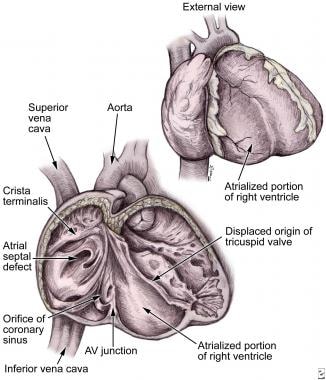
Anatomical features of Ebstein malformation are presented in Image 1.

The displacement of the septal and posterior leaflets of the tricuspid valve into the right ventricle leaves a portion of the right ventricular wall between the leaflet attachments and the true annulus in continuity with the right atria. This atrialized right ventricle is usually very thin and dilated with a decrease in the actual number of myocardial fibers. The functional right ventricle below the valve may also be thin and dilated with decreased contractile function (Anderson, 1979).

The anatomy of the conduction system is normal; the atrioventricular node is located at the apex of the triangle of Koch, and the sinoatrial node is located at the junction of the superior vena cava and the right atrium. The location of the bundle of His is normal, but abnormalities of the right bundle branch have been described (Anderson, 1979; Lev, 1970). Accessory atrioventricular connections are present in up to 20% of patients and are associated with Wolff-Parkinson-White syndrome (Danielson, 1992; Oh, 1985; Gentles, 1992).

The right atrium is enlarged and may reach enormous size. An atrial septal defect is usually present and ranges from a patent foramen ovale to a large secundum defect. The coronary arteries are normal in distribution, and the right coronary artery is often displaced by the enlarged right atrium and atrialized right ventricle. Associated cardiac anomalies include pulmonary stenosis or atresia, ventricular septal defect, patent ductus arteriosus, tetralogy of Fallot, and coarctation of the aorta (Watson, 1974; Kumar, 1971). In patients with Wolff-Parkinson-White syndrome, accessory pathways are typically the atrioventricular type and are localized to the right ventricular free wall or to the posterior interventricular septum (bundles of Kent) (Smith, 1982).

Ebstein malformation of the left atrioventricular valve occurs in up to 75% of patients with L-transposition of the great arteries or corrected transposition of the great arteries (Allwork, 1976). In these patients, displacement of the septal and posterior leaflets is similar to that in right-sided lesions, but the anterior leaflet is usually smaller (Anderson, 1978). In addition, the wall of the functional right ventricle is rarely thin and dilated, and the wall of the atrialized right ventricle is also less thin and dilated. Left-sided accessory pathways have been described only in those patients with Ebstein malformation of the left-sided atrioventricular valve.


Patients with Ebstein malformation and biventricular failure should not undergo attempted repair of the defect, and they should be considered candidates for orthotopic heart transplantation. Controversy exists concerning neonates with Ebstein malformation because some patients with severe defects may not be considered candidates for surgery (except possibly for heart transplantation).


Lab Studies

  • Routine laboratory study results may be in the reference range. In symptomatic neonates, acidosis may lead to metabolic and electrolyte derangements. Arterial blood gas levels determine the severity of cyanosis and indicate the amount of right-to-left shunting at the atrial septal defect.

Imaging Studies

  • Chest radiography
    • The heart shadow may be normal or marked by massive cardiomegaly. Typically, the shadow of the great vessels is narrow because of a small aorta and main pulmonary artery. Right atrial and right ventricular enlargement produces a heart shadow with a globular shape. The apical region of the left ventricle may be elevated from the diaphragm, as seen in right ventricular enlargement (see Image 2).
    • Pulmonary vascularity findings may range from normal to significantly decreased depending on the severity of the defect and the amount of pulmonary blood flow.
    • A cardiothoracic ratio greater than 0.65 is a predictor of sudden death; some physicians consider this finding an indication for surgery (Gentles, 1992).
  • Echocardiography
    • Echocardiography has evolved as the primary diagnostic tool to aid in diagnosing Ebstein malformation in patients. A well-documented correlation exists between findings upon echocardiography and findings upon operation or autopsy (Shiina, 1984).
    • Echocardiography can define the morphology of the tricuspid valve as well as specific abnormalities of the leaflets. In addition, the function, thickness, and size of the right and left ventricles can be assessed. Coexisting cardiac lesions can also be identified.
    • Color flow Doppler allows for better assessment of tricuspid valve incompetence and degree of shunting at the atrial level.
    • Two systems that classify disease severity have been developed based on echocardiographic findings. The classification of Carpentier is based on tricuspid valve morphology, while the classification of Celermajer is based on cardiac chamber size (Carpentier, 1988; Celermajer, 1992). More recently, real-time 3-dimensional transthoracic echocardiography has provided a more comprehensive assessment of the anatomic and morphologic features in patients with Ebstein anomaly (Patel, 2005).
    • If echocardiography is inadequate or indeterminate, cine computed tomography (CT) and magnetic resonance imaging (MRI) are also useful for diagnostic purposes (Link, 1988).
  • Cardiac catheterization
    • Prior to recent advances in echocardiography, cardiac catheterization was the definitive diagnostic study for patients with Ebstein malformation. Early studies demonstrated that cardiac catheterization in patients with Ebstein malformation was associated with an increased risk of arrhythmia and significant mortality (Watson, 1974). Currently, cardiac catheterization is reserved for patients with associated cardiac defects, previous shunt placements, or possible pulmonary artery stenosis.
    • During cardiac catheterization, hemodynamic findings usually demonstrate elevated right atrial pressures with a pulse wave contour showing a dominant v wave and a steep y descent. For patients with severe right atrial enlargement, the right atrial pulse wave may be normal despite the presence of severe tricuspid regurgitation.
    • Right ventricular pressure may be normal or mildly elevated. Significantly elevated right ventricular pressure may be found in patients with right ventricular outflow tract obstruction or elevated pulmonary artery pressures. The demonstration of right atrial pressure in the proximal right ventricle strongly indicates the presence of Ebstein malformation.
  • Angiography
    • Contrast angiography demonstrates right atrial enlargement and displacement of the septal and posterior tricuspid valve leaflets below the true tricuspid annulus. In most studies, the origin of the displaced septal and posterior leaflets can be seen on the right ventricular wall.
    • If the tricuspid valve is incompetent, contrast often moves back and forth between the right atrium and the right ventricle. Right-to-left shunting of contrast is seen across any atrial septal defect.
    • In most patients, blood flow through the right side of the heart and pulmonary arteries is slower than normal.

Diagnostic Procedures

  • ECG findings are almost always abnormal. Right axis deviation and right bundle-branch block are common. P wave morphology usually indicates right atrial enlargement, and the PR interval is often prolonged. Since both atrial arrhythmias and ventricular arrhythmias are common, the results of a 24-hour Holter monitor should be obtained from any patient with a history of arrhythmia or palpitation.
  • Electrophysiologic studies should be performed on those patients with a history of ventricular preexcitation, wide-complex arrhythmia, or syncope.


Medical therapy

Treatment must be individualized since the broad spectrum of presentations does not allow for a standardized approach. Although most patients require surgical intervention at some time, some patients who are mildly affected may never require surgery.

When neonates present with cyanosis and acidosis, they should be sedated, intubated, and paralyzed. Inotropic support and intensive medical management are necessary in neonates with severe ventricular dysfunction and congestive heart failure. Metabolic acidosis is managed with sodium bicarbonate infusion. Prostaglandin E1 (PGE1, alprostadil) therapy is initiated to maintain patency of the ductus arteriosus and to improve pulmonary blood flow (Ivy, 1993). In severe cases, inhaled nitric oxide therapy may lower pulmonary vascular resistance and improve pulmonary blood flow. If cyanosis improves, then PGE1 infusion can be weaned as pulmonary vascular resistance decreases. Following weaning from PGE1 therapy, close observation is required to assess whether the neonate oxygenates adequately after closure of the ductus arteriosus.

In older children and adults, medical treatment is confined to management of arrhythmia and symptom relief of congestive heart failure. Surgical therapy should be considered in any patient with progressive symptoms, exercise intolerance, or frequent arrhythmia.

Surgical therapy

Goals of surgical intervention are as follows: to increase pulmonary blood flow, to minimize tricuspid insufficiency, to reduce or eliminate right-to-left shunting, to optimize right ventricular function, and to reduce or eliminate arrhythmia. Ideally, the tricuspid valve can be repaired, which may allow the patient to avoid valve replacement with a bioprosthetic valve and the need for future valve replacement.

Preoperative details

Preoperative management should focus on optimal medical management of congestive heart failure and improvement in oxygenation. Neonates who are critically ill may require pulmonary vasodilator therapy and PGE1 to maintain ductal patency and adequate pulmonary blood flow. In addition, inotropic support may be used to improve cardiac function. Serum electrolyte balance and volume status should also be optimized prior to surgery. In older patients, medical management of atrial and ventricular arrhythmias or catheter ablation of accessory pathways may be necessary.

Intraoperative details

Most operations are performed using cardiopulmonary bypass, bicaval cannulation, moderate systemic hypothermia, and cardioplegia for myocardial arrest. In neonates, single venous cannulation and a period of circulatory arrest may also be used to complete the repair.

The Danielson repair consists of plication of the atrialized right ventricle in a horizontal plane, posterior tricuspid annuloplasty, closure of the atrial septal defect, and right atrial reduction (Danielson, 1979). The Danielson repair is depicted in Image 3. Plication of the atrialized right ventricle brings the base of the posterior leaflet into the plane of the anterior leaflet. Posterior annuloplasty brings the anterior leaflet closer to both the posterior leaflet and the septal leaflet and reduces the annular diameter. This repair essentially creates a competent monocuspid valve from the large anterior leaflet, which coapts to the free edge of the relocated posterior leaflet and the septal leaflet. The Danielson repair improves right ventricular function by obliterating the atrialized right ventricle and by achieving a competent tricuspid valve. In addition, electrophysiologic mapping for localization of accessory pathways is performed in patients witharrhythmia.

The Carpentier repair consists of plication of the atrialized right ventricle in a vertical plane, detachment and relocation of the lateral posterior leaflet and a portion of the anterior leaflet in the plane of the true annulus, and ring tricuspid annuloplasty (Carpentier, 1988). The Carpentier repair is depicted in Image 4.

This repair creates a bileaflet valve with the relocated posterior leaflet and septal leaflet serving as one leaflet to coapt with the anterior leaflet. Relocating the septal leaflet and the medial portion of the posterior leaflet to the true annulus is not possible because the ventricular septum cannot be plicated in the same way as the free wall of the atrialized right ventricle. In theory, this technique preserves the height of the right ventricle and restores right ventricular morphology. Carpentier morphologically classified this defect into types A, B, C, and D and proposed modifications for each type. His surgical approach is based largely on the motionand function of the anterior leaflet, as determined by preoperative echocardiography (Chauvaud, 2003).

The Hetzer repair consists of reduction in the size of the tricuspid orifice to achieve adequate coaptation of the most mobile leaflet tissue, closure of the atrial septal defect, and right atrial reduction (Hetzer, 1998). This repair differs from the Carpentier and Danielson techniques by not including a plication of the atrialized right ventricle. Interestingly, in patients with a cleft anterior tricuspid leaflet, this technique may create a dual-orifice tricuspid valve by approximating the posterior and anterior annulus in the middle of the valve orifice.

Newer techniques to repair the tricuspid valve in patients with Ebstein anomaly have centered on detachment of both the abnormal septal and posterior leaflets and their respective chordae and papillary muscles. This allows complete relocation of the leaflets to the level of the true annulus, but requires successful reimplantation of the papillary muscles of each leaflet. Early results with this type of technique have recently been reported (Wu, 2004).

The Starnes repair for neonates with Ebstein malformation consists of patch closure of the tricuspid valve orifice, atrial septectomy, and insertion of a systemic-to-pulmonary artery shunt (Starnes, 1991). The Starnes repair is depicted in Image 5. This repair creates a functional tricuspid atresia in the neonate as palliation to a subsequent single ventricle repair with a Fontan procedure. In some neonates, this procedure may result in distension of the right ventricle due to continued drainage of Thebesian veins into the ventricular cavity. Fenestration of the patch closing the orifice of the ventricle may be necessary to avoid this complication.

Tricuspid valve replacement is required if repair is not feasible or successful. Most institutions currently favor the use of porcine bioprosthetic valves for tricuspid valve replacement because mechanical valve replacement in the tricuspid position is associated with a high frequency of valve malfunction and thrombotic complications (Sanfelippo, 1976). Some replacement techniques oversize the bioprosthesis and attach the sewing annulus to the atrial wall proximal to the coronary sinus as shown in Image 6. This avoids suturing in the area of conduction tissue, but it places the coronary sinus in the right ventricle (Kiziltan, 1998). This type of supra-annnular implantation of a tricuspid valve bioprosthesis has been successfully used in adults with Ebstein anomaly to avoid complications related to arrhythmias (Tanaka, 2001).

Laks described a modification of this technique using a skirt of pericardium to bridge the conduction tissue and the triangle of Koch (Milgalter, 1991). This technique allows placement of the valve at the true annulus, avoids suturing in the area of conduction tissue, and leaves the coronary sinus draining into the right atrium. This modified approach is depicted in Image 7.

A shunt from the superior vena cava to pulmonary artery (Glenn shunt) used to be performed to improve pulmonary blood flow in patients with Ebstein malformation (Glenn, 1966). Early experiences determined this technique to be of limited usefulness in these patients. More recently, the use of Glenn shunts in patients with Ebstein malformation has been revisited with more promising short-term results (Marianeschi, 1998).

The right atrial Maze procedure is a modification of the Maze procedure and has been used to treat atrial arrhythmia in patients with Ebstein malformation (Kiziltan, 1998). This procedure may reduce or eliminate atrial arrhythmia by preventing reentry conduction at the atrial level. Currently, accessory conduction pathways can be treated with catheter-based radiofrequency ablation before or after surgical repair (Hetzer, 1998).

Heart transplantation has been used in patients with Ebstein malformation who have experienced failed attempts at repair, in those with severe biventricular dysfunction, and in symptomatic neonates with pulmonary atresia or other major cardiac defects (Mayer, 1990; Weyand, 1998). In addition, mechanical support has been used in infants with severe Ebstein malformation as a bridge to heart transplantation (Weyand, 1998). Lack of donors for neonates and infants, long waiting times, and current long-term survival make heart transplantation a controversial treatment option.

Postoperative details

Postoperative management of the neonate who is critically ill often requires continued therapy to reduce pulmonary vascular resistance by means of ventilator manipulation and PGE1 or nitric oxide therapy. Sedation with or without paralysis may be useful in the first 24 hours to help maintain hemodynamic and respiratory stability. Inotropic agents are usually necessary to support the poorly functioning right ventricle. Atrial and ventricular arrhythmias should be treated early and aggressively with intravenous therapy.

Postoperative treatment of older children and adults usually requires inotropic support and treatment of arrhythmia. Central venous pressure and waveform should be monitored for evidence of recurrent tricuspid insufficiency (in those patients undergoing valve repair) and right ventricular failure. Most patients can be weaned from ventilator support without difficulty and extubated early (within 12-24 h postoperatively).

Follow-up

Patients undergoing surgical repair require careful follow-up and echocardiographic evaluation to assess the tricuspid valve and right ventricular function. Following tricuspid valve repair, some patients with mild-to-moderate residual tricuspid incompetency progress to severe regurgitation and ultimately require valve replacement. An early evaluation of right ventricular function also serves as a baseline for comparison with future studies. Patients with medically managed arrhythmia need frequent evaluation to assess pharmaceutical dosing and efficacy.


Postoperative complications are often correlated with the age of the patient, severity of the defect, presence of associated defects, and difficulty of the repair. In neonates, the most common postoperative problems are low cardiac output and ventricular failure. Atrial and ventricular arrhythmias may occur. Neonates undergoing a repair to create a single ventricle physiology have shunt-dependent pulmonary circulation and may have complications related to increased or decreased shunt flow or thrombosis.

In older patients, residual tricuspid insufficiency following valve repair may be severe enough to warrant an early return to the operating room for tricuspid valve replacement. Ventricular dysfunction and right ventricular failure may require significant inotropic support during postoperative recovery. Atrial and ventricular arrhythmias occurring in the early postoperative period may be difficult to manage medically, and they may be associated with ventricular dysfunction. In addition, complete heart block may occur with either valve repair or valve replacement, requiring the use of a temporary pacemaker and possibly the implantation of a permanent pacemaker. Myocardial ischemia may occur because the right coronary artery may be compromised by suture plication of the atrialized right ventricle.


Long-term results of surgical treatment are continuing to improve. Patients who present at a younger age with associated defects or severe symptoms have a worse prognosis. In addition, moderate-to-severe cyanosis, a cardiothoracic ratio greater than 0.65, and NYHA class III and class IV are also predictors of increased mortality (Kumar, 1971; Gentles, 1992; Celermajer, 1994; Yetman, 1998).

Danielson and colleagues at the Mayo Clinic have surgical experience with more than 400 patients with Ebstein malformation (Danielson, 2000). The data have recently been analyzed for the first 312 patients undergoing surgical intervention from 1972-1996. Patients range in age from 9 months to 71 years, with a mean age of 20.7 years. No neonates were in this group.

In the Danielson study, tricuspid valve repair was successful in 43% of patients, and bioprosthesis was used to replace the tricuspid valve in 53% of patients. Approximately 4% of patients underwent a Fontan reconstruction or other procedure. In this series, 20 (6.4% early mortality) hospital deaths and 24 (7.3%) late deaths occurred. Forty-four patients had accessory conduction pathways (Wolff-Parkinson-White syndrome) and underwent successful pathway ablation as part of the repair. Fifteen patients underwent right-sided Maze procedures for control of atrial dysrhythmia, and 4 underwent ablation of the atrioventricular node for reentry tachycardia. Seventeen (12.6%) of the 135 patients who underwent valve repair required reoperation for valve regurgitation 1.5-18 years later (mean, 8.7 y). Eight bioprosthetic valves required replacement 1-16 years after implantation.

Reduction in cardiomegaly occurred in most patients. Atrial arrhythmia decreased, and late postoperative exercise testing showed a significant improvement in performance. Maximal oxygen consumption increased from a mean of 47% predicted value preoperatively to a mean of 72% postoperatively. Follow-up of those patients evaluated more than a year after operation determined that 93% were NYHA functional class I or class II. Carpentier, Hetzer, and others have reported similar results using different techniques of repair in much smaller series of patients (Carpentier, 1988; Hetzer, 1998; Quaegebeur, 1991; Marianeschi, 1998, Chen, 2004). The addition of a right atrial Maze procedure to the repair has been successful in reducing or eliminating atrial arrhythmia (Kiziltan, 1998).

Dearani and Danielson recently reported on their experience with tricuspid valve repair of Ebstein anomaly in young children from 1974-2003 (Dearani, 2006). This is an experience of 52 children, aged 5 months to 12 years, with a mean age of 7 years. Early mortality was 5.8% (3 patients), with no mortality since 1984. Freedom from all reoperations at 5, 10, and 15 years was 91%, 77%, and 61%, respectively. Tricuspid stenosis was not described in any patient despite significant somatic growth of these children following tricuspid valve repair.

In infants and children undergoing tricuspid valve replacement, insertion of the largest possible bioprosthetic valve is beneficial to accommodate growth. The durability of a porcine bioprosthesis for tricuspid valve replacement has been favorable, with freedom from reoperation of 97% at 5 years and 81% at 15 years (Kiziltan, 1998). Furthermore, warfarin anticoagulation is not necessary in the absence of atrial fibrillation.

Starnes and colleagues reported a series of 5 symptomatic neonates who underwent closure of the tricuspid orifice, atrial septectomy, and systemic-to-pulmonary artery shunt (Starnes, 1991). All 5 patients (aged 1-9 d) survived, and 2 of them have successfully undergone a Fontan reconstruction. Unfortunately, surgical intervention in symptomatic neonates continues to be associated with a high mortality in most centers. Improvements in the surgical outcomes of this high-risk group have recently been reported (McElhinney, 2005; Knott-Craig, 2002).


Ebstein malformation presents with a wide spectrum of morphologic variability and clinical manifestations across an extreme age range. Controversy still exists regarding the best management of symptomatic neonates. Neonates who are critically ill have an extremely high mortality with or without surgical intervention. If intervention is taken, whether a single ventricle approach ultimately improves the outcome remains uncertain. A definite role for use of the Glenn shunt in the treatment of these patients is also unclear. The role of cardiac transplantation in these patients remains controversial. With advances in fetal cardiac surgery and catheterization, in utero intervention may play a role in fetuses diagnosed with severe forms of Ebstein malformation and may improve subsequent survival.

In older children and adults who become symptomatic, indications and the timing of surgical repair remain controversial. Fortunately, current surgical techniques have led to increasingly better surgical outcomes and long-term results in this diverse group of patients.


Media file 1:  Anatomical features of Ebstein malformation. Note the atrialized portion of the right ventricle and displacement of the tricuspid valve.
Click to see larger pictureClick to see detailView Full Size Image
Media type:  Image

Media file 2:  Characteristic chest radiograph of a neonate with Ebstein malformation. The heart shadow demonstrates cardiomegaly with evidence of severe right atrial enlargement.
Click to see larger pictureClick to see detailView Full Size Image
Media type:  X-RAY

Media file 3:  Surgical repair of Ebstein malformation as described by Danielson. A, The right atrium is incised and reduced, and the atrial septal defect is closed with a patch. The arrow identifies the large anterior leaflet. B, Mattress sutures with felt pledgets are used to pull the tricuspid annulus and valve together in a horizontal plane, obliterating the atrialized right ventricle. C, Sutures are tied after all have been inserted. The arrow identifies the septal leaflet. D, A posterior annuloplasty is used to narrow the orifice of the tricuspid annulus. E, Completed repair resulting in a competent tricuspid valve.
Click to see larger pictureClick to see detailView Full Size Image
Media type:  Image

Media file 4:  Surgical repair of Ebstein malformation as described by Carpentier. The anterior and posterior leaflets are detached from the tricuspid annulus. In type D lesions, fenestrations are used to create interchordal spaces for the passage of blood into the right ventricle outflow tract (insert). Mattress sutures with pledgets are placed in a vertical plane to plicate the atrialized portion of the right ventricle (top right). The anterior leaflet is reattached at the level of the true annulus with a continuous running suture (bottom left). An annuloplasty ring is inserted to reinforce the repair (bottom right).
Click to see larger pictureClick to see detailView Full Size Image
Media type:  Image

Media file 5:  Surgical repair of Ebstein malformation in the neonate as described by Starnes. The atrial septal defect is enlarged by excising the remaining septum. The tricuspid valve orifice is closed with a Gore-Tex patch, effectively creating tricuspid atresia. A Gore-Tex shunt (not shown) is then placed to connect the innominate artery to the right pulmonary artery.
Click to see larger pictureClick to see detailView Full Size Image
Media type:  Image

Media file 6:  Surgical replacement of the tricuspid valve in Ebstein malformation. A, The atrialized right ventricle is plicated in a horizontal plane. B, Sutures are placed on the atrial side of the coronary sinus and atrioventricular node to avoid injury to the conduction system. C, Sutures are tied with the heart beating and perfused to ensure the conduction system is intact.
Click to see larger pictureClick to see detailView Full Size Image
Media type:  Image

Media file 7:  Surgical replacement of the tricuspid valve using a pericardial patch to avoid injury to the conduction system. The valve insertion is begun anterior to the coronary sinus using a continuous running suture. A glutaraldehyde-treated pericardial patch is sutured to the septal portion of the prosthetic valve sewing annulus. The free margin of the patch is then sutured to the atrial tissue beyond the area of the conduction tissue.
Click to see larger pictureClick to see detailView Full Size Image
Media type:  Image


  • Allwork SP, Bentall HH, Becker AE, et al. Congenitally corrected transposition of the great arteries: morphologic study of 32 cases. Am J Cardiol. Dec 1976;38(7):910-23. [Medline].
  • Anderson KR, Lie JT. The right ventricular myocardium in Ebstein''s anomaly: a morphometric histopathologic study. Mayo Clin Proc. Mar 1979;54(3):181-4. [Medline].
  • Anderson KR, Danielson GK, McGoon DC, Lie JT. Ebstein's anomaly of the left-sided tricuspid valve: pathological anatomy of the valvular malformation. Circulation. Sep 1978;58(3 Pt 2):I87-91. [Medline].
  • Barber G, Danielson GK, Heise CT, Driscoll DJ. Cardiorespiratory response to exercise in Ebstein''s anomaly. Am J Cardiol. Sep 15 1985;56(8):509-14. [Medline].
  • Barnard CN, Schrire V. Surgical correction of Ebstein''s malformation with prosthetic tricuspid valve. Surgery. Aug 1963;54:302-8. [Medline].
  • Benson LN, Child JS, Schwaiger M, et al. Left ventricular geometry and function in adults with Ebstein''s anomaly of the tricuspid valve. Circulation. Feb 1987;75(2):353-9. [Medline].
  • Boston US, Dearani JA, O'Leary PW, et al. Tricuspid valve repair for Ebstein's anomaly in young children: a 30-year experience. Ann Thorac Surg. Feb 2006;81(2):690-5; discussion 695-6. [Medline].
  • Carpentier A, Chauvaud S, Mace L, et al. A new reconstructive operation for Ebstein''s anomaly of the tricuspid valve. J Thorac Cardiovasc Surg. Jul 1988;96(1):92-101. [Medline].
  • Celermajer DS, Dodd SM, Greenwald SE, et al. Morbid anatomy in neonates with Ebstein''s anomaly of the tricuspid valve: pathophysiologic and clinical implications. J Am Coll Cardiol. Apr 1992;19(5):1049-53. [Medline].
  • Celermajer DS, Bull C, Till JA, et al. Ebstein''s anomaly: presentation and outcome from fetus to adult. J Am Coll Cardiol. Jan 1994;23(1):170-6. [Medline].
  • Chauvaud S, Berrebi A, d'Attellis N, et al. Ebstein's anomaly: repair based on functional analysis. Eur J Cardiothorac Surg. 2003;23(4):525-31. [Medline].
  • Chen JM, Mosca RS, Altmann K, et al. Early and medium-term results for repair of Ebstein anomaly. J Thorac Cardiovasc Surg. 2004;127 (4):990-8. [Medline].
  • Danielson GK, Maloney JD, Devloo RA. Surgical repair of Ebstein''s anomaly. Mayo Clin Proc. Mar 1979;54(3):185-92. [Medline].
  • Danielson GK, Driscoll DJ, Mair DD, et al. Operative treatment of Ebstein''s anomaly. J Thorac Cardiovasc Surg. Nov 1992;104(5):1195-202. [Medline].
  • Danielson GK. Ebstein's anomaly: Historical aspects and current management. AHA Cardiothoracic and Vascular Newsletter. 2000.
  • Ebstein W. Ueber einen sehr seltenen Fall von Insufficienz der Valvula Tricuspidalis bedingt durch eine angeborene hochgradige Missbildung derselben. Arch Anat Physiol. 1866;33:238.
  • Gentles TL, Calder AL, Clarkson PM, Neutze JM. Predictors of long-term survival with Ebstein''s anomaly of the tricuspid valve. Am J Cardiol. Feb 1 1992;69(4):377-81. [Medline].
  • Giuliani ER, Fuster V, Brandenburg RO, Mair DD. Ebstein''s anomaly: the clinical features and natural history of Ebstein''s anomaly of the tricuspid valve. Mayo Clin Proc. Mar 1979;54(3):163-73. [Medline].
  • Glenn WW, Browne M, Whittemore R. Circulatory bypass of the right side of the heart: Cavo-pulmonary artery shunt–Indications and results (report of a collected series of 537 cases). In: Cassels DE, ed. The heart and circulation in newborn and infant. New York, NY:. Grune & Stratton;1966:345.
  • Hardy KL, May IA, Webster CA, Kimball KG. Ebstein''s anomaly: A functional concept and successful definitive repair. J Thorac Cardiovasc Surg. Dec 1964;48:927-40. [Medline].
  • Hetzer R, Nagdyman N, Ewert P, et al. A modified repair technique for tricuspid incompetence in Ebstein''s anomaly. J Thorac Cardiovasc Surg. Apr 1998;115(4):857-68. [Medline].
  • Hong YM, Moller JH. Ebstein''s anomaly: a long-term study of survival. Am Heart J. May 1993;125(5 Pt 1):1419-24. [Medline].
  • Hunter SW, Lillehei CW. Ebstein''s malformation of the tricuspid valve; study of a case together with suggestion of a new form of surgical therapy. Dis Chest. Mar 1958;33(3):297-304. [Medline].
  • Ivy D, Loehr J, Schaffer M. Usefulness of prolonged prostaglandin infusion in neonates with Ebstein''s anomaly. Am J Cardiol. Dec 1 1993;72(17):1327-9. [Medline].
  • Kiziltan HT, Theodoro DA, Warnes CA, et al. Late results of bioprosthetic tricuspid valve replacement in Ebstein''s anomaly. Ann Thorac Surg. Nov 1998;66(5):1539-45. [Medline].
  • Knott-Craig CJ, Overholt ED, Ward KE, et al. Repair of Ebstein's anomaly in the symptomatic neonate: an evolution of technique with 7-year follow-up. Ann Thorac Surg. 2002;73(6):1786-92. [Medline].
  • Kumar AE, Fyler DC, Miettinen OS, Nadas AS. Ebstein''s anomaly. Clinical profile and natural history. Am J Cardiol. Jul 1971;28(1):84-95. [Medline].
  • Lev M, Liberthson RR, Joseph RH, et al. The pathologic anatomy of Ebstein''s disease. Arch Pathol. Oct 1970;90(4):334-43. [Medline].
  • Link KM, Herrera MA, D''Souza VJ, Formanek AG. MR imaging of Ebstein anomaly: results in four cases. AJR Am J Roentgenol. Feb 1988;150(2):363-7. [Medline].
  • Marianeschi SM, McElhinney DB, Reddy VM, et al. Alternative approach to the repair of Ebstein''s malformation: intracardiac repair with ventricular unloading. Ann Thorac Surg. Nov 1998;66(5):1546-50. [Medline].
  • Mayer JE Jr, Perry S, O''Brien P, et al. Orthotopic heart transplantation for complex congenital heart disease. J Thorac Cardiovasc Surg. Mar 1990;99(3):484-91; discussion 491-2. [Medline].
  • McElhinney DB, Salvin JW, Colan SD, et al. Improving outcomes in fetuses and neonates with congenital displacement (Ebstein's malformation) or dysplasia of the tricuspid valve. Am J Cardiol. 2005;96(4):582-6. [Medline].
  • Milgalter E, Laks H. Use of a pericardial patch to bridge the conduction tissue during tricuspid valve replacement. Ann Thorac Surg. Dec 1991;52(6):1337-9. [Medline].
  • Netter FH, Van Mierop LH. Embryology. In: Yonkman FF, ed. The Ciba Collection of Medical Illustrations. Vol 5. Summit, NJ:. Ciba Pharmaceutical Co;1969:125.
  • Oh JK, Holmes DR Jr, Hayes DL, et al. Cardiac arrhythmias in patients with surgical repair of Ebstein''s anomaly. J Am Coll Cardiol. Dec 1985;6(6):1351-7. [Medline].
  • Patel V, Nanda NC, Rajdev S, et al. Live/real time three-dimensional transthoracic echocardiographic assessment of Ebstein's anomaly. Echocardiopgraphy. 2005;22(10):847-54. [Medline].
  • Quaegebeur JM, Sreeram N, Fraser AG, et al. Surgery for Ebstein''s anomaly: the clinical and echocardiographic evaluation of a new technique. J Am Coll Cardiol. Mar 1 1991;17(3):722-8. [Medline].
  • Sanfelippo PM, Giuliani ER, Danielson GK, et al. Tricuspid valve prosthetic replacement. Early and late results with the Starr-Edwards prosthesis. J Thorac Cardiovasc Surg. Mar 1976;71(3):441-5. [Medline].
  • Shiina A, Seward JB, Edwards WD, et al. Two-dimensional echocardiographic spectrum of Ebstein''s anomaly: detailed anatomic assessment. J Am Coll Cardiol. Feb 1984;3(2 Pt 1):356-70. [Medline].
  • Smith WM, Gallagher JJ, Kerr CR, et al. The electrophysiologic basis and management of symptomatic recurrent tachycardia in patients with Ebstein''s anomaly of the tricuspid valve. Am J Cardiol. Apr 1 1982;49(5):1223-34. [Medline].
  • Spitaels SE. Ebstein''s anomaly of the tricuspid valve complexities and strategies. Cardiol Clin. Aug 2002;20(3):431-9, vii. [Medline].
  • Starnes VA, Pitlick PT, Bernstein D, et al. Ebstein''s anomaly appearing in the neonate. A new surgical approach. J Thorac Cardiovasc Surg. Jun 1991;101(6):1082-7. [Medline].
  • Tanaka M, Ohata T, Fukuda S, et al. Tricuspid valve supra-annular implantation in adult patients with Ebstein's anomaly. Ann Thorac Surg. 2001;71(2):582-6. [Medline].
  • Watanabe M, Harada Y, Takeuchi T, et al. Modified Starnes operation for neonatal Ebstein''s anomaly. Ann Thorac Surg. Sep 2002;74(3):916-7. [Medline].
  • Watson H. Natural history of Ebstein''s anomaly of tricuspid valve in childhood and adolescence. An international co-operative study of 505 cases. Br Heart J. May 1974;36(5):417-27. [Medline].
  • Weyand M, Kececioglu D, Kehl HG, et al. Neonatal mechanical bridging to total orthotopic heart transplantation. Ann Thorac Surg. Aug 1998;66(2):519-22. [Medline].
  • Wu Q, Huang Z. A new procedure for Ebstein's anomaly. Ann Thorac Surg. 2004;77(2):470-6. [Medline].
  • Yetman AT, Freedom RM, McCrindle BW. Outcome in cyanotic neonates with Ebstein''s anomaly. Am J Cardiol. Mar 15 1998;81(6):749-54. [Medline].
  • Zalzstein E, Koren G, Einarson T, Freedom RM. A case-control study on the association between first trimester exposure to lithium and Ebstein''s anomaly. Am J Cardiol. Mar 15 1990;65(11):817-8. [Medline].
  • van Son JA, Konstantinov IE, Zimmerman V. Wilhelm Ebstein and Ebstein's malformation. Eur J Cardiothorac Surg. 2001;20(5):1082-5. [Medline].

Ebstein Malformation: Surgical Perspective excerpt

Article Last Updated: Jun 16, 2006