Continually Updated Clinical Reference
 
 
  All Sources     eMedicine     Medscape     Drug Reference     MEDLINE
 
eMedicine - Atrial Septal Defect, Unroofed Coronary Sinus: Surgical Perspective : Article by

Quick Find
Authors & Editors
Introduction
Indications
Relevant Anatomy
Contraindications
Workup
Treatment
Complications
Outcome and Prognosis
Future and Controversies
Multimedia
References


Patient Education
Heart Center

Ventricular Septal Defect Overview

Ventricular Septal Defect Causes

Ventricular Septal Defect Symptoms

Ventricular Septal Defect Treatment

Tetralogy of Fallot Overview


Author: Samuel Weinstein, MD, Associate Professor, Albert Einstein College of Medicine; Director, Department of Pediatric Cardiothoracic Surgery, The Children's Hospital at Montefiore

Samuel Weinstein is a member of the following medical societies: American College of Surgeons, American Heart Association, American Medical Association, Ohio State Medical Association, and Society of Thoracic Surgeons

Coauthor(s): Robert E Michler, MD, Karl P Klassen Chair and Professor of Surgery, Ohio State University; Chief, Division of Cardiothoracic Surgery and Thoracic Transplantation, Montefiore Medical Center; Suzanne Courtwright, MS, CPNP, Pediatric Nurse Practitioner, Department of Cardiothoracic Surgery, Division of Pediatric and Adult Congenital Heart Disease, Montefiore Medical Center

Editors: Daniel S Schwartz, MD, FACS, Clinical Assistant Professor of Cardiothoracic Surgery, New York University School of Medicine; Consulting Staff, Department of Surgery, Division of Thoracic Surgery, North Shore University Hospital/Long Island Jewish Medical Center; Mary L Windle, PharmD, Adjunct Assistant Professor, University of Nebraska Medical Center College of Pharmacy, Pharmacy Editor, eMedicine.com, Inc; John Myers, MD, Director, Pediatric and Congenital Cardiovascular Surgery, Departments of Surgery and Pediatrics, Professor, Penn State Children's Hospital, Milton S Hershey Medical Center; Daniel Rauch, MD, FAAP, Director, Pediatric Hospitalist Program, Associate Professor, Department of Pediatrics, New York University School of Medicine; John Kupferschmid, MD, Director of Congenital Heart Surgery, Department of Surgery, Methodist Children's Hospital at San Antonio

Author and Editor Disclosure

Synonyms and related keywords: atrial septal defect, unroofed coronary sinus, ASD, coronary sinus atrial septal defect, coronary sinus ASD, persistent left superior vena cava, persistent LSVC, left superior vena cava, LSVC, left SVC, right superior vena cava, RSVC, right anterior cardinal vein, left anterior cardinal vein, coronary sinus, unroofed coronary sinus atrial septal defect, unroofed coronary sinus ASD

Coronary sinus atrial septal defects (ASDs) are rare and usually associated with other forms of congenital heart disease, usually heterotaxy syndromes. They are also frequently associated with a persistent left superior vena cava (LSVC), which is the most common anomaly of systemic venous drainage (Ramos, 2005).

Problem

Symptomatology stems from right-to-left shunting, the amount of which is related to the size of the defect and the presence or absence of a persistent LSVC draining into or through it. The presence of a persistent LSVC also creates risk for brain abscess and cerebral emboli (Troost, 2006). Undiagnosed, this defect may leave behind a significant residual right-to-left shunting flowing surgical repair of other associated defects (Watanabe, 2004).

Etiology

Coronary sinus ASDs are usually associated with other forms of congenital heart disease (eg, heterotaxy syndromes) or persistent LSVC. Persistent LSVC occurs in 0.1-0.5% of the general population, with 8% draining into the left atrium. Unroofed coronary sinus ASD is seen in 75% of patients with an LSVC that drains into the left atrium and is usually associated with other forms of congenital heart disease and heterotaxy syndromes (Ramos, 2005).

Pathophysiology

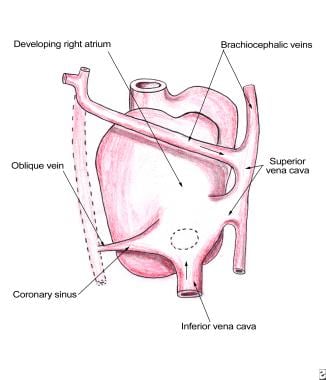
In normal fetal development, the paired anterior cardinal veins drain the upper body and extremities of the fetus and become connected by an oblique vessel. During the 8-week period of embryological development, a communication forms between the veins, which becomes the innominate vein. The distal end of the left anterior cardinal vein degenerates, and the remaining right anterior cardinal vein ultimately becomes the right superior vena cava (RSVC).

The distal end of the left anterior cardinal vein drains into the coronary sinus before it degenerates; this explains the drainage pattern of a persistent LSVC into the coronary sinus. Failure of the distal left anterior cardinal vein to degenerate is possible with or without degeneration of the right cardinal veins (Ramos, 2005). A persistent LSVC can be the sole drainage of systemic venous blood in the upper extremities and the head, or it may exist in conjunction with an RSVC. With dual superior vena cavae (SVCs), a bridging innominate vein is often not present.

Clinical

Patients usually present with symptoms related to their concomitant defects. Unroofed coronary sinus ASD is difficult to diagnose based on clinical signs and symptoms alone and should be suspected in a patient with an LSVC and a history of brain abscess or cerebral emboli or in a patient with a left-to-right interarterial shunt with unexplained arterial oxygen desaturation. Suspect a brain abscess or a cerebral embolism whenever an LSVC is seen on an echocardiograph. Coronary sinus ASDs have been reported to occur with several other congenital heart defects, such as canal defects (Alexi-Meskishvili, 1999), cor triatriatum (van Son, 1999), pulmonary atresia or stenosis, abnormal ventriculoarterial connection (Miraldi, 2002), tetralogy of Fallot, and anomalous pulmonary venous return (Takahashi, 2005).


As in other ASDs, indications for surgery include symptoms of ASD physiology (eg, left-to-right shunting), right heart volume overload, and risk of cerebral embolism. Indications for surgical repair include complications from right-to-left shunting, including cerebral emboli and brain abscesses (Troost, 2006).


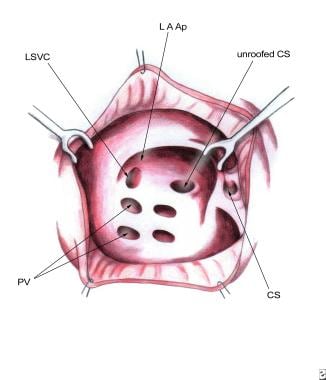
The LSVC enters the pericardium anterior to the left pulmonary artery. It then runs posterior to enter the left atrium and drain through the coronary sinus to the right atrium. When the wall between the coronary sinus tube and left atrium fails to form (which is thought to be caused by a maldevelopment of the arteriosinus fold) the systemic venous blood drains directly into the left atrium. This fenestration into the left atrium usually occurs between the left atrial appendage and the left upper pulmonary vein (Drinkwater, 1996). When this fold is missing, the defect is called an unroofed coronary sinus or unroofed coronary sinus ASD.


Surgery is contraindicated in the presence of major genetic abnormalities.


Imaging Studies

  • Echocardiography and MRI can reveal a left SVC before surgery; however, the diagnosis can be missed even by those with experience, which can lead to a diagnosis made at the time of surgery (Hahm, 2000).


Surgical therapy

The goals of surgical therapy include the separation of systemic venous drainage from pulmonary venous drainage, completion of the atrial septum, and management of the LSVC, if present. This lesion can be repaired with systemic venous cannulation of LSVC, RSVC, and IVC; right atriotomy and cardiac arrest; or with circulatory arrest if the patient is an infant or neonate.

Intraoperative details

Repair of a coronary sinus ASD without a LSVC can be accomplished with a roofing procedure (Takahashi, 2005). After cardiac arrest and right atriotomy, the defect is examined through the atrial septum. If the atrial septum is intact, the fossa ovalis is incised for exposure. When the tissues are redundant, the defect can be closed primarily. A cannula or obturator may be introduced into the coronary sinus toward the left atrium to stent the area while a roof of pericardial tissue is created (de Leval, 1994). The patch runs from a location between the left atrial (LA) appendage and upper pulmonary veins, continues inferiorly toward the mitral valve, and terminates near the right atrium and right atrial orifice of the coronary sinus. Bites are placed superficially toward the right side of the atrium to avoid injury to conduction tissue (de Leval, 1994). The atrial septum is then repaired primarily or with a patch.

If an LSVC is present, the repair can be performed in a similar manner, or with an intraatrial baffle to help avoid narrowing of pulmonary veins or obstruction of the mitral valve (de Leval, 1994; Mainwairing, 1998; Ootaki, 2003). After cardiac arrest and right atriotomy, the atrial septum is first incised for exposure if the ASD is small or nonexistent. A patch of pericardium serves as a baffle, separating the orifice of the left SVC from the pulmonary veins. This allows the pulmonary venous blood to drain toward the mitral valve, while the systemic venous blood drains directly to the right atrium. When a common atrium is present or when a coronary sinus is absent, landmarks for the conduction system are not available to the surgeon (de Leval, 1994). To remedy this and avoid the area of conduction, de Leval has described placement of the sutures along the base of the septal leaflet of the tricuspid valve and then out onto the right atrial wall beyond the tricuspid valve annulus.

In each case, the left SVC is addressed on its own merits. If it is small and a bridging innominate vein is present, the left SVC can be ligated. Others have recommended ligation when the occlusion pressure is less than 16 mm Hg (Ootaki, 2003). If it is large and is the sole source of venous drainage for the upper extremities and head, an intraatrial baffle can be considered. Still, others have described extracardial techniques, ie, reimplantation of the LSVC into the right atrium (Shumacker et al, 1967, in de Leval, 1994) or RSVC (van Son, 1998).

Postoperative details

An LSVC to the left atrium with absence of the coronary sinus and with a low-lying ASD is known as Raghib syndrome. Physiologically, this is similar to an unroofed coronary sinus ASD with an LSVC and common atrium. This syndrome should be suspected whenever an inferior type sinus venosus ASD is present with a LSVC. Simple closure of the ASD results in arterial desaturation. ASD repair and LSVC ligation can be performed, or, in more complex situations, excision of the atrial septum with an intraatrial baffle can be preformed (Mainwairing, 1998).

Follow-up

For excellent patient education resources, visit eMedicine's Heart Center. Also, see eMedicine's patient education articles Ventricular Septal Defect and Tetralogy of Fallot.


Complications are similar to other atrial level repairs. Risks of residual left-to-right shunting and risk of heart block or sinus node dysfunction are most commonly encountered. However, these ASDs are usually seen with other lesions, which may have more severe complications that take precedence.


Outcome and prognosis for an isolated coronary sinus ASD are excellent, but the more serious lesions that can be associated may alter the overall outcome for a patient.


Results of surgical repair are closely related to the complexity of the associated lesions also being operated on. An unroofed coronary sinus should be suspected whenever an LSVC is encountered on echocardiogram. Failure to repair these defects results in excessive blood return to the heart and a residual right-to-left shunt.

Debate on this topic is negligible because this ASD is a very rare lesion—most centers may see 1 or 2 a year. A minimally invasive approach could be discussed, but these ASDs are observed in children who usually have other more complex problems; thus, a minimally invasive approach would often not apply.


Media file 1:  The dotted line illustrates the degenerated left anterior cardinal vein. This posterior view illustrates how the left superior vena cava will drain into the coronary sinus.
Click to see larger pictureClick to see detailView Full Size Image
Media type:  Image

Media file 2:  The fenestration is seen draining between the left atrial appendage and the pulmonary veins.
Click to see larger pictureClick to see detailView Full Size Image
Media type:  Image

Media file 3:  3A: A venous cannula stent opens the coronary sinus while sutures are placed. 3B: A pericardial patch is used in a roofing procedure.
Click to see larger pictureClick to see detailView Full Size Image
Media type:  Image

Media file 4:  A pericardial patch is used to baffle the pulmonary veins directly toward the mitral valve. This approach allows unobstructed flow from the orifice of the left superior vena cava to drain to the right-sided atrium.

Click to see larger pictureClick to see detailView Full Size Image
Media type:  Image


  • Aikawa S, Abe M, Yoshimura Y, et al. Surgical treatment in an infant with atrial septal defect and persistent left superior vena cava draining into the coronary sinus; report of a case. Kyobu Geka. Jun 2003;56(6):494-6. [Medline].
  • Alexi-Meskishvili V, Dahnert I, Beyer E, et al. Successful total correction of complete atrioventricular canal, total anomalous pulmonary venous drainage and unroofed coronary sinus in an infant. Eur J Cardiothorac Surg. Jan 1999;15(1):95-6. [Medline].
  • Banitt PF. Total anomalous pulmonary venous connection to unroofed coronary sinus in patient with no symptoms. Am Heart J. Oct 1996;132(4):886-8. [Medline].
  • Brunelli F, Amaducci A, Mhagna Z, et al. Uncommon presentation and surgical correction of unroofed coronary sinus syndrome. Ann Thorac Surg. Aug 2003;76(2):619-21. [Medline].
  • De Leval M. Anomalies of the systemic venous return. In: Stark J, De Leval M, eds. Surgery for Congenital Heart Defects. 2nd ed. Philadelphia:. WB Saunders Co;1994:322-326.
  • Drinkwater DC, D'Agostino HJ. Anomalous pulmonary and systemic venous connections. In: Baue AE, Geha AS, et al, eds. Glenn's Thoracic and Cardiovascualr Surgery. 6th ed. Conn:. Appleton & Lange;1996:1113-1114.
  • Gonzalez-Juanatey C, Testa A, Vidan J, et al. Persistent left superior vena cava draining into the coronary sinus: report of 10 cases and literature review. Clin Cardiol. Sep 2004;27(9):515-8. [Medline].
  • Hahm JK, Park YW, Lee JK, et al. Magnetic resonance imaging of unroofed coronary sinus: three cases. Pediatr Cardiol. Jul-Aug 2000;21(4):382-7. [Medline].
  • Iga K, Hori K, Matsumura T, et al. Unroofed coronary sinus syndrome: diagnostic consideration by contrast echocardiography and usefulness of transesophageal echocardiography and magnetic resonance imaging. Heart Vessels. 1992;7(2):91-4. [Medline].
  • Mainwairing RD, Lamberti JL. Atrial septal defects. In: Kaiser LR, Kron IL, Spray TL, eds. Mastery of Cardiothoracic Surgery. Philadelphia:. Lippincott-Raven;1998:683-686.
  • Matsuwaka R, Tomokuni T, Ishikawa S, et al. Partially unroofed coronary sinus associated with tricuspid atresia. An important associated lesion in the Fontan operation. Eur J Cardiothorac Surg. 1987;1(3):180-2. [Medline].
  • Miraldi F, di Gioia CR, Proietti P, et al. Cardinal vein isomerism: an embryological hypothesis to explain a persistent left superior vena cava draining into the roof of the left atrium in the absence of coronary sinus and atrial septal defect. Cardiovasc Pathol. May-Jun 2002;11(3):149-52. [Medline].
  • Moore KL. The Developing Human: Clinically Oriented Embryology. Philadelphia:. WB Saunders Co;1982:299-302.
  • Ootaki Y, Yamaguchi M, Yoshimura N, et al. Unroofed coronary sinus syndrome: diagnosis, classification, and surgical treatment. J Thorac Cardiovasc Surg. Nov 2003;126(5):1655-6. [Medline].
  • Ramos N, Fernandez-Pineda L, Tamariz-Martel A, et al. [Absent right superior vena cava with left superior vena cava draining to an unroofed coronary sinus]. Rev Esp Cardiol. Aug 2005;58(8):984-7. [Medline].
  • Takahashi H, Kaminishi Y, Saito T, Misawa Y. Anatomical repair of partially unroofed coronary sinus syndrome through the coronary sinus orifice. Ann Thorac Cardiovasc Surg. Jun 2005;11(3):208-10. [Medline].
  • Troost E, Gewillig M, Budts W. Percutaneous closure of a persistent left superior vena cava connected to the left atrium. Int J Cardiol. Jan 26 2006;106(3):365-6. [Medline].
  • Watanabe M, Ono S, Okada Y, et al. Spontaneous closure of an unroofed coronary sinus. Pediatr Int. Dec 2004;46(6):722-5. [Medline].
  • van Son JA, Autschbach R, Mohr FW. Repair of cor triatriatum associated with partially unroofed coronary sinus. Ann Thorac Surg. Oct 1999;68(4):1414-6. [Medline].
  • van Son JA, Black MD, Haas GS, et al. Extracardiac repair versus intracardiac baffle repair of complex unroofed coronary sinus. Thorac Cardiovasc Surg. Dec 1998;46(6):371-4. [Medline].

Atrial Septal Defect, Unroofed Coronary Sinus: Surgical Perspective excerpt

Article Last Updated: Jun 19, 2006