Continually Updated Clinical Reference
 
 
  All Sources     eMedicine     Medscape     Drug Reference     MEDLINE
 
eMedicine - Vascular Ring, Double Aortic Arch : Article by

Quick Find
Authors & Editors
Introduction
Clinical
Differentials
Workup
Treatment
Medication
Follow-up
Miscellaneous
Multimedia
References

Related Articles
Asthma

Bronchiolitis

Congenital Stridor

Laryngomalacia

Pulmonary Artery Sling

Respiratory Syncytial Virus Infection

Stridor

Subglottic Stenosis

Tracheomalacia

Vascular Ring, Right Aortic Arch


Patient Education
Click here for patient education.


Author: Doff B McElhinney, MD, Assistant Professor of Pediatrics, Harvard Medical School; Associate in Cardiology, Department of Cardiology, Children's Hospital of Boston

Doff B McElhinney is a member of the following medical societies: American Academy of Pediatrics and American College of Cardiology

Coauthor(s): Gil Wernovsky, MD, FACC, FAAP, Children's Hospital of Philadelphia; Professor, Department of Pediatrics, University of Pennsylvania

Editors: Juan Carlos Alejos, MD, Assistant Clinical Professor, Department of Pediatrics, Division of Cardiology, University of California at Los Angeles; Mary L Windle, PharmD, Adjunct Assistant Professor, University of Nebraska Medical Center College of Pharmacy, Pharmacy Editor, eMedicine.com, Inc; Ameeta Martin, MD, Associate Professor, Department of Pediatrics, Section of Pediatric Cardiology, University of Nebraska College of Medicine; Gilbert Herzberg, MD, Assistant Professor, Department of Pediatrics, Section of Pediatric Cardiology, New York Medical College; Stuart Berger, MD, Professor of Pediatrics, Division of Cardiology, Medical College of Wisconsin; Chief of Pediatric Cardiology, Medical Director of Pediatric Heart Transplant Program, Medical Director of The Heart Center, Children's Hospital of Wisconsin

Author and Editor Disclosure

Synonyms and related keywords: vascular ring, aortic arch anomaly, double arch, isolated vascular ring, congenital heart defect, congenital aortic defect, double aortic arch, ventricular septal defect, tetralogy of Fallot, truncus arteriosus, transposition of the great arteries, pulmonary atresia, complex univentricular defects, DiGeorge syndrome, velocardiofacial syndrome, conotruncal anomaly face syndrome, CATCH-22 syndrome, chromosome band 22q11 deletion syndrome, palatal abnormalities, laryngotracheal anomalies, speech and learning delay, hypocalcemia, VACTERL association, CHARGE association, esophageal atresia, apparent life-threatening events, ALTE, death spells

Background

Double aortic arch is one of the 2 most common forms of vascular ring, a class of congenital anomalies of the aortic arch system in which the trachea and esophagus are completely encircled by connected segments of the aortic arch and its branches. Although the double aortic arch has various forms, the common defining feature is that both the left and right aortic arches are present.

Embryology

The easiest way to understand the anatomy and development of double aortic arch and other forms of vascular ring is to begin by considering the bilateral system of pharyngeal arch vessels in the early embryo.

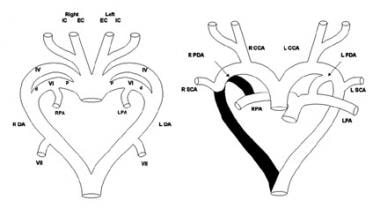
Early in the course of embryonic morphogenesis, 6 pairs of pharyngeal arch arteries develop in conjunction with the branchial pouches. The first through sixth arches appear in a fairly sequential fashion, with left-to-right symmetry, and constitute the primitive vascular supply to the brachiocephalic structures, running from the aortic sac to the paired dorsal aortas. As normal cardiovascular morphogenesis proceeds, a patterned regression and persistence of the various arches and right-sided dorsal aorta occur, ultimately resulting in the mature configuration of the thoracic aorta and its branches. The third, fourth, and sixth arches, along with the seventh intersegmental arteries and the left dorsal aorta, are the primary contributors to the normal aortic arch and its major thoracic branches (see Media file 1).

The segments of the bilateral aortic arch system that normally regress include the distal portion of the sixth arch and the right-sided dorsal aorta. Normally, the left fourth arch becomes the aortic arch, the right fourth arch contributes to the innominate artery, the distal left sixth arch becomes the ductus arteriosus, the proximal sixth arches bilaterally contribute to the proximal branch pulmonary arteries, the left dorsal aorta becomes the descending thoracic aorta, and the dorsal intersegmental arteries bilaterally become the subclavian arteries.

Vascular rings are formed when this process of regression and persistence does not occur normally, and the resulting vascular anatomy completely encircles the trachea and esophagus. (Other forms of aortic arch anomalies occur in which a vascular ring is not present.) A double aortic arch is formed when both fourth arches and both dorsal aortas remain present.

Anatomy

Double aortic arch has various forms. Both arches may be patent, or an atretic (but persistent) segment may be present at one of several locations in either arch. When both arches are patent, the right or left arch may be larger, or they may be similar in size. A cervical arch on either side, variable laterality of the descending thoracic aorta, coarctation of the major arch, and/or discontinuity of the central pulmonary arteries may be present. In general, the apex of the right-sided arch is more superior than the left arch, and on occasion, a cervical arch may be present on either side.

In more than 75% of patients with double aortic arch, the right arch is dominant. Among patients with a right-dominant double arch, those with a patent minor arch outnumber those with an atretic minor arch. When the minor arch is atretic, the atretic segment almost always is distal to the left subclavian artery, although atresia may also occur between the left common carotid and subclavian arteries. In approximately 20% of patients, the left arch is dominant. In these patients, the minor right arch typically is patent.

Associated cardiovascular anomalies

Double aortic arch usually occurs without associated cardiovascular anomalies. Ventricular septal defect and tetralogy of Fallot probably are the most common associated defects, although truncus arteriosus, transposition of the great arteries, pulmonary atresia, and complex univentricular defects sometimes occur in conjunction with a double arch.

Associated syndromes and noncardiac conditions

Double aortic arch is associated with a chromosome band 22q11 deletion in approximately 20% of patients (see Causes). Band 22q11 deletion is responsible for DiGeorge, velocardiofacial, and conotruncal anomaly face syndromes, which often are referred to using the unified terms CATCH-22 syndrome or chromosome band 22q11 deletion syndrome. In patients with double aortic arch, the frequency of phenotypes satisfying the clinical criteria for these various syndromes is not known. Rather, the important point is that double aortic arch may be associated with band 22q11 deletion, which has various other possible manifestations. These include, but are not limited to, palatal abnormalities, laryngotracheal anomalies, speech and learning delay, characteristic facial features, hypocalcemia, abnormalities of T-cell–mediated immune function, and neurologic defects.

Occasionally, patients with double aortic arch may have anomalies consistent with either vertebral, anal, cardiac, tracheal, esophageal, renal, and limb (VACTERL) or posterior coloboma, heart defect, choanal atresia, retardation, genital, and ear (CHARGE) associations.

One of the more important noncardiac features that sometimes is found in association with double aortic arch is esophageal atresia, insofar as an undiagnosed arch anomaly may complicate repair of the esophageal atresia, which usually is recognized earlier than the double aortic arch.

Another noncardiac anomaly that may be associated with vascular rings is a congenital laryngeal web, which may present with the same symptoms and signs as a vascular ring. Accordingly, patients with persistent stridor or upper airway obstruction after repair of a vascular ring, particularly those with a chromosome 22q11 deletion, should be evaluated for the presence of a congenital laryngeal web.

Pathophysiology

By definition, vascular rings encircle the trachea and esophagus, usually causing compression of both structures. Compression of the trachea causes upper airway obstruction that impairs inspiratory and, to a lesser degree, expiratory airflow. The extent of respiratory impairment depends on the severity of compression, which can vary considerably. Significant compression of the trachea appears to be more common with double aortic arch than with other forms of vascular ring and often is more severe.

In addition to airway symptoms, patients may experience swallowing difficulties related to esophageal compression. These typically manifest as vomiting and feeding intolerance in infants and younger children and as dysphagia later in life. Swallowing dysfunction may contribute to respiratory symptoms as a result of aspiration and/or compression or irritation of the membranous portion of the trachea as a food bolus traverses the area of esophageal obstruction. Although respiratory or esophageal pathophysiology may predominate in any given patient, respiratory compromise usually is more problematic in younger patients. Patients with primarily esophageal symptomatology tend to be older at presentation. The pathophysiology of double aortic arch does not differ in the various anatomic forms.

Frequency

United States

Generally, incidence of double aortic arch and vascular rings is unknown, although vascular rings comprise an estimated 1% of cardiovascular malformations that are managed surgically. In most surgical series, 45-65% of patients undergoing repair of a vascular ring have a double aortic arch.

Mortality/Morbidity

  • The natural history of double aortic arch is not well defined. Vascular rings were among the first congenital cardiovascular anomalies repaired surgically, and surgical management has been the standard of care for more than 50 years. Patients with significant airway compression may die as a result of respiratory compromise, but such events are rare.
  • Preoperative morbidity generally is limited to respiratory symptoms, feeding problems, or both. Some patients may develop recurrent respiratory infections, and some may exhibit failure to thrive as the result of a combination of increased metabolic requirements from respiratory and feeding work and relatively poor oral intake.
  • Other rare complications, such as esophageal erosion and aortoesophageal fistula, have been reported.

Race

Based on limited data, no racial predilection is apparent.

Sex

No sex predilection has been documented in patients with double aortic arch or its various subtypes.

Age

Double aortic arch is a developmental abnormality that is present in the fetus. The postnatal age at which the anomaly is identified may vary, although in most patients, double aortic arch is diagnosed in early infancy.


History

Presentation of symptoms in patients with double aortic arch depends on several factors, including the severity of tracheal compression, esophageal compression, or both and whether associated anomalies are present.

  • Among patients with a vascular ring, those with double aortic arch tend to present earlier than those with other anatomic variations. The classic history in a patient with double aortic arch is noisy breathing noted by the parents during the first few weeks of life.
  • Young patients may have experienced episodes that often are termed apparent life-threatening events (ALTE) or death spells, in which acute apneic or severe obstructive events are accompanied by cyanosis. Patients with less severe tracheal compression may give a history of persistent respiratory symptoms without frank stridor, often treated as asthma or bronchiolitis, or a history of recurrent lower respiratory infections.
  • Esophageal symptoms include emesis, choking, or dysphagia and are more common in older infants and children than in young infants.
  • Occasionally, patients may reach older childhood or adulthood before developing persistent or progressive symptoms of dysphagia, respiratory symptoms, or both.
  • Rarely, fetal echocardiography may reveal double aortic arch and types of vascular ring.
  • In neonates with associated cardiac or noncardiac anomalies, a double aortic arch may be diagnosed incidentally during the course of evaluation.

Physical

Physical findings can vary, often in accordance with the patient's history.

  • Newborns with associated anomalies may have no evidence of a vascular ring on physical examination, but this situation is the exception because most patients have readily recognizable physical signs.
  • The classic sign of double aortic arch and of vascular rings in general is nonpositional stridor; however, many young infants with double aortic arch have adventitious expiratory breath sounds, as well as the characteristic inspiratory stridor. Respiratory findings typically do not improve with nebulized bronchodilator therapy and usually are more prominent with agitation or crying.

Causes

A persistent double aortic arch occurs when abnormal regression of the embryonic aortic arch segments is present, in which both the left and right aortic arches remain intact. With the different forms of double aortic arch, different segments of the embryonic aortic arch system, which normally regress, remain patent.

  • Factors responsible for the aberrant persistence of certain aortic arch segments have not been clearly identified, and the pathogenesis of this anomaly remains a mystery. Double aortic arch typically occurs without associated cardiovascular defects, although other lesions may be present, and accordingly, it is not usually found as part of a syndromic complex.
  • In a study at the author's institution, band 22q11 deletions were found in 3 of 22 patients (14%) with double aortic arch.1 This chromosomal anomaly is associated with aortic arch anomalies in patients with other forms of conotruncal heart disease and other isolated vascular abnormalities, and band 22q11 deletion is likely to be an important etiologic factor in double aortic arch. Most such mutations arise de novo, and no recognizable inheritance pattern is present.
  • Familial recurrence of double aortic arch has been reported, supporting a genetic etiology for this anomaly. Teratogen-induced double aortic arch in animal models also has been reported. The mechanisms and significance of these models have not been elucidated.


Asthma
Bronchiolitis
Congenital Stridor
Laryngomalacia
Pulmonary Artery Sling
Respiratory Syncytial Virus Infection
Stridor
Subglottic Stenosis
Tracheomalacia
Vascular Ring, Right Aortic Arch

Other Problems to be Considered

Laryngeal web


Lab Studies

  • In differentiating double aortic arch from upper or lower respiratory infections, a WBC count and respiratory viral studies may be helpful. However, because patients with double aortic arch are predisposed to respiratory infections, the diagnosis of an infection does not exclude the possibility of double aortic arch.
  • As a result of the possible association between double aortic arch and band 22q11 deletion, practitioners may wish to obtain a karyotype and a fluorescence in situ hybridization (FISH) test for deletions within band 22q11. The diagnosis of band 22q11 deletions allows targeted evaluation and follow-up care for conditions frequently found in patients with this chromosomal anomaly.

Imaging Studies

  • Chest radiography: In patients with a double aortic arch, chest radiography may indicate the presence of a vascular ring. In some patients, lateral indentation of the tracheal air column may be revealed by anteroposterior or posteroanterior projection, usually in both the more superior right arch and the more inferior left arch. On lateral chest films, posterior indentation of the trachea by the right arch may be depicted.
  • Echocardiography: In most patients, the diagnosis of double aortic arch can be made reliably based on echocardiography; helpful information is obtained with suprasternal, high parasternal, and subcostal imaging. However, because patients with a vascular ring typically present with respiratory symptoms, the diagnosis is usually made based on other imaging modes. Echocardiography is important in the evaluation of associated cardiovascular anomalies.
  • MRI and CT scanning: MRI and CT scanning are the best single imaging studies for the diagnosis and characterization of vascular rings. MRI and CT provide complete information in regard to the arterial branching pattern, clearly demonstrate the locations and extent of airway and esophageal obstruction, and can be used to delineate cardiac anatomy (see Media file 3). In addition to tomographic images, 3-dimensional reconstruction of the aorta and airways can be a useful tool for preoperative planning.
  • Cardiac catheterization: This is not usually indicated in patients with double aortic arch. Although angiography was once the criterion standard for the diagnosis of this anomaly, MRI is both less invasive and diagnostically superior. Angiograph findings may be somewhat confusing because of the overlapping projection of the various vascular structures. This problem may be somewhat ameliorated by the use of digital subtraction angiography or countercurrent brachial angiography, which provide sequential information that can help clarify the aortic branching pattern.
  • Barium esophagography: Frequently, the diagnosis of a vascular ring is made initially with barium esophagography. In patients with a double aortic arch, bilateral indentation of the esophagus is observed on the anteroposterior view, with the right-sided indentation superior to the left, and posterior indentation is observed on the lateral view. Although this test is not necessary to make the diagnosis of double arch, it often is obtained in the preliminary evaluation of patients with symptoms of an upper airway and/or an esophageal pathologic condition. If a ring is strongly suspected on the basis of chest radiography or echocardiography findings, barium esophagography is not indicated. Rather, if additional imaging is desired, a more thorough diagnostic study, such as MRI, should be performed.

Other Tests

  • Electrocardiography: No characteristic ECG findings are associated with double aortic arch, and ECG findings are usually normal, except in patients with associated cardiovascular anomalies.

Procedures

  • Diagnostic procedures are generally not necessary in the evaluation of patients with a double aortic arch.
  • Bronchoscopy may be obtained in the evaluation of a patient with a suspected airway pathologic condition but is not indicated in most patients. Pulsatile compression of the posterior and lateral walls of the trachea can be observed in patients with a double aortic arch, but the specific type of vascular ring cannot always be determined. Other imaging modalities, especially MRI and CT, permit characterization of the severity and location of tracheal obstruction while offering superior definition of vascular anatomy.
  • In some patients, depending on surgeon preference, bronchoscopy may be performed in the operating room before and after repair of the vascular ring to determine the efficacy of relief of tracheal compression. This is of particular value in young patients in whom persistent tracheomalacia is a concern.

Histologic Findings

Patients with a double aortic arch do not require a histologic tissue examination.


Medical Care

  • Medical care prior to surgical repair depends on the clinical presentation. In most patients, only supportive care is required.
  • Catheter interventions are not used in the management of double aortic arch.

Surgical Care

  • Indications: Surgical division of the vascular ring is indicated in any patient with symptoms of airway or esophageal compression and in patients undergoing surgery for repair of associated cardiovascular or thoracic anomalies.
  • Techniques: The fundamental principle of surgical management of double aortic arch is division of the ring to relieve compression of the trachea and esophagus. In general, this is achieved by dividing the minor arch through an ipsilateral thoracotomy.
    • When the minor arch is atretic, the atretic segment is ligated or clipped and then divided. When the minor arch is patent, it is usually ligated and divided between the subclavian artery and descending aorta. The ligamentum arteriosum, which is almost always left sided, is ligated and divided as well.
    • Dissection should be carried down to the trachea and esophagus to ensure that no constricting fibrous bands remain.
    • If necessary to minimize residual posterior compression of the trachea/esophagus, arteriopexy may be performed by suturing the retroesophageal aortic segment to the prevertebral fascia.
    • Video-assisted thoracoscopic division of vascular rings is performed at several centers and appears to be an effective approach in most cases, but data on outcomes are limited. Robotically assisted division of vascular rings has also been reported.
    • When associated intracardiac anomalies require surgery through a median sternotomy, division of the double arch is performed during the same procedure.
  • Results: In the current era, essentially no operative mortality is associated with repair of isolated double aortic arch. Outcomes in patients with associated anomalies depend on the coexisting condition.
  • Postoperative care and precautions: Postoperative care after division of double aortic arch is similar to that for patients undergoing other cardiovascular procedures through a thoracotomy. Most patients experience immediate relief after surgery, although persistent respiratory symptoms and signs may be present, especially in very young infants with severe preoperative symptoms. Except in patients undergoing concurrent repair of associated anomalies, cardiopulmonary bypass is not used during the repair; therefore, postoperative cardiac function typically is not a problem.
  • Complications in the early postoperative period are uncommon after division of a vascular ring.
    • The major issue is persistent respiratory symptoms, especially in neonates who are more susceptible to tracheomalacia.
    • Other rare operative complications include chylothorax resulting from injury to the thoracic duct, diaphragmatic paresis/paralysis secondary to phrenic nerve injury, and, following repair through a left thoracotomy (ie, in patients with a right-dominant double arch), vocal cord paresis/paralysis resulting from injury to the recurrent laryngeal nerve.

Consultations

Unless specific associated anomalies or problems are identified, consultations usually are not necessary. As noted above, band 22q11 deletion is present in a substantial proportion of patients with double aortic arch. Consultation with a geneticist is indicated in patients with other characteristic features of the band 22q11 deletion syndrome and may be appropriate in young infants, in whom typical features of the syndrome may not yet be evident.

Diet

No special dietary considerations are indicated in patients with double aortic arch other than those dictated by associated conditions. Postoperatively, enteral feeding is resumed as soon as possible. In patients with dysphagia or emesis as a presenting symptom, adequate oral intake should be verified, and feeding therapy should be instituted if necessary. In patients with band 22q11 deletion, velopharyngeal insufficiency or cleft palate frequently is present; oral feedings should be resumed with the aid of feeding specialists.

Activity

Patients with double aortic arch are not subject to specific restrictions on activity. Prior to repair, activity may be limited by symptoms. Following repair, any persistent respiratory symptoms resulting from tracheomalacia should dictate activity limitations.


Aside from analgesia, pharmacologic therapy is not typically required in patients with double aortic arch unless associated conditions are present.


Further Inpatient Care

  • Routine postthoracotomy care is provided following repair of double aortic arch.
  • Patients are removed from mechanical ventilation as soon as possible, and tube thoracostomy usually is discontinued on the first postoperative day.
  • The remainder of the inpatient stay is focused on determining and managing any residual symptomatology, providing sufficient enteral nutrition, transitioning the patient to enteral analgesics, and educating the parents.

Further Outpatient Care

  • Close follow-up observation should be maintained after repair of double aortic arch, especially in young children with persistent tracheomalacia or other respiratory symptoms.
  • Additional imaging or bronchoscopic evaluation is not indicated unless residual symptoms persist or other mitigating circumstances are present.
  • No dietary or activity restrictions are indicated after repair of an isolated vascular ring.

In/Out Patient Meds

  • Aside from analgesic medications, pharmacologic therapy is not usually required after removal from mechanical ventilation. Relief from the pain of the thoracotomy incision may be achieved with age-appropriate narcotic and nonsteroidal anti-inflammatory medications.

Transfer

  • After postoperative stabilization in the intensive care unit and removal from mechanical ventilatory support, the patient may be transferred to the regular inpatient care area for advancement of feedings and additional postoperative care.

Deterrence/Prevention

  • No methods are known to prevent development of double aortic arch.

Complications

  • Complications are uncommon after repair of vascular rings.
  • The major postoperative symptom is persistent respiratory symptoms, including cough, dyspnea, and wheezing. Pulmonary function testing reveals persistent upper airway obstruction in some patients. Others have evidence of lower airway obstruction that usually is responsive to bronchodilator therapy. Whether the incidence of lower airway obstruction is higher in patients who have undergone repair of vascular rings than in the population at large or whether such a pathologic condition in patients with rings has any relationship to prior anatomic and functional abnormalities is not known.
  • Rarely, patients with unrepaired double aortic arch may develop an aortoesophageal fistula, which causes fatal hemorrhage.

Prognosis

  • Long-term prognosis for patients with repaired double aortic arch is excellent; persistent respiratory symptoms are the most common adverse outcomes.
  • In patients with a repaired double aortic arch, lifestyle implications are minimal and most likely are related to residual symptoms or associated anomalies.

Patient Education

  • For the early posthospital period, educate parents concerning the possible persistence of symptoms, the potential benefit of prone positioning in patients with tracheomalacia, signs and symptoms of aspiration, and management of the thoracotomy incision.


Medical/Legal Pitfalls

  • Failure to diagnose and properly define the anatomy of a double aortic arch (most significant potential medicolegal pitfall)

Special Concerns

  • No special issues or concerns are related to pregnancy in patients with repaired vascular ring.
  • In patients with an unrepaired ring, pregnancy-induced physiologic changes should not be of special concern, although symptoms may be exacerbated in certain situations.


Media file 1:  Schematic diagram (left) of the primitive pharyngeal arch system shows the left (L) and right (R) external carotid (EC) and internal carotid (IC) arteries, fourth (IV) and sixth (VI) pharyngeal arches, distal pulmonary arterial segments (PA), dorsal aortas (DA), and seventh intersegmental arteries (VII). The proximal (p) sixth arches develop into the proximal pulmonary arteries and the distal (d) sixth arches become the arterial ducts. The seventh intersegmental arteries develop into the subclavian arteries. Schematic diagram (right) shows the segments of the pharyngeal arch system that regress (shown in black) in the normal formation of the thoracic great arteries. Left pulmonary artery (LPA); ductus arteriosus (PDA); right pulmonary artery (RPA); subclavian artery (SCA).
Click to see larger pictureClick to see detailView Full Size Image
Media type:  Image

Media file 2:  Schematic diagram (left) depicts the segments of the pharyngeal arch system that regress (shown in black) so that the mature vascular anatomy of a double aortic arch can develop. The dominant and minor arches can vary in laterality and specific patterns of branching and segmental hypoplasia/atresia. (These variables are not specified in this diagram.) Left (L) and right (R) external carotid (EC) and internal carotid (IC) arteries; fourth (IV) and sixth (VI) pharyngeal arches; distal pulmonary arterial segments (PA); dorsal aortas (DA); seventh intersegmental arteries (VII); proximal (p) sixth arches; distal (d) sixth arches. Mature anatomy (right) of a double aortic arch with a dominant right arch and patent minor left arch. In most patients, a single left-sided ductus arteriosus or ligamentum arteriosum is present. Left pulmonary artery (LPA); ductus arteriosus (PDA); right pulmonary artery (RPA); subclavian artery (SCA).
Click to see larger pictureClick to see detailView Full Size Image
Media type:  Image

Media file 3:  Transverse MRI images in a patient with double aortic arch. Both arches are patent; the right arch is dominant. Images A-F are arranged in a caudad to cephalad order. (A) Transverse image at the level of the pulmonary valve. The ascending aorta (AAo) and descending aorta (DAo), cephalad to the junction of the left and right arches, can be seen. (B) At the level of the pulmonary artery (PA) bifurcation, the distal confluence of the left and right arches forming the single descending aorta is depicted. (C) The distal portions of the left (L) and right (R) arches can be seen posterior and to the left and right sides of the trachea. Note the anteroposterior compression of the tracheal carina (anterior to and between the arches). (D) Moving cephalad, the dominance of the right arch can be seen. (E) At the level of the proximal/transverse aortic arches, the origin of the left and right arches from the rightward ascending aorta can be seen. (F) The left and right common carotid and subclavian arteries arise from the left and right arches, respectively. The common carotid arteries are the dark round structures anterior to and to either side of the trachea. The subclavian arteries are the dark round structures posterior to and to either side of the trachea.
Click to see larger pictureClick to see detailView Full Size Image
Media type:  MRI

Media file 4:  Coronal spin-echo MRI images in a patient with a double aortic arch. Both arches are patent, with the right (R) slightly larger in caliber than the left (L). Compression of the trachea (T) between the 2 arches can be seen (left). The confluence of the arches and the descending aorta (D) are shown (right).

Click to see larger pictureClick to see detailView Full Size Image
Media type:  MRI


  1. McElhinney DB, Clark BJ 3rd, Weinberg PM, et al. Association of chromosome 22q11 deletion with isolated anomalies of aortic arch laterality and branching. J Am Coll Cardiol. Jun 15 2001;37(8):2114-9. [Medline].
  2. Achiron R, Rotstein Z, Heggesh J, et al. Anomalies of the fetal aortic arch: a novel sonographic approach to in-utero diagnosis. Ultrasound Obstet Gynecol. Dec 2002;20(6):553-7. [Medline].
  3. Anand R, Dooley KJ, Williams WH, Vincent RN. Follow-up of surgical correction of vascular anomalies causing tracheobronchial compression. Pediatr Cardiol. Mar-Apr 1994;15(2):58-61. [Medline].
  4. Angelini A, Dimopoulos K, Frescura C, et al. Fatal aortoesophageal fistula in two cases of tight vascular ring. Cardiol Young. Mar 2002;12(2):172-6. [Medline].
  5. Arciniegas E, Hakimi M, Hertzler JH, et al. Surgical management of congenital vascular rings. J Thorac Cardiovasc Surg. May 1979;77(5):721-7. [Medline].
  6. Backer CL, Ilbawi MN, Idriss FS, DeLeon SY. Vascular anomalies causing tracheoesophageal compression. Review of experience in children. J Thorac Cardiovasc Surg. May 1989;97(5):725-31. [Medline].
  7. Backer CL, Mavroudis C, Rigsby CK, Holinger LD. Trends in vascular ring surgery. J Thorac Cardiovasc Surg. Jun 2005;129(6):1339-47. [Medline].
  8. Bertrand JM, Chartrand C, Lamarre A, Lapierre JG. Vascular ring: clinical and physiological assessment of pulmonary function following surgical correction. Pediatr Pulmonol. Nov-Dec 1986;2(6):378-83. [Medline].
  9. Bonnard A, Auber F, Fourcade L, et al. Vascular ring abnormalities: a retrospective study of 62 cases. J Pediatr Surg. Apr 2003;38(4):539-43. [Medline].
  10. Burke RP, Rosenfeld HM, Wernovsky G, Jonas RA. Video-assisted thoracoscopic vascular ring division in infants and children. J Am Coll Cardiol. Mar 15 1995;25(4):943-7. [Medline].
  11. Cerillo AG, Amoretti F, Moschetti R, et al. Sixteen-row multislice computed tomography in infants with double aortic arch. Int J Cardiol. Mar 18 2005;99(2):191-4. [Medline].
  12. Chaikitpinyo A, Panamonta M, Sutra S, et al. Aortoesophageal fistula: a life-threatening cause of upper gastrointestinal hemorrhage in double aortic arch, a case report. J Med Assoc Thai. Aug 2004;87(8):992-5. [Medline].
  13. Chun K, Colombani PM, Dudgeon DL, Haller JA Jr. Diagnosis and management of congenital vascular rings: a 22-year experience. Ann Thorac Surg. Apr 1992;53(4):597-602; discussion 602-3. [Medline].
  14. Fleenor JT, Weinberg PM, Kramer SS, Fogel M. Vascular rings and their effect on tracheal geometry. Pediatr Cardiol. Sep-Oct 2003;24(5):430-5. [Medline].
  15. Giavini E, Prati M, Vismara C. Morphogenesis of aortic arch malformations in rat embryos after maternal treatment with glycerol formal during pregnancy. Acta Anat (Basel). 1981;109(2):166-72. [Medline].
  16. Hartenberg MA, Salzberg AM, Krummel TM, Bush JJ. Double aortic arch associated with esophageal atresia and tracheoesophageal fistula. J Pediatr Surg. May 1989;24(5):488-90. [Medline].
  17. Hartyanszky IL, Lozsadi K, Marcsek P, et al. Congenital vascular rings: surgical management of 111 cases. Eur J Cardiothorac Surg. 1989;3(3):250-4. [Medline].
  18. Heck HA Jr, Moore HV, Lutin WA, et al. Esophageal-aortic erosion associated with double aortic arch and tracheomalacia. Experience with 2 infants. Tex Heart Inst J. 1993;20(2):126-9. [Medline].
  19. Kocis KC, Midgley FM, Ruckman RN. Aortic arch complex anomalies: 20-year experience with symptoms, diagnosis, associated cardiac defects, and surgical repair. Pediatr Cardiol. Mar-Apr 1997;18(2):127-32. [Medline].
  20. Koontz CS, Bhatia A, Forbess J, Wulkan ML. Video-assisted thoracoscopic division of vascular rings in pediatric patients. Am Surg. Apr 2005;71(4):289-91. [Medline].
  21. Lillehei CW, Colan S. Echocardiography in the preoperative evaluation of vascular rings. J Pediatr Surg. Aug 1992;27(8):1118-20; discussion 1120-1. [Medline].
  22. McElhinney DB, Jacobs I, McDonald-McGinn DM, Goldmuntz E. Chromosomal and cardiovascular anomalies associated with congenital laryngeal web. Int J Pediatr Otorhinolaryngol. Oct 21 2002;66(1):23-27. [Medline].
  23. McElhinney DB, McDonald-McGinn D, Zackai EH, Goldmuntz E. Cardiovascular anomalies in patients diagnosed with a chromosome 22q11 deletion beyond 6 months of age. Pediatrics. Dec 2001;108(6):E104. [Medline].
  24. Mihaljevic T, Cannon JW, del Nido PJ. Robotically assisted division of a vascular ring in children. J Thorac Cardiovasc Surg. May 2003;125(5):1163-4. [Medline].
  25. Patel CR, Lane JR, Spector ML, Smith PC. Fetal echocardiographic diagnosis of vascular rings. J Ultrasound Med. 2006;25:[Medline].
  26. Picard E, Tal A. Tracheal compression caused by double aortic arch in two sisters. Isr J Med Sci. Nov 1992;28(11):799-801. [Medline].
  27. Rimell FL, Shapiro AM, Meza MP, et al. Magnetic resonance imaging of the pediatric airway. Arch Otolaryngol Head Neck Surg. Sep 1997;123(9):999-1003. [Medline].
  28. van Son JA, Julsrud PR, Hagler DJ, et al. Imaging strategies for vascular rings. Ann Thorac Surg. Mar 1994;57(3):604-10. [Medline].
  29. Weinberg PM. Aortic arch anomalies. In: Emmanouilides G, Reimenschneider T, Allen H, eds. Moss and Adams Heart Disease in Infants, Children and Adolescents. 5th ed. Lippincott Williams & Wilkins; 1995:810-37.
  30. Yoo SJ, Min JY, Lee YH, et al. Fetal sonographic diagnosis of aortic arch anomalies. Ultrasound Obstet Gynecol. Nov 2003;22(5):535-46. [Medline].

Vascular Ring, Double Aortic Arch excerpt

Article Last Updated: Nov 5, 2007