Practice Essentials
Persistent pulmonary hypertension of the newborn (PPHN) is defined as the failure of the normal circulatory transition that occurs after birth. It is a syndrome characterized by marked pulmonary hypertension that causes hypoxemia secondary to right-to-left shunting of blood at the foramen ovale and ductus arteriosus.
Signs and symptoms
PPHN is often associated with the following signs and symptoms of perinatal distress:
-
Asphyxia
-
Tachypnea, respiratory distress
-
Respiratory acidosis
-
Loud, single second heart sound (S2) or a harsh systolic murmur (secondary to tricuspid regurgitation)
-
Low Apgar scores
-
Meconium staining
-
Cyanosis; poor cardiac function and perfusion
-
Systemic hypotension
-
Symptoms of shock
Idiopathic persistent pulmonary hypertension of the newborn can present without signs of acute perinatal distress. Marked lability in oxygenation is frequently part of the clinical history.
Diagnosis
Suspect PPHN whenever the level of hypoxemia is out of proportion to the level of pulmonary disease. Clinically, PPHN is most often recognized in term or near-term neonates, but it can occur in premature neonates. Preductal and postductal oxygen saturation measurements via pulse oximetry will often show a 10% or higher gradient difference, which is dependent on the magnitude of left-to-right shunting at the foramen ovale (with preductual saturations being higher). It is important to note that these findings are not specific to PPHN and must be differentiated from structural heart disease
In contrast to adult primary pulmonary hypertension, the newborn syndrome is not defined by a specific pressure of the pulmonary circulation. The diagnosis is confirmed regardless of the pulmonary arterial pressure, as long as it is accompanied by a right-to-left shunt and absence of congenital heart disease. [1]
Echocardiography is considered the most reliable noninvasive test to establish the diagnosis, assess cardiac function, and exclude associated structural heart disease.
Laboratory testing
-
Arterial blood gas levels (through an indwelling line [eg, umbilical arterial catheter or preductal peripheral arterial line]): To assess the pH, partial pressure of carbon dioxide (PaCO2) and the partial pressure of oxygen (PaO2) which might be higher in the preductal arterial line.
-
Complete blood cell count with differential: To evaluate for high hematocrit level (polycythemia and hyperviscosity syndrome may lead to or exacerbate PPHN); to determine whether an underlying sepsis or pneumonia is present
-
Coagulation studies (eg, platelet count, prothrombin time, partial thromboplastin time, international normalized ratio): To assess for coagulopathy (increased disease severity)
-
Serum electrolytes (eg, calcium) and glucose levels
Imaging studies
-
Chest radiography: To assess for presence of underlying parenchymal lung disease (eg, meconium aspiration syndrome, pneumonia, surfactant deficiency) and/or to exclude underlying disorders (eg, congenital diaphragmatic hernia); see the image below
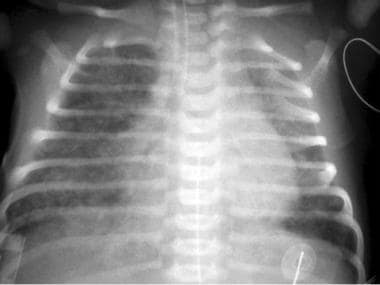 Persistent pulmonary hypertension of the newborn (PPHN). Meconium aspiration in a neonate. This radiograph was obtained shortly after birth and shows ill-defined, predominantly perihilar opacities in the lungs; these are more severe on the right than on the left. The lungs are hyperexpanded. The neonate's heart size is within normal limits.
-
Echocardiography: To screen and assist in making the diagnosis of PPHN and to rule out a structural heart lesion
-
Echocardiography with Doppler and color-flow mapping: To assess presence/direction of the intracardiac shunt at the ductus arteriosus and foramen ovale, as well as estimate the pulmonary arterial systolic/diastolic pressures
-
Cranial ultrasonography: To assess for intraventricular bleeding and for peripheral areas of hemorrhage or infarct if ECMO is being considered
-
Cranial ultrasonography with Doppler flow: To assess whether a nonhemorrhagic infarct is present
-
Brain computed tomography scanning or magnetic resonance imaging: To evaluate for central nervous system injury

Procedures
-
Cardiac catheterization: Rarely utilized to exclude congenital heart disease (eg, obstructed anomalous pulmonary venous return, pulmonary vein stenosis) because echocardiographic findings are typically diagnostic
Management
The treatment strategy for PPHN is aimed at maintaining adequate systemic blood pressure, decreasing pulmonary vascular resistance, ensuring oxygen release to tissues, and minimizing lesions induced by high levels of inspired oxygen and ventilator high pressure settings.
General management principles include the following:
-
Continuous monitoring of oxygenation, blood pressure, and perfusion
-
Maintaining a normal body temperature
-
Correction of electrolytes/glucose abnormalities and metabolic acidosis
-
Nutritional support
-
Minimal stimulation/handling of the newborn
-
Minimal use of invasive procedures (eg, suctioning)
Medical therapy
PPHN treatment may consist of the following:
-
Inotropic support (eg, dopamine [first line in the absence of cardiac dysfunction], dobutamine, milrinone)
-
Surfactant administration: For premature and full-tem newborns with parenchymal lung disease
-
Endotracheal intubation and mechanical ventilation: To maintain normal functional residual capacity by recruiting areas of atelectasis; to avoid overexpansion
-
High-frequency ventilation: Used in newborns with underlying parenchymal lung disease and low lung volumes; therapy is best in centers with clinicians experienced in achieving/maintaining optimal lung distention
-
Correction of hypoglycemia, hypocalcemia, acidosis, and alkalosis
-
Induced paralysis: Controversial; paralytic agents are typically reserved for newborns who cannot be treated with sedatives alone (Note: paralysis, especially with pancuronium, may promote atelectasis of dependent lung regions and promote ventilation-perfusion mismatch.)
Pharmacotherapy
-
Inhaled pulmonary vasodilators (eg, nitric oxide) and supplemental oxygen
-
Systemic vasodilators are potentially beneficial for chronic PPHN after the newborn period (eg, prostacyclin, phosphodiesterase inhibitors, endothelin receptor antagonists)
-
Prostaglandin E1 if the ductus arteriosus is closed or restrictive in the setting of suprasystemic pulmonary artery pressures and/or right ventricular dysfunction leading to poor systemic perfusion

Overview
Persistent pulmonary hypertension of the newborn (PPHN) is defined as the failure of the normal circulatory transition that occurs after birth. It is a syndrome characterized by marked pulmonary hypertension that causes hypoxemia secondary to right-to-left extrapulmonary shunting of deoxygenated blood. Clinically, PPHN is most often recognized in term or near-term neonates, but it is being increasingly recognized in preterm infants as well. [4]
Because virtually all newborns are born with elevated pulmnary pressures and have a patent foramen ovale and a patent ductus arteriosus immediately after birth, the presence of elevated pulmonary vascular resistance beyond baseline (PPHN) may lead to a right-to-left shunting of blood and severe hypoxemia. With inadequate pulmonary perfusion, neonates are at risk for developing refractory hypoxemia, hypercarbia, and acidosis.
The diagnosis of PPHN is confirmed by echocardiography. The cardinal findings include abnormal right ventricular dilatation, leftward deviation of the interventricular septum, tricuspid regurgitation, and right-to-left shunting at the levels of the patent foramen ovale and patent ductus arteriosus. [5]
Fetal pulmonary hypertension
Pulmonary hypertension is a normal and necessary state for the fetus, because the placenta, not the lungs, serves as the organ of gas exchange. Most of the right ventricular output crosses the ductus arteriosus to the aorta, and only 13-21% of the combined ventricular output is directed to the pulmonary vascular bed. [4]
Mechanisms that maintain high pulmonary vascular resistance (PVR) in utero include low fetal oxygen content, fluid-filled alveoli causing compression of the pulmonary blood vessels, and the presence of vasoconstrictor mediators, such as endothelin-1, thromboxane, and leukotriene.
Normal cardiopulmonary transition
A dramatic cardiopulmonary transition occurs at birth, as pulmonary blood flow increases 8- to 10-fold and pulmonary arterial pressure decreases by 50% within 24 hours. This is due to a marked increase in oxygen tension, the establishment of an air-liquid interface, and rhythmic distention of the lungs from breathing. [6, 7] The most critical signals for these transitional changes are mechanical distention of the lungs, a decrease in carbon dioxide tension, and an increase in oxygen tension in the lungs. Endothelial nitric oxide (NO) production in the lungs increases after birth as a result of the increased blood flow and oxygenation. The NO then mediates pulmonary vasodilation via cyclic guanosine monophosphate (cGMP). Cyclic adenosine monophosphate (cAMP) is increased after birth by the arachidonic acid-prostacyclin pathway which promotes smooth muscle cell relaxation.
Failure of circulatory transition
In some newborns, this normal decrease in pulmonary vascular tone does not occur, resulting in PPHN. This results in shunting of blood away from the lungs and severe central hypoxemia.
Severe PPHN can be associated with poor cardiac output and shock, signs of which include tachycardia, ashen or gray color, capillary refill time more than 3 seconds, oliguria, hypotension, and lactic acidosis. This is commonly seen when the ductus arteriosus is restrictive and right-to-left shunting is compromised at this level or at the foramen ovale.
Neurologic sequelae
Although most surviving newborns with persistent pulmonary hypertension of the newborn have normal neurodevelopmental outcomes, as many as 25% have significant neurodevelopmental sequelae with a high prevalence of both expressive and receptive linguistic deficits. [8]
Etiology
Pulmonary endothelium-derived vasodilators
Several events take place after birth as a fetus transitions from placental gas exchange to that taken care of by the lungs. At birth, the umbilical cord is clamped, which removes the low-resistance placenta circulation and increases the systemic circulation. In addition, pulmonary blood pressure begins to rapidly fall, leading to an increase in pulmonary blood flow.
The drop in pulmonary vascular resistance is due to several factors, including ventilation of the lungs causing an increase in oxygen tension and the release of several vasoactive factors by the pulmonary endothelium, including endothelin-1 (ET-1), nitric oxide (NO), and prostacyclin (PGI2). Endothelial nitric oxide synthase (eNOS) (or nitric oxide synthase type 3) is the most extensively studied enzyme in persistent pulmonary hypertension of the newborn (PPHN). When activated by shear stress or adenosine triphosphate (ATP), it converts L-arginine into NO and L-citrullin.
NO is a potent vasodilator and its production and release by the pulmonary endothelium rapidly increases after birth. The increase in oxygen tension is an important stimulator for this process. NO stimulates the soluble guanylate cyclase enzyme in the pulmonary vascular smooth muscle cells, leading to the conversion of guanosine triphosphate nucleotide into cyclic guanosine monophosphate (cGMP). The increase in intracellular cGMP leads to a decrease in calcium influx and relaxation of smooth muscle cells by stimulating protein kinase G. [9, 10] cGMP is down-regulated by phosphodiesterase 5 activity. Phosphodiesterase 5, which is abundantly expressed in lung tissue, particularly during fetal life, is a key regulator of perinatal pulmonary circulation. [11]
Experimental studies of chronic pulmonary hypertension in newborn animals have demonstrated impaired endothelial release of NO and increased production of vasoconstrictors (eg, endothelin-1). [12] Endothelin-1, a 21–amino acid polypeptide elaborated by the endothelium, is a vasoconstrictor to the pulmonary arteries and enhances oxygen formation that depletes NO bioavailability and promotes the growth of the pulmonary artery muscular layer.
Vascular endothelial growth factor (VEGF) is another potent endothelial cell mitogen and regulator of angiogenesis. In vivo, inhibition of VEGF receptors in normal fetal sheep results in impaired vascular growth and leads to pulmonary hypertension. [13]
Genetic factors may increase susceptibility to pulmonary hypertension. Strong links between PPHN and polymorphisms of the carbamoyl phosphate synthase gene have been reported. [14] However, the importance of this finding is uncertain, and further work is needed in this area. More recently, investigators have described an association between polymorphisms in urea cycle enzyme genes and PPHN; they reported three single-nucleotide polymorphisms (SNPs) (rs41272673, rs4399666, and rs2287599) in the carbamoyl phosphate synthase 1 gene (CPS1) were significantly associated with PPHN. [15] In addition, a recognized emerging cause of pediatric pulmonary hypertension is rare variants in the T-box transcription gene (TBX4); however, their pathophysiology and how they contribute to PPHN are unclear. [16] CPS1, NOTCH3, and SMAD9 appear to be risk genes for late preterm and term PPHN. [17] Larger studies are needed to replicate these findings.
Selective serotonin reuptake inhibitors (SSRIs), commonly prescribed antidepressants, have been reported to be associated with PPHN, especially during the third trimester of pregnancy. The prevalence of PPHN in newborns exposed to SSRIs in the second half of pregnancy is increased 6-fold. However, one recent study involving 1104 infants born to mothers who received antidepressants in the third trimester and an equal number of controls failed to demonstrate this association. [18]
Therefore, the US Food and Drug Administration (FDA) has stated that it is premature to reach any conclusion about a possible link between SSRI use in pregnancy and PPHN. They are advising healthcare professionals not to alter their current clinical practice of treating depression during pregnancy and to report any adverse events to the FDA MedWatch program. [19]
Persisten pulmonary hypertension of the newborn (PPHN) is most commonly associated with 1 of 3 underlying etiologies [20] :
-
Acute pulmonary vasoconstriction
-
Hypoplasia of the pulmonary vascular bed (commonly seen with congenital diaphragmatic hernia)
-
Idiopathic pulmonary hypertension
There also appears to be a complex relationship between PPHN and cesarean delivery, including the following factors [21] :
-
Iatrogenic prematurity
-
Higher rates of late preterm delivery
-
Lack of physiologic changes of labor
-
Limited pulmonary vasodilator synthesis
-
Lower levels of protective antioxidants
-
Greater risk of respiratory distress syndrome, with a concomitant rise in endothelin-1 levels
Acute pulmonary vasoconstriction
The most commonly encountered scenario in PPHN is acute pulmonary vasoconstriction due to acute perinatal events, such as:
-
Alveolar hypoxia secondary to parenchymal lung disease, such as meconium aspiration syndrome, respiratory distress syndrome, or pneumonia
-
Hypoventilation resulting from asphyxia or other neurologic conditions
-
Hypothermia
-
Hypoglycemia (defined as < 40 mg/dL in neonates per the American Association of Pediatrics)
Hypoplasia of the pulmonary vascular bed
Hypoplasia of the pulmonary vascular bed is another cause of persistent pulmonary hypertension of the newborn.
Congenital diaphragmatic hernia is an abnormality of diaphragmatic development that allows the abdominal viscera to enter the chest and compress the lung, impairing growth.
Oligohydramnios may also produce pulmonary hypoplasia and associated persistent pulmonary hypertension of the newborn.
A congenital cystic adenomatoid malformation may lead to lung hypoplasia, but PPHN is not a common finding in this condition. [22]
Idiopathic pulmonary hypertension
Idiopathic pulmonary hypertension accounts for approximately 10% of the cases of PPHN. It is caused by impaired pulmonary relaxation after birth in the absence of parenchymal lung disease. One cause of idiopathic PPHN is constriction, or premature closure of the ductus arteriosus in utero, which can occur after exposure to aspirin or nonsteroidal anti-inflammatory drugs (NSAIDs) (eg, ibuprofen, naproxen) during the third trimester. Evaluation of infants at autopsy shows significant remodeling of their pulmonary vasculature, with vascular wall thickening and smooth muscle hyperplasia. [23] Furthermore, the smooth muscle extends to the level of the intra-acinar arteries, which does not normally occur until late in the postnatal period. As a result, infants do not vasodilate their pulmonary vessels adequately in response to birth-related stimuli, and they present with hypoxemia and hyperlucent lung fields on radiography, which is termed black lung PPHN.
Epidemiology
Incidence in the United States
The incidence of persistent pulmonary hypertension in the newborn (PPHN) in the United States has been reported to range from 0.4 to 6.8 per 1000 live births. [4] Although PPHN has been traditionally thought of as a diagnosis in term newborns, it is increasingly being recognized in preterm infants. One study reported an incidence of 5.4 per 1000 live births in infants 34-36 weeks' gestation. [24]
An analysis of the North American Pediatric Pulmonary Hypertension Network Registry (2014-2018) found "significant racial variability in the prevalence of pulmonary hypertension subtypes and survival outcomes among children with pulmonary hypertension." [25] For example, black neonates had a higher prevalence of PPHN and an increased mortality risk, whereas white neonates had a greater prevalence of congenital diaphragmatic hernia. [25]
Morbidity and mortality
Relatively recent advancements in the treatment and management of PPHN (such as inhaled nitric oxide and extracorporeal membrane oxygenation) have helped to reduce the morbidity and mortality of this disease; however, the mortality rate still remains approximately 10% in those infants with moderate to severe disease, and it is higher in infants with other morbidities such as pulmonary hypoplasia and congenital diaphragmatic hernia. [26] PPHN has been associated with significant long-term morbidities in up to 25% of infants, including neurodevelopmental impairments and hearing difficulties. [26]
A 2019 report of a retrospective California population-based study (2005-2012) found a large postdischarge morbidity burden of infants with PPHN in their first year of life, including those with mild PPHN and causes involving pulmonary vascular changes that have been believed to be of short duration and recoverable. [27] The investigators also identified the following as risk factors for postdischarge mortality and morbidity in the first year of life of newborns with PPHN. [27] :
-
Hispanic ethnicity
-
Small for gestational age
-
Severe PPHN
-
PPHN etiology (eg, congenital diaphragmatic hernia, meconium aspiration syndrome)
Patient History
Persistent pulmonary hypertension of the newborn (PPHN) should be suspected in any newborn with profound and often labile hypoxemia. Infants will have a preductal and postductal oxygen saturation gradient difference of at least 10%, which is dependent on the magnitude of the left-to-right shunting at the foramen ovale (with preductal saturations being higher). These findings are not specific to PPHN and, therefore, it is important to rule out structural heart disease with an echocardiogram.
A thorough history is important to identify causes that may increase the risk for having PPHN such as meconium aspiration syndrome, respiratory distress syndrome, congenital diaphragmatic hernia, pulmonary hypoplasia, pneumonia, and sepsis. Infants of mothers who have diabetes, asthma, or obesity are also reported to be at increased risk for PPHN. [24]
A few genetic risk factors have been identified in patients who have developed PPHN including trisomy 21 (independent of any cardiac lesion), genetic mutations leading to surfactant protein B deficiency, and mutations in the ATP-binding cassette transporter 3 gene. [4]
Physical Examination
Persistent pulmonary hypertension of the newborn (PPHN) most typically affects infants who are phenotypically normal, although PPHN occurs with higher frequency in newborns with Down syndrome [28] and structurally normal hearts.
The most characteristic findings in an infant with PPHN are hypoxemia and a preductal-postductal saturation gradient. Infants will often have signs of respiratory distress, wide swings in arterial oxygenation levels due to acute changes in pulmonary blood flow and right-to-left shunting, and a cardiac examination revealing a loud, single second heart sound with a harsh murmur due to tricuspid regurgitation.
The patient may also present with systemic hypotension and symptoms of shock with echocardiographic evidence of poor right ventricular systolic function.
Differential Diagnosis
The differential diagnosis for persistent pulmonary hypertension of the newborn (PPHN) includes the following*:
-
Cyanotic congenital heart disease, such as transposition of the great arteries, [29] obstructed total anomalous pulmonary venous connection, tricuspid atresia, and pulmonary atresia with intact ventricular septum
-
Primary parenchymal lung disease such as neonatal pneumonia, respiratory distress syndrome, pulmonary sequestration, and pulmonary hypoplasia resulting in hypercarbia and respiratory acidosis
-
Sepsis
-
Alveolar capillary dysplasia
-
Surfactant protein B deficiency
-
Respiratory or metabolic acidosis of any etiology
-
Meconium aspiration syndrome
-
Asphyxia
*PPHN can occur in isolation or as a result of any of the above diagnoses, with the exception of structural heart lesions.
Laboratory Studies
The studies discussed below are indicated in persistent pulmonary hypertension of the newborn (PPHN).
Arterial blood gas
Check arterial blood gases (ABGs) initially and frequently, ideally through an indwelling line (eg, umbilical artery catheter or peripheral artery such as the radial or posterior tibial artery). Assess the pH, the partial pressure of carbon dioxide (PaCO2), and the partial pressure of oxygen (PaO2), which might be higher in the arterial line. Using these values you can calculate the alveolar-arterial (A-a) gradient, as follows:
A-a Gradient = [FiO2 × (PB – PH2O) – (PaCO2/0.8)] – PaO2, where FiO2 is the fraction of inspired oxygen, PB is the local barometric pressure, PH20 is the water vapor pressure, and 0.8 is the respiratory quotient.
Be aware that the choice of sampling site can affect the ABG results. Newborns with PPHN frequently have right-to-left shunting across the patent ductus arteriosus. Therefore, preductal PaO2 values may be elevated when compared with postductal sites, unless there is significant right-to-left shunting at the level of the foramen ovale.
Oxygenation is often assessed by using the oxygenation index (OI). The OI is calculated as the mean airway pressure multiplied by the FiO2, and this product is divided by the postductal PaO2 (see below). An OI of 40 typically prompts consideration of extracorporeal membrane oxygenation (ECMO) support.
OI = (FiO2 × MAP × 100) / PaO2, where MAP is the mean airway pressure.
Complete blood cell count
Evaluate the complete blood cell (CBC) count for an abnormally elevated hematocrit level, because polycythemia and hyperviscosity syndrome may produce or aggravate PPHN.
The white blood cell (WBC) count and differential may help in determining whether an underlying sepsis or pneumonia is present.
Red cell distribution width (RDW) appears to have the potential to be a useful, simple marker for predicting PPHN before performing echocardiography in hypoxemic neonates admitted to the neonatal intensive care unit (NICU). [30] In a retrospective study (2014-2016) of all term infants with PPHN admitted to a NICU, investigators found that RDW was higher in PPHN infants than those in the control group, and the optimal PPHN predictive RDW cut point was 17.9 (with an 85.7% sensitivity). Significant predictors of PPHN were maternal underlying disease and RDW. [30]
Laboratory tests to assess for coagulopathy includes a platelet count, prothrombin time (PT), partial thromboplastin time (PTT), and international normalized ratio (INR). If present, such coagulopathy may indicate sepsis and more severe disease.
Serum electrolytes
Monitor serum electrolyte and glucose levels initially and frequently.
In particular, maintaining glucose and ionized calcium levels within the reference ranges is important, because hypoglycemia and hypocalcemia tend to worsen PPHN. Calcium is a critical cofactor for NO synthase activity.
Radiography
Chest radiography maybe useful in determining whether underlying parenchymal lung disease (eg, meconium aspiration syndrome, pneumonia, surfactant deficiency) is present. Chest radiography also assists in excluding underlying disorders, such as congenital diaphragmatic hernia.
In newborns with idiopathic persistent pulmonary hypertension of the newborn (PPHN), the lung fields appear clear, with decreased vascular markings.
The heart size is typically normal in infants with PPHN.
Echocardiography
The diagnosis of persistent pulmonary hypertension of the newborn (PPHN) should be suspected whenever the level of hypoxemia is out of proportion to the level of pulmonary disease. Echocardiography plays a major role in screening and assisting in making the diagnosis of PPHN. It is considered the most reliable, convenient, and noninvasive test to establish the diagnosis of PPHN, assess cardiac function, and rule out associated structural heart disease.
Echocardiography with Doppler and color-flow mapping allows the physician to assess the presence and direction of the shunt at the ductus arteriosus and foramen ovale. It can estimate the pulmonary arterial systolic and diastolic pressures especially when the ductus arteriosus is restrictive. The right ventricle systolic pressure (RVSP) is estimated from the maximal tricuspid regurgitation flow velocity (v) in milliseconds and the estimated right atrial pressure (RAP) in the modified Bernoulli equation: RVSP = 4v2 + RAP. In newborns, a reasonable estimate of RAP is 5 mm Hg. Pulmonary diastolic pressure (PDP) can be estimated when pulmonary insufficiency is present as: PDP = 4V2 + RAP, where V is the insufficiency peak velocity.
Abnormal-appearing right ventricular hypertrophy or dilatation, leftward bowing of the interventricular septum into the left ventricle, tricuspid regurgitation (TR), and right-to-left or bidirectional shunting at the patent foramen ovale, and patent ductus arteriosus are the cardinal findings seen on echocardiography in infants with PPHN.
Echocardiographic factors that appear to be predictive of poor outcomes (progression to death/ECMO) in infants with PPHN include diminished tricuspid annular plane systolic excursion (TAPSE), right ventricular global longitudinal peak strain (GLPS), and a predominant right-to-left shunt across the patent ductus arteriosus. [31]
Echocardiography is also used to define the anatomy of the pulmonary veins and to rule out obstructed total anomalous pulmonary venous return, which presents in a similar clinical scenario, prior to initiating extracorporeal membrane oxygenation (ECMO).
Although rarely utilized, additional morphologic and functional information can be acquired by magnetic resonance imaging (MRI) and computed tomography (CT) of the chest tomography, if lung pathology is suspected.
Ultrasonography
Perform cranial ultrasonography if extracorporeal membrane oxygenation (ECMO) is considered in a newborn, to evaluate for intraventricular bleeding and for peripheral areas of hemorrhage or infarct as systemic heparinization is necessary.
Doppler flow studies can be a helpful adjunct in determining whether a nonhemorrhagic infarct is present.
Other Tests
Pulse oximetry
Continuous pulse oximetry screening is valuable in the ongoing treatment of the newborn with persistent pulmonary hypertension (PPHN), allowing the caregiver to assess the patient's oxygen saturation over time and as a guide to the adequacy of oxygen delivery at the tissue level.
Oximeter probes can be placed on preductal (right hand) and postductal (feet) sites to assess for right-to-left shunting at the level of the foramen ovale and ductus arteriosus. A difference greater than 10% between preductal and postductal oxygen saturations correlates to right-to-left ductal shunting. Sites on the left hand should be avoided, because it may be preductal or postductal. Significant right-to-left shunting at the level of the foramen ovale may result in lower-than-expected preductal oxygen saturations (right hand), although a significant differential should still be evident when compared to postductal oxygen saturations.
Cardiac catheterization
Cardiac catheterization is rarely utilized to confirm the diagnosis of PPHN because echocardiography is diagnostic in excluding complex congenital heart disease and in evaluating the severity of pulmonary artery hypertension. The risk/benefit ratio is also increased in this patient population when considering transportation of a sick newborn with PPHN to the catheterization laboratory and the possibility of precipitating a pulmonary hypertensive crisis during catheter manipulation.
Treatment & Management
General considerations
General management principles for the newborn with persistent pulmonary hypertension (PPHN) includes maintaining a normal body temperature and correction of electrolytes or glucose abnormalities and metabolic acidosis.
The treatment strategy is aimed at maintaining adequate systemic blood pressure, decreasing pulmonary vascular resistance, ensuring oxygen release to tissues, and minimizing barotrauma induced by high levels of inspired oxygen and high ventilator pressure settings.
The care of newborns with PPHN requires meticulous attention to detail. Continuous monitoring of oxygenation, blood pressure, and perfusion is critical.
It is important for all those caring for sick newborns to use minimal stimulation and to minimize the use of invasive procedures, such as suctioning.
2015 American Heart Association and American Thoracic Society guidelines on pediatric pulmonary hypertension
In November 2015, the American Heart Association (AHA) and American Thoracic Society (ATS) released updated guidelines on the diagnosis, evaluation, and management of pediatric pulmonary hypertension. Among their recommendations are the following [32] :
-
Inhaled nitric oxide should be used to reduce the need for extracorporeal membrane oxygenation (ECMO) in term and near-term infants with PPHN or hypoxemic respiratory failure who have an oxygenation index that exceeds 25.
-
Cardiac catheterization beyond the neonatal period should include acute vasoreactivity testing unless there is a specific contraindication.
-
Genetic testing with counseling can be useful for children with idiopathic pulmonary artery hypertension (PAH) or in families with heritable PAH to define the pathogenesis, to determine family members at risk, and for family planning.
-
Longitudinal care in an interdisciplinary pediatric pulmonary hypertension program is recommended for infants following congenital diaphragmatic hernia repair who have pulmonary hypertension or are at risk of developing late pulmonary hypertension. Extracorporeal membrane oxygenation (ECMO) is recommended for patients with congenital diaphragmatic hernia with severe pulmonary hypertension who do not respond to medical therapy.
-
Screening for pulmonary hypertension by echocardiogram is recommended in infants with bronchopulmonary dysplasia. Evaluation and treatment of lung disease, including assessments for hypoxemia, aspiration, structural airway disease, and the need for changes in respiratory support, are recommended in infants with bronchopulmonary dysplasia and pulmonary hypertension before initiation of PAH-targeted therapy.
-
Anticoagulation should not be used in young children with PAH because of concerns about harm from hemorrhagic complications.
Inotropic drugs
Optimal circulatory support is important to maintain adequate perfusion and maximize tissue oxygenation. Rapid infusion of colloid or crystalloid solutions, unless there is evidence of intravascular depletion, should be avoided as it results in a further increase in right atrial pressure which could lead to worsening of both the right-to-left shunting at the level of the foramen ovale and right ventricular systolic function.
Inotropic support with dopamine, dobutamine, and/or milrinone is frequently helpful in maintaining adequate cardiac output and systemic blood pressure while avoiding excessive volume administration. Although dopamine is frequently used as a first-line agent, other agents, such as dobutamine and milrinone, are helpful when myocardial contractility is poor.
Placement of a venous catheter into the umbilical vein (or other central vein) will allow for the administration of inotropic agents or hypertonic solutions (eg, calcium gluconate solution).
Avoid catheter placement into the neck vessels, which should be saved for extracorporeal support, if needed.
Surfactant administration
Surfactant therapy does not appear to be effective when PPHN is the primary diagnosis [33] ; however, it should be considered in patients with parenchymal lung disease, such as respiratory distress syndrome, meconium aspiration syndrome, pneumonia, or sepsis, which is often associated with surfactant deficiency, inactivation, or both.
Single-center trials have shown that surfactant improves oxygenation, reduces air leak, and reduces the need for extracorporeal membrane oxygenation (ECMO) in infants with meconium aspiration. [34] A multicenter trial showed benefit in infants with parenchymal lung disease, such as meconium aspiration syndrome and sepsis, but this trial failed to show reduction in ECMO use in newborns with idiopathic PPHN. [33]
High-frequency ventilation
High-frequency ventilation (HFV) is another important modality if a newborn has underlying parenchymal lung disease with low lung volumes. This modality is best used in a center with physicians who are experienced in achieving and maintaining optimal lung distention.
The response to HFV can be rapid, and care must be taken to prevent hypocarbia and lung overdistention.
Extracorporeal membrane oxygenation
ECMO, an adaptation of cardiopulmonary bypass, is used when aggressive medication and ventilatory support fails to maintain acceptable oxygenation and perfusion. [2, 3]
The most common indications for ECMO use among neonates in the United States are meconium aspiration syndrome and congenital diaphragmatic hernia. An analysis of the Extracorporeal Life Support Organization (ELSO) registry from 1999-2004 reported that neonates with PPHN represented more than 20% of those requiring ECMO support. [35]
Several studies demonstrated a reduction in ECMO use from 1990-2000 because of the advancement in the medical management of PPHN, specifically the use of high-frequency ventilation, inhaled nitric oxide (iNO), and surfactant administration. [36, 37] However, since 2000, the number of PPHN cases reported to the ELSO registry has remained relatively stable, ranging from 115 to 157 cases per year, which may demonstrate a plateau in the benefit for medical therapy for PPHN. [38]
One criterion for the institution of ECMO is an elevated oxygenation index (OI) that is consistently 40 or higher.
Veno-veno ECMO support can now be provided using a double-lumen catheter in the internal jugular vein; thus, veno-aterial ECMO and ligation of the right common carotid artery can be avoided.
Although iNO is an effective selective pulmonary vasodilator, ECMO remains the only therapy that has been proven to be life-saving for PPHN. Therefore, timely transfer to an ECMO center is vital for newborns with severe PPHN.
It is often difficult to determine the proper timing of a referral to an ECMO center. Referral and transfer should occur before refractory hypoxemia develops. Early consultation and discussion with clinicians at the ECMO center is strongly recommended.
Identifying and maintaining communication with clinicians at an ECMO center is especially important given the widespread availability of iNO therapy. Continuous delivery of iNO is required during transport. The referring center is responsible for determining what transport capabilities are available in order to administer a successful therapeutic iNO program.
Current ECMO entry criteria are suitable for situations in which newborns with PPHN respond well or not at all to iNO and/or high-frequency oscillatory treatment. [2] In newborns with partial response to iNO and/or high-frequency oscillatory treatment, because ECMO criteria are never met, these patients may develop lung damage and even die waiting.
Guidelines for transfer to an ECMO center for consultation are published on the ELSO Web site. Individual centers may have modified guidelines. Therefore, an ongoing relationship with the closest ECMO center is needed to provide optimal care.
Baseline criteria for consideration for ECMO include an evaluation of risk factors, because of the invasive nature of the therapy and a need for heparinization.
Baseline criteria for newborns considered for ECMO are generally as follows:
-
Gestation of more than 34 weeks
-
Weight more than 2000 g
-
No major intracranial hemorrhage on cranial sonograms (ie, larger than a grade II hemorrhage)
-
Reversible lung disease
-
No evidence of lethal congenital anomalies or congenital heart disease resulting in hypoxemia that is clinically presenting similar to PPHN
Mechanical ventilation
Endotracheal intubation and mechanical ventilation are almost always necessary for the newborn with PPHN. The goal of mechanical ventilation should be to maintain normal functional residual capacity (FRC) by recruiting areas of atelectasis, as well as to avoid overexpansion.
Adjust ventilator settings to maintain normal lung expansion (ie, of approximately 9 ribs) on chest radiography. Monitoring of tidal volume and of pulmonary mechanics is frequently helpful in preventing overexpansion, which can elevate PVR, aggravate right-to-left shunting, and increase the risk for pneumothorax.
In newborns with severe airspace disease who require high peak inspiratory pressures (ie, >30 cm water) or mean airway pressures (>15 cm water), consider HFV to reduce barotraumas and associated air leak syndrome. When HFV is used, the goal should still be to optimize lung expansion and FRC and to avoid overdistention.
A frequent concern is determining the target arterial PaO2 level. Although hyperoxic ventilation continues to be a mainstay in the treatment of PPHN, surprisingly little is known about what oxygen concentrations maximize benefits and minimize risks. PaO2 levels of 50 mm Hg or more typically provide for adequate tissue oxygen delivery. Aiming for higher PaO2 concentrations may lead to increased ventilator support and barotrauma. Further, the use of extreme hyperoxia in PPHN management may be toxic to the developing lung, owing to the formation of reactive oxygen radicals.
Newborns with PPHN nearly always require sedation to minimize agitation, which can increase pulmonary vascular resistance (PVR). Often fentanyl or morphine in combination with a benzodiazepine is used.
Acidosis and alkalosis correction
Acidosis can act as a pulmonary vasoconstrictor and should be avoided. The use of sodium bicarbonate was common prior to the approval of iNO. [39] Previous studies have shown that the pulmonary vascular response to alkalosis is transient, and prolonged alkalosis may paradoxically worsen pulmonary vascular tone, reactivity, and permeability leading to edema. [40] Further, alkalosis causes cerebral constriction and reduces cerebral blood flow and oxygen delivery to the brain and thus might be associated with worse neurodevelopmental outcomes.
Currently, there is no evidence suggesting that using sodium bicarbonate infusions to induce alkalosis provides any short- or long-term benefit. [39]
Some still advocate using sodium bicarbonate infusions to maintain an alkaline pH. Serum sodium concentration should be carefully monitored if bicarbonate infusions are used, and ventilation must be adequate to allow for carbon dioxide clearance.
Walsh-Sukys et al reported that the use of alkaline infusion is associated with an increased need for ECMO when the newborn is aged 28 days. [39] Therefore, use this approach with caution.
Many clinicians have good success without using alkalinization. In a series of 15 patients, Wung et al applied a strategy designed to maintain PaO2 at 50-70 mm Hg and PaCO2 at less than 60 mm Hg (ie, gentle ventilation). [41] This approach resulted in excellent outcomes and a low incidence of chronic lung disease.
Induced paralysis
The use of paralytic agents is highly controversial and is typically reserved for newborns who cannot be treated with sedatives alone. Be aware that paralysis, in particular with pancuronium, may promote atelectasis of dependent lung regions and promote ventilation-perfusion mismatch.
A review of 385 newborns with persistent pulmonary hypertension of the newborn by Walsh-Sukys et al suggested that paralysis may be associated with an increased risk of death. [39]
Medications
In addition to oxygen supplementation, therapeutic strategies to manage persistent pulmonary hypertension of the newborn (PPHN) include lung recruitment with optimal mean airway pressure, surfactant (especially if meconium aspiration syndrome or respiratory distress syndrome is suspected), and the use of inhaled and intravenous vasodilators. Sedation is often necessary to prevent any agitation, which may worsen the PPHN.
Pulmonary vasodilators
Inhaled nitric oxide (iNO)
Nitric oxide (NO) is an endothelially derived signaling molecule that is a rapid and potent dilator of vascular smooth muscle. An important benefit for infants with PPHN is that it can be delivered through a ventilator because of its low molecular weight. Once in the bloodstream, it avidly binds to hemoglobin, limiting its systemic vascular activity and increasing its selectivity for the pulmonary circulation. Treatment with iNO is usually initiated when the oxygen index (OI) is between 15 and 25. [5]
In 2 large randomized trials, iNO reduced the need for ECMO support by approximately 40%. Although these trials led to the US Food and Drug Administration (FDA) approving iNO as a therapy for PPHN, iNO did not reduce mortality, the length of hospitalization, or the risk of neurodevelopmental impairment. [4]
A randomized study showed that beginning iNO at an earlier point in the disease course (for an OI of 15-25) did not decrease the incidence of ECMO and/or death or improve other patient outcomes, including the incidence of neurodevelopmental impairment.
The use of iNO has not been demonstrated to reduce the need for ECMO in newborns with congenital diaphragmatic hernia. In these newborns, iNO should be used in non-ECMO centers to allow for acute stabilization, followed by immediate transfer to a center that can provide ECMO.
Contraindications to iNO include congenital heart disease characterized by ductal dependent systemic blood flow (eg, interrupted aortic arch, critical aortic stenosis, hypoplastic left heart syndrome) and severe left ventricular dysfunction.
Currently, the initial recommended concentration of iNO is 20 ppm. Higher concentrations are not more effective and are associated with a higher incidence of methemoglobinemia and formation of nitrogen dioxide. [42]
In infants who respond, an improvement in oxygenation is evident within few minutes. Some studies have shown that concentrations as low as 5 ppm are effective in improving oxygenation. [43, 44] Lower concentrations (2 ppm) are not effective. [45] Once initiated, iNO should be gradually weaned to prevent rebound vasoconstriction.
During iNO treatment, continuous monitoring of nitrogen dioxide and daily serum levels of methemoglobin should be obtained (methemoglobin levels should be kept at < 5%).
Appropriate lung recruitment and expansion are essential to achieve the best response. If a newborn has severe parenchymal lung disease and PPHN, strategies such as high-frequency ventilation (HFV) may be required.
In centers that do not have immediate availability of ECMO support, use of iNO must be approached with caution. Since iNO cannot be abruptly discontinued, transport with iNO is usually needed if a subsequent referral for ECMO is necessary. This capability should be determined in collaboration with the ECMO center before treatment is started. The use of iNO with HFV creates particular problems for transport, and this should be considered before these therapies are combined in a non-ECMO center. [46]
Vasodilators potentially beneficial for persistent pulmonary hypertension beyond the newborn period
Prostacyclin
Prostacyclin is a vascular endothelium–derived product of arachidonic acid metabolism with potent vasodilatory activity. It also has inhibitory effects on platelet aggregation, inflammation, and vascular smooth muscle proliferation. Inhaled prostacyclin (epoprostenol) may act synergistically with iNO to cause effective pulmonary vasodilation. It has been used successfully in older patients with pulmonary hypertension but not commonly for PPHN. Treatment with epoprostenol in a randomized control trial has shown improvements over placebo in exercise capacity as assessed by the distance walked in 6 minutes, quality of life, pulmonary hemodynamics, and survival in idiopathic pulmonary hypertension. [47] In a 2018 retrospective study (2004-2016) that evaluated the efficacy of inhaled epoprostenol in neonates with PPHN, investigators noted a significant improvement in the oxygen index after 12 hours of treatment, followed by a rebound effect with discontinuation but no potential side effects. [48]
Its use requires permanent vascular access as it has very short half life (~5 min), and any abrupt interruption in its delivery due to catheter dislodgment, blockage, or leak may result in potentially fatal rebound pulmonary hypertension. Its effect can wean overtime owing to the phenomenon of tachyphylaxis. [49] Commonly observed adverse effects are due to systemic vasodilation and include headache, dizziness, facial flushing, jaw pain, leg cramps, and gastrointestinal upset.
Phosphodiesterase inhibitors
Among the 11 isoforms of phosphodiesterases (PDEs), the most important are the PDE3 and PDE5 isoforms, which degrade cyclic adenosine monophosphate (cAMP) and cyclic guanosine monophosphate (cGMP), respectively.
Sildenafil, a PDE5 inhibitor was shown to selectively reduce pulmonary vascular resistance in both animal models and adult humans. It also has been reported to be successful in the treatment of infants with PPHN. [50] It is presently available in both oral and intravenous forms; however, the intravenous form increases the possible side effect of systemic vasodilation. Intravenous administration was shown in one study to improve oxygenation in patients with PPHN with and without prior exposure to iNO. [51]
In a Cochrane meta-analysis with 37 newborns from centers that did not have access to iNO and HFV, significant improvement in oxygenation was observed in the group receiving sildenafil. [52] This study noted that sildenafil may be a treatment option for PPHN.
Additional studies are needed to assess the safety and efficacy of sildenafil compared with treatment with the more costly iNO. [53]
Abmen et al reported on the FDA's recent warning against using sildenafil for pediatric pulmonary hypertension in patients aged 1-17 years because of an apparent increase in mortality if used in high doses for long-term therapy. This warning, which is based on extremely limited data, indicates the need for further assessment of the efficacy and safety of sildenafil, especially with long-term treatment. [54]
A more recent systematic review of off-label use of sildenafil in premature infants at risk for bronchopulmonary dysplasia (BPD) or BPD-associated pulmonary hypertension as well as term or near-term infants with pulmonary hypertension reported little evidence to support the use of sildenafil in term or near-term infants with PPHN in areas where iNO is available. [55] The investigators also noted the need for more data regarding sildenafil dosing, safety, and efficacy in premature, term, and near-term infants with pulmonary hypertension. [55]
Milrinone is an ionotropic vasodilator which inhibits PDE3 and has been shown to relax pulmonary arteries in lamb models of PPHN. [51] Although not widely used, it has been reported in a case series to be effective in treating infants with severe PPHN. [56]
Endothelin-receptor antagonists
The endothelins (ETs) comprise a family of three 21-amino acid peptides, ET-1, ET-2, and ET-3. Of these, only ET-1 plays an important role in the regulation of vascular tone. ET-1 is a very potent vasoconstrictor and smooth muscle mutagen produced primarily by vascular endothelial cells. [57, 58]
The development of the endothelin receptor antagonists represents an important milestone in the therapeutic approach for pulmonary hypertension.
Bosentan is the first orally active treatment to show efficacy in a randomized trial of pulmonary arterial hypertension. Randomized controlled trials and systematic reviews in adults have shown that bosentan improves the outcomes of patients with pulmonary hypertension. [59, 60] A placebo-controlled trial with 47 infants diagnosed with PPHN at a center where iNO was not available found that bosentan was more effective than placebo in improving oxygenation and was well tolerated in term and late preterm neonates. [61]
There are 2 main concerns with the use of bosentan: the potential for serious hepatic injury and teratogenic effects. Monthly monitoring of liver function tests for the duration of treatment is mandatory, as approximately 10% of adult patients receiving bosentan show an increase in liver transaminase levels of 3-fold or greater. [62]
Other drugs under investigation
Studies have shown that Rho A/Rho kinase activation causes pulmonary vasoconstriction and promotes pathogenic vascular remodeling. Previous investigators have demonstrated that inhibition of the activity of Rho A/Rho kinases using the Rho kinase inhibitor fasudil has beneficial effects on the pulmonary vasculature on different animal models of pulmonary hypertension. [63]
Magnesium sulfate promotes vasodilatation by antagonizing the entry of calcium ions into the smooth muscle cells. [64] However, its pulmonary vasodilator properties have not been studied in the adult or pediatric population.
Combination therapy offers a greater option to enhance pulmonary vasodilatation compared with monotherapy. For example, iNO can work synergistically with PDE-5 inhibitors to increase cGMP levels; prostacyclin (PGI2) (which enhances c-AMP) can work synergistically with iNO (which enhances c-GMP); endothelin receptors antagonists can work synergistically with iNO.
Additional Inpatient Care
Neurologic evaluation
After recovery, consider evaluation for central nervous system (CNS) injury by performing brain computed tomography (CT) scanning or magnetic resonance imaging (MRI).
Advise a complete examination for the patient by a neurologist or a developmental pediatrician after discharge, as the incidence of significant neurodevelopmental impairment is 25%.
Since the prevalence of hearing loss is high, order an automated hearing test before discharging the patient.
Feeding
Newborns recovering from persistent pulmonary hypertension of the newborn often feed poorly for several days or weeks.
Nasogastric (NG) feeding is frequently required to support the newborn until oral feeding is established.
Speech therapy may be helpful in reestablishing normal patterns of feeding.
Follow-Up Care
Owing to the high risk of neurodevelopmental impairment and sensorineural hearing loss, infants should be monitored closely for the first 2 years of life, preferably in a specialty follow-up clinic for developmental follow-up care.
The pulmonary hypertension clinic also offers comprehensive evaluation and an individual treatment plan for patients with persistence of any level of pulmonary hypertension.
Recommend complete screening before pediatric patients enter school, to determine if they have any subtle deficits that may predispose them to learning disabilities.
Reassess the infant's hearing when he or she is aged 6 months and again as the results indicate. Late sensorineural hearing loss has been reported in a high percentage of patients.
Questions & Answers
Overview
How is persistent pulmonary hypertension of the newborn (PPHN) defined?
How is the diagnosis of persistent pulmonary hypertension of the newborn (PPHN) confirmed?
What is fetal pulmonary hypertension?
What is considered a normal cardiopulmonary transition at birth?
What are symptoms of severe persistent pulmonary hypertension of the newborn (PPHN)?
What is persistent pulmonary hypertension of the newborn (PPHN)?
What are the signs and symptoms of persistent pulmonary hypertension of the newborn (PPHN)?
How is persistent pulmonary hypertension of the newborn (PPHN) diagnosed?
What is the focus of treatment for persistent pulmonary hypertension of the newborn (PPHN)?
What are general management principles for persistent pulmonary hypertension of the newborn (PPHN)?
What is included in medical therapy for persistent pulmonary hypertension of the newborn (PPHN)?
What is the role of drug treatment for persistent pulmonary hypertension of the newborn (PPHN)?
What are the most common causes of persistent pulmonary hypertension of the newborn (PPHN)?
What is the incidence of persistent pulmonary hypertension of the newborn (PPHN) in the US?
What is the morbidity and mortality for persistent pulmonary hypertension of the newborn (PPHN)?
What are physical findings suggestive of persistent pulmonary hypertension of the newborn (PPHN)?
What is the role of drug treatment for persistent pulmonary hypertension of the newborn (PPHN)?
-
Persistent pulmonary hypertension of the newborn (PPHN). Meconium aspiration in a neonate. This radiograph was obtained shortly after birth and shows ill-defined, predominantly perihilar opacities in the lungs; these are more severe on the right than on the left. The lungs are hyperexpanded. The neonate's heart size is within normal limits.