| Patient Education |
|
Click here for patient education.
|
|
You are in: eMedicine Specialties >
Pediatrics: Genetics and Metabolic Disease > Genetics
Waardenburg Syndrome
Article Last Updated: Jun 19, 2008
AUTHOR AND EDITOR INFORMATION
Section 1 of 10
Author: Robert A Schwartz, MD, MPH, Professor and Head of Dermatology, Professor of Medicine, Professor of Pediatrics, Professor of Pathology, Professor of Preventive Medicine and Community Health, UMDNJ-New Jersey Medical School
Robert A Schwartz is a member of the following medical societies: Alpha Omega Alpha, American Academy of Dermatology, American College of Physicians, and Sigma Xi
Coauthor(s):
Sergiusz Jozwiak, MD, PhD, Head, Professor, Department of Child Neurology, The Children's Memorial Health Institute of Warsaw, Poland;
Ian Krantz, MD, Department of Pediatrics, Assistant Professor, University of Pennsylvania and Children's Hospital of Philadelphia
Editors: Erawati V Bawle, MD, FAAP, FACMG, Director, Division of Genetic and Metabolic Disorders, Department of Pediatrics, Children's Hospital of Michigan; Professor (Clinician-Educator), Wayne State University School of Medicine; Mary L Windle, PharmD, Adjunct Assistant Professor, University of Nebraska Medical Center College of Pharmacy, Pharmacy Editor, eMedicine.com, Inc; Robert Anthony Saul, MD, Clinical Professor, Department of Pediatrics, University of South Carolina; Senior Clinical Geneticist, Greenwood Genetic Center; Paul D Petry, DO, FACOP, FAAP, Consulting Staff, Freeman Pediatric Care, Freeman Health System; Bruce Buehler, MD, Professor, Department of Pediatrics, Pathology and Microbiology, Executive Director, Hattie B Munroe Center for Human Genetics and Rehabilitation, University of Nebraska Medical Center
Author and Editor Disclosure
Synonyms and related keywords:
Waardenburg syndrome, WS, WS1, WS2, Klein-Waardenburg syndrome, WS3, Waardenburg-Shah syndrome, WS4, hearing loss, dystopia canthorum, retinal pigmentary differences, Hirschsprung disease, melanocytes, sensorineural hearing loss, SNHL, congenital SNHL, hair hypopigmentation, congenital leucoderma, synophrys, medial eyebrow flare, broad high nasal root, hypoplasia of alae nasi, premature graying hair, PCWH, cleft lip and palate, neural tube defects, broad nasal root, heterochromia irides, skin hypopigmentation, white forelock, intense blue iris, synophrys, premature graying, ptosis of the eyelids, hypoplasia alae nasi
Background
Waardenburg syndrome (WS) is named after the Dutch ophthalmologist who, in 1947, first described a patient with hearing loss, dystopia canthorum (ie, lateral displacement of the inner canthi of the eyes), and retinal pigmentary differences. In 1951, after identifying other patients with similar symptoms, Waardenburg defined the syndrome now classified as Waardenburg syndrome type 1 (WS1).1 Findings in WS1 include hearing loss, dystopia canthorum, and pigmentary abnormalities of the hair, skin, and eyes. In 1971, Arias defined the phenotype of Waardenburg syndrome type 2 (WS2), which includes all of the WS1 features except dystopia canthorum.2 Both WS1 and WS2 are transmitted as autosomal dominant conditions with interfamilial and intrafamilial variability. Two far rarer variant forms of WS have also been identified. Waardenburg syndrome type 3 (WS3), or Klein-Waardenburg syndrome, includes features of WS in association with severe contractures. Waardenburg syndrome type 4 (WS4), or Waardenburg-Shah syndrome, has features of WS in association with Hirschsprung disease. WS4 is a heterogeneous disorder with either autosomal recessive or autosomal dominant inheritance.
Pathophysiology
Both the auditory and the pigmentary abnormalities of WS could be explained by a failure of proper melanocyte differentiation. Melanocytes are required in the stria vascularis for normal cochlear function. With the exception of those in the retina, melanocytes are derived from the embryonic neural crest. Other tissues derived from the neural crest that are involved in WS1 and the rarer WS3 and WS4 variants include the frontal bone, limb muscles, and enteric ganglia. Mutations in multiple genes cause the various forms of WS. Most, if not all, cases of WS1 are caused by mutations in the PAX3 gene located on chromosome band 2q35. Mutations in PAX3 have also been found in patients with a WS3 phenotype. PAX3 belongs to a family of paired-domain proteins that bind DNA and regulate gene expression. Mutations in the microphthalmia-associated transcription factor (MITF) gene, located on chromosome band 3p14.1-p12.3, cause some cases of WS2. Other cases of WS2 have been linked to another locus on band 1p; still others remain unlinked to either locus. Evidence suggests that the MITF gene transactivates the tyrosinase gene, which is involved in melanocyte differentiation. The molecular mechanism of the PAX3 gene remains unclear. A study by Watanabe in 1998 showed that PAX3 transactivates the MITF promotor.3 Therefore, mutations in the PAX3 gene could affect regulation of the MITF gene, leading to abnormalities of melanocyte differentiation. WS4 is caused by homozygous mutations in either the endothelin-3 (EDN3) or the endothelin-B receptor (EDNRB) genes. Heterozygous mutations in either gene cause isolated Hirschsprung disease. Heterozygous mutations in the SOX10 gene also reportedly cause WS4. The SOX10 gene interacts with PAX3 in regulating the MITF gene. SOX10 mutations are associated with a more severe phenotype: peripheral demyelinating neuropathy, central dysmyelinating leukodystrophy, WS, and Hirschsprung disease (PCWH).4 Homozygous mutations of the EDNRB gene may result in WS4, whereas mutated heterozygotes manifest isolated Hirschsprung disease in lower penetrance.5 However, recent findings in a family were consistent with previous observations that the full spectrum of WS4 occurred to the mutate homozygotes.
Two nonsense PAX3 mutations were identified in Chinese patients with WS1. One is heterozygous for a novel nonsense mutation S209X, and the other is heterozygous for a previously reported mutation in the European population R223X.6 Both mutations created stop codons leading to truncation of the PAX3 protein.
Frequency
United States
WS prevalence is estimated at approximately 1 case per 42,000 individuals; WS1 and WS2 are believed to be equally common. This syndrome is considered responsible for 2-3% of cases of congenital deafness.
International
International prevalence of WS is believed to be equivalent to US rates.
Mortality/Morbidity
Affected individuals may have higher risk for neural tube defects, cleft lip and palate, limb abnormalities, and Hirschsprung disease. Mortality rates are comparable with unaffected individuals.
Race
WS has no known racial or ethnic predilection.
Sex
Males and females are affected with equal frequency.
Age
WS may be detected in newborns by obvious pigmentary differences and by hearing screening. In individuals with only mild features, WS may remain undiagnosed until another family member receives medical attention, usually because of congenital sensorineural hearing loss (SNHL).
History
In 1992, the Waardenburg Syndrome Consortium proposed diagnostic criteria for Waardenburg syndrome type 1 (WS1).7 Individuals should be considered to have WS1 if they have 2 major or one major and 2 minor criteria from the list below. In 1995, Liu et al used the same list to define WS2.8 Individuals with 2 major features who do not have dystopia canthorum are considered to have WS2. The following are the major and minor criteria: - Major criteria
- Congenital SNHL
- Pigmentary disturbances of the iris
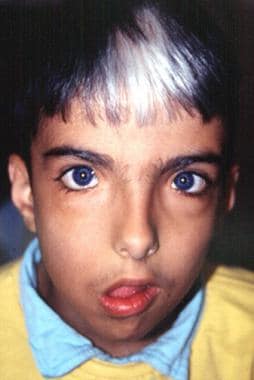
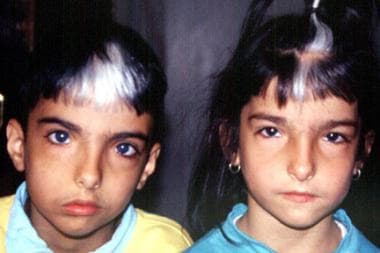
- Hair hypopigmentation (ie, white forelock)
- Affected first-degree relative
- Dystopia canthorum, with a W index that exceeds 1.95
- Minor criteria
- Congenital leucoderma (ie, several areas of hypopigmented skin)
- Synophrys or medial eyebrow flare
- Broad high nasal root
- Hypoplasia of alae nasi
- Prematurely graying hair (ie, predominately white by age 30 y)
WS has been associated in a few patients with urinary system anomalies.9 A screening program to detect WS throughout Columbia identified 95 affected individuals belonging to 95 families; the frequency rate of WS was 5.38% in the institutionalized deaf population.10 All patients had sensorineural deafness, and the most common features included broad nasal root (58.9%), an affected first-degree relative (37.9%), heterochromia irides (36.8%), skin hypopigmentation (31.6%), white forelock (28.0%), intense blue iris (27.4%), synophrys (12.6%), premature graying (10.5%), ptosis of the eyelids (9.5%), and hypoplasia alae nasi (1.1%).
Physical
- Facial features
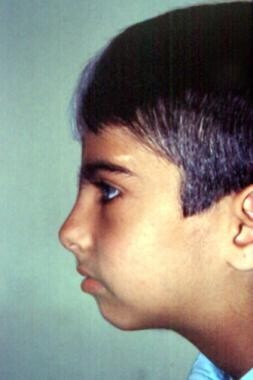
- Broad high nasal root
- Synophrys, medial flaring of the eyebrows, or both
- Hypoplastic alae nasi
- Dystopia canthorum: This condition is not always clinically evident but is present in nearly all cases of WS1, distinguishing it from WS2.
- Skin features
- Hypopigmentation, possibly on the face, trunk, or limbs with or without an associated white forelock
- Patches of hyperpigmentation in some families with WS
- Hair features
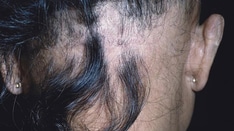
- White forelock (present at birth or developing later; may also disappear later)
- White body hair, eyebrows, eyelashes
- Dark tufts of hair or black forelock
- Premature graying (ie, <30 y)
- Eye features
- Complete or segmental heterochromia
- Brilliant sapphire blue eyes
- Aural features (SNHL)
- Variable incidence within and between families
- Affects 58% of individuals with WS1 and 77% of individuals with WS2
- Mild-to-profound hearing loss (profound SNHL most common in WS1 and WS2)
- Low-frequency loss or U-shaped audiograms in some affected individuals
- Can be bilateral, asymmetric, or unilateral
- Typical hearing loss not progressive
- Less commonly associated findings
- Neural tube defects
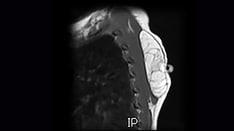
- Sprengel shoulder (ie, congenital upward scapular displacement)
- Cleft lip or palate
- Hirschsprung disease (primarily in cases of WS4 but reported in families with WS1 and WS2)
- Contractures and limb muscle hypoplasia (in patients with WS3)
Causes
- Most, if not all, cases of WS1 are caused by mutations in the PAX3 gene located on chromosome band 2q35.
- Deletions, frameshifts, splice site, and nonsense mutations, as well as whole gene deletions, have been reported.
- WS1 may be inherited in an autosomal dominant pattern or may be the result of a de novo mutation.
- WS3 is also caused by mutations in the PAX3 gene.
- WS3 may be inherited as a dominant disorder.
- In some cases, WS3 may be a manifestation of homozygous mutations of this gene.
- Mutations in the MITF gene, located on chromosome band 3p14.1-p12.3, cause some cases of WS2.
- Deletions, missense, splice site, and nonsense mutations have been reported.
- These mutations may be inherited in an autosomal dominant pattern or may be de novo.
- Some cases of WS2 have been linked to another locus on 1p21-p13.3, and some remain unlinked to either loci.
- WS4 is caused by homozygous mutations in either the EDN3 or the EDNRB gene.
- Heterozygous mutations in either of these genes cause isolated Hirschsprung disease.
- Heterozygous mutations in the SOX10 gene have also been reported to cause WS4.
Other Problems to be Considered
Nonsyndromic SNHL Piebaldism due to mutations in the KIT gene (Online Mendelian Inheritance in Man [OMIM] #172800) Tietz syndrome (ie, albinism and deafness [OMIM #103500]) Ocular albinism with sensorineural deafness (OMIM #103470)
Lab Studies
- Molecular testing: Mutation analysis of the PAX3 gene is available on a clinical basis for individuals or families with Waardenburg syndrome type 1 (WS1) or WS3. Mutations have not been identified in some families with WS1, although most are linked to the 2q35 region. Research continues on mutations of MITF, EDN3, EDNRB, and SOX10.
Other Tests
- Audiology: Formal audiologic evaluation is used to detect mild or unilateral hearing loss, which may not be clinically evident in the proband or family members.
Medical Care
- Genetic counseling
- Individuals with Waardenburg syndrome type 1 (WS1) and WS2 have a 50% chance in each pregnancy of having an affected offspring. Clinical features can widely vary within families, and predicting whether offspring will be more or less severely affected than the parent is impossible.
- Recurrence risk for unaffected parents is very low, but gonadal mosaicism could cause the syndrome in another offspring. Unless molecular testing confirms that parents are unaffected, be cautious about using that term and do so only after a complete clinical evaluation for subtle manifestations.
- Risk of recurrence for WS3 and WS4 depends on the individual's specific molecular etiology.
- Audiology and otolaryngology management
- An audiologist should provide regular follow-up for affected individuals with SNHL to manage optimal treatment with hearing aids or other auditory devices.
- Follow-up should continue with an otolaryngologist to exclude structural abnormalities of the inner ear, to manage causes of additional conductive hearing loss, and to discuss possible treatment using a cochlear implant.
- Other management issues: In rare cases, additional subspecialists may be needed to manage neural tube defects, cleft lip or palate, limb abnormalities, and Hirschsprung disease.
Surgical Care
- Surgery may be required to repair some cases of severe dystopia canthorum.
- In rare cases, surgery may be needed to repair neural tube defects, cleft lip or palate, or Hirschsprung disease.
- WS is often characterized by varying degrees of congenital hearing loss. Cochlear implantation in children with WS should be considered and may be beneficial.11, 12
Consultations
- Clinical geneticist
- Otolaryngologist
- Audiologist
- Plastic surgeon
- Orthopedist
- Gastroenterologist
- Neurosurgeon
Diet
- WS management requires no special diet.
Activity
- WS management requires no activity restrictions.
Drug therapy currently is not a component of the standard of care for this syndrome. See Treatment.
Further Inpatient Care
- Inpatient care may be necessary for patients requiring surgical repair of neural tube defects, cleft lip or palate, limb abnormalities, and Hirschsprung disease.
Further Outpatient Care
- Monitor recommendations and results of regularly scheduled audiologic and otolaryngology evaluations and testing.
- Monitor management of rare associated abnormalities when present (ie, neural tube defects, limb anomalies, cleft lip or palate, Hirschsprung disease).
Prognosis
- Cognition is generally normal. The developmental prognosis for patients with hearing loss depends on appropriate intervention (ie, early amplification, appropriate educational intervention).
- Prognosis in rarer cases depends on the severity of the additional abnormalities.
Patient Education
Medical/Legal Pitfalls
- Failure to identify congenital SNHL in a newborn, with possible significant effect on language development
- Failure to provide adequate genetic counseling
- Failure to evaluate for possible associated problems (eg, Hirschsprung disease)
Special Concerns
- An individual affected with Waardenburg syndrome type 1 (WS1) or WS2 has a 50% chance of passing on the gene to each offspring.
- Prenatal testing may be available for families with a previously identified gene mutation. Prenatal testing can determine whether the fetus has inherited the mutation but does not help predict syndrome severity or how the syndrome will manifest (eg, possible SNHL).
- WS manifestations can widely vary between and within families.
- Waardenburg PJ. A new syndrome combining developmental anomalies of the eyelids, eyebrows and nose root with pigmentary defects of the iris and head hair and with congenital deafness. Am J Hum Genet. 1951;3:195-253.
- Arias S. Genetic heterogeneity in the Waardenburg syndrome. Birth Defects Orig Artic Ser. Mar 1971;07(4):87-101. [Medline].
- Watanabe A, Takeda K, Ploplis B, Tachibana M. Epistatic relationship between Waardenburg syndrome genes MITF and PAX3. Nat Genet. Mar 1998;18(3):283-6. [Medline].
- Verheij JB, Sival DA, van der Hoeven JH, et al. Shah-Waardenburg syndrome and PCWH associated with SOX10 mutations: A case report and review of the literature. Eur J Paediatr Neurol. 2006;10(1):11-7. [Medline].
- Sangkhathat S, Chiengkriwate P, Kusafuka T, et al. Novel mutation of Endothelin-B receptor gene in Waardenburg-Hirschsprung disease. Pediatr Surg Int. Dec 2005;21(12):960-3. [Medline].
- Yang SZ, Cao JY, Zhang RN, et al. Nonsense mutations in the PAX3 gene cause Waardenburg syndrome type I in two Chinese patients. Chin Med J (Engl). Jan 5 2007;120(1):46-9. [Medline].
- Farrer LA, Grundfast KM, Amos J, et al. Waardenburg syndrome (WS) type I is caused by defects at multiple loci, one of which is near ALPP on chromosome 2: first report of the WS consortium. Am J Hum Genet. May 1992;50(5):902-13. [Medline].
- Liu XZ, Newton VE, Read AP. Waardenburg syndrome type II: phenotypic findings and diagnostic criteria. Am J Med Genet. Jan 2 1995;55(1):95-100. [Medline].
- Ekinci S, Ciftci AO, Senocak ME, Buyukpamukcu N. Waardenburg syndrome associated with bilateral renal anomaly. J Pediatr Surg. May 2005;40(5):879-81. [Medline].
- Tamayo ML, Gelvez N, Rodriguez M, et al. Screening program for Waardenburg syndrome in Colombia: clinical definition and phenotypic variability. Am J Med Genet A. Apr 15 2008;146A(8):1026-31. [Medline].
- Daneshi A, Hassanzadeh S, Farhadi M. Cochlear implantation in children with Waardenburg syndrome. J Laryngol Otol. Sep 2005;119(9):719-23. [Medline].
- Migirov L, Henkin Y, Hildesheimer M, Muchnik C, Kronenberg J. Cochlear implantation in Waardenburg's syndrome. Acta Otolaryngol. Jul 2005;125(7):713-7. [Medline].
- Baspinar O, Gungor M, Parlak M, Coskun Y. Waardenburg syndrome type II and dilated cardiomyopathy in a child. Pediatr Int. Feb 2006;48(1):100-2. [Medline].
- Dourmishev AL, Dourmishev LA, Schwartz RA, Janniger CK. Waardenburg syndrome. Int J Dermatol. Sep 1999;38(9):656-63. [Medline].
- Dourmishev AL, Dourmishev LA, Schwartz RA, Janniger CK. Waardenburg's syndrome with facial palsy and lingua plicata: is that a new type of disease?. Cutis. Mar 1999;63(3):139-41. [Medline].
- Edery P, Attie T, Amiel J, et al. Mutation of the endothelin-3 gene in the Waardenburg-Hirschsprung disease (Shah-Waardenburg syndrome). Nat Genet. Apr 1996;12(4):442-4. [Medline].
- Klein D. Historical background and evidence for dominant inheritance of the Klein-Waardenburg syndrome (type III). Am J Med Genet. Feb 1983;14(2):231-9. [Medline].
- Otman SG, Abdelhamid NI. Waardenburg syndrome type 2 in an African patient. Indian J Dermatol Venereol Leprol. Nov-Dec 2005;71(6):426-7. [Medline].
- Pingault V, Bondurand N, Kuhlbrodt K. SOX10 mutations in patients with Waardenburg-Hirschsprung disease. Nat Genet. Feb 1998;18(2):171-3. [Medline].
- Puffenberger EG, Hosoda K, Washington SS, et al. A missense mutation of the endothelin-B receptor gene in multigenic Hirschsprung's disease. Cell. Dec 30 1994;79(7):1257-66. [Medline].
- Read AP, Newton VE. Waardenburg syndrome. J Med Genet. Aug 1997;34(8):656-65. [Medline].
- Shah KN, Dalal SJ, Desai MP, et al. White forelock, pigmentary disorder of irides, and long segment Hirschsprung disease: possible variant of Waardenburg syndrome. J Pediatr. Sep 1981;99(3):432-5. [Medline].
- Steel KP, Barkway C. Another role for melanocytes: their importance for normal stria vascularis development in the mammalian inner ear. Development. Nov 1989;107(3):453-63. [Medline].
- Tachibana M, Takeda K, Nobukuni Y, et al. Ectopic expression of MITF, a gene for Waardenburg syndrome type 2, converts fibroblasts to cells with melanocyte characteristics. Nat Genet. Sep 1996;14(1):50-4. [Medline].
- Tassabehji M, Newton VE, Read AP. Waardenburg syndrome type 2 caused by mutations in the human microphthalmia (MITF) gene. Nat Genet. Nov 1994;8(3):251-5. [Medline].
- Tassabehji M, Read AP, Newton VE, et al. Waardenburg's syndrome patients have mutations in the human homologue of the Pax-3 paired box gene. Nature. Feb 13 1992;355(6361):635-6. [Medline].
- Zlotogora J, Lerer I, Bar-David S, et al. Homozygosity for Waardenburg syndrome. Am J Hum Genet. May 1995;56(5):1173-8. [Medline].
Waardenburg Syndrome excerpt Article Last Updated: Jun 19, 2008
|