Continually Updated Clinical Reference
 
 
  All Sources     eMedicine     Medscape     Drug Reference     MEDLINE
 
eMedicine - Von Willebrand Disease : Article by

Quick Find
Authors & Editors
Introduction
Clinical
Differentials
Workup
Treatment
Medication
Follow-up
Miscellaneous
References

Related Articles
Bernard-Soulier Syndrome

Hemophilia A and B

Hemophilia C


Patient Education
Skin, Hair, and Nails Center

Bruises Overview

Bruises Causes

Bruises Symptoms

Bruises Treatment


Author: John D Geil, MD, Associate Professor of Pediatrics, Division of Hematology/Oncology, University of Kentucky College of Medicine; Consulting Staff, Department of Pediatric Hematology/Oncology, University of Kentucky Children's Hospital

John D Geil is a member of the following medical societies: American Academy of Pediatrics and American Society of Pediatric Hematology/Oncology

Editors: J Martin Johnston, MD, Associate Professor of Pediatrics, Mercer University School of Medicine; Director of Pediatric Hematology/Oncology, Backus Children's Hospital; Consulting Oncologist/Hematologist, St Damien's Pediatric Hospital; Mary L Windle, PharmD, Adjunct Assistant Professor, University of Nebraska Medical Center College of Pharmacy, Pharmacy Editor, eMedicine.com, Inc; James L Harper, MD, Associate Professor, Department of Pediatrics, Division of Hematology/Oncology and Bone Marrow Transplantation, Associate Chairman for Education, Department of Pediatrics, University of Nebraska Medical Center; Assistant Clinical Professor, Department of Pediatrics, Creighton University; Director, Continuing Medical Education, Children's Memorial Hospital; Pediatric Director, Nebraska Regional Hemophilia Treatment Center; Samuel Gross, MD, Professor Emeritus, Department of Pediatrics, University of Florida, Clinical Professor, Department of Pediatrics, UNC, Adjunct Professor, Department of Pediatrics, Duke University; Max J Coppes, MD, PhD, MBA, Executive Director, Center for Cancer and Blood Disorders, Children's National Medical Center, Washington, DC; Professor of Medicine, Oncology, and Pediatrics, Georgetown University

Author and Editor Disclosure

Synonyms and related keywords: von Willebrand disease, VWD, von Willebrand factor, VWF, congenital bleeding disorder

Background

Although referred to as a single disease, von Willebrand disease (VWD) is in fact a family of bleeding disorders caused by an abnormality of the von Willebrand factor (VWF). VWD is the most common hereditary bleeding disorder.

First described by Erik Adolf von Willebrand in 1926, VWD is a congenital bleeding disorder characterized by a lifelong tendency toward easy bruising, frequent epistaxis, and menorrhagia.

Pathophysiology

VWD is due to an abnormality, either quantitative or qualitative, of the VWF, which is a large multimeric glycoprotein that functions as the carrier protein for factor VIII (FVIII). VWF also is required for normal platelet adhesion. As such, VWF functions in both primary (involving platelet adhesion) and secondary (involving FVIII) hemostasis. In primary hemostasis, VWF attaches to platelets by its specific receptor to glycoprotein Ib on the platelet surface and acts as an adhesive bridge between the platelets and damaged subendothelium at the site of vascular injury. In secondary hemostasis, VWF protects FVIII from degradation and delivers it to the site of injury.

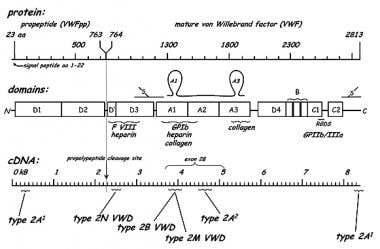
VWF is composed of dimeric subunits that are linked by disulfide bonds to form complex multimers of low, intermediate, and high molecular weights. The small multimers function mainly as carriers for FVIII.

High molecular weight multimers have higher numbers of platelet-binding sites and greater adhesive properties. Each multimeric subunit has binding sites for the receptor glycoprotein Ib on nonactivated platelets and the receptor glycoprotein IIb/IIIa on activated platelets. This facilitates both platelet adhesion and platelet aggregation, making high molecular weight multimers most important for normal platelet function.

VWd types

VWD can be classified into 3 main types, of which 70-80% are considered to be type 1.

  • Type 1 VWD is characterized by a partial quantitative decrease of qualitatively normal VWF and FVIII. An individual with type 1 VWD generally has mild clinical symptoms, and this type usually is inherited as an autosomal dominant trait; however, penetrance may vary dramatically in a single family. In addition, clinical and laboratory findings may vary in the same patient on different occasions. Typically, a proportional reduction in VWF activity, VWF antigen, and FVIII exists with type 1 VWD.
  • Of patients with VWD, 15-20% have type 2 disease. VWD type 2 is a variant of the disease with primarily qualitative defects of VWF. Type 2 VWD can be either autosomal dominant or recessive. Of the 5 known type 2 VWD subtypes (ie, 2A, 2B, 2C, 2M, 2N), type 2A VWD is by far the most common.
    • Type 2A VWD is inherited as an autosomal dominant trait and is characterized by normal-to-reduced plasma levels of factor VIIIc (FVIIIc) and VWF. Analysis of VWF multimers reveals a relative reduction in intermediate and high molecular weight multimer complexes. The multimeric abnormalities are commonly the result of in vivo proteolytic degradation of the VWF. The ristocetin cofactor activity is greatly reduced, and the platelet VWF reveals multimeric abnormalities similar to those found in plasma.
    • Type 2B VWD also is inherited as an autosomal dominant trait. This type is characterized by a reduction in the proportion of high molecular weight VWF multimers, while the proportion of low molecular weight fragments are increased. Patients with type 2B VWD have a hemostatic defect caused by a qualitatively abnormal VWF and intermittent thrombocytopenia. The abnormal VWF has an increased affinity for platelet glycoprotein Ib. The platelet count may fall further during pregnancy, in association with surgical procedures, or after the administration of desmopressin acetate (DDAVP). Although some investigators found DDAVP to be clinically useful in persons with type 2B VWD, studies directed at excluding the 2B variant should be completed before DDAVP is used therapeutically. Measurements of FVIIIc and VWF in plasma are variable; however, studies involving the use of titered doses of ristocetin reveal that aggregation of normal platelets is enhanced and induced by unusually small amounts of the drug.
    • In patients with the rare type 2M VWD, laboratory results are similar to those of certain patients with type 2A VWD. Type 2M VWD is characterized by a decreased platelet-directed function that is not due to a decrease of high–molecular weight multimers. Laboratory findings show decreased VWF activity, but VWF antigen, FVIII, and multimer analysis are found to be within reference range.
    • Type 2N VWD is also rare and is characterized by a markedly decreased affinity of VWF for FVIII, resulting in FVIII levels reduced to usually around 5% of the reference range. Other VWF laboratory parameters (ie, VWF antigen [VWF:Ag], ristocetin cofactor activity) are usually normal. The FVIII-binding defect in these patients is inherited in an autosomal recessive manner. Evaluate patients with FVIII deficiency and a bleeding disorder that is not clearly transmitted as an X-linked disorder or those who respond incompletely to hemophilia A therapy for type 2N VWD. Unfortunately, the confirmatory test for type 2N VWD is not routinely available, likely resulting in an underestimate of the true frequency of this subtype.
  • Type 3 is the most severe form of VWD. In the homozygous patient, type 3 VWD is characterized by marked deficiencies of both VWF and FVIIIc in the plasma, the absence of VWF from both platelets and endothelial cells, and a lack of response to DDAVP. Type 3 VWD is characterized by severe clinical bleeding and is inherited as an autosomal recessive trait. Consanguinity is common in kindreds with this variant. Less severe clinical abnormalities and laboratory abnormalities may be identified in occasional heterozygotes; however, such cases are difficult to identify. Multimeric analysis of the small amount of VWF present yields variable results, in some cases revealing only small multimers.

Frequency

United States

VWD is estimated to affect fewer than 3% of the population.

International

Prevalence worldwide is estimated at 0.9-1.3%.

Mortality/Morbidity

  • The morbidity in individuals with VWD is variable. Many children with VWD are asymptomatic. Some of these children have cutaneous and/or mucus membrane bleeding (eg, easy bruising, epistaxis).
  • Menorrhagia is a common symptom in females with VWD. It occurs in more than 50% of women with VWD and may be the only clinical manifestation of the disease.
  • The rare type 3 VWD can manifest with severe bleeding symptoms similar to severe hemophilia (eg, hemarthrosis, intramuscular bleeding).

Race

No influence of ethnicity on the prevalence of VWD exists.

Sex

VWD affects males and females in equal numbers.

Age

VWD is a congenital bleeding disorder and can be diagnosed at any age.


History

  • Many children with von Willebrand disease (VWD) are asymptomatic and are diagnosed as a result of a positive family history or during routine preoperative screening (eg, prolonged bleeding time). Importantly, remember that a wide variation in clinical manifestations exists, even for members of the same family.
  • The history may reveal the following:
    • Increased or easy bruising
    • Recurrent epistaxis
    • Menorrhagia
    • Postoperative bleeding (particularly after tonsillectomy or dental extractions)
    • Family history of a bleeding diathesis
      • Bleeding from wounds
      • Gingival bleeding
      • Postpartum bleeding

Physical

  • The physical exam may be normal, but the following may be present:
    • Increased bruises
    • Mucosal bleeding

Causes

  • VWD is caused by an inherited defect that results in a deficiency or dysfunction of von Willebrand factor (VWF). The gene for VWF is on the short arm of chromosome 12. It spans approximately 180 kilobases (kb) and is composed of 52 exons. Exons range in size from 40 base pairs (bp) to 1.4 kb. Various point mutations, insertions, and deletions at the VWF locus have been described.
  • In some cases, VWD is believed to result from other pathologic processes; however, because of the relatively high prevalence of VWD, its concomitant occurrence with other disease states may be coincidental.
  • Nevertheless, acquired forms of VWD can be observed in the following conditions:
    • Wilms tumor
    • Congenital heart disease
    • Systemic lupus erythematosus
    • Angiodysplasia
    • Seizure disorders treated with valproic acid
    • Hypothyroidism


Bernard-Soulier Syndrome
Hemophilia A and B
Hemophilia C

Other Problems to be Considered

Other platelet function abnormalities, such as Glanzmann thrombasthenia, storage pool defects, and acquired abnormal platelet function due to medication (eg, aspirin, long-term NSAID use)


Lab Studies

  • Screening tests
    • Complete blood count: Assess platelet number and morphology, which should be normal in most patients with von Willebrand disease (VWD) (except those with type 2B VWD).
    • Template bleeding time: Because it is reasonably well standardized, the template bleeding time is used as a screening test for primary hemostasis. The reference range for the bleeding time in children is longer than that of adults. Results of the bleeding time are affected by many technical factors, such as the direction of the incision and the skill of the technician. Although a bleeding time outside of the reference range may suggest a defect in hemostasis, it is not diagnostic. Similarly, a bleeding time within the reference range does not exclude the presence of such a defect. While neither sensitive nor specific for VWD, template-bleeding time is outside of the reference range in about 50% of patients with type 1 VWD. Patients with VWD types 2A, 2B, 2M, and 3 often have prolonged bleeding times. The template bleeding time has largely been replaced by automatic platelet function analyzers (PFAs) such as the PFA-100.
    • Prothrombin time (PT) is within reference range in VWD.
    • Activated partial thromboplastin time (aPTT): Approximately 25% of patients with type 1 VWD have aPTT results outside of the reference range. These results may be caused by concurrent deficiencies of other clotting factors in addition to, or rather than, FVIII. The aPTT should be outside of the reference range in patients with severe VWD or type 2N VWD in whom circulating FVIII levels are very low. Because aPTT and the template bleeding time are insensitive tests for VWD, add von Willebrand factor (VWF) activity to the screening tests performed for patients with suspected bleeding disorders (see below).
  • Specific assays
    • VWF levels are variable and can be influenced by a number of factors including blood type. Individuals with type O blood have lower values of VWF levels on average, whereas those with type AB blood have higher values of VWF. Day-to-day variation in VWF levels is a normal occurrence in the same individual; therefore, a single level within reference range does not exclude the diagnosis of VWD.
    • FVIII activity is variably decreased.
    • VWF activity (ristocetin cofactor): Ristocetin is an antibiotic that causes VWF to bind to and, subsequently, to activate platelets. In the ristocetin cofactor assay, platelets from individuals who are healthy, standard concentrations of ristocetin, and varying quantities of patient or control plasma are used. In individuals who are healthy, platelets rapidly agglutinate in response to ristocetin; however, the presence of plasma VWF is necessary for the reaction to occur. The degree of platelet agglutination is proportional to the concentration of VWF in the plasma. Several variations of this assay have been developed. Because the result of this assay reflects the functional activity of VWF, it is usually called the VWF activity. It is variably decreased in VWD.
    • VWF antigen: The total plasma concentration of VWF protein is measured by one of several assays. The Laurell rocket immunoelectrophoresis technique measures the amount of VWF protein in the plasma, whereas radioimmunoassays and enzyme-linked immunoabsorbent assays reflect the number of VWF-binding sites. These tests determine the total amount of VWF antigen in the plasma but do not reflect its molecular structure and, hence, may be normal in VWD variants with abnormal multimers. Therefore, VWF antigen is variably decreased.
  • Subtype determination
    • In multimer analysis to determine the physical structure of VWF (ie, whether high molecular weight multimers are present), plasma is electrophoresed through agarose gel. The presence or absence of high molecular weight VWF is used to classify VWD. Absence or decreased levels of high molecular weight VWF multimers is consistent with type 2 VWD. Further analysis of VWF subunits has been performed with sophisticated electrophoretic techniques, resulting in the description of many type 2 variants.

Other Tests

  • In some laboratories, platelet VWF analysis is performed. Gene analysis also can be performed for diagnosis.


Medical Care

Minor bleeding problems, such as bruising or a brief nosebleed, may not require specific treatment. For more serious bleeding, medications that can raise the von Willebrand factor (VWF) level and, thereby, limit bleeding are available. The goal of therapy is to correct the defect in platelet adhesiveness (by raising the level of effective VWF) and the defect in blood coagulation (by raising the FVIII level). In recent years, desmopressin (1-deamine-8-D-arginine vasopressin, DDAVP) has become a mainstay of therapy for most patients with mild von Willebrand disease (VWD). At appropriate doses, DDAVP causes a 2- to 5-fold increase in plasma VWF and FVIII concentrations in individuals who are healthy and patients who are responsive. DDAVP can be used to treat bleeding complications or to prepare patients with VWD for surgery.

In general, a patient's responsiveness to DDAVP prior to its use for these purposes can be determined. Once determined, such responsiveness generally is consistent in patients over time and within families. In patients with serious bleeding, prompt treatment is important in order to decrease the possibility of complications.

Consultations

Consult a pediatric or adult hematologist.

Activity

No evidence suggests that extensive activity restrictions are necessary for most patients with mild type1 VWD. Patients with more severe forms of VWD should follow guidelines developed for patients with severe hemophilia.


Drug Category: Vasopressin analogues

Desmopressin is a synthetic analogue of antidiuretic hormone. It is considered the primary treatment for bleeding in individuals with mild von Willebrand disease (VWD). It works by causing release of von Willebrand factor (VWF) from endothelial storage sites.

Desmopressin can be administered intravenously, intranasally, or subcutaneously. The dose for hemostasis is approximately 15 times the dosage used to treat individuals with diabetes insipidus. The regular intranasal preparation (0.1 mg/mL), which is used to treat persons with diabetes insipidus, is too dilute to elicit a hemostatic response. A high-concentration intranasal preparation (ie, Stimate 1.5 mg/mL) has been licensed and has shown a similar response as the intravenous form.

The higher concentration intranasal preparation allows home treatment for bleeding symptoms; however, experience with its use in the surgical setting is limited. Most experience in treating individuals with VWD is with intravenous infusion, with which the response is rapid (ie, peak VWF levels in approximately 45-90 min of infusion). Doses may be repeated at intervals of 12-24 hours for continued bleeding or for postoperative use. Desmopressin has also been administered subcutaneously with a favorable response.

Drug NameDesmopressin (Stimate)
DescriptionIncreases cellular permeability of collecting ducts, resulting in reabsorption of water by kidneys.
Test patients for response prior to usage in a bleeding episode. A 2- to 5-fold increase in VWF and FVIII commonly is obtained after treatment.
The higher concentration of desmopressin (ie, Stimate 1.5 mg/mL) is prescribed for VWD to provide an adequate dose.
Pediatric Dose0.3 mcg/kg IV or 1-2 inhalations of nasal spray; use high concentration product (1.5 mg/mL)
ContraindicationsDocumented hypersensitivity; platelet-type von Willebrand disease; nonresponsiveness in previous testing
InteractionsCoadministration with demeclocycline and lithium decrease effects; fludrocortisone and chlorpropamide increase effects of desmopressin
PregnancyB - Usually safe but benefits must outweigh the risks.
PrecautionsRestrict free-water intake to avoid hyponatremia; mild facial flushing and headache may occur; tachyphylaxis develops with repeated usage

Drug Category: Plasma products

For patients with VWD who do not respond to desmopressin, and for individuals with the rare types 2B or 3 VWD, plasma-derived Factor VIII (FVIII) concentrates that contain VWF in high molecular weight can be used. The product used must contain VWF in the high molecular weight form to be effective. However, most available FVIII concentrates do not contain sufficient VWF to be used in VWD. Cryoprecipitate contains multimeric VWF; however, concerns about possible virus transmission have led many clinicians to choose FVIII products that contain multimeric VWF and have undergone viral inactivation processes. Only a minority of currently available FVIII products contain VWF; the protein has been eliminated from the others. In general, the dosage of cryoprecipitate or FVIII to be used is calculated on the basis of FVIII units. Other blood products are rarely required for patients with VWD. Platelet transfusion may benefit patients with type 3 VWD who do not respond to VWF-containing concentrates or

cryoprecipitate.

Drug NameAntihemophilic factor/von Willebrand Factor Complex, human (Alphanate, Humate-P)
DescriptionSome FVIII concentrates (eg, Humate-P, Alphanate) also contain VWF in high molecular weight form. These concentrates are especially useful in types 2B and 3 vWD.
Alphanate is indicated to prevent excessive bleeding for surgical and invasive procedures in vWD in cases in which desmopressin is either ineffective or contraindicated. It is not indicated for patients with severe vWD (ie, Type 3) undergoing major surgery.
Humate-P is indicated for treatment and prevention of spontaneous and trauma-induced bleeding episodes for patients with mild-to-moderate or severe vWD.
Adult DoseNote: Ratio of vWF:RCoF activity and FVIII potency contained in each vial of Alphanate or Humate-P is on vial's label; this ratio varies by lot, so dosage should be reevaluated whenever lot selection is changed

Alphanate:Preoperative dose: 60 vWF:RCoF IU/kg IV
Subsequent infusions: 40-60 vWF:RCof IU/kg IV q8-12h prn
Dose may be reduced after postoperative day 3; continue treatment until healing is complete; maintain vWF activity of 40-50% during at least 1-3 d postoperation for minor procedures and at least 3-7 d postoperation for major procedures

Humate-P:Type I disease
Minor bleeding: 40-50 U/kg (1 or 2 doses) IV
Major bleeding: Loading dose of 40-75 U/kg IV, then 40-60 U/kg q8-12h for 3 d to keep RCoF activity nadir >50%; then 40-50 U/kg qd for up to 7 d
Type 2 and 3 disease
Minor bleeding: 40-50 U/kg (1 or 2 doses) IV
Major bleeding: Loading dose of 60-80 U/kg IV, then 40-60 U/kg q8-12h for 3 d to keep RCoF activity nadir >50%; then 40-50 U/kg IV qd for up to 7 d; monitor FVIII levels

Pediatric DoseAlphanate:
Initial dose: 75 vWF:RCof IU/kg IV
Subsequent infusions: 50-75 vWF:RCof IU/kg IV q8-12h prn
Dose may be reduced after postoperative day 3; continue treatment until healing is complete

Humate-P: 20-50 U/kg IV; base dose on patient weight, baseline FVIII level, and bleeding severity

ContraindicationsDocumented hypersensitivity
InteractionsNone reported
PregnancyC - Safety for use during pregnancy has not been established.
PrecautionsViral contamination and infection are remotely possible but unlikely due to prescreening; may induce anamnestic response; monitor patients for signs or symptoms of any allergic reactions by monitoring vital signs including pulse rate; reduce rate of administration or discontinue AHF concentrate if significant change in vital signs occur and are thought to be due to allergic reaction and not to continuing active bleeding; immune tolerance regimens can be associated with nephrotic syndrome, which requires discontinuation of product

Drug NameAminocaproic acid (Amicar)
DescriptionInhibits fibrinolysis via inhibition of plasminogen activator substances and, to a lesser degree, through antiplasmin activity. Main problem is that the thrombi that forms during treatment are not lysed and effectiveness is uncertain. Has been used to prevent recurrence of subarachnoid hemorrhage (SAH). Useful in mucous membrane bleeding.
Pediatric Dose100 mg/kg/dose PO q4-6h
ContraindicationsDocumented hypersensitivity; evidence of active intravascular clotting process; since aminocaproic acid can be fatal in patients with disseminated intravascular coagulation (DIC), it is important to differentiate between hyperfibrinolysis and disseminated intravascular coagulation
InteractionsCoadministration with estrogens may cause increase in clotting factors, leading to a hypercoagulable state
PregnancyC - Safety for use during pregnancy has not been established.
PrecautionsDo not administer unless a definite diagnosis of hyperfibrinolysis has been made; caution in cardiac, hepatic, or renal disease


In/Out Patient Meds

  • Epsilon amino caproic acid (Amicar)
    • Inhibition of fibrinolysis
    • Useful in mucous membrane bleeding
    • Dose: 100 mg/kg/dose PO q4-6h

Deterrence/Prevention

Avoid medications with known antiplatelet effects. Although aspirin is rarely taken by children, over-the-counter compounds containing acetylsalicylic acid often are used by adolescents. Ibuprofen and other nonsteroidal anti-inflammatory agents are reversible cyclooxygenase inhibitors and may cause intestinal bleeding. The risks of these and other medicines with antiplatelet effects should be considered in light of the severity of the von Willebrand disease (VWD). Provide patients with VWD a list of prescription and nonprescription medications to avoid. This list should include the following:

  • Over-the-counter medications
    • Aspirin
    • Ibuprofen
    • Naproxen
    • Antihistamines
    • Ethanol
  • Antiplatelet agents
    • Dipyridamole
    • Ticlopidine
    • Prescription nonsteroidal anti-inflammatory compounds
  • Antimicrobials
    • High-dose penicillins
    • Cephalosporins
    • Nitrofurantoin
    • Hydroxychloroquine
  • Cardiovascular medications
    • Propranolol
    • Furosemide
    • Calcium channel blockers
    • Quinidine
  • Others
    • Caffeine
    • Tricyclic antidepressants
    • Phenothiazines
    • Valproate
    • Heparin

Prognosis

  • Individuals with VWD have a lifelong tendency toward easy bruising, frequent epistaxis, and menorrhagia.

Patient Education

  • Avoid medications with antiplatelet activity.
  • Mild activity restrictions may be necessary.
  • For excellent patient education resources, visit eMedicine's Skin, Hair, and Nails Center. Also, see eMedicine's patient education article Bruises.


Medical/Legal Pitfalls

  • Failure to recognize bleeding tendency prior to elective surgery
  • Failure to recognize associated symptoms (eg, menorrhagia)
  • Failure to inform patient and family of activity restrictions
  • Excessive bruising suggestive of child abuse frequently instigates an evaluation to rule out a coagulopathy. Borderline abnormal lab results may mislead an investigator/caregiver and prevent recognition of actual abuse. Because von Willebrand disease (VWD) is a common disorder, its coexistence with nonaccidental trauma needs to be considered if the evidence of abuse is strong. Alternatively, the medical professional must recognize that the caregivers of a child with VWD may be falsely suspected of abuse, with obvious stressful ramifications.

Special Concerns

  • The dose of intranasal desmopressin used in VWD is about 15 times the dose used to treat patients with diabetes insipidus. A more concentrated nasal spray (1.5 mg/mL) is available for patients with VWD compared to the spray used for individuals with diabetes insipidus (0.1 mg/mL).
  • Restrict free-water intake to avoid hyponatremia, especially in very young or elderly patients.
  • May repeat desmopressin at intervals of 12-24-hours; however, depletion of tissue stores eventually develops.


  • Batlle J, Torea J, Rendal E, Fernandez MF. The problem of diagnosing von Willebrand''s disease. J Intern Med Suppl. 1997;740:121-8. [Medline].
  • Carcao MD, Blanchette VS, Dean JA, et al. The Platelet Function Analyzer (PFA-100): a novel in-vitro system for evaluation of primary haemostasis in children. Br J Haematol. Apr 1998;101(1):70-3. [Medline].
  • Lee CA, Brettler DB, eds. Guidelines for the diagnosis and management of von Willebrand disease. Haemophilia. 1997;3:1-25.
  • Mannucci PM. Treatment of von Willebrand's Disease. N Engl J Med. Aug 12 2004;351(7):683-94. [Medline].
  • Nichols WC, Ginsburg D. von Willebrand disease. Medicine (Baltimore). Jan 1997;76(1):1-20. [Medline].
  • Sadler JE. A revised classification of von Willebrand disease. For the Subcommittee on von Willebrand Factor of the Scientific and Standardization Committee of the International Society on Thrombosis and Haemostasis. Thromb Haemost. Apr 1994;71(4):520-5. [Medline].
  • Werner EJ. von Willebrand disease in children and adolescents. Pediatr Clin North Am. Jun 1996;43(3):683-707. [Medline].
  • Werner EJ, Abshire TC, Giroux DS, et al. Relative value of diagnostic studies for von Willebrand disease. J Pediatr. Jul 1992;analysis(1):34-8. [Medline].
  • Zhang Z, Blomback M, Anvret M. Understanding von Willebrand''s disease from gene defects to the patients. J Intern Med Suppl. 1997;740:115-9. [Medline].

Von Willebrand Disease excerpt

Article Last Updated: Feb 12, 2007