| Patient Education |
|
Click here for patient education.
|
|
You are in: eMedicine Specialties >
Pediatrics: Genetics and Metabolic Disease > Genetics
Silver-Russell Syndrome
Article Last Updated: Jul 25, 2006
AUTHOR AND EDITOR INFORMATION
Section 1 of 11
Author: Lawrence A Wetterau, MD, Assistant Professor, Section of Endocrinology, Children's Hospital Central California
Lawrence A Wetterau is a member of the following medical societies: American Academy of Pediatrics, Endocrine Society, and Lawson-Wilkins Pediatric Endocrine Society
Coauthor(s):
Margaret McGovern, MD, PhD, Vice Chair, Professor, Department of Human Genetics, Mount Sinai School of Medicine
Editors: Elaine H Zackai, MD, Director of Clinical Genetics Center, Professor of Pediatrics, Department of Pediatrics, Division of Human Genetics and Molecular Biology, University of Pennsylvania, Children's Hospital of Philadelphia; Mary L Windle, PharmD, Adjunct Assistant Professor, University of Nebraska Medical Center College of Pharmacy, Pharmacy Editor, eMedicine.com, Inc; Robert Anthony Saul, MD, Clinical Professor, Department of Pediatrics, University of South Carolina; Senior Clinical Geneticist, Greenwood Genetic Center; Daniel Rauch, MD, FAAP, Director, Pediatric Hospitalist Program, Associate Professor, Department of Pediatrics, New York University School of Medicine; Bruce Buehler, MD, Professor, Department of Pediatrics, Pathology and Microbiology, Executive Director, Hattie B Munroe Center for Human Genetics and Rehabilitation, University of Nebraska Medical Center
Author and Editor Disclosure
Synonyms and related keywords:
Silver-Russell syndrome, SRS, Russell-Silver syndrome, Silver-Russell dwarfism, Silver syndrome
Background
Silver-Russell syndrome (SRS) originally was described by Silver and colleagues in 1953 and, soon afterwards, by Russell in 1954. The first reports were in children with characteristic facies, low birthweight, asymmetry, and growth retardation.
Over the past several years, more than 400 patients have been described, with phenotypes ranging from mild to classic. Some patients have maternal uniparental disomy of chromosome 7, with the possibility of imprinting (eg, inheriting 2 copies of maternal chromosome 7, with no paternal contribution).
Pathophysiology
Growth failure is the primary abnormality. Patients typically present with intrauterine growth retardation, difficulty feeding, failure to thrive, or postnatal growth retardation. Adequate catch-up growth often does not occur, and final adult height still is less than normal (£-3.6 SD). Older children and adults do not manifest clinical features as clearly as infants or young children.
Growth hormone insufficiency may be present. Abnormalities of spontaneous growth hormone (GH) secretion and subnormal responses to provocative growth hormone stimulation testing have been reported in a significant number of children with SRS. Facial dysmorphism exists, with small triangular facies and normal head circumference. Because length usually is less than normal, the head appears disproportionately large. Intelligence may be normal, or the patient may have a learning disability. The limbs may be asymmetric, and camptodactyly (ie, fixed flexion of digits) or clinodactyly (ie, incurving) of one or more fingers may exist.
Frequency
International
More than 400 cases have been reported. Estimates of incidence range from as high as 1 in 3,000 to as low as 1 in 100,000.
Mortality/Morbidity
Infants have failure to thrive, feeding difficulties, and fasting hypoglycemia.
Sex
The male-to-female ratio is equal.
Age
Clinical features are easier to identify in infants and younger children, particularly the small triangular facies. These findings are more difficult to recognize in adults.
History
- Diagnostic criteria are not strictly established and only recently were proposed by a group whose homogeneous SRS patients generally had at least 4 of the following features:
- Birthweight less than or equal to -2 SD from the mean
- Poor postnatal growth, less than or equal to -2 SD from the mean at diagnosis
- Preservation of occipitofrontal circumference
- Classic facial phenotype
- Asymmetry
- Low birthweight (£-2 SD)
- Feeding difficulties during infancy
- Tendency for fasting hypoglycemia during infancy and early childhood
- Tendency for increased sweating during infancy, particularly on the head and upper trunk
- Developmental delay
- Poor head control during infancy caused by relatively large size of head compared to a small body
- Motor impairment caused by lack of muscle bulk and strength
- Impairment of cognitive abilities (language, arithmetic) during childhood in about 50% of patients
Physical
- Dysmorphic facies
- Classic features include normal head circumference (head may appear large because of small body size), blue sclerae, small triangular facies, a high forehead that tapers to a small jaw, micrognathia, prominent nasal bridge, and down-turning corners of the mouth.
- Mild dysmorphic facies include some features of the classic facies.
- Growth and skeletal
- Prenatal onset short stature (final height £-3.6 SD)
- Late closure of anterior fontanelle
- Asymmetry, usually of the limbs
- Hemihypertrophy
- Clinodactyly of the fifth finger
- Camptodactyly
- Syndactyly of second and third toes
- Sprengel deformity
- Genital anomalies
- Hypospadias
- Posterior urethral valves
- X-ray findings, hand: Delayed bone age, ivory epiphyses of the distal phalanges, small middle phalanx of the fifth finger (80%), pseudoepiphyses at the base of the second metacarpal
- Other (occasional)
- Cardiac defects
- Malignancy (eg, craniopharyngioma, testicular seminoma, hepatocellular carcinoma, Wilms tumor)
Causes
- SRS is both clinically and genetically a heterogeneous disorder, and the basic underlying defect is not known. SRS usually occurs sporadically and its etiology is not identified in most cases. A variety of molecular defects have been reported, mostly involving chromosomes 7 and 17. Defects have also been reported in chromosomes 1 and X. A few cases of autosomal dominant transmission are described, including ring 2 chromosome, balanced translocation of band 17q25, and duplication of band 7p11.2-p13.
- Approximately 10% of patients have proven uniparental disomy (UPD) and methylation. Imprinting may play a role in the clinical phenotype of SRS in these patients. UPD is the inheritance of both alleles from the same parent and none from the other parent. Multiple reports suggest that approximately 10% of patients may have maternal uniparental disomy of chromosome 7 (mUPD7). Heterodisomy (inheritance of both alleles from 1 parent) and isodisomy (inheritance of 2 copies of a single allele from 1 parent) are both demonstrated. Partial heterodisomy or isodisomy have also been shown. Recent findings also suggest that imprinting defects on chromosome 11 within the 11p15 region may also play a role in SRS.
- Imprinting involves the methylation of particular bases within an allele. The methylation pattern differs depending on whether the allele is obtained from the mother or from the father's genome. If the allele is methylated, then that gene selectively is turned off.
Fanconi Syndrome
Fetal Alcohol Syndrome
Other Problems to be Considered
Dubowitz syndrome
Lab Studies
- Use chromosomal analysis and karyotyping to evaluate for other disorders.
- If SRS is suspected, obtain patient and parental blood to evaluate for uniparental disomy of chromosome 7. This can be done only in specialized molecular diagnostic labs.
Imaging Studies
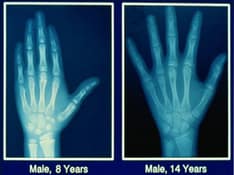
- Obtain a hand radiograph to determine bone age. Plain film hand x-ray findings include the following:
- Delayed bone age
- Ivory epiphyses of distal phalanges
- Small middle phalanx of the fifth finger in 80% of SRS patients
- Pseudoepiphyses at base of second metacarpal
Medical Care
- Growth
- Significant effort must be undertaken to optimize caloric intake.
- Growth hormone therapy should be considered in a child with SRS who has not manifested adequate catch-up growth by age 2 years. Growth hormone was approved in the United States in 2001 by the US Food and Drug Administration for use in children born small for gestational age who have not yet manifested adequate catch-up growth by age 2 years. Recombinant human growth hormone (rhGH) is given via daily subcutaneous injections. Recommended dose is 0.48 mg/kg/week.
- Development
- An early intervention program, including physical therapy, is beneficial.
- Special education courses are needed when the child is older.
Surgical Care
- Consider enteral feeding if the patient does not tolerate oral feeding and has severe failure to thrive. Nasogastric or percutaneous endoscopic gastrostomy (PEG) feeds are needed to facilitate growth and maintenance.
Consultations
- Consult a clinical geneticist to differentiate SRS from etiologies of growth retardation, asymmetry, and other clinical findings.
- Consult a gastroenterologist or nutritionist to optimize caloric intake and enhance growth and feeding therapy.
- Developmental evaluation places the patient in Early Intervention, special education programs, physical therapy, and occupational therapy as early as possible.
- Consult a pediatric endocrinologist to consider the use of recombinant human growth hormone (rhGH) in an infant nearing age 2 years who has not manifested adequate catch-up growth.
Diet
- Patients should have a nutritional evaluation to provide optimal calories for growth. As stated previously, nasogastric or PEG feeding may be required.
rhGH has been shown to substantially improve linear growth in patients with SRS. Additional long-term studies and continued efforts to optimize dosing regimens are required before benefits on final adult height can be fully assessed.
Further Inpatient Care
- The patient may require hospitalization for enteral tube feeding.
Further Outpatient Care
- The patient may need home-health services for enteral tube feeding follow-up at home.
- Early intervention programs and special education classes are beneficial.
- Feeding, physical, and occupational therapy are beneficial.
Prognosis
- The prognosis is relatively good.
- Some patients may have a learning disability.
Patient Education
- Educate the family regarding the growth and development of these children.
Special Concerns
- Genetic counseling
- Most studies demonstrate that the siblings of children with SRS do not have the disorder. Therefore, risk for recurrence is expected to be minimal.
- In some of the cases seen to date, the children of patients with SRS do not have the disorder.
The authors and editors of eMedicine gratefully acknowledge the contributions of previous author Ainu Prakash-Cheng, MD, PhD to the development and writing of this article.
- Azcona C, Stanhope R. Hypoglycaemia and Russell-Silver syndrome. J Pediatr Endocrinol Metab. Jul 2005;18(7):663-70. [Medline].
- Chernausek SD. Treatment of short children born small for gestational age: US perspective, 2005. Horm Res. 2005;64 Suppl 2:63-6. [Medline].
- Christoforidis A, Maniadaki I, Stanhope R. Managing children with Russell-Silver syndrome: more than just growth hormone treatment?. J Pediatr Endocrinol Metab. Jul 2005;18(7):651-2. [Medline].
- Cutfield WS, Lindberg A, Rapaport R, et al. Safety of growth hormone treatment in children born small for gestational age: the US trial and KIGS analysis. Horm Res. 2006;65 Suppl 3:153-9. [Medline].
- Davies PS, Valley R, Preece MA. Adolescent growth and pubertal progression in the Silver-Russell syndrome. Arch Dis Child. Feb 1988;63(2):130-5. [Medline].
- Duncan PA, Hall JG, Shapiro LR, Vibert BK. Three-generation dominant transmission of the Silver-Russell syndrome. Am J Med Genet. Feb 1990;35(2):245-50. [Medline].
- Eggermann T, Wollmann HA, Kuner R, et al. Molecular studies in 37 Silver-Russell syndrome patients: frequency and etiology of uniparental disomy. Hum Genet. Sep 1997;100(3-4):415-9. [Medline].
- Eggermann T, Meyer E, Ranke MB, et al. Diagnostic proceeding in Silver-Russell syndrome. Mol Diagn. 2005;9(4):205-9. [Medline].
- Gicquel C, Le Bouc Y. Hormonal regulation of fetal growth. Horm Res. 2006;65 Suppl 3:28-33. [Medline].
- Gicquel C, Rossignol S, Cabrol S. Epimutation of the telomeric imprinting center region on chromosome 11p15 in Silver-Russell syndrome. Nat Genet. Sep 2005;37(9):1003-7. [Medline].
- Graham JM Jr, Rimoin DL. Abnormal body size and proportion. In: Emery and Rimoin's Principle and Practice of Medical Genetics. Vol. I. 1997:737-752.
- Jones KL. Russell-Silver syndrome. In: Smith's Recognizable Patterns of Human Malformation. 5th ed. 1997:96-9.
- Kotzot D, Schmitt S, Bernasconi F, et al. Uniparental disomy 7 in Silver-Russell syndrome and primordial growth retardation. Hum Mol Genet. Apr 1995;4(4):583-7. [Medline].
- Lacassie Y, Arriaza MI, Vargas A, La Motta I. Ring 2 chromosome: ten-year follow-up report. Am J Med Genet. Jul 16 1999;85:117-22. [Medline].
- Lai KY, Skuse D, Stanhope R, Hindmarsh P. Cognitive abilities associated with the Silver-Russell syndrome. Arch Dis Child. Dec 1994;71(6):490-6. [Medline].
- Langlois S, Yong SL, Wilson RD, et al. Prenatal and postnatal growth failure associated with maternal heterodisomy for chromosome 7. J Med Genet. Nov 1995;32:871-5. [Medline].
- Li CC, Chodirker BN, Dawson AJ, Chudley AE. Severe hemihypotrophy in a female infant with mosaic Turner syndrome: a variant of Russell-Silver syndrome?. Clin Dysmorphol. Apr 2004;13(2):95-8. [Medline].
- Midro AT, Debek K, Sawicka A, et al. Second observation of Silver-Russel syndrome in a carrier of a reciprocal translocation with one breakpoint at site 17q25. Clin Genet. Jul 1993;44(1):53-5. [Medline].
- Monk D, Wakeling EL, Proud V, et al. Duplication of 7p11.2-p13, including GRB10, in Silver-Russell syndrome. Am J Hum Genet. Jan 2000;66(1):36-46. [Medline].
- Monk D, Bentley L, Hitchins M, et al. Chromosome 7p disruptions in Silver Russell syndrome: delineating an imprinted candidate gene region. Hum Genet. Oct 2002;111(4-5):376-87. [Medline].
- Moore GE, Abu-Amero S, Wakeling E, et al. The search for the gene for Silver-Russell syndrome. Acta Paediatr Suppl. Dec 1999;433:42-8. [Medline].
- Preece MA, Price SM, Davies V, et al. Maternal uniparental disomy 7 in Silver-Russell syndrome. J Med Genet. Jan 1997;34(1):6-9. [Medline].
- Price SM, Stanhope R, Garrett C, et al. The spectrum of Silver-Russell syndrome: a clinical and molecular genetic study and new diagnostic criteria. J Med Genet. Nov 1999;36(11):837-42. [Medline].
- Rakover Y, Dietsch S, Ambler GR, et al. Growth hormone therapy in Silver Russell syndrome: 5 years experience of the Australian and New Zealand Growth database (OZGROW). Eur J Pediatr. Oct 1996;155(10):851-7. [Medline].
- Ramirez-Duenas ML, Medina C, Ocampo-Campos R, Rivera H. Severe Silver-Russell syndrome and translocation. Clin Genet. Jan 1992;41(1):51-3. [Medline].
- Rizzo V, Traggiai C, Stanhope R. Growth hormone treatment does not alter lower limb asymmetry in children with Russell-Silver syndrome. Horm Res. 2001;56(3-4):114-6. [Medline].
- Rossignol S. Silver-Russell syndrome and its genetic origins. J Endocrinol Invest. 2006;29(1 Suppl):9-10. [Medline].
- Russell A. A syndrome of "intrauterine dwarfism" recognisable at birth with craniofacial dysostosis, disproportionately short arms and other abnormalities (5 examples). Proc Royal Soc Med. 1954;47:1040-4.
- Schlegel D, Arcona A, Morgan J, Hatt C. Silver-Russell syndrome: a case study of neuropsychological deficits in a 8-year-old male. Arch Clin Neuropsychol. Nov 2000;15(8):790-1.
- Shuman C, Weksberg R, Nedelescu R. Chromosome 7 uniparental disomy in Russell-Silver Syndrome. Am J Hum Genet. 1996;59S:A284(1648).
- Silver HK, Kiyasu W, George J. Syndrome of congenital hemihypertrophy, shortness of stature and elevated urinary gonadotropins. Pediatrics. 1953;12:368-75.
- Spence JE, Perciaccante RG, Greig GM, et al. Uniparental disomy as a mechanism for human genetic disease. Am J Hum Genet. Feb 1988;42(2):217-26. [Medline].
- Spotila LD, Sereda L, Prockop DJ. Partial isodisomy for maternal chromosome 7 and short stature in an individual with a mutation at the COL1A2 locus. Am J Hum Genet. Dec 1992;51(6):1396-405. [Medline].
- Stanhope R, Albanese A, Azcona C. Growth hormone treatment of Russell-Silver syndrome. Horm Res. 1998;49 Suppl 2:37-40. [Medline].
- Tanner JM, Lejarraga H, Cameron N. The natural history of the Silver-Russell syndrome: a longitudinal study of thirty-nine cases. Pediatr Res. Aug 1975;9(8):611-23. [Medline].
- Voss R, Ben-Simon E, Avital A, et al. Isodisomy of chromosome 7 in a patient with cystic fibrosis: could uniparental disomy be common in humans?. Am J Hum Genet. Sep 1989;45(3):373-80. [Medline].
- Wakeling EL, Abu-Amero S, Price SM, et al. Genetics of Silver-Russell syndrome. Horm Res. 1998;49 Suppl 2:32-6. [Medline].
- Wollmann HA, Kirchner T, Enders H, et al. Growth and symptoms in Silver-Russell syndrome: review on the basis of 386 patients. Eur J Pediatr. Dec 1995;154(12):958-68. [Medline].
- Yoshihashi H, Maeyama K, Kosaki R, et al. Imprinting of human GRB10 and its mutations in two patients with Russell-Silver syndrome. Am J Hum Genet. Aug 2000;67(2):476-82. [Medline]. [Full Text].
- van Haelst MM, Eussen HJ, Visscher F, et al. Silver-Russell phenotype in a patient with pure trisomy 1q32.1-q42.1: further delineation of the pure 1q trisomy syndrome. J Med Genet. Aug 2002;39(8):582-5. [Medline]. [Full Text].
Silver-Russell Syndrome excerpt Article Last Updated: Jul 25, 2006
|