
Practice Essentials
Juvenile rheumatoid arthritis (JRA) is the most common chronic rheumatologic disease in children and is one of the most common chronic diseases of childhood (see the image below). The etiology is unknown, and the genetic component is complex, making clear distinctions between the various subtypes difficult. A new nomenclature, juvenile idiopathic arthritis (JIA), is being increasingly used to provide better definition of subgroups.
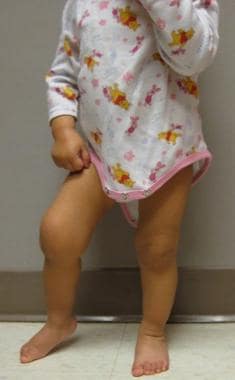 Eighteen-month-old girl with arthritis in her right knee. Note the flexion contracture of that knee.
Signs and symptoms
History findings in children with JIA may include the following:
-
Arthritis present for at least 6 weeks before diagnosis (mandatory for diagnosis of JIA)
-
Either insidious or abrupt disease onset, often with morning stiffness or gelling phenomenon and arthralgia during the day
-
Complaints of joint pain or abnormal joint use
-
History of school absences or limited ability to participate in physical education classes
-
Spiking fevers occurring once or twice each day at about the same time of day
-
Evanescent rash on the trunk and extremities
-
Psoriasis or more subtle dermatologic manifestations
Physical findings are important to provide criteria for diagnosis and to detect abnormalities suggestive of alternative etiologies, as well as to indicate disease subtypes. Such findings include the following:
-
Arthritis: Defined either as intra-articular swelling on examination or as limitation of joint motion in association with pain, warmth, or erythema of the joint; physical findings in JIA reflect the extent of joint involvement
-
Synovitis: Characterized by synovial proliferation and increased joint volume; the joint is held in a position of maximum comfort, and range of motion often is limited only at the extremes
Types of JIA include the following:
-
Systemic-onset juvenile idiopathic arthritis
-
Oligoarticular juvenile idiopathic arthritis
-
Polyarticular juvenile idiopathic arthritis
-
Psoriatic arthritis
-
Enthesitis-related arthritis
-
Undifferentiated arthritis
See Clinical Presentation for more detail.
Diagnosis
Diagnosis of JIA is based on the history and physical examination findings. When physical findings do not document definite arthritis, further evaluation is warranted. Laboratory studies that may be considered include the following:
-
Inflammatory markers: Erythrocyte sedimentation rate (ESR) or CRP level
-
Complete blood count (CBC) and metabolic panel
-
Liver function tests and assessment of renal function with serum creatinine levels
-
Antinuclear antibody (ANA) testing
-
Rheumatoid factor (RF) and anti–cyclic citrullinated peptide (CCP) antibody
-
Additional studies: Total protein, albumin, fibrinogen, ferritin, D-dimer, angiotensin-converting enzyme (ACE), antistreptolysin 0 (AS0), anti-DNAse B, urinalysis
When only a single joint is affected, radiography is important to exclude other diseases. Basic radiographic changes in JIA include the following:
-
Soft tissue swelling
-
Osteopenia or osteoporosis
-
Joint-space narrowing
-
Bony erosions
-
Intra-articular bony ankylosis
-
Periosteitis
-
Growth disturbances
-
Epiphyseal compression fracture
-
Joint subluxation
-
Synovial cysts
Other imaging modalities that may be helpful include the following:
-
Computed tomography
-
Magnetic resonance imaging
-
Ultrasonography and echocardiography
-
Nuclear imaging
Other studies and procedures that may be considered include the following:
-
Dual-energy radiographic absorptiometry (DRA)
-
Arthrocentesis and synovial biopsy
-
Pericardiocentesis
See Workup for more detail.
Management
A team-based approach to the treatment of JIA can be helpful. Management may include 1 or all of the following areas:
-
Pharmacologic therapy with nonsteroidal anti-inflammatory drugs (NSAIDs), disease-modifying antirheumatic drugs (DMARDs), biologic agents, or intra-articular and oral corticosteroids
-
Psychosocial interventions
-
Measures to enhance school performance (eg, academic counseling)
-
Improved nutrition
-
Physical therapy
-
Occupational therapy
American College of Rheumatology (ACR) criteria for complete remission are as follows [1] :
-
No inflammatory joint pain
-
No morning stiffness
-
No fatigue
-
No synovitis
-
No progression of damage, as determined in sequential radiographic examinations
-
No elevation of the ESR and CRP level
The ACR recommends treatment approaches to JIA on the basis of the following 5 treatment groups [2] :
-
A history of arthritis in 4 or fewer joints
-
A history of arthritis in 5 or more joints
-
Active sacroiliac arthritis
-
Systemic arthritis without active arthritis
-
Systemic arthritis with active arthritis
Within each group, choice of therapy is guided by the severity of disease activity and the presence or absence of features indicating a poor prognosis.
Advances in medical treatment have reduced the need for surgical intervention. Procedures that may be considered in specific circumstances include the following:
-
Synovectomy
-
Osteotomy and arthrodesis
-
Hip and knee replacement
See Treatment and Medication for more detail.

Background
Juvenile rheumatoid arthritis (JRA) is the most common chronic rheumatologic disease in children and is one of the most common chronic diseases of childhood. It represents a group of disorders that share the clinical manifestation of chronic joint inflammation.
The etiology is unknown, and the genetic component is complex, making clear distinctions between the various subtypes difficult. As a result, the various sets of classification criteria that have been recognized have different benefits and limitations. A new nomenclature, juvenile idiopathic arthritis (JIA), is being increasingly used in order to better define subgroups.
Go to Osteoarthritis, Pediatric Osteoarthritis, and Rheumatoid Arthritis for complete information on these topics.
Criteria and classification
Three groups have developed sets of criteria to classify children with arthritis: the American College of Rheumatology (ACR), the European League Against Rheumatism (EULAR), and the International League of Associations for Rheumatology (ILAR). [3, 4, 5]
The ACR criteria define juvenile rheumatoid arthritis (JRA) by age limit (< 16 y) and the duration of disease (>6 weeks). (See Table.) The organization recognizes the following 3 subtypes:
-
Polyarticular
-
Pauciarticular
-
Systemic
Other forms of childhood arthritis, such as juvenile ankylosing spondylitis and psoriatic arthritis, are classified under spondyloarthropathies.
The ILAR classification of JIA includes the following categories:
-
Systemic-onset JIA
-
Persistent or extended oligoarthritis
-
Rheumatoid factor (RF)–positive polyarthritis
-
RF-negative polyarthritis
-
Psoriatic JIA
-
Enthesitis-related arthritis
-
Undifferentiated - The disease does not meet criteria for any of the other subgroups, or it meets more than 1 criterion (and therefore could be classified in a number of subgroups).
The EULAR proposed the term juvenile chronic arthritis (JCA) for the heterogeneous group of disorders that manifest as juvenile arthritis. The diagnosis requires that the arthritis begins before age 16 years and lasts for at least 3 months. The EULAR criteria for JCA recognize the following subtypes, based on characteristics at onset:
-
Pauciarticular (1-4 joints)
-
Polyarticular (≥5 joints)
-
Presence of RF (2 positive tests at least 3 months apart)
-
Systemic onset with characteristic features
-
Positivity for rheumatoid factor
-
Juvenile ankylosing spondylitis
-
Juvenile psoriatic arthritis
This article will use the ILAR nomenclature unless differentiation is required between JIA and JRA or JCA.
Table. Comparison of Classification Criteria for Chronic Childhood Arthritis (Open Table in a new window)
Classification |
ACR(1977) |
ILAR (1997) |
Nomenclature |
Juvenile rheumatoid arthritis |
Juvenile idiopathic arthritis |
Minimum duration |
≥6 wk |
≥6 wk |
Age at onset |
< 16 y |
< 16 y |
≤ 4 joints in first 6 mo after presentation |
Pauciarticular juvenile rheumatoid arthritis |
Oligoarticular juvenile idiopathic arthritis: (A) Persistent < 4 joints for course of disease; (B) Extended >4 joints after 6 mo |
>4 joints in first 6 mo after presentation |
Polyarticular juvenile rheumatoid arthritis |
Polyarticular juvenile idiopathic arthritis-rheumatoid factor negative Polyarticular juvenile arthritis-rheumatoid factor positive |
Fever, rash, arthritis |
Systemic juvenile rheumatoid arthritis |
Systemic juvenile idiopathic arthritis |
Other categories included |
Exclusion of other forms |
Psoriatic juvenile idiopathic arthritis Enthesitis-related arthritis Undifferentiated: (A) Fits no other category; (B) Fits more than 1 category |
Inclusion of psoriatic arthritis, inflammatory bowel disease, juvenile ankylosing spondylitis |
No |
Yes |
Etiology and Pathophysiology
The etiology and pathogenesis of JIA are not completely understood. Genetic susceptibility plays a major role, but there is significant overlap between loci associated with JIA and those associated with other autoimmune diseases. [6]
JIA is a genetically complex disorder in which multiple genes are important for disease onset and manifestations. The IL2RA/CD25 gene has been implicated as a JIA susceptibility locus, as has the VTCN1 gene. [7] Associations have been found between specific HLA alleles and clinical subtypes of JIA (eg, HLA-A(*)02:06 with susceptibility to JIA accompanied by uveitis, and HLA-DRB1(*)04:05 with polyarticular JIA, in a Japanese cohort). [8]
A study by Ombrello examined the MHC locus in a large collection of systemic juvenile idiopathic arthritis patients and verified the relationship between the class II HLA region and systemic juvenile idiopathic arthritis, implicating adaptive immune molecules in the pathogenesis of the disease. [9]
Humoral and cell-mediated immunity are involved in the pathogenesis of JIA. T lymphocytes have a central role, releasing proinflammatory cytokines (eg, tumor necrosis factor–alpha [TNF-α], interleukin [IL]-6, IL-1) and favoring a type-1 helper T-lymphocyte response. A disordered interaction between type 1 and type 2 T-helper cells has been postulated.
Studies of T-cell receptor expression confirm recruitment of T-lymphocytes specific for synovial nonself antigens. Evidence for abnormalities in the humoral immune system include the increased presence of autoantibodies (especially antinuclear antibodies), increased serum immunoglobulins, the presence of circulating immune complexes, and complement activation.
Chronic inflammation of synovium is characterized by B-lymphocyte infiltration and expansion. Macrophages and T-cell invasion are associated with the release of cytokines, which evoke synoviocyte proliferation. A study by Scola et al found synovium to contain messenger ribonucleic acid (mRNA) for vascular endothelial growth factor and angiopoietin 1, as well as for their receptors, suggesting that induction of angiogenesis by products of lymphocytic infiltration may be involved in persistence of disease. [10]
Some pediatric rheumatologists view systemic-onset JIA as an autoinflammatory disorder, such as familial Mediterranean fever (FMF) or cryopyrin-associated periodic fever syndromes, rather than a subtype of JIA. This theory is supported by work demonstrating similar expression patterns of a phagocytic protein (S100A12) in systemic-onset JIA and FMF, as well as the same marked responsiveness to IL-1 receptor antagonists. [11]
FMF is associated with mutations in the MEFV gene; these mutations are associated with activation of the IL-1b pathway, resulting in inflammation. A study by Ayaz et al found an increased frequency of MEFV mutations in Turkish children who were diagnosed with systemic JIA [12] ; this study has not been replicated in other populations.
In a nested case–control study of 153 children with juvenile arthritis and 1,530 matched controls, researchers found that exposure to antibiotics during childhood significantly increased the risk for developing JIA (adjusted odds ratio = 2.6) in a dose-dependent manner. Compared with those with no exposure, the odds ratio for developing JIA was 3.1 for children exposed to one or two courses of antibiotics, and for those exposed to three to five courses the odds ratio was 3.8. [13] The association between antibiotic exposure and JIA was similar for different classes of antibiotics. No association was found between exposure to nonbacterial antimicrobial agents and JIA. Adjustment for the number and type of infections and age at antibiotic exposure did not change the associations significantly. [13]
Epidemiology
United States statistics
Approximately 300,000 children in the United States are estimated to have some type of arthritis. The incidence rate estimates for JIA range from 4-14 cases per 100,000 children annually; for JRA, the prevalence has ranged from 1.6 to 86.1 cases per 100,000. [14] These wide-ranging numbers are attributable to differing definitions and criteria for childhood arthritis; population differences, including environmental exposure and immunogenetic susceptibility; and difficulty in case ascertainment and lack of population based data.
International statistics
Worldwide, JIA appears to occur more frequently in certain populations (eg, indigenous peoples) from such disparate areas as British Columbia and Norway. A study in Sweden found the prevalence of JIA there to be similar to that in Minnesota, approximately 85 cases per 100,000 population, with an incidence of 11 cases per 100,000 population. A study from Germany found a prevalence rate of 20 cases per 100,000 population, with an incidence rate of 3.5 cases per 100,000 population.
Estimates from Norway include a prevalence rate of 148 cases per 100,000 population with an incidence rate of 22 cases per 100,000 population. The incidence of JIA in Japan has been reported to be low.
Disease-associated mortality for JIA is difficult to quantify, but it is estimated to be less than 1% in Europe and less than 0.5% in North America. Most deaths associated with JIA in Europe are related to amyloidosis, and most in the United States are related to infections.
The approximate frequencies of the various forms of JRA are as follows:
-
Oligoarticular - 30%
-
Polyarticular RF negative - 20%
-
Polyarticular RF positive – 5%
-
Systemic-onset – 5%
-
Psoriatic - 5%
-
Enthesitis Related – 25%
-
Undifferentiated – 10%
Sexual differences in frequency
Girls with an oligoarticular onset outnumber boys by a ratio of 3:1. In children with uveitis, the ratio of girls to boys is 5-6.6:1, and in children with polyarticular onset, girls outnumber boys by 2.8:1. In striking contrast, systemic-onset occurs with equal frequency in boys and girls. Boys outnumber girls with enthesitis-related arthritis. [15]
Age-related differences in frequency
Although JIA is defined as arthritis beginning before age 16 years, the age at onset is often much lower, with the highest frequency occurring in children aged 1-3 years. [16] This age distribution is most evident in girls with oligoarticular JIA and psoriatic arthritis.
Polyarticular RF-negative JIA has a biphasic peak of onset; the first is at a young age (1-4 y), similar to oligoarticular JIA, and the second peak is at age 6-12 years. RF-positive disease is more common in adolescents. Systemic-onset JIA is not characterized by a peak age of onset; it is spread across the childhood years. The usual age of onset of enthesitis-related arthritis is 10-12 years. [15]
Prognosis
Advances in treatment over the last 20 years—especially the introduction of early use of intra-articular steroids, methotrexate, and biologic medications—have dramatically improved the prognosis for children with arthritis. Almost all children with JIA lead productive lives. However, many patients, particularly those with polyarticular disease, may have problems with active disease throughout adulthood, with sustained remission attained in a minority of patients.
Early hip or wrist involvement, symmetrical disease, the presence of RF, and prolonged active systemic disease have been associated with poor long-term outcomes. Compared with adults with RF-positive rheumatoid arthritis, however, children are at less risk for rheumatoid lung involvement and vasculitis. The anti – cyclic citrullinated peptide antibodies (CCP) antibodies test may be more specific than the RF test, but it is not as well studied in children.
Children with systemic-onset disease tend to either respond completely to medical therapy or develop a severe polyarticular course that tends to be refractory to medical treatment, with disease persisting into adulthood.
Most children with oligoarticular disease demonstrate eventual permanent remission, although a small number progress to persisting polyarticular disease.
Concern has been raised that the use of biologics may increase cancer risk among patients with JIA; however, lack of data on the baseline risk of cancer in this population has made it difficult to determine whether the concern is justified. A review of a large cohort of patients from the Swedish registry found an increased risk of cancer in patients who had not been on biologic therapies and had been diagnosed with JIA in the last 20 years. However, this risk was not found if the analysis was extended to patients diagnosed between 1969 and 1987. [17, 18]
The results of this study were not statistically significant. Nevertheless, they may have implications for interpretation of cancer signals in patients with JIA, particularly those who are on ongoing therapy with biologic agents, such as TNF-alpha inhibitors.
Patient Education
Educating the patient, family, and school personnel (eg, classroom teachers, physical education teachers, nurses) about JIA and its presentation, treatment, and potential effects is continually necessary. Members of the pediatric rheumatology team in pediatric rheumatology clinics are the best educators about JIA. Another important source of information is the American Juvenile Arthritis Organization, a council of the Arthritis Foundation.
For patient education information, see the Arthritis Center, as well as Juvenile Rheumatoid Arthritis and Juvenile Rheumatoid Arthritis Treatment.
-
Patient with active polyarticular arthritis. Note swelling (effusions) of all proximal interphalangeal (PIP) joints in addition to boney overgrowth. Also note lack of distal interphalangeal joint (DIP) involvement. The patient has interosseus muscle wasting (observed on the dorsum of the hands), and subluxation and ulnar deviation of the wrists are present. Image courtesy of Barry L. Myones, MD.
-
Wrist radiographs of the patient with active polyarticular arthritis shown in Media file 2. Note severe loss of cartilage in the intercarpal spaces and the radiocarpal space of the right wrist. A large erosion is present in the articular surface of the ulnar epiphysis. The view of the left wrist shows boney ankylosis involving the lateral 4 carpal bones with sparing of the pisiform. Erosions are present in the distal radius and ulna. Almost a loss of cartilage has occurred between the radius and ulna and the carpus. Narrowing of the carpal/metacarpal joints is present. Image courtesy of Barry L. Myones, MD.
-
Close-up of the proximal interphalangeal (PIP) effusions in the patient with active polyarthritis shown in Media files 2 and 3. Synovial thickening and effusion, as well as boney overgrowth, are present at the PIP joints bilaterally. Image courtesy of Barry L. Myones, MD.
-
Patient with inactive polyarticular arthritis. Long-term sequelae of polyarticular disease includes joint subluxation (note both wrists and thumbs), joint contractures (at proximal interphalangeal joints [PIPs] and distal interphalangeal joints [DIPs]), boney overgrowth (at all PIPs), and finger deformities (eg, swan-neck or boutonniere deformities). Image courtesy of Barry L. Myones, MD.
-
Hand and wrist radiographs of the patient with inactive polyarticular arthritis shown in Media file 5. Long-term sequelae of polyarticular disease includes periarticular osteopenia, generalized increase in the size of epiphyses, accelerated bone age, narrowed joint spaces (especially at the fourth and fifth proximal interphalangeal joints [PIPs] bilaterally), boutonniere deformities (at left third and fourth interphalangeal joints), and medial subluxation of the first metacarpophalangeal joints (MCPs) bilaterally. Flattening and erosion of the radial carpal articular surface is present in both wrists. Mild narrowing of the joint spaces exists at the carpometacarpal joints and intercarpal rows bilaterally, with sclerotic change of the intercarpal row (right > left). The trapezium and trapezoid may be fused bilaterally. Image courtesy of Barry L. Myones, MD.
-
Sequelae of chronic anterior uveitis. Note the posterior synechiae (weblike attachments of the pupillary margin to the anterior lens capsule) of the right eye secondary to chronic anterior uveitis. This patient has a positive antinuclear antibodies (ANAs) and initially had a pauciarticular course of her arthritis. She now has polyarticular involvement but no active uveitis. Image courtesy of Carlos A. Gonzales, MD.
-
One set of suggested algorithms for the treatment of patients with juvenile arthritis. This should not be considered dogmatic because treatment is not standardized and remains empiric and, at times, controversial.
-
Systemic juvenile idiopathic arthritis (JIA) rash.
-
Child with pericardial effusion due to systemic onset juvenile idiopathic arthritis (JIA).
-
Flexion and extension views of C-spine in child with poorly controlled polyarticular juvenile idiopathic arthritis (JIA).
-
Temporal-mandibular joint (TMJ) MRI postgadolinium infusion. Abnormal increased uptake indicative of synovitis in child with polyarticular juvenile idiopathic arthritis (JIA).
-
Eighteen-month-old girl with arthritis in her right knee. Note the flexion contracture of that knee.
-
Ankylosis in the cervical spine at several levels due to long-standing juvenile rheumatoid arthritis (also known as juvenile idiopathic arthritis).
-
Widespread osteopenia, carpal crowding (due to cartilage loss), and several erosions affecting the carpal bones and metacarpal heads in particular in a child with advanced juvenile rheumatoid arthritis (also known as juvenile idiopathic arthritis).
-
(A) T2-weighted MRI shows high signal in both hips, which may be due to hip effusions or synovitis. High signal intensity in the left femoral head indicates avascular necrosis. (B) Coronal fat-saturated gadolinium-enhanced T1-weighted MRI shows bilateral enhancement in the hips. This indicated bilateral active synovitis, which is most pronounced on the right. Because the image was obtained with fat saturation, the hyperintensity in both hips is pathologic, reflecting an inflamed pannus.
Tables
Classification |
ACR(1977) |
ILAR (1997) |
Nomenclature |
Juvenile rheumatoid arthritis |
Juvenile idiopathic arthritis |
Minimum duration |
≥6 wk |
≥6 wk |
Age at onset |
< 16 y |
< 16 y |
≤ 4 joints in first 6 mo after presentation |
Pauciarticular juvenile rheumatoid arthritis |
Oligoarticular juvenile idiopathic arthritis: (A) Persistent < 4 joints for course of disease; (B) Extended >4 joints after 6 mo |
>4 joints in first 6 mo after presentation |
Polyarticular juvenile rheumatoid arthritis |
Polyarticular juvenile idiopathic arthritis-rheumatoid factor negative Polyarticular juvenile arthritis-rheumatoid factor positive |
Fever, rash, arthritis |
Systemic juvenile rheumatoid arthritis |
Systemic juvenile idiopathic arthritis |
Other categories included |
Exclusion of other forms |
Psoriatic juvenile idiopathic arthritis Enthesitis-related arthritis Undifferentiated: (A) Fits no other category; (B) Fits more than 1 category |
Inclusion of psoriatic arthritis, inflammatory bowel disease, juvenile ankylosing spondylitis |
No |
Yes |

What would you like to print?
- Overview
- Presentation
- DDx
- Workup
- Treatment
- Approach Considerations
- History of Arthritis in 4 or Fewer Joints
- History of Arthritis in 5 or More Joints
- Active Sacroiliac Arthritis
- Systemic Arthritis with Active Systemic Features and without Active Arthritis
- Systemic Arthritis with Active Arthritis and without Active Systemic Features
- Hospital Admission
- Exercise and Other Nonpharmacologic Therapy
- Surgical Treatment
- Treatment of Macrophage Activation Syndrome
- Treatment of Uveitis
- Diet and Activity
- Consultations
- Long-Term Monitoring
- Show All
- Medication
- Questions & Answers
- Media Gallery
- Tables
- References


