Continually Updated Clinical Reference
 
 
  All Sources     eMedicine     Medscape     Drug Reference     MEDLINE
 
eMedicine - Hyperaldosteronism : Article by

Quick Find
Authors & Editors
Introduction
Clinical
Differentials
Workup
Treatment
Medication
Follow-up
Miscellaneous
Multimedia
References

Related Articles
Congenital Adrenal Hyperplasia


Patient Education
Click here for patient education.


Author: George P Chrousos, MD, FAAP, MACP, MACE, Professor and Chair, Department of Pediatrics, Athens University Medical School

George P Chrousos is a member of the following medical societies: American Academy of Pediatrics, American College of Endocrinology, American College of Physicians, American Pediatric Society, American Society for Clinical Investigation, Association of American Physicians, Endocrine Society, Lawson-Wilkins Pediatric Endocrine Society, and Society for Pediatric Research

Coauthor(s): Antony Lafferty, MB ChB, FRACP, Senior Lecturer of Pediatric Endocrinology, Monash University Department of Pediatrics, National Institutes of Health, Bethesda, MD, and Princess Margaret Hospital for Children, Perth, Western Australia

Editors: Thomas A Wilson, MD, Professor of Clinical Pediatrics, Department of Pediatrics; Director of Pediatric Endocrinology, Division of Pediatric Endocrinology, Department of Pediatrics, State University of New York at Stony Brook; Mary L Windle, PharmD, Adjunct Assistant Professor, University of Nebraska Medical Center College of Pharmacy, Pharmacy Editor, eMedicine.com, Inc; Merrily P M Poth, MD, Professor, Department of Pediatrics and Neuroscience, Uniformed Services University of the Health Sciences; Stephen Kemp, MD, PhD, Professor, Department of Pediatrics, Section of Pediatric Endocrinology, University of Arkansas and Arkansas Children's Hospital

Author and Editor Disclosure

Synonyms and related keywords: hyperaldosteronism, aldosteronism, primary aldosteronism, primary hyperaldosteronism, familial hyperaldosteronism type I, FH-I, glucocorticoid remediable aldosteronism, GRA, familial hyperaldosteronism type II, FH-II, secondary hyperaldosteronism, idiopathic hyperaldosteronism, IHA

Background

Aldosterone is a steroid hormone produced exclusively in the zona glomerulosa of the adrenal cortex. It is the major circulating mineralocorticoid in humans. The principal regulators of its synthesis and secretion are the renin-angiotensin system and potassium ion concentrations. Minor regulators include adrenocorticotropic hormone (ACTH) from the pituitary, atrial natriuretic peptide from the heart, and local adrenal secretion of dopamine. A number of aldosterone precursors, including deoxycorticosterone and 18-hydroxycorticosterone, have mineralocorticoid activity and may produce or exacerbate features typical of mineralocorticoid hypertension when present in excessive amounts in various pathologic states.

The principal site of action of aldosterone is the distal nephron, although several other sites of aldosterone-sensitive sodium regulation exist, including the sweat glands and GI tract. Hyperaldosteronism is characterized by excessive secretion of aldosterone causing increases in sodium reabsorption and loss of potassium and hydrogen ions. It may be either primary (autonomous) or secondary. It represents part of a larger entity of hypermineralocorticoidism that may be caused by aldosterone, its mineralocorticoid precursors, or from defects that modulate aldosterone effects on its target tissues.

Pathophysiology

Aldosterone secretion and its regulation

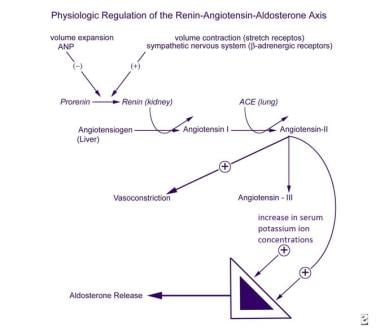
Aldosterone participates in the homeostasis of circulating blood volume and serum potassium concentration that, in turn, feed back to regulate aldosterone secretion by the zona glomerulosa of the adrenal cortex. Aldosterone secretion is stimulated by actual or apparent depletion in blood volume detected by stretch receptors and by an increase in serum potassium ion concentrations, and it is suppressed by hypervolemia and hypokalemia. The mechanisms regulating aldosterone secretion are complex, involving the zona glomerulosa of the adrenal glands, the juxtaglomerular apparatus in the kidneys, the cardiovascular system, the autonomic nervous system, the lungs, and the liver (see Image 1). The major factors stimulating aldosterone production and release by the zona glomerulosa are angiotensin II and the serum potassium concentration.

ACTH stimulates aldosterone secretion in an acute and transient fashion but does not appear to play a significant role in the long-term regulation of mineralocorticoid secretion. The major inhibitors of the zona glomerulosa include circulating atrial natriuretic peptide (ANP) and, locally, dopamine. Although ANP levels are clearly increased in hyperaldosteronism, neither ANP nor dopamine has been implicated as a primary cause of clinically disordered aldosterone secretion. Metoclopramide has been shown to increase aldosterone secretion, suggesting that dopamine may tonically inhibit aldosterone release. The physiologic roles of adrenomedullin and vasoactive intestinal peptide (VIP) on aldosterone secretion remain to be clarified, although both of these neuropeptides are produced in rat zona glomerulosa.

The juxtaglomerular apparatus is the principal site of regulation of angiotensin II production (see Image 1). The synthesis of prorennin, its conversion to renin, and its systemic secretion are stimulated by blood volume contraction detected by stretch receptors, beta-adrenergic stimulation of the sympathetic nervous system, and prostaglandins I2 and E2. These processes are inhibited by volume expansion and ANP. Renin converts angiotensinogen, a proenzyme synthesized in the liver, into the decapeptide angiotensin I, which is then converted in the lungs into an octapeptide, angiotensin II, by angiotensin-converting enzyme. Angiotensin II is both a stimulator of aldosterone secretion and a potent vasopressor. Angiotensin II is metabolized to angiotensin III, a heptapeptide that is also a stimulator of aldosterone secretion.

The synthesis and secretion of prostaglandins I2 and E2 and the normal function of the stretch receptors are dependent upon intracellular ionized calcium concentration. Renal prostaglandin secretion is stimulated by catecholamines and angiotensin II. The complex regulation of aldosterone synthesis and secretion provides several points at which disturbance in the regulation of aldosterone secretion may occur.

Aldosterone biosynthesis

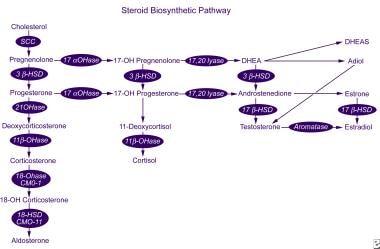
Aldosterone is synthesized from cholesterol in a series of 6 biosynthetic steps (see Image 2). Only the last 2 steps are specific to aldosterone synthesis, the first 4 being common to the cortisol synthesis by the zona fasciculata. Consequently, a defect in one of the specific aldosterone synthetic enzymes does not lead to hypercortisolism and secondary ACTH-mediated adrenal hyperplasia. The enzyme aldosterone synthase is encoded by the gene CYP11B2 and has 11beta-hydroxylase, 18-hydroxylase, and 18-hydroxydehydrogenase activity. This gene is located on human chromosome arm 8q24.3-tel, close to the gene CYP11B1 that encodes 11beta-hydroxylase, the enzyme that catalyzes the final step of cortisol synthesis. Mutations in these genes can result in a number of disorders of aldosterone synthesis that are discussed below (see Differentials).
Aldosterone receptors

Aldosterone action on target tissues (eg, distal renal tubule, sweat glands, salivary glands, large intestinal epithelium) is mediated via a specific mineralocorticoid receptor. Mineralocorticoid receptors exhibit equal affinity for mineralocorticoids and cortisol, yet the aldosterone receptors in the distal tubule and elsewhere are protected from the activation by cortisol by 11beta-hydroxysteroid dehydrogenase type 2, which locally converts cortisol to inactive cortisone.

Primary aldosteronism

Primary aldosteronism or primary hyperaldosteronism refers to a renin-independent increase in the secretion of aldosterone. Approximately 99% of cases of primary aldosteronism are due to either an aldosterone-producing adenoma ([APA] approximately 40% of cases) or idiopathic hyperaldosteronism ([IHA] approximately 60% of cases, almost all of which are bilateral). Adrenocortical carcinomas that are purely aldosterone secreting are exceedingly rare and are usually large at the time of diagnosis. Unilateral adrenocortical hyperplasia is a rare occurrence.

Primary hyperaldosteronism is principally a disease of adulthood, with its peak incidence in the fourth to sixth decades of life. APAs are usually benign encapsulated adenomas that are less than 2 cm in diameter. Most cases are solitary, although in as many as one third of cases, evidence exists of nodularity in the same adrenal, suggesting that it has arisen in a previously hyperplastic gland.

Patients with IHA have bilateral thickening and variable nodularity of their adrenal cortex. A wide spectrum of severity exists for this disorder, which may go undetected for a long period with no hypokalemia and only mild hypertension. A proposal is that IHA arises as a result of an undetected adrenal cortical–stimulating factor. Possibly, this disorder may arise as a result of an activating mutation in an adrenal cortex–specific gene, although neither hypothesis has been proven.

Inherited forms of primary hyperaldosteronism account for only 1% of cases of primary aldosteronism but are more likely to occur during childhood years. These include familial hyperaldosteronism types I and II.

Familial hyperaldosteronism type I (glucocorticoid-remediable aldosteronism)

Familial hyperaldosteronism type I (FH-I) represents about 1% of cases of primary hyperaldosteronism. It may be detected in asymptomatic individuals when screening the offspring of affected individuals, or patients may present in infancy with hypertension, weakness, and failure to thrive due to hypokalemia. It is inherited in an autosomal dominant manner and has a low frequency of new mutations. The first clinical description of glucocorticoid-remediable aldosteronism (GRA) was in 1966, with the genetic mechanism discovered in 1992. It arises as a result of unequal crossing over of CYP11B1 (11beta-hydroxylase gene) and CYP11B2 (aldosterone synthase gene) during meiosis, producing a fusion product that couples the ACTH-sensitive promoter of CYP11B1 to the CYP11B2 gene.

The result is ACTH-dependent aldosterone production and production of 17-hydroxylated analogs of 18-hydroxycortisol under ACTH regulation from ectopic enzyme expression in the zona fasciculata. Bilateral hyperplasia of the zona fasciculata occurs and high levels of novel 18-hydroxysteroids appear in the urine. Adenoma formation is rare, but patients do have a significant increase in incidence of cerebrovascular aneurysms, for which they require screening.

Familial hyperaldosteronism type II

Familial hyperaldosteronism type II (FH-II) is a familial nonglucocorticoid-suppressible inherited form of hyperaldosteronism that was recognized as a distinct entity by Gordon et al, although cases had previously been described in the 1980s. Similar to FH-I, it is also inherited in an autosomal dominant manner. The mechanism and gene locus have not yet been identified, although CYP11B2, the renin and angiotensin II receptor genes, have been excluded. Current analysis suggests that this is not a single disorder. Unlike FH-I, some kindreds with FH-II exhibit a high rate of adenoma formation.

Secondary hyperaldosteronism

This represents a diverse group of disorders characterized by physiologic activation of the renin-angiotensin-aldosterone (R-A-A) axis as a homeostatic mechanism designed to maintain serum electrolyte concentrations or fluid volume. In the presence of normal renal function, it may lead to hypokalemia. Secondary hyperaldosteronism can be divided into 2 categories depending on whether associated hypertension exists. The former category includes renovascular hypertension, which results from renal ischemia and hypoperfusion leading to activation of the R-A-A axis. The most common causes of renal artery stenosis in children are fibromuscular hyperplasia and neurofibromatosis. Hypokalemia may occur in up to 20% of patients.

Plasma renin activity (PRA) levels are often in the reference range, but elevated levels of PRA may be detected after provocation with a single dose of captopril 1 mg/kg. Renal ischemia is also thought to underlie the secondary hyperaldosteronism observed in malignant hypertension. Hyperreninemia and secondary aldosteronism have also been reported in patients with pheochromocytoma, apparently as a result of functional renal artery stenosis. Renin-producing tumors are very rare, and very high levels of PRA (up to 50 ng/mL/h) are noted, frequently with an increased prorennin-to-renin ratio. The tumors are generally of renal origin and include Wilms tumors and renal cell carcinomas. Hyperkalemia due to chronic renal failure also causes secondary hyperaldosteronism. Low sodium-to-potassium ratios can be measured in saliva and stool. Cyclosporin-induced hypertension in solid organ transplant patients may also involve a component of hyperaldosteronism.

Secondary hyperaldosteronism in the absence of hypertension occurs as a result of homeostatic attempts to maintain sodium or circulatory volume or to reduce potassium. Clinical situations where this may occur include the presence of diarrhea, excessive sweating, low cardiac output states, and hypoalbuminemia due to liver or renal disease or nephrotic syndrome. As outlined below, this also occurs developmentally in newborn infants.

Increased mineralocorticoid dependency in the young

The mineralocorticoid dependency of sodium reabsorption is increased during infancy and childhood, with its peak in the neonatal period before decreasing progressively with advancing age. This arises because the reabsorption of sodium and water by the proximal tubule is least efficient in early life, resulting in an increased sodium and water load at the level of the distal renal tubule.

Because sodium and water resorption from the distal tubule is mediated by the R-A-A axis, the PRA of a newborn infant is approximately 10-fold to 20-fold higher than that of an adult. This results in relative increases in aldosterone production rates (>300 mcg/m2/d in a newborn infant compared with 50 mcg/m2/d in an adult) and plasma aldosterone concentrations (80 pg/dL versus 16 pg/dL, respectively) in the neonate. This increased mineralocorticoid dependency in early life explains why young infants exhibit profound clinical symptoms of hypoaldosteronism that gradually improve with advancing age.

Frequency

International

Primary hyperaldosteronism is a rare condition in children. The youngest child reported with an aldosterone-secreting adenoma was aged 3 years. Earlier use of hypokalemia as a diagnostic requirement, as advocated by some authorities, may have led to underrecognition of the contribution of primary aldosteronism to hypertension. A study that used saline infusion as a screening test for primary aldosteronism reported a frequency of 2.2% of primary aldosteronism among 1036 unselected adults with hypertension. A smaller study that used the aldosterone-to-PRA ratio in plasma suggested that primary aldosteronism might account for an even greater proportion of cases of hypertension.

Most hyperaldosteronism observed in the general population is sporadic, with most cases due to bilateral adrenal hyperplasia. APAs are likely to be diagnosed earlier than IHA because they are more likely than IHA to produce early symptomatic hypertension and hypokalemia. APAs account for 40% of cases of primary hyperaldosteronism. Possibly, the distinction between adenoma and hyperplasia is not as clear as was once thought because, in one third of cases, associated hyperplasia or nodules of the adjacent zona glomerulosa is present, implying that the adenoma may have arisen in previously hyperplastic tissue.

Inherited forms of primary hyperaldosteronism, ie, FH-1 (GRA) and FH-II, account for approximately 1% of cases of primary aldosteronism, although they are more likely than other causes of primary hyperaldosteronism to occur during childhood and adolescent years.

Studies of secondary hyperaldosteronism have found that approximately 15% of adults attending hypertension clinics have elevated PRA. Reliable figures for children are not readily available.

Mortality/Morbidity

Primary hyperaldosteronism can result in a significant increase in morbidity and mortality as a result of hypertensive vascular (hypertrophy then sclerosis of intimal smooth muscle), renal (sclerosis), and cardiac (hypertrophy then dilatation) complications. Through early recognition and treatment of hypertension, these complications can be avoided in children.

Patients with GRA must undergo assessment of their cerebral circulation because this disorder is associated with a significant risk of cerebral vascular aneurysms. Provided that hypertension is well treated, morbidity and mortality are not increased significantly.

Hypokalemia is more frequently observed in patients with adenomas, although it should not be considered a diagnostic feature of primary hyperaldosteronism, as was once thought. Patients with adenomas are more likely to develop this complication, as are patients who have milder disease but receive treatment with diuretics for their hypertension, before the hyperaldosteronism is diagnosed. Hypokalemic patients may experience neuromuscular symptoms such as weakness or paralysis, constipation, and polyuria and polydipsia because of an associated renal concentrating defect. Hypokalemia also impairs insulin secretion and can promote the development of diabetes mellitus.

Although cardiac fibrosis has been reported in adults with primary aldosteronism, no such reports exist in children, possibly because of their shorter duration of disease at the time of diagnosis. Cardiac fibrosis has also been reported in rats treated with excess mineralocorticoids, especially if hyperglycemia is also present. This effect can be ameliorated with amiloride. The role of aldosterone in diabetic heart disease has been questioned, and trials of mineralocorticoid antagonists in this condition have been initiated.

Race

The literature on adults demonstrates that blacks are at significantly greater risk of hypertension-related morbidity and mortality than whites. They are also more likely to develop low-renin hypertension, although no studies indicate that the prevalence of primary hyperaldosteronism is significantly higher in blacks.

Sex

Data on adults suggest that hyperaldosteronism has a female preponderance. Equivalent information is not available for children, where primary hyperaldosteronism due to inherited syndromes is likely to represent a greater proportion of cases.

Age

Because the 2 causes that account for about 99% of cases of primary hyperaldosteronism have a peak age of onset in adulthood, the less common causes account for a larger percentage of children with hyperaldosteronism. For this reason, children with apparent hyperaldosteronism should be evaluated for evidence of congenital defects of the R-A-A axis and inherited forms of hypermineralocorticoidism.


History

Primary hyperaldosteronism may be asymptomatic, particularly in its early stages. When present, symptoms are related to hypertension (if severe), hypokalemia, or both.

  • The spectrum of hypertension-related symptoms includes the following:
    • Headaches
    • Facial flushing
    • If severe, weakness, visual impairment, impaired consciousness, and seizures (hypertensive encephalopathy)
  • Hypokalemia can be precipitated by non–potassium-sparing diuretics or sodium loading. Symptoms of hypokalemia include the following:
    • Constipation
    • Polyuria and polydipsia (because of impaired renal concentrating ability)
    • Weakness
    • If low enough, paralysis and disturbances of cardiac rhythm
  • Hyperglycemia or frank diabetes mellitus possible because insulin secretion is a potassium-dependent process that may be impaired by hypokalemia
  • If secondary hyperaldosteronism is suspected as the cause of hypertension, history should include questions about flushing, diaphoresis, anxiety attacks, and headaches (pheochromocytoma) and about hematuria and abdominal fullness (Wilms or other renal tumor), in addition to the above symptoms.
  • For patients in whom secondary hyperaldosteronism is suggested, questions should be specifically directed at potential causes (eg, the presence and duration of swelling, the child's exercise tolerance).
  • Information should be sought about a family history of essential hypertension and familial syndromes that include the following:
    • Neurofibromatosis (associated with renal artery stenosis and pheochromocytoma)
    • Multiple endocrine neoplasia (MEN) type 2
      • MEN 2A - Parathyroid adenoma, medullary thyroid carcinoma (MTC), pheochromocytoma
      • MEN 2B - Mucosal neuromas of eyelids, lips, and tongue with long thin face, pheochromocytoma, and MTC
    • Von Hippel-Lindau syndrome - Cerebellar hemangioblastoma; renal and pancreatic cysts and carcinoma; hemangiomas of the retina, liver, and adrenal glands; pheochromocytomas

Physical

Any child or adolescent with significant hypertension deserves thorough investigation into the cause.

  • Hypermineralocorticoidism should be considered in any patient with associated hypokalemia, although it should not be excluded in its absence.
  • Patients with significant hypertension should have their blood pressure repeated several times, preferably with an automated device after a supine rest.
  • Examination of the hypertensive patient should include the following:
    • General - Dysmorphic features (eg, MEN 2B); evidence of neurofibromatosis type 1 (NF-1), ie, cafe-au-lait lesions, axillary freckling, short stature, and evidence of disease in parents; features of Cushing syndrome, ie, obesity, short stature, striae, and hirsutism
    • Neck - Thyroid mass (MTC associated with MEN 2)
    • Cardiovascular - Assessment of left ventricular muscle mass as well as exclusion of murmurs and pulse differential (eg, coarctation of the aorta), abdominal bruits (renal artery stenosis), and peripheral edema (secondary hyperaldosteronism)
    • Abdomen - Masses (Wilms tumor), hepatomegaly (cardiac failure or liver disease), splenomegaly, ascites
    • Neurologic - Examination of the eyes and visual acuity (severe hypertension may interfere with vision); examination of the eye grounds (important to look for retinal angiomas [von Hippel-Lindau syndrome]); hypertensive retinopathy, which is of prognostic significance, including arterial narrowing, hemorrhages, cotton-wool spots, papilledema; Lisch nodules of the iris (NF-1)
    • Strength assessment - Patients should be evaluated for weakness. Focal neurologic signs or impaired conscious state in a patient with severe hypertension requires urgent treatment and CNS imaging to exclude infarct or hemorrhage.
    • Skin - In patients who have secondary hyperaldosteronism, an examination should be performed to look for evidence of NF-1.

Causes

The following is a summary of etiologies of hyperaldosteronism and conditions that mimic hyperaldosteronism:

  • Primary hyperaldosteronism
    • APA - High aldosterone, low PRA
    • IHA - Responds to posture (bilateral adrenal hyperplasia)
    • Primary adrenal hyperplasia - Responds to posture (unilateral disease)
    • GRA - Sustained suppression of aldosterone ( <4 ng/dL) with dexamethasone
    • FH-II - Familial (probably autosomal dominant)
  • Secondary hyperaldosteronism
    • Edema disorders (eg, cardiac failure, nephrotic syndrome) - High aldosterone, nonsuppressed plasma renin activity (>2 ng/mL)
    • Renovascular hypertension
    • Renin-producing tumors
    • Pregnancy
  • Conditions that mimic aldosterone excess
    • Congenital adrenal hyperplasia (11beta-hydroxylase deficiency, 17alpha-hydroxlyase deficiency) - Low aldosterone, low PRA, elevated steroid intermediates
    • Primary glucocorticoid resistance - High glucocorticoid secretion unsuppressed by dexamethasone
    • Deoxycorticosterone-secreting tumors - Elevated deoxycorticosterone levels
    • Syndrome of apparent mineralocorticoid excess
    • Liddle syndrome
    • Licorice ingestion
    • Carbenoxolone

The following is a discussion of causes of hypokalemia:

  • Hypokalemia may be precipitated by a diet that is rich in sodium or the concomitant administration of drugs that produce kaliuresis (including diuretics and carbenoxolone).
  • Taking carbenoxolone or eating large quantities of licorice may result in hypokalemia because of blockade of the target tissue enzyme that protects the aldosterone receptor from the relatively higher levels of circulating cortisol (apparent mineralocorticoid excess).


Congenital Adrenal Hyperplasia

Other Problems to be Considered

Secondary hyperaldosteronism
Apparent mineralocorticoid excess (types I and II)
Liddle syndrome
Glucocorticoid resistance
Exogenous mineralocorticoid excess
Drug-induced apparent mineralocorticoid excess


Lab Studies

  • The evaluation of a patient in whom hyperaldosteronism is suggested has several distinct stages. The finding of hypertension, hypokalemia, or both most commonly precipitates the decision to screen. The presence of these 2 features together has a 50% predictive value. The first step entails confirmation that hyperaldosteronism is present and, if it is not present, exclusion of other conditions that produce a similar picture. The next step involves differentiating primary from secondary causes of hyperaldosteronism.
  • Aldosterone-to-renin ratio
    • The aldosterone-to-renin ratio (ARR) is the most sensitive means of differentiating primary from secondary causes of hyperaldosteronism. It can be obtained under random conditions of sodium intake.
    • Values obtained in the upright position (standing for 2 h) have greater sensitivity than supine test results. Patients should be normokalemic because hypokalemia suppresses aldosterone secretion. A ratio of plasma aldosterone (ng/dL) to plasma renin activity (ng/mL/h) of greater than 20 with a plasma aldosterone level greater than 15 ng/dL is highly suggestive of primary aldosteronism.
    • The principle behind this test is that as aldosterone secretion rises, PRA, a measure of the rate of production of angiotensin I from endogenous angiotensinogen, in ex vivo testing should fall because of sodium retention. This negative feedback response should occur when the aldosterone levels are supraphysiologic for that individual patient, and PRA may fall well before plasma aldosterone is clearly increased.
    • When using this screening test, the aldosterone must be elevated in addition to having an elevated ARR because, with the more sensitive PRA assays, having an ARR in excess of 20 without having an elevated aldosterone is possible.
    • The most important factors that can interfere with the diagnostic reliability of the ARR test are drugs and renal impairment. Beta-blockers can reduce PRA levels, leading to a falsely elevated ratio, and dihydropyridine calcium antagonists (eg, nifedipine) can reduce aldosterone levels, tending to lead to a falsely normal ratio in some patients with primary aldosteronism. Diuretics tend to induce secondary aldosteronism. Spironolactone, an aldosterone receptor antagonist, can raise plasma renin levels. Spironolactone and diuretics should be withheld for 6 weeks, and beta-blockers and dihydropyridine calcium antagonists should be withheld for 5-7 days before testing. Patients' hypertension can be controlled with diltiazem and alpha-blockers when testing for primary aldosteronism. Renal impairment can lead to a high aldosterone-to-renin ratio in patients without primary aldosteronism because fluid retention suppresses PRA and hyperkalemia stimulates aldosterone secretion.
    • After a positive screening test result, subsequent testing is directed at confirming aldosterone secretory autonomy and differentiating an APA, for which surgery is currently the first line of treatment, from IHA, which is usually treated medically. The possibility of GRA, which accounts for approximately 1% of primary aldosteronism, should be kept in mind.
  • Saline infusion test
    • The saline infusion test can confirm autonomous aldosterone secretion. Other tests described include the measurement of urine aldosterone excretion during oral salt loading or the fludrocortisone suppression test. All tests rely on the principle that a lack of suppression of aldosterone excretion with intravascular expansion is indicative of aldosterone production.
    • The saline infusion test is performed by infusing 1140 mL/m2 body surface area (BSA) of 0.9% saline over 4 hours. Plasma aldosterone and cortisol are measured before and at the end of infusion. Those without primary aldosteronism should have a fall in plasma aldosterone levels to less than 10 ng/dL. Plasma aldosterone values greater than 10 ng/dL confirm primary aldosteronism, and levels from 5-10 may be considered borderline.
    • Cortisol levels are taken to exclude an ACTH-mediated rise in aldosterone.
    • Consider the risks of fluid expansion or hypokalemia in susceptible patients.
  • Oral salt loading
    • The oral salt loading test consists of administering 12 g/1.7m2 BSA of sodium chloride tablets and ad libitum diet for 3 days followed by a 24-hour urinary aldosterone measurement.
    • Urinary aldosterone values greater than 10-14 mcg/d with a urine sodium excretion greater than 250 nmol/d are considered diagnostic of primary aldosteronism.
  • Captopril test
    • The captopril test has also been used for screening. It is based on the principle that inhibition of angiotensin II production should not affect autonomous secretion of aldosterone in primary aldosteronism.
    • Application of the 60-minute aldosterone-to-renin ratio after 25 mg of oral captopril yielded a sensitivity of 100% and specificity of 83% for diagnosis of primary aldosteronism, but the test was only marginally better than baseline values. Somewhat lower sensitivity was noted in a larger study using aldosterone and PRA 90 minutes after a 50-mg dose of captopril.
  • Fludrocortisone suppression test: The fludrocortisone suppression test uses fludrocortisone (0.1 mg q6h) and salt loading. It is less frequently used and was described by Gordon et al in 1995.
  • Tests to differentiate between an APA and other forms of primary aldosteronism
    • Postural testing: Postural testing is best performed after overnight recumbency. An intravenous catheter is inserted at 7 am, and baseline aldosterone, cortisol, and PRA are obtained at 8 am. After 2 hours of ambulation, repeat aldosterone, cortisol, and PRA are obtained. Typically, APAs are angiotensin II unresponsive, and a fall in aldosterone over 2 hours is observed in parallel with reduced circadian ACTH and cortisol release. A rise in aldosterone is observed in IHA. Cortisol levels are used to validate the test, and a rise in cortisol release suggests an ACTH surge, which invalidates the test. Diagnostic accuracy of 85% is reported.
    • 18-Hydroxycorticosterone: Levels of 18-hydroxycorticosterone are typically elevated (>100 ng/dL) in APA and are significantly lower in patients with IHA. Although a diagnostic accuracy of 82% is reported, 18-hydroxycorticosterone levels have been noted to parallel the severity of aldosteronism, and levels of aldosterone and clinical severity are greater in APA than IHA.
    • Dexamethasone suppression: In cases of bilateral aldosterone secretion or when the diagnosis is suspected on the basis of family history, GRA can be excluded with a 4-day dexamethasone suppression test (0.5 mg q6h). The aldosterone and renin levels can be measured before testing, at 2 days, and at 4 days of suppression testing. The typical response in patients without GRA is for the aldosterone levels to fall by approximately 50% and return to the reference range by the end of testing; however, persistent suppression of aldosterone levels to less than 4 ng/dL are reported in GRA. The test achieves a sensitivity of 92% and a specificity of 100% for the diagnosis of GRA compared to direct genetic testing. Biochemically unique, markedly elevated levels of 18-oxocortisol and 18-hydroxycortisol (>100 nmol/d) are also observed in GRA. Mutation analysis for the hybrid gene that gives rise to GRA is now available by Southern blotting or a long–polymerase chain reaction (PCR) technique. Thisislikelyto
      supersede the time-intensive dexamethasone suppression test.

Imaging Studies

  • Computed tomography scanning of the adrenal glands
    • Adrenal CT scanning is 70% sensitive in detecting APAs. Mean APA size was 1.8 cm in one large series; however, 19% of these tumors were less than 1 cm.
    • Adrenal incidentalomas are very uncommon in children, meaning that in the presence of hyperaldosteronism, a positive finding on adrenal CT scanning makes the diagnosis of an adenoma very likely.
    • Aldosteronomas are typically lipid-rich and commonly appear as homogeneous lesions with a low Hounsfield number consistent with this high lipid content.
  • Adrenal scintigraphy has insufficient diagnostic accuracy for routine use in diagnosing adrenal adenomas.

Procedures

  • Adrenal venous sampling
    • Adrenal venous sampling requires considerable skill. It can be performed as an outpatient procedure, although younger children may need general anesthesia.
    • Infusion of ACTH into a peripheral vein (50 mcg/h, starting 30 min before sampling) masks the effects of confounding ACTH peaks during sampling.
    • Venography is avoided to reduce the risk of adrenal hemorrhage.
    • With comparison of simultaneous aldosterone, cortisol ratios in the adrenal veins and the inferior vena cava allow detection of unilateral or bilateral sources of aldosterone hypersecretion.
    • Although the cut-off for lateralization is controversial, both 5:1 and 10:1 have been advocated. Nevertheless, adrenal venous sampling is the criterion standard for the differential diagnosis of primary aldosteronism.

Histologic Findings

Aldosterone-producing adenoma

Unlike cortisol-producing adrenocortical tumors, in which the remaining ipsilateral and contralateral glands are commonly atrophic, the nontumorous cortex may show hyperplasia of the zona glomerulosa, forming either a broad zone locally or thickening of the entire cortex, with tongues of glomerulosalike cortex extending inward from the subcapsular region. This appearance has been reported in up to one third of patients with aldosteronoma and suggests that the tumor has arisen from within an area that was hyperplastic, although neither an external stimulus nor an intrinsic defect has been found to date.

Idiopathic hyperaldosteronism

IHA is a disease of the zona glomerulosa with a variable macroscopic appearance that can range from hyperplasia with micronodules and macronodules, hyperplasia without nodules, and normal appearing zona glomerulosa with micronodules. The glands may be normal in weight or heavy. The normal microscopic appearance of the zona glomerulosa is of small discontinuous subcapsular nests of cells. In hyperplasia, the zona glomerulosa may form continuous bands of cells that may be visibly thickened, as either a continuous sheet or focally extending as tongues into the adjacent cortex. This process may be focal or diffuse and may vary from one part of the gland to another, requiring multiple sections.

Glucocorticoid remediable hyperaldosteronism

This disorder is the result of formation of a hybrid gene that leads to ACTH-mediated mineralocorticoid synthesis by the zona fasciculata. Histologically, evidence exists of hyperplasia of this zone in addition to the zona glomerulosa.


Medical Care

  • Surgical excision of the affected adrenal gland is recommended for all patients with a proven APA.
    • Ensuring good control of blood pressure and replenishment of potassium levels preoperatively is important. The literature on adults indicates that removal of an APA by unilateral adrenalectomy results in normotension in approximately 70% of cases and improves blood pressure control and restores normokalemia in most of the remainder. These rates are likely to be even better in children who have fewer independent factors that predispose to hypertension.
    • Persistent hypertension despite control of hyperaldosteronism may be the result of coexistent essential hypertension, hypertensive vascular damage secondary to the hyperaldosteronism, or, rarely, another cause of secondary hypertension. Pheochromocytoma and renal artery stenosis have been reported in association with APA.
  • Postoperative hypoaldosteronism is common.
    • Potassium replacement may produce hyperkalemia in this period.
    • Patients may need supplementation with mineralocorticoids for several months after successful surgery.
    • Immediate postoperative declines in blood pressure may not be sustained.
  • Medical care for IHA is as follows:
    • Although bilateral adrenalectomy corrects hypokalemia in patients with IHA, it has not been shown to be effective at controlling blood pressure. This may be because this condition is typically insidious in its onset, allowing time for chronic hypertension to cause secondary damage. Furthermore, bilateral adrenalectomy commits the patient to lifelong replacement therapy with glucocorticoids and mineralocorticoids.

      Control of hypokalemia and hypertension in IHA can be achieved with sodium restriction (to <2 g/d) and spironolactone or amiloride, but additional antihypertensives are often needed to achieve good control in this patient group. Pediatric drug doses are outlined in the Table. Although spironolactone is an effective aldosterone antagonist, it antagonizes testosterone synthesis and action and can cause hypogonadism with gynecomastia and reduction in libido and erectile dysfunction in pubertal and adult males. Menstrual irregularities are also common in females. For this reason, it should be used with caution in peripubertal children.

    • Newer alternatives are being produced with better specificity for the mineralocorticoid receptor. Amiloride and triamterene may be used instead of spironolactone. They have a direct effect on the renal tubule to impair sodium reabsorption in exchange for potassium and hydrogen.

    Drugs Used in the Management of Hyperaldosteronism

    DrugClassPediatric Dose
    SpironolactoneAldosterone antagonist0-10 kg: 6.25 mg/dose PO q12h
    11-20 kg: 12.5 mg/dose PO q12h
    21-40 kg: 25 mg/dose PO q12h
    >40 kg: 25 mg PO q8h
    Potassium canrenoateAldosterone antagonist3-8 mg/kg IV qd; not to exceed 400 mg
    AmiloridePotassium-sparing diuretic0.2 mg/kg q12h
    TriamterenePotassium-sparing diuretic2 mg/kg/dose q8-24h
    NifedipineDihydropyridine calcium channel antagonist0.25-0.5 mg/kg PO q6-8h
    AmlodipineCalcium channel antagonist0.05-0.2 mg/d PO
    DoxazosinAlpha1-specific adrenergic antagonist0.02-0.1 mg/d; not to exceed 4 mg
    PrazosinAlpha1-specific adrenergic antagonist0.005 mg/kg test dose, then 0.025-0.1 mg/kg/dose q6h; not to exceed 0.5 mg/dose
  • Glucocorticoid-remediable hyperaldosteronism
    • In adult patients with GRA, control of hypertension can be achieved by treatment with physiologic doses of dexamethasone. However, in children, avoiding dexamethasone is best because of its adverse effects on growth and bone density. Hydrocortisone is a better choice because of its short half-life (typical dose is 10-12 mg/m2), but it is not as efficient at reducing mineralocorticoid levels.
    • Children receiving long-term treatment with glucocorticoids require consultation by a pediatric endocrinologist. GRA is associated with intracranial aneurysm and hemorrhagic stroke, and screening for intracranial aneurysms in patients with proven GRA is recommended. Amiloride and spironolactone have also been used as monotherapy for treating GRA.
  • Familial hyperaldosteronism type II
    • Patients with FH-II should be regularly observed, and treatment should be started when they develop hypertension. Treatment is with the same agents as for IHA. In the event that patients develop an adenoma, adrenal venous sampling should be considered to confirm lateralization of aldosterone hypersecretion before surgical removal.
    • In cases where gradient is lacking, medical treatment is recommended, with regular monitoring. Because patients with FH-II are not at increased risk of carcinoma, nonsurgical management may be worth considering.

Surgical Care

  • Laparoscopic adrenalectomy significantly reduces operative morbidity with a substantially shorter hospital stay and reduced blood loss compared with an open approach.
  • A limited number of case reports of isolated adenomectomy with preservation of the remaining normal adrenal tissue exist.
  • Transcatheter arterial ablation with high-concentration ethanol injection of APA in 18 patients has been reported.

Consultations

  • Endocrinology: Once screening indicates a possible diagnosis of hyperaldosteronism, referral to an endocrinologist is recommended for further assessment and management because a number of causes of primary aldosteronism in children and adolescents can be managed medically.
  • Cardiology: Patients with severe or long-standing hypertension may require assessment by a cardiologist because hyperaldosteronism may lead to myocardial fibrosis. This problem is more likely to occur in adults in whom the duration of disease is much greater.

Diet

  • Patients being evaluated for hyperaldosteronism should be receiving a high-sodium intake as described above. Adult recommendations are for a sodium intake of 10 g/d or more. This amount can be reduced proportionately for children, depending upon size. Regular monitoring of potassium is important when increasing sodium in patients with suspected hyperaldosteronism because this may unmask hypokalemia.
  • Medical management of patients with established hyperaldosteronism should include salt restriction. This should include not adding salt to cooking and not having salt on the table. Ideally, patients should receive fewer than 2 g of sodium chloride a day. Problems with compliance may occur because this degree of restriction is often unpalatable to children.

Activity

  • Patients with significant hypertension should be advised to avoid strenuous activity until blood pressure is under control because strenuous activity may further exacerbate their problem.
  • The type of surgery that has been performed governs postoperative activity. Patients should avoid bathing or wetting their wounds until they have healed. Patients who have undergone laparotomy must avoid heavy lifting for 6 weeks after their operation. Patients who have undergone laparoscopic adrenalectomy need only restrict their activity while they are sore or the wound has not healed.


Drug Category: Aldosterone antagonists

These agents are used to lower the blood pressure, normalize serum potassium, and minimize postoperative hypoaldosteronism.

Drug NameSpironolactone (Aldactone)
DescriptionMost commonly used to treat hyperaldosteronism because it directly antagonizes aldosterone effect at the distal tubule.
Adult Dose100-400 mg/d PO
Pediatric Dose<10 kg: 6.25 mg/dose PO q12h
11-20 kg: 12.5 mg/dose PO q12h
21-40 kg: 25 mg/dose PO q12h
>40 kg: 25 mg PO q8h
ContraindicationsDocumented hypersensitivity; anuria; acute renal insufficiency; significant impairment of renal excretory function; hyperkalemia
InteractionsConcomitant administration of ACE inhibitors with potassium-sparing diuretics has been associated with severe hyperkalemia; in patients with hyperaldosteronism, this is less likely to be a problem, although it must be kept in mind; alcohol, barbiturates, or narcotics may potentiate orthostatic hypotension; corticosteroids and ACTH may intensify electrolyte depletion, particularly hypokalemia; spironolactone reduces vascular responsiveness to norepinephrine, exercise caution in treatment of patients subjected to regional or general anesthesia; may potentiate nondepolarizing skeletal muscle relaxants (eg, tubocurarine); lithium generally should not be administered with diuretics; diuretic agents reduce renal clearance of lithium and add high risk of lithium toxicity
NSAIDs can reduce diuretic, natriuretic, and antihypertensive effects of loop, potassium-sparing, and thiazide diuretics; combination of NSAIDs (eg, indomethacin) with potassium-sparing diuretics has been associated with severe hyperkalemia, monitor closely; may increase half-life of digoxin; this may result in increased serum digoxin levels and subsequent digitalis toxicity, possible mechanisms include displacement from tissue binding sites, decreased renal clearance, and false elevation of RIA tests results
PregnancyD - Unsafe in pregnancy
PrecautionsMay cause fluid or electrolyte imbalance (eg, hypomagnesemia, hyponatremia, hypochloremic alkalosis, hyperkalemia), serum and urine electrolyte determinations are particularly important when the patient is vomiting excessively or receiving parenteral fluids; warning signs or symptoms of fluid and electrolyte imbalance, irrespective of cause, include dryness of the mouth, thirst, weakness, lethargy, drowsiness, restlessness, muscle pains or cramps, muscular fatigue, hypotension, oliguria, tachycardia, and GI disturbances such as nausea and vomiting
Hyperkalemia may occur with impaired renal function, drug or food interactions, or excessive potassium intake and can cause cardiac irregularities, which may be fatal; hyperkalemia warning signs include paresthesia, muscle weakness, fatigue, flaccid paralysis of the extremities, bradycardia, and shock, an ECG should be obtained
Monitor serum potassium levels because mild hyperkalemia may not be associated with ECG changes, discontinue spironolactone immediately if potassium is increased; treatment of severe hyperkalemia includes IV administration of calcium chloride, sodium bicarbonate, and/or PO or IV glucose with a rapid-acting insulin preparation; additionally, temporary measures to be repeated as required include cationic exchange resins (eg, sodium polystyrene sulfonate PO/PR); persistent hyperkalemia may require dialysis
May cause reversible hyperchloremic metabolic acidosis, usually in association with hyperkalemia with decompensated hepatic cirrhosis, even in the presence of normal renal function
Dilutional hyponatremia, manifested by dryness of the mouth, thirst, lethargy, and drowsiness and confirmed by a low serum sodium level may be caused or aggravated, especially when coadministered with other diuretics; dilutional hyponatremia may occur in edematous patients in hot weather; appropriate therapy is water restriction rather than administration of sodium, except in rare instances when the hyponatremia is life-threatening
May cause transient elevation of BUN, especially in preexisting renal impairment
Antagonizes testosterone synthesis and causes hypogonadism with gynecomastia and a reduction in libido and erectile dysfunction in pubertal and adult males; menstrual irregularities are also common in females; for this reason, it should be used with caution in peripubertal children; newer alternatives are being produced with better specificity for the mineralocorticoid receptor

Drug Category: Potassium-sparing diuretics

Management of hypokalemia associated with hyperaldosteronism when spironolactone is contraindicated.

Drug NameTriamterene (Dyrenium)
DescriptionInhibits reabsorption of sodium ions in exchange for potassium and hydrogen ions at the segment of the distal tubule under control of adrenal mineralocorticoids (especially aldosterone). This activity is not directly related to aldosterone secretion or antagonism, and it is a result of a direct effect on the renal tubule.
The fraction of filtered sodium reaching this distal tubular exchange site is relatively small, and the amount that is exchanged depends on the level of mineralocorticoid activity; thus, the degree of natriuresis and diuresis produced by inhibition of the exchange mechanism is necessarily limited.
Increasing the amount of available sodium and the level of mineralocorticoid activity by the use of more proximally acting diuretics increases the degree of diuresis and potassium conservation. May occasionally cause increases in serum potassium, which can result in hyperkalemia. It does not produce alkalosis because it does not cause excessive excretion of titratable acid and ammonium.
Adult Dose50-100 mg PO bid initially; increase as required; not to exceed 300 mg/d
Pediatric DoseNot established; no official FDA license in children; suggested dose is 2 mg/kg PO q8-24h
ContraindicationsDocumented hypersensitivity; anuria; severe or progressive kidney disease or dysfunction with the possible exception of nephrosis; severe hepatic disease
InteractionsCoadministration with other potassium-conserving agents, such as spironolactone, amiloride, or other formulations containing triamterene, may significantly increase serum potassium levels; lithium generally should not be administered with diuretics because they reduce the renal clearance of lithium and add a high risk of lithium toxicity; acute renal failure reported in patients receiving indomethacin and formulations containing triamterene; administer NSAIDs with caution (monitor serum potassium frequently); triamterene may interfere with measurement of quinidine
PregnancyB - Usually safe but benefits must outweigh the risks.
PrecautionsCaution in severe hepatic encephalopathy, diabetes, renal dysfunction, and history of renal stones

Drug NameAmiloride (Midamor)
DescriptionAntikaliuretic drug with weak natriuretic, diuretic, and antihypertensive activity. Decreases the enhanced urinary excretion of magnesium, which occurs when a thiazide or loop diuretic is used alone. Possesses potassium-conserving activity in patients receiving kaliuretic diuretic agents.
Adult Dose5 mg/d PO initially; increasing stepwise to 20 mg/d with close monitoring of potassium
Pediatric DoseNot established; no official FDA license in children; suggested dose is 0.2 mg/kg PO q12h
ContraindicationsDocumented hypersensitivity; hyperkalemia; renal impairment
InteractionsCoadministration with potassium supplements or other antikaliuretic drugs may cause hyperkalemia; lithium generally should not be administered with diuretics because they reduce lithium renal clearance and add a high risk of lithium toxicity; read circulars for lithium preparations before use of SC concomitant therapy; coadministration of NSAIDs can reduce diuretic, natriuretic, and antihypertensive effects of loop, potassium-sparing, and thiazide diuretics
PregnancyB - Usually safe but benefits must outweigh the risks.
PrecautionsShould not be used in patients with significant hepatic or renal impairment; potassium retention associated with use of an antikaliuretic agent is accentuated with renal impairment and may result in rapid development of hyperkalemia; monitor serum potassium level, mild hyperkalemia usually not associated with abnormal ECG findings

Drug Category: Antihypertensive agents

The treatment of hypertension should be designed to reduce the blood pressure and other risk factors of coronary heart disease. Pharmacologic therapy should be individualized based on a patient's age, race, known pathophysiologic variables, and concurrent conditions. Treatment should be designed not only to lower blood pressure safely and effectively but also to avoid or reverse hyperlipidemia, glucose intolerance, and left ventricular hypertrophy.

Drug NameNifedipine (Adalat, Procardia)
DescriptionCalcium channel?blocking agent producing vasodilator with antianginal and antihypertensive effects. It acts by blocking the postexcitation release of calcium ions into cardiac and vascular smooth muscle, thereby inhibiting the activation of ATPase on myofibril contraction. The overall effect is reduced intracellular calcium levels in cardiac and smooth muscle cells of the coronary and peripheral vasculature, resulting in dilatation of coronary and peripheral arteries. Available as short-acting and SR preparations.
Adult Dose10-30 mg IR cap PO tid; not to exceed 120-180 mg/d
30-60 mg SR tab PO qd; not to exceed 90-120 mg/d
Pediatric Dose0.25-0.5 mg/kg PO q6-8h; not to exceed 10 mg/dose
ContraindicationsDocumented hypersensitivity; significant liver disease
InteractionsIn a patient with hyperaldosteronism, dihydropyridine class of drugs (ie, nifedipine) may produce false-negative results and should be stopped before evaluation is started; caution with coadministration of any agent that can lower BP, including beta-blockers and opioids; H2 blockers (cimetidine) may increase toxicity
PregnancyC - Safety for use during pregnancy has not been established.
PrecautionsMay cause hypotension, particularly during the initial administration and titration; mild-to-moderate peripheral edema may occur and usually responds to diuretic therapy; liver enzyme abnormalities occur rarely but are rarely clinically significant; may decrease platelet aggregation in vitro; positive direct Coombs test result with or without hemolytic anemia has been reported

Drug NameAmlodipine (Norvasc)
DescriptionCalcium channel?blocking agent. Vasodilator with antianginal and antihypertensive effects. It acts by blocking the postexcitation release of calcium ions into cardiac and vascular smooth muscle, thereby inhibiting the activation of ATPase on myofibril contraction. The overall effect is reduced intracellular calcium levels in cardiac and smooth muscle cells of the coronary and peripheral vasculature, resulting in dilatation of coronary and peripheral arteries.
Adult Dose2.5 mg/d PO if adding to other drugs or 5 mg/d PO; not to exceed 10 mg/d
Pediatric DoseNot established; no official FDA license in children; suggested dose is 0.05-0.2 mg/d PO
ContraindicationsDocumented hypersensitivity
InteractionsFentanyl may increase hypotensive effects; may increase cyclosporine levels; histamine H2 antagonists (eg, cimetidine) may increase toxicity
PregnancyC - Safety for use during pregnancy has not been established.
PrecautionsAdjust dose in renal or hepatic impairment; may cause lower extremity edema; allergic hepatitis has occurred but is rare; may cause hypotension, particularly during the initial administration and titration

Drug NameDoxazosin (Cardura)
DescriptionAlpha1-adrenergic antagonist.
Adult Dose1 mg PO qd; may increase to 2 mg qd thereafter and titrate to higher doses
Pediatric DoseNot established; no official FDA license in children; suggested dose is 0.02-0.1 mg/d PO; not to exceed 4 mg/d
ContraindicationsDocumented hypersensitivity
InteractionsDoxazosin is highly (98%) protein bound, use caution and monitor for dose adjustment when using in combination with other highly protein-bound drugs (eg, digoxin, coumarins, anticonvulsants); effects decrease with coadministration of NSAIDs; effects increase with coadministration of diuretics and antihypertensive medications
PregnancyC - Safety for use during pregnancy has not been established.
PrecautionsHypotension symptoms may be avoided by starting the drug at low dose and administering the first dose hs; caution in renal impairment

Drug NamePrazosin (Minipress)
DescriptionPostsynaptic alpha1-antagonist. Decreases blood pressure with minimal risk of reflex tachycardia.
Adult DoseInitial: 1 mg PO bid/tid
Maintenance: 6-15 mg/d PO bid/tid
Pediatric DoseInitial: 5 mcg (0.005 mg)/kg PO test dose; not to exceed 0.5 mg/dose
Maintenance: 0.025-0.1 mg/kg/dose PO q6h; not to exceed 0.5 mg/dose
ContraindicationsDocumented hypersensitivity
InteractionsSeverity and duration of hypotension following first dose of prazosin may be greater in patients receiving beta-adrenergic blocking drugs (eg, propranolol) or verapamil; indomethacin may decrease antihypertensive activity of prazosin; prazosin may decrease antihypertensive effects of clonidine
PregnancyC - Safety for use during pregnancy has not been established.
PrecautionsMarked orthostatic hypotension, syncope, and loss of consciousness may occur with first dose; rash, pruritus, alopecia, diaphoresis, lupus erythematosus, dizziness, headache, drowsiness, lack of energy, nausea, palpitations, and weakness can occur as adverse effects; decrease dose in severe renal insufficiency


Further Outpatient Care

  • Frequency and requirement for follow-up depends upon the cause of the hyperaldosteronism.
  • Patients who are treated medically need regular follow-up to ensure adequacy of blood pressure control and treatment of hypokalemia.
  • In children, doses must be adjusted as patients grow.
  • In cases with familial hyperaldosteronism, genetic counseling is also important at an age-appropriate level.

In/Out Patient Meds

  • Severe hypokalemia may require intravenous correction if the potassium is less than 2.5 mmol/L or the patient is clinically symptomatic. Once stable, sodium restriction and oral potassium supplements may be used as effectively as or in addition to potassium-sparing diuretics.
  • Spironolactone is the most effective drug for controlling the effects of hyperaldosteronism, although it may interfere with the progression of puberty. Newer drugs with greater specificity for the mineralocorticoid receptor than spironolactone are becoming available.
  • Alternative medications for patients in whom aldosterone antagonists are contraindicated include amiloride and triamterene as well as calcium channel antagonists (see Medication), alpha-adrenergic antagonists (especially alpha1-specific agents, eg, prazosin, doxazosin); in patients with angiotensin II–responsive disease, angiotensin-converting enzyme inhibitors and angiotensin II receptor antagonists are indicated.

Transfer

  • Patients receiving medical treatment for hyperaldosteronism must be transferred to a physician with experience managing such cases. This may be an endocrinologist, a cardiologist, or a nephrologist.

Complications

  • Complications of primary hyperaldosteronism can be divided into those due to the primary disease, such as hypertension and hypokalemia, and those arising from treatment.
  • Hypertension
    • Hypertension due to hyperaldosteronism can cause damage to many organs and organ systems, including the heart (hypertrophy and myocardial fibrosis), the blood vessels (vascular remodeling with medial and intimal hypertrophy and acceleration of atherogenesis), the eyes (arterial narrowing, retinal ischemia, and papilledema), the kidneys (progressive deterioration with nephrosclerosis), and the brain (hemorrhage).
    • Aggressive blood pressure control and early diagnosis and treatment of the underlying hyperaldosteronism minimize the risk of these complications.
  • Hypokalemia
    • Hypokalemia initially results in weakness, constipation, polyuria, and, if more severe, may cause cardiac arrhythmias.
    • Patients on cardiac drugs are at greater risk of this complication.
  • Adrenal venous sampling
    • Adrenal venous sampling should be performed in centers with appropriate expertise. Adrenal veins are often small, and the right vein is difficult to cannulate.
    • Performance of adrenal venography is not recommended because this may cause bleeding into the gland.
  • Specific treatment-related complications
    • The use of laparoscopic adrenalectomy considerably reduces postoperative recovery time and complication risk. The risk of operative complications is related directly to the experience of the surgeon.
    • In addition to these complications, following surgical removal of aldosteronoma, a period of hypoadrenalism can occur. If not recognized, this can result in clinically significant hyponatremia and hyperkalemia.

Prognosis

  • The age of the patient and the duration of disease before diagnosis are the 2 most important prognostic factors.
  • Adult studies have shown that hypertension is improved significantly in approximately 70% of cases (see Treatment). This figure is likely to be higher in children because disease duration is shorter and the prevalence of other causes of hypertension is lower.

Patient Education

  • Patients with mild hyperaldosteronism must learn how to avoid foods that are high in sodium because this exacerbates their hypertension and increases their tendency to develop hypokalemia.
  • Patients also need to know that medication can lead to hyperkalemia and hypotension, particularly in the presence of intercurrent illness, and they should be advised to see their pediatrician in these circumstances.


Medical/Legal Pitfalls

  • Potential medicolegal problems may arise in the diagnosis and treatment of hyperaldosteronism. A delay in diagnosis of hypertension can lead to prolonged exposure to hypertension and secondary damage as well as permanent remodeling of the blood vessels.
  • The differentiation of primary hyperaldosteronism from more common secondary causes is another area where potential medicolegal problems may arise. This may arise because of failure to discontinue medications, failure to appreciate factors that may confound testing results, or failure to control blood pressure when the relevant medications are stopped.
  • Adrenal venous sampling is not without risk and can lead to damage of the adrenal if not performed correctly. Similarly, failure to cannulate the right adrenal vein can lead to an incorrect diagnosis of unilateral disease when, in fact, it is bilateral.
  • The presence of a solitary adrenal mass on CT scan in a child or young adult with hyperaldosteronism is very likely to be the cause of the hyperaldosteronism because the prevalence of nonfunctioning adrenal adenomas is very low in childhood.

Special Concerns

  • Secondary hyperaldosteronism
    • Secondary hyperaldosteronism may be due to a physiologic attempt of the organism to maintain an adequate blood volume.
    • The patient may be normotensive and have edema or may have hypertension and no edema. Secondary hyperaldosteronism may be secondary to renal ischemia.
    • Secondary hyperaldosteronism can be distinguished clinically and biochemically from primary hyperaldosteronism.
  • Syndrome of apparent mineralocorticoid excess
    • The syndrome of apparent mineralocorticoid excess is a rare cause of juvenile hypertension that was first described in 1979 with an additional 25-30 cases reported since. Patients present with severe hypokalemia and metabolic alkalosis and suppressed PRA and aldosterone.
    • Two types of apparent mineralocorticoid excess have been described. Type I apparent mineralocorticoid excess has impaired 11bHSD activity with impaired conversion of cortisol to cortisone and impaired 5b-reductase activity. These patients have markedly elevated urinary ratio of cortisol (F), tetrahydrocortisone-F (THF), and allo-THF to cortisone (E), THE, and allo-THE. Many of these patients have molecular defects of 11bHSD type 2. Type II apparent mineralocorticoid excess is characterized by a decreased rate of cortisol clearance and turnover but a normal urinary ratio of THF to THE.
    • Treatment of apparent mineralocorticoid excess is often difficult. A low-sodium diet and spironolactone (1-4 mg/kg/d) is often effective but may not be long-lasting.
    • Patients with type II apparent mineralocorticoid excess respond to suppression of cortisol production with dexamethasone, a steroid with little mineralocorticoid activity. The problem is that dexamethasone is not suitable for growing children because of its significant growth-suppressing properties.
  • Liddle syndrome
    • Liddle syndrome is an autosomal dominant disorder that can partially mimic hyperaldosteronism. Patients present at a young age with hypertension and hypokalemia.
    • Both PRA and aldosterone levels are suppressed. It is caused by mutations of the carboxy terminus of the beta- or gamma-subunits of the renal epithelial sodium channel that result in a constitutively open channel. Treatment with the potassium-sparing diuretic triamterene is often effective.
  • Glucocorticoid resistance
    • Glucocorticoid resistance is a rare disorder that has been identified in several patients or members of kindreds. When familial, it is transmitted in both an autosomal recessive and dominant fashion. Point mutations and microdeletions of the glucocorticoid receptor have been described.
    • Affected patients have an absence of cushingoid features, increased cortisol and ACTH levels (compensating for reduced glucocorticoid receptor function), and resistance to dexamethasone suppression of cortisol levels. The clinical manifestations are highly variable, although increased production of adrenal steroidogenic precursors, such as deoxycorticosterone and adrenal androgens (eg, delta-4-androstenedione and dehydroepiandrostenedione), can produce hypertension in both sexes and hyperandrogenism in children and women.
    • Treatment is with high-dose synthetic glucocorticoids with minimal mineralocorticoid activity, such as dexamethasone (1-3 mg/d), to suppress plasma levels of ACTH and, ultimately, the secretion of adrenal steroids with androgenic and mineralocorticoid activity.
  • Congenital adrenal hyperplasia
    • 11Beta-hydroxylase deficiency is the second most common form of congenital adrenal hyperplasia (accounting for about 5% of all cases of congenital adrenal hyperplasia), with a frequency of 1 in 100,000 live births. Because conversion of 11-deoxycortisol to cortisol and 11-deoxycorticosterone to aldosterone are both reduced, ACTH hypersecretion leads to excessive production of adrenal androgens as well as these precursors. 11- Deoxycorticosterone has mineralocorticoid activity and can produce hypertension and sometimes hypokalemia.
    • The extent of virilization is extremely variable, ranging from newborn female infants with ambiguous genitalia to early male virilization to hirsutism and infertility in adult women.
    • The diagnosis should be considered in patients with features of hyperandrogenism and hypertension of mineralocorticoid excess type. The age at presentation correlates with the severity of the defect. Treatment in younger children is with hydrocortisone or cortisone acetate. Those who have finished growing may be treated with dexamethasone. Care must be taken; this may precipitate a salt-losing state because this synthetic steroid has no mineralocorticoid activity and suppresses levels of 11- deoxycorticosterone by inhibiting ACTH release. Patients with 11beta-hydroxylase deficiencies who are treated with glucocorticoids may need treatment with mineralocorticoid during acute intercurrent illness.
    • A variety of mutations of the P-450c11 gene has been described. The diagnosis can be made on the basis of elevated levels of 11- deoxycorticosterone after ACTH stimulation, although basal levels are often diagnostic in affected neonates and infants. Treatment involves glucocorticoid replacement at physiologic doses.
    • Lyase and 17alpha-hydroxylase deficiencies are very rare. P-450c17 mutations produce a block in production of a single enzyme with both 17alpha-hydroxylase and 17,20-lyase activities (see Image 1). Blockade of production of sex steroids can produce failure of female pubertal development and variable degrees of incomplete virilization with ambiguous genitalia in males. Deficient cortisol production results in ACTH hypersecretion with increased production of aldosterone precursors, including 11- deoxycorticosterone. Plasma renin activity and aldosterone are low. Treatment involves glucocorticoid treatment similar to 11beta-hydroxylase. Males respond to testosterone in the neonatal period with phallic growth that may improve the outcome of corrective surgery. Both sexes also need pubertal induction.
  • Drug-induced apparent mineralocorticoid excess
    • Some drugs can cause a clinical and biochemical picture consistent with hyperaldosteronism. They include carbenoxolone, a synthetic derivative of glycyrrhizinic acid that is used to treat peptic and oral ulcers and gastroesophageal reflux. It causes fluid and sodium retention and may cause hypokalemia, headaches, and myopathy.
    • Excessive ingestion of licorice produces a picture similar to AME because of its content of glycyrrhetinic acid that blocks the enzyme 11b-HSD2 at the distal tubule, allowing access of circulating glucocorticoid to the mineralocorticoid receptor.
    • Biochemically, the features of this disorder include suppression of both aldosterone and renin.


Media file 1:  Steroid biosynthetic pathway.
Click to see larger pictureClick to see detailView Full Size Image
Media type:  Graph

Media file 2:  Physiologic regulation of the renin-angiotensin-aldosterone axis.
Click to see larger pictureClick to see detailView Full Size Image
Media type:  Graph


  • Abdelhamid S, Muller-Lobeck H, Pahl S, et al. Prevalence of adrenal and extra-adrenal Conn syndrome in hypertensive patients. Arch Intern Med. Jun 10 1996;156(11):1190-5. [Medline].
  • Batlle DC, Hizon M, Cohen E, et al. The use of the urinary anion gap in the diagnosis of hyperchloremic metabolic acidosis. N Engl J Med. Mar 10 1988;318(10):594-9. [Medline].
  • Beckers A, Abs R, Willems PJ. Aldosterone-secreting adrenal adenoma as part of multiple endocrine neoplasia type 1 (MEN1): loss of heterozygosity for polymorphic chromosome 11 deoxyribonucleic acid markers, including the MEN1 locus. J Clin Endocrinol Metab. Aug 1992;75(2):564-70. [Medline].
  • Biglieri EG, Slaton PE Jr, Silen WS, et al. Postoperative studies of adrenal function in primary aldosteronism. J Clin Endocrinol Metab. May 1966;26(5):553-8. [Medline].
  • Biglieri EG. Primary aldosteronism. Curr Ther Endocrinol Metab. 1997;6:170-2. [Medline].
  • Blumenfeld JD, Sealey JE, Schlussel Y, et al. Diagnosis and treatment of primary hyperaldosteronism. Atlas SA. Dec 1 1994;121(11):877-85. [Medline][Full Text].
  • Boscaro M, Betterle C, Volpato M, et al. Hormonal responses during various phases of autoimmune adrenal failure: no evidence for 21-hydroxylase enzyme activity inhibition in vivo. J Clin Endocrinol Metab. Aug 1996;81(8):2801-4. [Medline].
  • Bravo EL, Tarazi RC, Dustan HP, et al. The changing clinical spectrum of primary aldosteronism. Am J Med. Apr 1983;74(4):641-51.