Practice Essentials
Thrombocytopenia-absent radius (TAR) syndrome is a rare condition in which thrombocytopenia is associated with bilateral radial aplasia. TAR syndrome was first described in 1951. An autosomal recessive inheritance pattern was proposed because TAR affected more than one member of some families. In 1969, TAR was defined as a syndrome and further classified as the association of hypomegakaryocytic thrombocytopenia and absent radii. The expression varies and includes abnormalities in the gastrointestinal (GI), skeletal, hematologic, and cardiac systems. [1, 2, 3] See the images below.
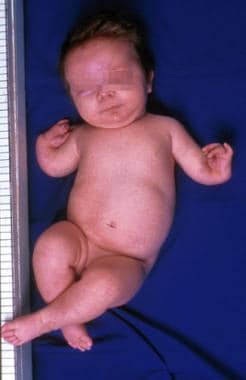 Infant with thrombocytopenia-absent radius syndrome. The arms and forearms are shortened, with radial deviation of both hands because of the absence of bilateral radii. The legs are normal. See also Media files 2 and 3.
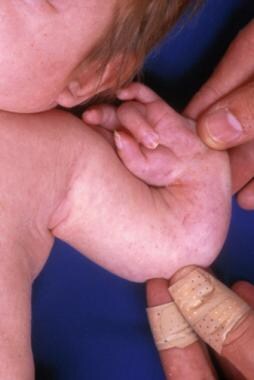 Same infant as in Media files 1 and 3. Close-up photograph of arm and forearm (volar aspect). Note the petechiae.
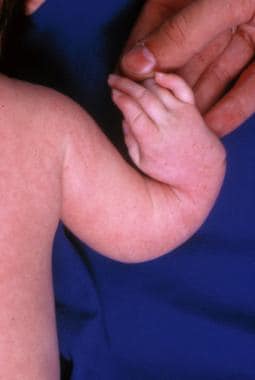 Same infant as in Media files 1 and 2. Close-up photograph of arm and forearm (dorsal aspect).
Signs and symptoms of thrombocytopenia-absent radius (TAR) syndrome
Upper-extremity abnormalities range from isolated absent radii to phocomelia. Abnormalities include the following:
-
Bilateral radial aplasia
-
Radial club hand
-
Hypoplastic carpals and phalanges
-
Hypoplastic ulnae, humeri, and shoulder girdles
-
Syndactyly and clinodactyly of fingers and toes
-
Selective hypoplasia of middle phalanx, fifth digit
-
Altered palmar contours
Only patients with TAR syndrome consistently have bilateral absence of the radii with the presence of thumbs and 4 digits.
Lower-extremity anomalies occur in 46% of patients and vary from clinically undetectable changes to phocomelia. These anomalies are usually less severe than those of the upper limbs. Abnormalities include the following:
-
Hip dislocation
-
Femoral torsion
-
Tibial torsion
-
Valgus and varus foot deformities
-
Deformity of the knee (eg, absence of the patella, patellar dislocation)
-
Absent tibiofibular joint
-
Abnormal toe placement
-
Fifth toe overlapping the fourth
Cardiac anomalies occur in 15-33% of patients and include the following:
Facial anomalies (which occur in 53% of patients) include the following:
-
Micrognathia (3-30% of patients)
-
Tall, broad forehead
-
Facial hemangiomas
-
Hypertelorism
-
Low, posteriorly rotated ears
Other abnormalities are numerous and include the following:
-
Asymmetrical first rib
-
Cervical rib, cervical spina bifida, fused cervical spine, and nuchal folds
-
Uterine anomalies
-
Dorsal pedal edema
-
Hyperhidrosis
-
Short stature (95% of patients at or below the 50th percentile)
-
Other skeletal malformations
-
Renal anomalies (23% of patients) - Include duplex ureter, mild renal pelvis dilatation, and horseshoe kidneys
-
Intracranial vascular malformation
-
Sensorineural hearing loss
-
Scoliosis
-
GI anomalies (eg, esophageal atresia, tracheoesophageal fistula, anal atresia)
-
Annular pancreas
Workup in thrombocytopenia-absent radius (TAR) syndrome
Laboratory studies
The platelet count is frequently less than 50 x 109/L (15-30 x 109/L). Platelet morphology looks normal on blood smear examination. Large platelets are not a feature. Eosinophilia is observed in 50% of patients.
Leukocytosis may be present, with a white blood cell (WBC) count of over 35 x 109/L with a left shift and picture of leukemoid reaction.
Anemia may be present secondary to bleeding.
Imaging studies
Characteristic skeletal involvement (ie, absent radii) is detectable during prenatal transvaginal ultrasonography as early as 13 weeks' gestation, when sufficient fetal skeletal ossification is present.
After radial aplasia is observed, ultrasonography of the extremities, face, and kidneys is indicated.
Procedures
Cordocentesis can be performed to confirm known genetic conditions. Cordocentesis poses a 1-2% risk of fetal loss and a risk of prolonged bleeding from the umbilical puncture site.
Management of thrombocytopenia-absent radius (TAR) syndrome
The mainstay of hospital treatment is supportive care. By far, the most important treatment is platelet transfusion. The goal of platelet transfusion is to maintain a sufficient volume of platelet to prevent bleeding without adverse effects.
Prophylactic transfusions with leukocyte-reduced platelet concentrates are used in patients at high risk of clinically significant hemorrhage.
Splenectomy may be partially effective for the treatment of thrombocytopenia in adults.
Hematopoietic stem cell transplantation (HSCT) is an option for patients who remain thrombocytopenic with bleeding despite platelet transfusions.
Splinting of the hands (and legs, if indicated) during infancy improves future function. If surgical correction of the arm deformities is indicated, it should be undertaken after the patient is hemodynamically stable. If surgery is not a feasible option to manage deformities of the upper limb as patients age, adaptive devices to assist with activities of daily living (eg, dressing, toileting, feeding) are helpful.

Pathophysiology
Some have proposed that the association of seemingly disparate skeletal and hematologic abnormalities is related to the simultaneous development of the heart, the radii, and the megakaryocytes at 6-8 weeks' gestation. The similarity of TAR syndrome to congenital rubella suggests intrauterine injury when the involved systems develop, but a common etiologic agent has not been identified.
The exact pathophysiology of the thrombocytopenia is still unclear. The platelet abnormality reflects platelet hypoproduction, for which numerous explanatory theories have been proposed. One suggestion is that a failure in production of humoral or cellular stimulators of megakaryocytopoiesis (eg, thrombopoietin) is responsible for inhibiting platelet production. However, studies by Ballmaier and colleagues and Sekine and associates showed comparable or increased levels of thrombopoietin in patients with TAR compared with healthy control subjects. [4, 5] These findings suggest that the thrombocytopenia is due to a lack of response to thrombopoietin, especially given the observation of normal thrombopoietin receptor expression on megakaryocytes; this raises the question of a defect in c-Mpl signaling.
Many mutations have been postulated; however, despite investigations of the c-mpl gene in patients with TAR, no mutations have been found in this gene. [6] Another proposed candidate gene is a HOX gene. The HOX family of genes plays a major role in embryogenesis and cell differentiation, including differentiation of hematopoietic cell lines. However, Fleischman and colleagues did not detect mutations in the coding sequence of HOX genes known to affect radial development. [7] Subsequently, an interstitial microdeletion of chromosome 1q was identified in 30 patients with TAR syndrome. [8] All patients and 75% of unaffected parents in this cohort had the microdeletion, suggesting co-inheritance of an additional modifier gene for disease expression.
Albers and colleagues applied high-throughput sequencing in 5 unrelated patients with TAR syndrome and the chromosome 1q21.1 deletion. [9] They discovered one low frequency single nucleotide polymorphism (SNP) in the noncoding 5' untranslated (UTR) region of the gene RBM8A in 4 of the cases and another low frequency noncoding SNP in the first intron of the same gene. These findings were further confirmed in 48 individuals with TAR syndrome. The investigators found coinheritance of the 1q21.1 deletion with either SNP, causing significant decreases in the level of Y14, a protein encoded by RBM8A. [10] The exact mechanism for which decreased levels of Y14 produces the phenotype associated with TAR syndrome remains to be elucidated. Y14 is part of the exon-junction complex (EJC), a set of proteins associated with transcript export, localization, and splicing, playing a critical in embryonic development. [11, 12] Some studies have suggested defects in signal transduction downstream of thrombopoietin.
A study by Manukjan et al indicated that in patients with TAR syndrome, those with the 5’UTR SNP in RBM8A have a significantly lower platelet count than do patients with the intron-1 SNP in this gene. [13]
TAR syndrome was initially considered an autosomal recessive disease. Some have suggested that the inheritance pattern may be autosomal dominant with variable penetrance.
Epidemiology
Frequency
United States
TAR syndrome rarely occurs in the United States.
International
Worldwide, TAR syndrome has an estimated prevalence of 1:100,000 live births. [14]
The frequency of TAR syndrome is 0.42 case per 100,000 live births in Spain.
Mortality/Morbidity
The major cause of mortality in TAR syndrome is hemorrhage. The incidence of hemorrhage is limited to the first 14 months of life. In a study by Hedberg and associates, 18 of 20 deaths in 76 patients were due to hemorrhagic events; most of patients who died had platelet counts < 10 X 109/L. [15]
Bleeding and hemorrhage can also result in clinically significant morbidity, especially intracranial hemorrhage. Hand and upper-extremity function is usually good if radial aplasia is the only skeletal abnormality. However, patients require plastic surgery, occupational therapy, and physiotherapy.
Race
No ethnic or racial predilection is reported.
Sex
The male-to-female ratio is 1:1. Greenhalgh and associates reported an excess of females (27:7), [16] as did Hall and colleagues (26:14). [17]
Age
TAR syndrome is congenital, and patients usually present with symptomatic thrombocytopenia in the first week of life.
Prognosis
The prognosis in TAR is better than in congenital amegakaryocytic thrombocytopenia (CAMT). Survival in TAR plateaus at greater than 70% after age 4 years. The platelet count improves after age 1 year (unlike in CAMT), so platelet transfusion is rarely needed after that.
-
Infant with thrombocytopenia-absent radius syndrome. The arms and forearms are shortened, with radial deviation of both hands because of the absence of bilateral radii. The legs are normal. See also Media files 2 and 3.
-
Same infant as in Media files 1 and 3. Close-up photograph of arm and forearm (volar aspect). Note the petechiae.
-
Same infant as in Media files 1 and 2. Close-up photograph of arm and forearm (dorsal aspect).