Practice Essentials
Kearns-Sayre syndrome (KSS) is characterized by the onset of ophthalmoparesis and pigmentary retinopathy [1] before age 20 years. Other frequently associated clinical features include cerebellar ataxia, cardiac conduction block, raised cerebrospinal fluid (CSF) protein content, and proximal myopathy. [2, 3] Affected children have short stature and often have multiple endocrinopathies, including diabetes mellitus, hypoparathyroidism, and Addison disease. [4] Renal tubular acidosis (proximal or distal) has been described in numerous cases, with occasional progression to end-stage renal failure. Bilateral sensorineural hearing loss is almost universal in those who survive into the fourth decade of life; this may not be fully corrected with hearing aids. No disease-modifying therapy is available for Kearns-Sayre syndrome. [5]
In a retrospective study by Khambatta et al of 35 patients with Kearns-Sayre syndrome, cardiovascular features of the group included syncope (6 patients; 17%) and sudden cardiac death (4 patients; 11%). The investigators suggested therefore that formal electrophysiologic studies and prophylactic defibrillators be considered in patients with the syndrome. Other cardiovascular features included heart block (11 patients; 31%) and conduction delays (23 patients; 66%). [6]
Signs and symptoms of Kearns-Sayre syndrome
Signs and symptoms of Kearns-Sayre syndrome include the following:
-
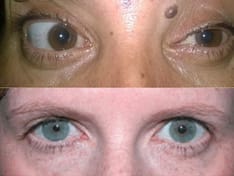
Muscle weakness - Proximal myopathy, ptosis, and external ophthalmoplegia [7]
-
Central nervous system (CNS) dysfunction - Retinitis pigmentosa, cerebellar ataxia, cognitive deficits, [8] cataracts, and encephalopathy
-
Cardiac dysfunction - Bradycardia, congestive cardiac failure
-
Endocrine dysfunction - Short stature, hypogonadism, and other disorders
Workup in Kearns-Sayre syndrome
The following studies are indicated in Kearns-Sayre syndrome (KSS):
-
Urine measurements - pH, protein, glucose, and amino acid levels
-
Serum creatinine kinase level - May be within the reference range or moderately elevated.
-
Lactate and pyruvate - Blood lactate and pyruvate are usually elevated; cerebrospinal fluid (CSF) lactate levels are elevated even if blood lactate levels are within the reference range; [9] CSF protein levels are very frequently elevated.
In young children, single large-scale deletions may be detectable in blood. Alternatively, diagnosis may be established by muscle biopsy with histochemistry and mitochondrial DNA (mtDNA) analysis for major rearrangements. [10]
Screening is recommended to exclude the endocrinologic abnormalities that occur in many patients. [11] Measure serum electrolyte, glucose, calcium, magnesium, and plasma cortisol levels, as well as thyroid function.
Magnetic resonance imaging (MRI) of the brain may reveal subcortical white matter lesions (hyperintense on T2 and fluid attenuation inversion recovery [FLAIR], may be bilateral) along with involvement of thalamus, basal ganglia, and brainstem.
Management of Kearns-Sayre syndrome
No disease-modifying therapy is available for Kearns-Sayre syndrome (KSS). Management is supportive vigilance for detection of associated problems.
Aponeurogenic ptosis and cricopharyngeal achalasia can be addressed surgically. With regard to diet, supplementation with coenzyme Q10 may be indicated. Exercise may help patients with myopathy.

Pathophysiology
The mitochondrial genome is a 16569 base-pair closed circular loop of double-stranded DNA found in multiple copies within the mitochondrial matrix. The mitochondrial genome encodes the genetic information for the 13 polypeptide subunits essential for the process of oxidative phosphorylation. In addition, mitochondrial DNA (mtDNA) encodes 2 ribosomal RNA genes and 22 transfer RNA (tRNA) genes necessary for the intramitochondrial synthesis of these 13 polypeptides. The genome was first sequenced in its entirety in 1981, [12] and this "Cambridge Sequence" was subject to minor revisions in 1999. [13] The mitochondrial genome is remarkably concise, containing little noncoding capacity and no introns. mtDNA is inherited almost exclusively through the maternal lineage, with only a single report of paternal inheritance. [14]
Located within the mitochondrial matrix, and lacking the efficient repair mechanisms available to nuclear DNA, mtDNA has a relatively high rate of mutation. Most of these mutations are inconsequential; however, a stable, replicative mutant mtDNA is sometimes produced. This is not necessarily a problem for the cell or tissue because multiple copies of mtDNA are present in each cell (in oocytes, this is in the region of 100,000 copies per cell), and both wild type and mutated mtDNA can coexist, a situation known as heteroplasmy. Disease only ensues when the proportion of mutated to wild-type mtDNA exceeds a tissue-specific threshold. This is usually in excess of 65% mutated mtDNA but can widely vary between tissues and individuals. Thus, the level of mutant heteroplasmy is an important determinant of the clinical presentation of mitochondrial disease; however, other factors, such as nuclear genetic background, must also be considered.
A study by Lin et al suggested that in cases of mitochondrial DNA heteroplasmy, the mitochondrial unfolded protein response leads to the propagation or maintenance of deleterious mitochondrial DNA. A transcriptional response triggered by defects in oxidative phosphorylation (which are themselves caused by deletion of mitochondrial DNA, such as that found in Kearns-Sayre syndrome), the mitochondrial unfolded protein response is involved in promoting the recovery and regeneration of defective mitochondria. [15]
Kearns-Sayre syndrome (OMIM #530000) occurs as a result of large-scale single deletions (or rearrangements) of mitochondrial DNA (mtDNA), which are usually not inherited but occur spontaneously, probably at the germ-cell level or very early in embryonic development. [16, 17] The risk of maternal transmission has been estimated to be approximately 1 in 24. [18] The deletions vary in size and location on the mitochondrial genome in different individuals, although a common deletion of 4.9kB is present in at least a third of patients with Kearns-Sayre syndrome.
How can a heterogeneous group of mitochondrial deletions lead to a similar phenotype? The proposed mechanism is based on the knowledge that transcription of mtDNA is polycistronic, which means that all genes encoded on the heavy and light strands are transcribed as 2 large precursor RNA strands. These subsequently cleave into separate RNA strands, including transfer RNA strands. A deletion anywhere in the mitochondrial genome may affect transcription or translation of genes that were not affected by the deletion.
An identical deletion has been identified in patients with 2 other conditions: Pearson syndrome, which is a sideroblastic anemia of childhood, pancytopenia, and exocrine pancreatic failure, and chronic progressive external ophthalmoplegia (CPEO), which consists of external ophthalmoplegia, bilateral ptosis, and proximal myopathy. [7] Mitochondrial deletions in CPEO tend to be localized in muscle tissue; in Pearson syndrome, mutations occur in hematopoietic cells, explaining the different clinical phenotypes.
Neither size nor location of the deletion alone determines clinical phenotype. Instead, the phenotype appears to be determined by the relative amounts of deleted and wild-type mtDNA. Very high levels of deleted mtDNA in all tissues are likely to cause Pearson syndrome, in which the dominant feature is pancytopenia. Lower levels of deleted mtDNA cause Kearns-Sayre syndrome. In CPEO, deleted mtDNA may be detected only in muscle tissue. CPEO and Kearns-Sayre syndrome vary in the location and percentage of mtDNA deletion. [19] Exceptions are recognized, and survivors of the pancytopenic crisis of Pearson syndrome can also develop Kearns-Sayre syndrome.
Epidemiology
Frequency
International
Kearns-Sayre syndrome is a rare disorder. Marked heterogeneity and various types of inheritance have been observed. By 1992, authors had described 226 cases.
Two studies have provided congruent information on the prevalence of large-scale mitochondrial deletions in the adult population. Remes et al estimated a prevalence of 1.6 cases per 100,000 population in a Finnish population (6 patients, only 3 of whom fulfilled the clinical criteria for Kearns-Sayre syndrome). [20] Schaefer et al estimated a prevalence of 1.17 cases per 100,000 population of large-scale mitochondrial deletions in North East England; however, the proportion of patients with Kearns-Sayre syndrome is not stated. [21]
Mortality/Morbidity
Although Kearns-Sayre syndrome probably reduces life expectancy, no numerical data are available. Morbidity depends on severity and the number of systems or organs involved, which widely varies from patient to patient. Heart block is a significant and preventable cause of mortality.
A literature review by Imamura et al involving 112 patients with arrhythmia-associated Kearns-Sayre syndrome found that arrhythmia first manifested as bundle branch block, which then evolved into atrioventricular block (AVB) and, in about 50% of the group, subsequently progressed to complete AVB. [22]
A study by Wiseman et al, using the National (Nationwide) Inpatient Sample database, found that out of 640 hospital admissions for Kearns-Sayre syndrome, 2.3% involved patients with ventricular arrhythmia (VA) or dysrhythmic cardiac arrest (dCA). Rates of VA and dCA were higher in individuals with conduction abnormalities. On discharge, a pacemaker (with or without a defibrillator) was present in about 70% of patients with Kearns-Sayre syndrome and conduction abnormality. [23]
Race
Kearns-Sayre syndrome has no known racial predilection.
Sex
Kearns-Sayre syndrome has no known sex predilection.
Age
Part of the characterization of Kearns-Sayre syndrome is onset in individuals younger than 20 years.
-
Skeletal muscle stained for both cytochrome oxidase (COX) and succinic dehydrogenase (SDH), two mitochondrial respiratory chain enzymes. Fibers that stain only for SDH and are COX-negative appear blue. Original magnification X 50.
-
Bilateral ptosis and external ophthalmoplegia. Top: patient looking straight ahead. Below: patient is being asked to look in the direction of the arrow in each case. Restriction of eye movements in each direction is demonstrated.
-
Modified Gomori Trichrome stain showing ragged red fibres. These show red staining round the periphery as well as within the sarcoplasm, giving a speckled appearance. Of the two affected muscle fibres pictured here, the one on the right shows a more extreme degree of mitochondrial proliferation and also some degeneration/vacuolation than the one on the left.