Practice Essentials
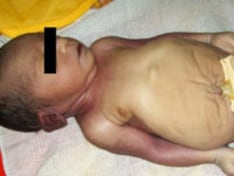
Beckwith-Wiedemann syndrome (BWS) is a pediatric cancer predisposition disorder that was first characterized by Dr J. Bruce Beckwith and Dr Hans-Rudolf Wiedemann in the early 1960s. Patients were first noted to have abdominal wall defects, macrosomia, macroglossia, and enlarged adrenal glands. Since then, clinical presentation has expanded to recognize hemihypertrophy/lateralized overgrowth, hyperinsulinism, omphalocele, and organomegaly as classic features of BWS. Additionally, it is now recognized that patients with BWS have a range of clinical features. Presentation of BWS occurs on a spectrum ranging from isolated asymmetry to classic features of BWS. [1]
Signs and symptoms
Cardinal features of BWS include the following:
-
Macroglossia
-
Hyperinsulinism
-
Omphalocele
-
Lateralized overgrowth/hemihypertrophy – typically presented as asymmetric muscle bulk, rather than length
-
Multifocal Wilms tumor/nephroblastomatosis
-
Pathology findings including adrenal cortical cytomegaly, placental mesenchymal dysplasia, or pancreatic adenomatosis
Suggestive features of BWS include the following:
-
Birth weight >2 standard deviation scores (SDS) above mean
-
Facial nevus simplex
-
Polyhydramnios and/or placentomegaly
-
Ear creases and/or pits
-
Transient hypoglycemia
-
Embryonal tumors (hepatoblastoma, isolated Wilms tumor, neuroblastoma, pheochromocytoma, rhabdomyosarcoma, adrenocortical carcinoma)
-
Nephromegaly and or hepatomegaly
-
Umbilical hernia/diastasis recti
See Presentation for more detail.
Diagnosis
Laboratory studies
If BWS is suspected, genetic testing should be performed.
Alpha-fetoprotein measurement is recommended every 3 months until age 4 years to screen for development of hepatoblastoma.
Imaging studies
Tumor screening includes a full abdominal ultrasound scan every 3 months until age 4 years and a renal ultrasound scan from age 4-7 years.
See Workup for more detail.
Management
Medical care is determined by the type and severity of BWS features.
Embryonal tumors require appropriate oncologic treatment modalities, which often include nephrectomy. Depending on the severity of macroglossia, surgical intervention may be required. Pancreatectomy may be required for patients with persistent and severe hyperinsulinism.
See Treatment and Medication for more detail.

Pathophysiology
BWS is a pediatric cancer predisposition disorder caused by changes in the imprinted gene loci on chromosome 11p15. Patients develop BWS as a result of the misregulation of key gene regions; the resulting misexpression of growth genes leads to the overgrowth that characterizes the condition.
While most autosomal genes are expressed biallelically, imprinted genes are expressed either from the maternal or paternal allele. These genes are regulated by specific regions near the genes called imprinting control regions (ICRs), which contain epigenetic marks (methylation) that coordinate gene expression. BWS is caused by genetic or epigenetic changes that disrupt the parent-of-origin specific expression of these genes. [2, 3] Most commonly, BWS is caused by epigenetic modifications to methylation at ICRs. BWS can also be caused by mutations in the genetic sequence, deletions, duplications in the region or chromosomal rearrangements.
The imprinted gene regions involved in BWS are H19/IGF2 and CDKN1C/KCNQ1OT1, all genes implicated in growth during early development. H19 encodes a long noncoding RNA that is maternally expressed; it is believed to act as a tumor suppressor. IGF2, or insulin-like growth factor 2, is a paternally expressed protein-coding gene. IGF2 is highly active during fetal development and acts as a growth promoter. CDKN1C, or cyclin-dependent kinase inhibitor 1C, is a gene that encodes a protein implicated in cell cycle regulation. KCNQ1OT1, or potassium voltage-gated channel subfamily Q member 1 opposite transcript 1 is the antisense transcript of the protein-coding gene KCNQ1. KCNQ1OT1 is implicated in regulating other growth genes. [4]
BWS can be caused by several different epigenetic or genetic changes at these loci. Causes can include changes to levels of methylation at the ICRs, paternal uniparental disomy (pUPD) of chromosome 11p15, chromosomal rearrangements involving the 11p15.5 region, point mutations in CDKN1C, or microdeletions in ICRs. [5] In cases where BWS is caused by epigenetic modifications to the genome, occurrence is sporadic and is generally not inherited. Risk of recurrence is the same as in the general population. Cases of BWS with a genetic cause may be inherited, though presentation depends on the parent of transmission.
Etiology
BWS is caused by genetic or epigenetic mutations at imprinting loci in chromosome 11p15.5. Imprinted genes are expressed in a parent-of-origin specific fashion. Specifically, while most genes are biallelically expressed, imprinted genes are expressed monoallelically, from either the maternal or paternal chromosome. Expression in these loci is controlled by biochemical changes (methylation) on regions within the loci known as imprinting control regions (ICRs). ICRs are differentially methylated between maternal and paternal alleles; this differential methylation directs parent-of-origin specific gene expression.
Common causes of BWS include genetic or epigenetic changes to these control regions that result in the disruption of the normal expression of growth genes at these loci. The imprinted regions involved in BWS are the KvDMR/CDKN1C (also known as Lit1) and H19/IGF2 regions. CDKN1C encodes a cell cycle regulator and tumor suppressor while IGF2 encodes a growth promoting factor. H19 is a non-coding RNA believed to play a part in inhibiting growth. CDKN1C and H19 are normally expressed solely from the maternal allele, while IGF2 is expressed paternally. [4, 6]
Imprinting center 2 (IC2) controls expression of the KvDMR/CDKN1C region while imprinting center 1 (IC1) controls expression of the H19/IGF2 region. In the KvDMR /CDKN1C region, IC2 on the maternal allele is methylated while paternal IC2 is unmethylated. For the H19/IGF2, methylation occurs on paternal IC1 while maternal IC1 is unmethylated. Maternal loss of methylation on IC2 causes BWS, likely through downregulation of CDKN1C. Maternal gain of methylation on IC1 also results in BWS, as this change upregulates expression of the growth promoting IGF2. [4]
Epigenetic causes of BWS include gain or loss of methylation on the ICRs. Loss of methylation on the maternal allele of IC2 is the most prevalent cause of BWS, accounting for 50-60% of cases. [1] Gain of methylation on the maternal allele of IC1 can also cause BWS, accounting for 5-10% of cases.
About 20% of cases of BWS are caused by paternal uniparental disomy (pUPD) of 11p15. Patients with pUPD have two paternal copies of 11p15; this results in both loss of methylation on IC2 as well as gain of methylation on IC1. This change is typically present in some cells and not others in different regions of the body leading to a more variable phenotype.
Other possible genetic causes include maternally inherited point mutations in CDKN1C, paternal duplications in 11p15.5, microdeletions in either ICR1 or ICR2, or chromosomal rearrangements involving the 11p15.5 region. Changes involving gene mutations, deletions or duplications are rarer than the diagnoses listed above. Genetic and epigenetic changes all result in the BWS overgrowth phenotype through the overexpression of growth promotion factors such as IGF2, or the under-expression of growth restriction factors such as CDKN1C or H19.
For most cases where BWS is caused by spontaneous epigenetic alterations such as methylation changes, risk of inheritance or recurrence of the disease is no higher than that of the risk for the general population. Cases with a genetic basis may be heritable if germline cells are affected. Manifestation of BWS in the next generation depends upon the parent of transmission. To date pUPD has not been reported as heritable.
Patients with BWS have a higher risk of developing embryonal tumors such as hepatoblastoma or Wilms tumor. Overall, the risk is between 5% and 10%, but this risk is stratified based on molecular diagnosis. The tumor risks by molecular diagnosis are as follows [7] :
-
IC2 loss of methylation (LOM): 2.5-3.1%
-
IC1 gain of methylation (GOM): 22.8-28.6%
-
pUPD: 13.8-17.3%
-
CDKN1C: 6.9-8.8%
-
Negative genetic testing: 6.7%
Patients with CDKN1C mutations also have 2.8% risk of developing neuroblastoma.
Epidemiology
BWS is estimated to occur in 1 in 10,500 live births in the general population. [8] As individuals with milder phenotypes often go undiagnosed, the incidence may be higher.
The incidence of BWS in children conceived through assistive reproductive technology is about 1:1200. [8] A study by Carli et al found that patients with BWS who were conceived through assisted reproductive techniques may have a milder phenotype than those with BWS who were conceived naturally. [9]
Race-, sex-, and age-related demographics
No race predilection is observed.
No sex predilection is noted.
BWS is a congenital disorder that is commonly diagnosed in early childhood. Patients with BWS have an increased risk of developing embryonal tumors in childhood. Particularly, patients with BWS have an increased risk of developing hepatoblastoma before 4 years of age and Wilms tumor before 7 years of age. [10] Clinical features of BWS typically decrease with age.
Prognosis
Prognosis is good and depends primarily on the status of the airway, on early management of hypoglycemia if present, and on tumor screening. Most patients with BWS have a normal life expectancy and generally do not develop serious medical problems in adulthood as a result of the condition.
About half of patients with BWS are large in height and weight for their age in early childhood, though adults with BWS may not be unusually tall. [1] Patients with BWS have increased risk of embryonal tumors, notably hepatoblastoma and Wilms tumor in childhood. Omphalocele and abdominal wall defects often either resolve or are repaired through surgery. Macroglossia may also be addressed with tongue-reduction surgery to remedy feeding, speaking, or breathing concerns, although many cases of macroglossia resolve without surgery.
Morbidity/mortality
Based on current data, patients with BWS have an increased tumor risk during childhood; periodic screening allows early detection and intervention. Complications related to BWS features such as omphalocele, hyperinsulinism, macroglossia may arise and require additional medical attention. Lifespan is anticipated to be normal. There are currently limited data in adults.
Complications
Medical and surgical complications are possible with treatment of abdominal tumors.