Continually Updated Clinical Reference
 
 
  All Sources     eMedicine     Medscape     Drug Reference     MEDLINE
 
eMedicine - Ventricular Septal Defect, General Concepts : Article by

Quick Find
Authors & Editors
Introduction
Clinical
Differentials
Workup
Treatment
Medication
Follow-up
Miscellaneous
Acknowledgments
Multimedia
References

Related Articles
Patent Ductus Arteriosus

Pulmonary Stenosis, Infundibular


Patient Education
Heart Center

Tetralogy of Fallot Overview

Tetralogy of Fallot Causes

Tetralogy of Fallot Symptoms

Tetralogy of Fallot Treatment

Ventricular Septal Defect Overview


Author: Prema Ramaswamy, MD, Co-director of Pediatric Cardiology, Maimonides Medical Center; Assistant Professor, Department of Pediatrics, Mount Sinai School of Medicine

Prema Ramaswamy is a member of the following medical societies: American Academy of Pediatrics and American College of Cardiology

Coauthor(s): Patturajah Anbumani, MD, MS, MCh, Adjunct Clinical Assistant Professor, Department of Medicine, New York College of Osteopathic Medicine; Clinical Assistant Professor, State University of New York-Downstate; Kuruchi Srinivasan, MD, Consulting Staff, Department of Internal Medicine, Nazareth Hospital; Viswanath Natesan, MD, Staff Physician, Department of Internal Medicine, Lutheran Medical Center; Sharmila Srinivasan, BS, State University of New York Upstate Medical University

Editors: Jeffrey Towbin, MD, Associate Chair of Pediatric/Cardiology, Departments of Pediatrics, Molecular and Human Genetics, Cardiovascular, Professor, Baylor College of Medicine and Texas Children's Hospital; Mary L Windle, PharmD, Adjunct Assistant Professor, University of Nebraska Medical Center College of Pharmacy, Pharmacy Editor, eMedicine.com, Inc; Hugh D Allen, MD, Professor, Department of Pediatrics, Division of Pediatric Cardiology and Department of Internal Medicine, Ohio State University College of Medicine; Gilbert Herzberg, MD, Assistant Professor, Department of Pediatrics, Section of Pediatric Cardiology, New York Medical College; Stuart Berger, MD, Professor of Pediatrics, Division of Cardiology, Medical College of Wisconsin; Chief of Pediatric Cardiology, Medical Director of Pediatric Heart Transplant Program, Medical Director of The Heart Center, Children's Hospital of Wisconsin

Author and Editor Disclosure

Synonyms and related keywords: ventricular septal defect, VSD, isolated ventriculoseptal defect, isolated ventricular defect, maladie de Roger, Eisenmenger complex, Eisenmenger's syndrome, Eisenmenger syndrome

Background

A ventricular septal defect (VSD) is a hole or a defect in the septum that divides the 2 lower chambers of the heart and that results in a communication between the ventricular cavities. The defect may occur as a primary anomaly with or without additional major associated cardiac defects. VSD may occur as a single component of a wide variety of intracardiac anomalies, namely, tetralogy of Fallot (TOF), complete atrioventricular (AV) canal defects, transposition of great arteries, and corrected transpositions.

In this article, the term VSD refers to an isolated VSD, or a defect in a heart with AV concordance. That is, the atria are attached to the correct ventricle and the normally related arteries (great arteries arising from the appropriate ventricle, ie, an otherwise normal heart) with no other major lesions. Isolated VSD occurs in approximately 2-6 of every 1000 live births and accounts for more than 20% of all congenital heart diseases. VSDs are the most common congenital heart defects encountered after bicuspid aortic valves.

Credit for the first clinical description is generally given to Roger's article published in 1879. The phrase maladie de Roger is still used to refer to a small asymptomatic VSD. In 1898, Eisenmenger described a patient with VSD, cyanosis, and pulmonary hypertension. This combination of a VSD, pulmonary vascular disease, and cyanosis has been termed the Eisenmenger complex. Pulmonary vascular disease and cyanosis in combination with any other systemic-to-pulmonary connection has been called the Eisenmenger syndrome (Wood, 1958). Heath and Edwards described the morphologic changes associated with pulmonary vascular disease in 1958, and their 6 categories of vascular change have remained the standard of comparison to the present (Heath, 1958).

Since 1979, real-time 2-dimensional echocardiography has dramatically improved the noninvasive anatomic assessment of VSD.

Definition

VSD is a developmental defect of the interventricular septum wherein a communication exists between the cavities of the 2 ventricles.

Embryology

Between the fourth and eighth weeks of gestation, the single ventricular chamber is effectively divided into 2. This division is accomplished with the fusion of the membranous portion of the ventricular septum, the endocardial cushions, and the bulbous cordis (proximal portion of the truncus arteriosus).

The muscular portion of the ventricular septum grows cephalad as each ventricular chamber enlarges, eventually meeting with the right and left ridges of the bulbous cordis. The right ridge fuses with the tricuspid valve and the endocardial cushions, separating the pulmonary valve from the tricuspid valve. The left ridge fuses with a ridge of the interventricular septum, leaving the aortic ring in continuity with the mitral ring.

The endocardial cushions develop concomitantly and finally fuse with the bulbar ridges and the muscular portion of the septum.

The fibrous tissue of the membranous portion of the interventricular septum makes the final closure and separates the 2 ventricles.

Anatomy

The interventricular septum is a curvilinear complex structure and this can be divided into 4 zones by anatomic landmarks in the right ventricle (RV). The RV has many heavy trabeculations. The stoutest of these is a Y)-shaped bundle, ie, the trabecula septomarginalis, which proceeds toward the apex and which gives rise to the moderator band, which courses transversely near the apex. The trabecula septomarginalis is an important structure that helps in the identification of the RV regardless of its location in the chest. The 2 limbs of the Y travel superiorly, and the anterior, or parietal, limb supports the pulmonic valve and the posterior limb (septal band) extends to the membranous septum.

The 4 parts of the ventricular septum are the following:

  1. the inlet septum is smooth walled and extends from the septal attachments of the tricuspid valve to the distal attachments of the tricuspid tensor apparatus. This region has also been called the AV canal septum (Van Praagh, 1989).
  2. The apical trabecular zone separates the coarse trabeculations of the RV from the fine ones seen in the left ventricle (LV). Van Praagh et al (1989) refer to this as the muscular septum or the ventricular sinus septum.
  3. The smooth-walled outlet or infundibular septum is separated from the trabeculated portion of the RV by the septal band of the trabecula marginalis. Van Praagh et al (1989) called this area the parietal band or the distal conal septum, and they refer to defects in this area as conal septal defects.
  4. The last and the smallest region in the ventricular septum is the membranous septum, which this lies between the anterior and the septal tricuspid leaflets and below the right and the noncoronary cusps of the aortic valve.
    • The 3 muscular components of the ventricular septum described above abut on the membranous septum and fan out from it as triangles, with the apices touching this septum. In the normal heart, the tricuspid and mitral valves are attached to the ventricular septum at different levels so that the tricuspid-valve attachment is apically displaced compared with the mitral-valve attachment. Therefore, a portion of the interventricular septum, called the AV septum, lies between the right atrium (RA) and the LV. This portion consists of a membranous part anteriorly and a muscular part posteriorly, and it is usually present in most hearts with an isolated VSD.
    • In the anterior aspect, the tricuspid-valve attachment divides the area of membranous septum into an interventricular component (between the LV and RV) and an AV component (between the LV and RA). When a VSD is isolated, the AV component of membranous septum is usually intact.

Classifications of VSDs

Many classifications of VSDs have been proposed. An underlying classification that is surgically and clinically useful is described below.

Perimembranous (infracristal, conoventricular) VSDs lie in the LV outflow tract just below the aortic valve. Because they occur in the membranous septum with defects in the adjacent muscular portion of the septum, they are subclassified as perimembranous inlet, perimembranous outlet, or perimembranous muscular. These are the most common types of VSDs and account for 80% of such defects. Perimembranous VSDs are associated with pouches or aneurysms of the septal leaflet of the tricuspid valve, which can partially or completely close the defect. In addition, an LV-to-RA shunt may be associated with this defect.

Supracristal (conal septal, infundibular, subpulmonic, subarterial, subarterial doubly committed, outlet) defects account for 5-8% of isolated VSDs in the United States but 30% of isolated VSDs in Japan. These defects lie beneath the pulmonic valve and communicate with the RV outflow tract above the supraventricular crest and are associated with aortic regurgitation secondary to the prolapse of the right aortic cusp.

Muscular VSDs (trabecular) are entirely bounded by the muscular septum and are often multiple. The term Swiss-cheese septum has been used to describe multiple muscular VSDs. Other subclassifications depend on the location and include central muscular or midmuscular, apical, or marginal when the defect is along the RV-septal junction. These VSDs account for 5-20% of all defects. Any single defect observed from the LV aspect may have several openings on the RV aspect.

Posterior (canal-type, endocardial cushion–type, AV septum–type, inlet, juxtatricuspid) VSDs lie posterior to the septal leaflet of the tricuspid valve. Although locations of posterior VSDs are similar to those of VSD observed with AV septal defects, they are not associated with defects of the AV valves. About 8-10% of VSDs are of this type.

Other anatomic considerations

The relationship of the AV conduction pathways to the defect is important to surgical repair. The AV node occupies the apex of the triangle of Koch that is limited posteriorly by the tendon of Todaro, inferiorly by the os of the coronary sinus and superiorly by the tricuspid valve annulus. The bundle of His arises from the AV node. In perimembranous defects, the bundle of His lies in a subendocardial position as it courses along the posterior-inferior margin of the defect. In inlet defects, the bundle of His passes anterosuperiorly to the defect. In muscular VSDs and outlet defects, the risk of heart block is minimal because the bundle is remote from the defect.

Patients with subpulmonary conal defects usually have deficiency of muscular or fibrous support below the aortic valve with subsequent herniation of the right aortic leaflet. However, in patients with perimembranous VSD with aortic insufficiency, it may be the right or the noncoronary cusp that prolapses.

Classification of congenital malformations - Phenotype

For purposes of etiologic analysis, clustering defects by potential pathogenic mechanisms is beneficial. The following pathologic classification allows for comparison of similar defects.

  • Subarterial VSD can be classified as abnormalities of ectomesenchymal tissue migration.
  • Perimembranous VSD can be classified as abnormal intracardiac blood flow.
  • Muscular VSD can be classified as abnormalities in cell death.
  • Type III in-flow VSD can be classified as abnormalities of the extracellular matrix and defects in the endocardial cushion.

Pathophysiology

A defect in the ventricular septum allows a communication between the systemic and pulmonary circulations. As a result, flow moves from a region of high pressure to low pressure (from the LV to the RV, ie, left-to-right shunt). The pathophysiologic effects of a VSD are secondary to hemodynamic effects secondary to a left-to-right shunt and changes in the pulmonary vasculature.

Left-to-right shunt

A left-to-right shunt at the ventricular level has 3 hemodynamic consequences: increased LV volume load, excessive pulmonary blood flow, and reduced systemic cardiac output.

Blood flow through the defect from the LV to the RV results in oxygenated blood entering the pulmonary artery (PA). This extra blood in addition to the normal pulmonary flow from the vena cava increases blood flow to the lungs and subsequently increases pulmonary venous return into the left atrium (LA) and ultimately into the LV. This increased LV volume results in LV dilatation and then hypertrophy. It increases the end-diastolic pressure and consequently LA pressure and then pulmonary venous pressure.

The increased pulmonary blood flow raises pulmonary capillary pressure, which can increase pulmonary interstitial fluid. When this condition is severe, patients can present with pulmonary edema. Therefore, both PA pressure and pulmonary venous pressure are elevated in a VSD. The increase in pulmonary venous pressure is not seen with an atrial septal defect because LA pressures are low, as blood can readily exit it through the atrial communication.

Finally, as blood is shunted through the VSD away from the aorta, cardiac output decreases, and compensatory mechanisms are stimulated to maintain adequate organ perfusion. These mechanisms include increased catecholamine secretion and salt and water retention by means of the renin-angiotensin system.

The degree of the left-to-right shunt determines the magnitude of the changes described above. The left-to-right shunt depends on 2 factors: 1 is anatomic, and 1 is physiologic. The anatomic factor is the size of the VSD. In a normal heart, RV pressure is about 25% that of the LV. In a large VSD, this pressure difference is no longer maintained because these holes offer no resistance to blood flow. They are also consequently called nonrestrictive VSDs. On the contrary, in a small VSD, the normal pressure difference between the ventricles is maintained. These are called restrictive VSDs because flow across the defect is somewhat restricted.

The physiologic factor is the resistance of the pulmonary vascular bed.

The location of the VSD is irrelevant in terms of the degree of the shunt.

Changes in the pulmonary vasculature

The terms pulmonary hypertension, high pulmonary resistance, and pulmonary vascular disease are often confused.

Pulmonary hypertension merely indicates a high blood pressure in the pulmonary circuit, and, depending on the duration, it can be reversible. Pulmonary resistance is a function of numerous factors, including age, altitude, hematocrit, and diameter of the pulmonary arterioles.

A neonate has increased resistance secondary to the increase in the media of the pulmonary arterioles and this decreases the effective diameter of the vessels. In addition to this, neonates have a relative polycythemia. This elevated pulmonary resistance usually declines to adult levels by 6-8 weeks.

Pulmonary vascular disease is ultimately an irreversible condition and may occur in individuals with a large left-to-right shunt over time. It may also occur in the absence of a shunt; this condition is called primary pulmonary hypertension.

A characteristic series of histologic changes ranging from grade I to grade VI (Heath and Edwards) are described.

The ultimate consequences of pulmonary vascular obstructive disease are irreversible vascular changes and pulmonary resistance equal to or exceeding systemic resistance.

Natural history

The natural history has a wide spectrum, ranging from spontaneous closure to congestive heart failure (CHF) to death in early infancy.

Spontaneous closure frequently occurs in children, usually occurs by the age of 2 years. Closure is uncommon after 4 years of age. Closure is most frequently observed in muscular defects (80%), followed by perimembranous defects (35-40%). Outlet VSDs have a low incidence of spontaneous closure, and inlet VSDs do not close.

Closure may occur by means of hypertrophy of the septum, formation of fibrous tissue, subaortic tags, apposition of the septal leaflet of tricuspid valve, or (in rare cases) prolapse of a leaflet of the aortic valve. When perimembranous VSDs close because of development of fibrous tissue or the apposition of the tricuspid valve, an aneurysm of the interventricular septum may appear.

A small VSD that does not spontaneously close is generally associated with a good prognosis. Patients are at risk for infective endocarditis, but small muscular VSDs pose no other adverse possibilities. However, small perimembranous VSD are associated with an increased risk of prolapse of the aortic cusp over time. In addition, a small but definite risk of malignant ventricular arrhythmia was reported by Kidd, et al. This study group, the Second Natural History Study, consisted of about 1000 patients who formed about 76% of the original cohort (Kidd, 1993). The original cohort was the First Natural History study and included 1280 patients (mostly children) with ventricular septal defects admitted after cardiac catheterization for a period from 1958-1969.

Wu et al reported a 45% incidence of LV-to-RA shunts and a 6% incidence subaortic ridges during 20-year follow-up of about 900 patients with perimembranous (Wu, 1993). This group later reported an increased incidence of infective endocarditis in patients who have LV-to-RA shunts (Wu, 2006).

Frequency

United States

VSD affects 2-7% of live births.

The patient's area of residence may influence the prevalence of known VSDs. For example, small muscular VSDs are most likely to be identified in urban locations possibly because of ready access to sophisticated healthcare in these locations.

A recent echocardiographic study revealed a high incidence of 5-50 VSDs per 1000 newborns. The defects in this study were small restrictive muscular VSDs, which typically spontaneously close in the first year of life.

VSDs are the most common lesion in many chromosomal syndromes, including trisomy 13, trisomy 18, trisomy 21, and relatively rare syndromes (see Table). However, in more than 95% of patients with VSDs, the defects are not associated with a chromosomal abnormality.

Race

Reports are inconclusive regarding racial differences in the distribution of VSDs. However, the doubly committed or outlet defect occurs most commonly in the Asian population. These constitute 5% of the defects in the Unites States but 30% of those reported in Japan.

Sex

  • VSDs are slightly more common in female patients with in male patients (56% vs 44%).
  • The incidence of abnormalities of the ectomesenchymal tissue migration (ie, subarterial VSD outlet) is highest in boys.


History

Symptoms and physical findings depend on the size of the defect and the magnitude of the left-to-right shunt.

  • Infants with small defects
    • Patients have mild or no symptoms.
    • These cases are most often brought to the cardiologist's attention because a murmur is detected on routine examination.
    • Feeding or weight gain is usually not affected.
  • Infants with moderate defects
    • Babies may have excessive sweating due to increased sympathetic tone. This sweating is especially notable during feeds
    • An important symptom is fatigue with feeding. Because feeding increases the need for cardiac output, this activity may unmask exercise intolerance in a baby.
    • A sensitive sign may be the lack of adequate growth, which is due to an increased caloric requirement and an inability of the infant to feed adequately.
    • Frequent respiratory infections may occur secondary to the pulmonary congestion.
    • Symptoms, which begin as pulmonary vascular resistance (PVR) decreases, may be clearly apparent by 2-3 months of age.
    • Symptoms occur earlier in the premature infant than in the full-term infant because pulmonary resistance decreases earlier in preterm babies than in term babies.
  • Infants with large VSDs
    • Symptoms and signs are similar to but more severe than those observed in infants with moderate defects.
    • Symptoms may be delayed, as they are with large defects, because of a delayed decrease in pulmonary vascular pressures.
    • Poor weight gain and frequent respiratory infections are common.
  • Patients with Eisenmenger syndrome, or VSD with severe pulmonary vascular disease
    • At rest, patients may have no symptoms
    • With exercise, symptoms include exertional dyspnea, cyanosis, chest pain, syncope, and hemoptysis.

Physical

In a patient with small defects, physical findings are primarily cardiac manifestations. In patients with moderate-to-large defects, growth may be affected that they cause abnormalities apparent on general examination.

  • Infants with small defects
    • Patients may have normal vital signs.
    • Physiologic splitting of S2 is usually retained.
    • The characteristic harsh, holosystolic murmur is loudest along the lower left sternal border (LSB), and it is well localized. Small defects can produce a high-pitched or squeaky noise.
    • The murmur is usually detected after the PVR decreases at about 4-8 weeks of age.
  • Infants with moderate defects
    • Infants often have a normal length and decreased weight. Poor weight gain is a sensitive indicator of CHF.
    • Infants may have mild tachypnea, tachycardia, and an enlarged liver.
    • The precordial activity is accentuated.
    • The murmur with moderate-sized defects is usually associated with thrill. A holosystolic harsh murmur is most prominent over the lower LSB.
    • The intensity of the pulmonary component is usually normal or slightly increased.
    • In addition to the harsh holosystolic murmur, a diastolic rumble may be detected in the mitral area. This rumble suggests functional mitral stenosis secondary to a large left-to-right shunt and indicates a surgical-level shunt (pulmonary-to-systemic flow ratio [Qp:Qs], 2:1)
  • Infants with large VSDs
    • As with moderate defects, signs of CHF are present. The cardinal signs of heart failure include tachycardia, tachypnea, and hepatomegaly. In addition, cardiomegaly is present and helps in differentially diagnosing heart failure as opposed to a respiratory condition, such bronchiolitis.
    • The murmur is holosystolic but poorly localized, and it is usually associated with a diastolic rumble.
    • A VSD is not typically associated with cyanosis. It is a "pink" condition; persistent cyanosis from birth indicates a relatively complicated lesion than isolated VSD. The occurrence of cyanosis after infancy suggests reversal of the shunt. Patients with large VSDs and marked elevations of PVR frequently appear well in childhood because the blood flow in their systemic and pulmonary circuits is well balanced.
  • Infants with VSD and high PVR
    • Children with Eisenmenger syndrome may have tachypnea only with exercise and not at rest.
    • They may be only mildly cyanotic at rest but then develop profound cyanosis with exercise.

Causes

  • Epidemiology: The incidence of VSD in all live births is 1.5-3.5 cases per 1000 term infants and 4.5-7 cases per 1000 premature infants. The lowered prevalence in adults is because many of the defects spontaneously close.
  • Inheritance: At present, a multifactorial etiology based on an interaction between hereditary predisposition and environmental influences is assumed to cause the defects. The following questions have relevant to children, their family, and their parents alike:
    • What caused a child's heart defect?
    • What is the risk of the other children and grandchildren having a heart defect?
  • Maternal factors
    • Maternal diabetes: Maternal diabetes has long been recognized as a risk factor for congenital cardiovascular malformations (CCVM).
    • Maternal phenylketonuria: The risk of CCVM remains high for infants of women with poorly controlled elevated phenylalanine levels.
    • Maternal alcohol consumption and fetal alcohol syndrome: No population-based data are available to define the range of risk alcohol consumption poses to the developing cardiovascular system. Investigators from the Baltimore-Washington Infant Study (BWIS) reported that maternal alcohol consumption was associated with only muscular VSD.
  • Genetic risk factors (familial aggregation of cardiac and noncardiac abnormalities)
    • The single largest determinant in the BWIS data set is the presence of a genetic risk factor defined as a preoccurrence of a congenital cardiovascular defect in the family.
    • A family history of a cardiac or noncardiac defect in either a parent or a preceding sibling is a major risk factor.
    • The incidence of VSD in siblings of patients with the same malformation is about 3 times that of the general population.
    • VSDs have been reported in identical twins, but the frequency of discordance is high, even in identical twins.
    • Familial congenital heart defects are often concordant by phenotype and developmental mechanism. Among cases with VSDs, preoccurrence of transposition, TOF, and truncus arteriosus is higher than expected.
  • Genotype-phenotype correlation
    • The challenge for the next generation of pediatric cardiologists is to collaborate with geneticists to define genotype-phenotype correlations.
    • Regarding genetic counseling and prospects for prevention, the single greatest change in counseling regarding the recurrence risk for CCVM is the recognition of familial and chromosomally based defects. Thorough evaluation includes the following:
      • An accurate clinical diagnosis of the cardiovascular defect(s) organized in a hierarchy (This is necessary to specify the type of VSD.)
      • Carefully detailed noncardiac defects
      • Careful family history of first- and second-degree relatives, including detailed analysis of pregnancy loss, racial origin, and consanguinity
      • A search for risk factors, such as gestational diabetes mellitus
  • Associated syndromes

    Aneuploid Syndromes Associated with VSDs

    SyndromeCCVM, (%)Type of CCVM
    Del 4q, 21, 3260VSD, atrial septal defect (ASD)
    Del 5p30-60VSD
    Trisomy 1380ASD, VSD, TOF
    Trisomy 18, Edwards syndrome100VSD, TOF, double-outlet RV (DORV)
    Trisomy 21, Down syndrome40-50VSD, AV canal (AVC)
    Del 22q 11, DiGeorge syndrome (single gene etiology, autosomal dominant)50Truncus arteriosus, TOF, VSD


Patent Ductus Arteriosus
Pulmonary Stenosis, Infundibular

Other Problems to be Considered

VSD with associated defects
AV septal defect
Double outlet RV with normally related great arteries
Mild or moderate subaortic stenosis
Large patent ductus arteriosis (PDA)


Imaging Studies

  • Chest radiography may show the following findings:
    • Small VSDs
    • Normal heart size
    • Normal pulmonary vascularity
    • Moderate or large VSDs
    • Increased cardiac silhouette
    • Increased pulmonary vascular markings with a prominent main PA segment.
    • Enlarged LA (visible on lateral radiographs)
    • Large VSD with marked increase in pulmonary resistance
    • Essentially normal-sized heart
    • RV hypertrophy with the cardiac apex rotated slightly upward, to the left, and posteriorly
    • Markedly prominent main PA and adjacent vessels
    • Decreased pulmonary vascularity in outer third of the lung fields
  • Two-dimensional echocardiography, with Doppler echocardiography and color flow imaging, can be used to determine the size and location of virtually all VSDs.
    • Doppler echocardiography provides additional physiologic information (ie, RV pressure, PA pressure, interventricular pressure difference).
    • A measurement of LA and LV diameters provides semiquantitative information about shunt volume. The size of the defect is often expressed in terms of the size of the aortic root. Defects that approximate the size of the aortic root are classified as large, those one third to two thirds of the diameter of the aorta are classified as moderate, and those less than one third of the aortic root diameter are classified as small.
    • The approach to various defects is as follows. By combining the subcostal and apical 4-chamber views with the parasternal short-axis and long-axis views, determining the precise location and size is possible.
      • A perimembranous subaortic defect is best imaged by using the subcostal approach with anterior angulation.
      • The supracristal defect is best observed on parasternal long- and short-axis views and on sagittal subcostal views. When prolapse of the right aortic cusp obscures the VSD, color Doppler echocardiography is invaluable in defining the location and size of the defect and the degree of secondary aortic incompetence.
      • In muscular septal defect, all views that show the ventricular septum must be used. Color Doppler echocardiography is critical to determine small defects.
      • Inlet or AV canal–type defects are best observed on the apical 4-chamber view.
  • MRI is a useful adjunct tool infrequently required for the diagnosis of ventricular septal defects.
    • MRI is usually used only when ultrasonography is not feasible or when sonographic findings are not diagnostic.
    • However, because MRI data about systemic and pulmonary flows are been well validated and well correlated with catheterization data, one of the indications for its use is in a VSD that is judged to be borderline during echocardiography in terms of the level of the left-to-right shunt. An MRI-derived Qp:Qs may then assist in decision making regarding surgery for such a defect.
  • Transesophageal echocardiography (TEE) is occasionally used. In the pediatric age group, it is used most often performed intraoperatively to assess the completeness of the repair.

Other Tests

  • Electrocardiography
    • Findings are normal with small VSDs.
    • In patients with moderate-sized VSDs and with moderate or large left-to-right shunts with volume overload in the LV, LV hypertrophy (LVH) is the rule.
    • Combined ventricular hypertrophy is common. This may manifest as a large equiphasic midprecordial voltage (>50 mm) in the midprecordial leads; this is known as the Katz-Wachtel phenomenon.
    • Inlet defects may be associated with left-axis deviation of the frontal plane QRS with Q waves in leads I and aVL.
    • In patients with large VSDs and equal ventricular pressures, RV hypertrophy is demonstrated.
    • In patients with large pulmonary blood flow, LA hypertrophy is evidenced by biphasic P waves in leads I, aVR, and V6, with prominent negative deflection in V1.

Procedures

  • Although catheterization was a standard part of the evaluation of a VSD in the past, detailed echocardiography is now preformed in most institutions. Echocardiography provides the information required for surgical closure.
  • Cardiac catheterization is used primarily in 2 settings:
    • Cardiac catheterization may be preformed in children with pulmonary hypertension of unknown reactivity.
    • In children with a small-to-moderate defect with only mild LV enlargement, cardiac catheterization is useful in definitively assessing Qp:Qs, which can assist in decision making regarding the need for surgery. As mentioned earlier, a Qp:Qs of approximately 2:1 is an indication for closure. MRI can provide this information in a noninvasive fashion.


Medical Care

  • Children with small VSDs are asymptomatic and have excellent long-term prognoses. Neither medical therapy nor surgical therapy is indicated. Antibiotic prophylaxis against endocarditis should be provided at the time of dental or surgical procedures likely to produce bacteremia. For more information, see Antibiotic Prophylactic Regimens for Endocarditis.
  • In children with moderate or large VSDs, a trial of medical therapy is indicated to manage symptomatic CHF because many VSDs may become smaller with time. Therapies may include the following:
    • Increased caloric density of feedings to ensure adequate weight gain. On occasion, oral feeds must be supplemented with tube feeds because a baby in CHF may be unable to consume adequate calories for appropriate weight gain.
    • Diuretics (eg, furosemide) may be used to relieve pulmonary congestion. Furosemide is usually given in a dosage of 1-3 mg/kg/d in 2 or 3 divided doses. Long-term furosemide treatment results in hypercalcemia and renal damage and electrolyte disturbances
    • Captopril 0.1-0.3 mg/kg given every 8 hours can be useful to reduce systemic afterload. The mechanism of action of angiotensin-converting enzyme (ACE) inhibitors is to reduce both the systemic and pulmonary pressures (more so of the latter), and this results in reducing the left to right shunt.
    • Digoxin 5-10 mcg/kg/d may be indicated if diuresis and afterload reduction do not relieve symptoms adequately.

Surgical Care

Transcatheter closure

Muscular VSDs have been closed with transcatheter devices for the past 15 years. Although relatively common, perimembranous VSDs can be difficult to close percutaneously. Previous devices (eg, Rashkind or button devices) have been unsuccessful in attempts to close the VSDs because of the proximity of the defects to the aortic valve and potential aortic valve damage.

A new device has just undergone phase I trials in the United States. The device is an Amplatzer membranous VSD occluder (AGA Medical Corporation; Golden Valley, Minn), which is an asymmetric, self-expandable, double-disk device, unlike the membranous occluder. Current recommendations are to use this device in older patients who weigh >8 kg and who have a subaortic rim >2 mm.

Most procedures are performed with the patient under general anesthesia and with echocardiographic guidance. Reported complications have included aortic and tricuspid regurgitation, device embolization, complete heart block, transient left bundle-branch block, hemolysis, small residual shunts, and perforation.

In their phase I study, Fu et al (2006) reported 3 adverse events of complete heart block, perihepatic bleeding, and rupture of tricuspid valve chordae tendineae. In a previous article, they reported 2 cases of transient heart block that responded to high-dose steroids (Yip, 2005).

Surgical closure

The first operation described for the treatment of a VSD was a palliative one and involved placing a restrictive band across the main PA (Muller, 1952). This was proposed since pulmonary vascular disease as a result of unimpeded flow to the lungs was recognized as a dreaded complication of a VSD. This surgery was popular for about 2 decades because it was associated with low mortality and morbidity.

Lillehei and associates performed the first intracardiac repair was at the University of Minnesota in 1954 using a parent as an oxygenator and a pump in controlled cross-circulation. In the 1970s, the current techniques of hypothermia and cardiopulmonary bypass were first reported (Barratt-Boyes, 1971; Castaneda, 1974). At present, direct surgical repair by using cardiopulmonary bypass is the preferred surgical therapy in most centers. PA banding, part of a 2-stage procedure, is largely reserved for critically ill infants with multiple VSDs or for those with associated anomalies.

  • Indications for surgical repair
    • Uncontrolled CHF, including growth failure and recurrent respiratory infection is an indication for surgical repair. Neither the age nor the size of the patient is prohibitive in considering surgery.
    • Large, asymptomatic defects associated with elevated PA pressure are often repaired when infants are younger than 1 year.
    • Surgical repair is indicated in older asymptomatic children with normal pulmonary pressure if pulmonary to systemic flow is greater than 2:1.
    • Prolapse of an aortic valve cusp. Early repair may prevent progression of the aortic insufficiency.
  • Video-assisted cardioscopy
    • Short-term results of video-assisted cardioscopy for intraventricular repair of VSD have led to its wide adoption as a means to reduce surgical trauma. Short-term results are excellent.
    • Long-term follow-up is necessary.
  • Approach
    • Most perimembranous and inlet defects are repaired by transatrial surgical approach.
    • Defects in the outlet septum are approached through the pulmonary valve.
    • Multiple muscular defects, especially near the apex, pose a difficult problem. Initial pulmonary banding or LV approach through an apical left ventriculotomy and closing the defect by a single patch are the standard approaches.
    • Transcatheter therapy remains an experimental approach.
    • A hybrid operation is a joint procedure involving the interventional cardiologist and the cardiac surgeon who concomitantly optimize surgical management of complex congenital heart disease. This approach may be used for multiple VSDs where the perimembranous VSD is repaired surgically and the muscular VSDs are closed by using a transcatheter device.
  • Postoperative sequelae
    • A murmur of a residual VSD is not infrequent. Selective use of intraoperative TEE to assess closure may be useful.
    • Decisions regarding reoperation are based on symptoms, left heart size, pulmonary pressure, and degree of shunting.
    • Right bundle-branch block (RBBB) is common and may be caused by ventriculotomy or direct injury to the right bundle itself.
    • Complete heart block can rarely occur and is associated with late mortality.
    • LV dysfunction may occur after left ventriculotomy to close a muscular VSD.
    • Ventricular arrhythmia can be a late problem.


Drug Category: Diuretics

Diuretics promote the excretion of water and electrolytes by the kidneys. They are used in the treatment of hypertension; heart failure; and hepatic, renal, or pulmonary disease when salt and water retention has resulted in edema or ascites.

Drug NameFurosemide (Lasix)
DescriptionIncreases excretion of water by interfering with chloride-binding cotransport system, which inhibits sodium and chloride reabsorption in ascending loop of Henle and distal renal tubule. Dose must be individualized. Depending on response, administer in increments of 20-40 mg, no sooner than 6-8 h after previous dose, until desired diuresis occurs. In infants, titrate in 1-mg/kg/dose increments until satisfactory effect achieved.
Adult Dose20-80 mg/d PO/IV/IM; titrate up to 600 mg/d for severe edematous states
Pediatric Dose1-3 mg/kg/d PO/IV divided bid/tid
ContraindicationsDocumented hypersensitivity; hepatic coma; anuria; severe electrolyte depletion
InteractionsMetformin decreases concentrations; interferes with hypoglycemic effect of antidiabetic agents and antagonizes muscle-relaxing effect of tubocurarine; auditory toxicity appears to be increased with coadministration of aminoglycosides (hearing loss of various degrees may occur); anticoagulant activity of warfarin may be enhanced when taken concurrently; increased plasma lithium levels and toxicity possible when taken concurrently
PregnancyC - Fetal risk revealed in studies in animals but not established or not studied in humans; may use if benefits outweigh risk to fetus
PrecautionsPerform frequent serum electrolyte, carbon dioxide, glucose, creatinine, uric acid, calcium, and BUN determinations during first few mo of therapy and periodically thereafter; long-term treatment causes hypercalcemia and renal damage and electrolyte disturbances

Drug Category: ACE inhibitors

These drugs are used to treat CHF. They may be of use to treat systemic afterload.

Drug NameCaptopril (Capoten)
DescriptionPrevents conversion of angiotensin I to angiotensin II, a potent vasoconstrictor, lowering aldosterone secretion. Can be useful in reducing systemic afterload.
Adult Dose6.25-12.5 mg PO tid; not to exceed 150 mg tid
Pediatric Dose0.1-0.3 mg/kg PO tid
ContraindicationsDocumented hypersensitivity; renal impairment
InteractionsNonsteroidal anti-inflammatory drugs (NSAIDs) may reduce hypotensive effects of captopril; ACE inhibitors may increase digoxin, lithium, and allopurinol levels; rifampin decreases captopril levels; probenecid may increase captopril levels; concurrent diuretics may enhance hypotensive effects of ACE inhibitors
PregnancyC - Fetal risk revealed in studies in animals but not established or not studied in humans; may use if benefits outweigh risk to fetus
PrecautionsUnsafe in second and third trimester of pregnancy; safety for use during first trimester of pregnancy been established; caution in renal impairment, valvular stenosis, severe CHF, hyperkalemia, and concurrent use with potassium-sparing diuretics or NSAIDs

Drug Category: Cardiac glycosides

These drugs possess positive inotropic activity, which is mediated by inhibition of sodium-potassium adenosine triphosphatase (ATPase). The also reduce conductivity in the heart, particularly through the AV node; therefore, they have a negative chronotropic effect. Cardiac glycosides have similar pharmacologic effects but considerably differ in their speed of onset and duration of action. These agents are used to slow the heart rate in supraventricular arrhythmias, especially atrial fibrillation. They are also administered in chronic heart failure.

Drug NameDigoxin (Lanoxin)
DescriptionCardiac glycoside with direct inotropic effects in addition to indirect effects on cardiovascular system. Acts directly on cardiac muscle, increasing myocardial systolic contractions. Indirect actions increase activity of carotid sinus nerve and enhance sympathetic withdrawal for any given increase in mean arterial pressure.
Adult Dose0.125-0.375 mg PO qd
Pediatric DoseTotal digitalizing dose:
Preterm infant: 20-30 mcg/kg PO
Term infant: 25-35 mcg/kg PO
1-5 years: 30-40 mcg/kg PO
5-10 years: 20-30 mcg/kg PO
Maintenance dose: 5-10 mcg/kg PO;
IV dose is 80% of PO dose
ContraindicationsDocumented hypersensitivity; beriberi heart disease; idiopathic hypertrophic subaortic stenosis; constrictive pericarditis; carotid sinus syndrome
InteractionsMedications that may increase levels include alprazolam, benzodiazepines, bepridil, captopril, cyclosporine, propafenone, propantheline, quinidine, diltiazem, aminoglycosides, PO amiodarone, anticholinergics, diphenoxylate, erythromycin, felodipine, flecainide, hydroxychloroquine, itraconazole, nifedipine, omeprazole, quinine, ibuprofen, indomethacin, esmolol, tetracycline, tolbutamide, and verapamil; medications that may decrease serum levels include aminoglutethimide, antihistamines, cholestyramine, neomycin, penicillamine, aminoglycosides, PO colestipol, hydantoins, hypoglycemic agents, antineoplastic treatment combinations (including carmustine, bleomycin, methotrexate, cytarabine, doxorubicin, cyclophosphamide, vincristine, procarbazine), aluminum or magnesium antacids, rifampin, sucralfate, sulfasalazine, barbiturates, kaolin/pectin, and aminosalicylic acid
PregnancyC - Fetal risk revealed in studies in animals but not established or not studied in humans; may use if benefits outweigh risk to fetus
PrecautionsHypokalemia may reduce positive inotropic effect of digitalis; IV calcium may produce arrhythmias in patients receiving digitalis; hypercalcemia predisposes patient to digitalis toxicity, and hypocalcemia can make digoxin ineffective until serum calcium levels are in the reference range; magnesium replacement must be started in patients with hypomagnesemia to prevent digitalis toxicity; patients with incomplete AV block may progress to complete block when treated; exercise caution in hypothyroidism, hypoxia, and acute myocarditis


Further Outpatient Care

  • Even patients with small VSDs require indefinite follow-up.
  • Patients with perimembranous VSDs who have undergone aneurysmal closure have a high incidence of LV-to-RA shunts and a 6% incidence of subaortic ridge as shown in a large Chinese study (Wu, 1993).
  • Emphasize the importance of good dental hygiene and prophylactic antibiotics for infective endocarditis.
  • With increasing age, the incidence of aortic leaflet prolapse and aortic insufficiency increases in children with the doubly committed and perimembranous type of VSD.

Complications

  • Eisenmenger complex
    • Eisenmenger complex is the most severe complication.
    • Fixed and irreversible pulmonary hypertension develops, resulting in reversal of the left-to-right shunt to a right-to-left shunt.
  • Secondary aortic insufficiency
    • Secondary aortic insufficiency is associated with prolapse of aortic valve leaflets.
    • This is rare in children younger than 2 years.
    • This complication is observed only in 5% of patients with VSD.
    • The incidence is higher in supracristal VSDs than in perimembranous VSDs.
  • Aortic regurgitation
    • The Development of aortic regurgitation in association with doubly committed subarterial VSD is a well-known phenomenon.
    • Aortic regurgitation is due to a poorly supported right coronary cusp combined with the Venturi effect produced by the VSD jet resulting in cusp prolapse.
  • RV outflow tract obstruction
    • RV outflow tract obstruction was noted in 7% of a large cohort of VSDs in France (Corone, 1977). the Investigators noted the obstruction to be infundibular.
    • A later angiocardiographic study showed that the obstruction was most often secondary to anomalous muscle bundles and only rarely infundibular (Pongiglione, 1982).
  • Subaortic obstruction
    • Discrete fibrous subaortic stenosis is occasionally associated with a VSD.
    • This complication is most often reported with perimembranous VSDs and can first appear after either spontaneous or surgical closure.
    • Zielinsky et al (1987) concluded that anterior or posterior malalignment of the outlet or the conal septum is present in all patients with a VSD who develop discrete subaortic stenosis.
  • Infective endocarditis
    • Infective endocarditis is rare in children younger than 2 years.
    • In the presence of infective carditis in pulmonary circulation, meticulously record the patient's history and echocardiographically investigate the left-to-right shunt. In VSD, both the systemic and pulmonary circulation may be affected; hence, vegetation manifests on both sides.
    • Embolization is highly expected despite the morphology of the vegetation. In general, vegetation >10 mm, particularly if pedunculated, should be regarded as an indication for surgical intervention, even in the absence of symptoms.
    • Infection is usually located at the ridge of the VSD itself or the tricuspid leaflet.

Prognosis

  • The current surgical mortality rate is less than 2% for isolated VSDs.
  • Children with small VSDs are asymptomatic and have excellent long-termprognoses.
  • The outcome of medical therapy for children with moderate or large VSDs is as follows:
    • Many infants improve, showing evidence of a gradual decrease in the magnitude of the left-to-right shunt when aged 6-24 months. Carefully assessing the cause of the decrease in left-to-right flow, which can reflect an increase in PVR, a decrease in the relative size of the defect, or the development of RV outflow tract hypertrophy resulting in functional or anatomic obstruction.
    • Most children with VSD remain in stable condition or improve after infancy. Heart failure rarely occurs after infancy. Anemia, respiratory infection, endocarditis, or the development of an associated lesion (eg, aortic insufficiency) can trigger a recurrence of symptoms.
  • A few patients who develop severe pulmonary vascular obstructive disease with predominant right-to-left shunts (Eisenmenger syndrome) at the time of referral require symptomatic therapy.
    • Cyanosis progressively increases, and exercise capacity decreases.
    • RBC reduction by means of partial-exchange transfusion may relieve symptoms associated with extreme polycythemia (eg, headache, extreme fatigue).
    • Select patients may be candidates for lung or heart-lung transplantation.

Patient Education

  • Lifestyle changes, ie, exercise before and after surgery or catheterization, may not be required.
    • A restrictive VSD with a functional normal heart imposes no exercise limitation.
    • Although patients can safely participate in competitive sports without restriction, adults in this category are uncommon. An important exception is the adult whose moderately restrictive perimembranous VSD decreased in size or closed spontaneously in infancy. However, 2-dimensional echocardiography with Doppler interrogation and color flow imaging should be performed to determine whether the defect closed by means of formation of a septal aneurysm.
  • Unrestricted exercise after surgical closure of a moderate-to-large VSD is permitted if the following criteria are met:
    • Postoperative PA pressure
    • Absence of clinically significant disturbances in ventricular rhythm during maximal exercise stress testing and during 24-hour ambulatory electrocardiography
    • Two-dimensional echocardiographic evidence of an intact ventricular septum with normalization of LV and LA size and LV function
    • Twelve-lead scalar ECG showing little or no evidence of LV volume overload or RV pressure overload
  • For excellent patient education resources, visit eMedicine's Heart Center. Also, see eMedicine's patient education articles Tetralogy of Fallot and Ventricular Septal Defect.


Medical/Legal Pitfalls

  • Failure to distinguish pathologic murmur of VSD from innocent physiologic murmurs
  • Failure to recognize subtle signs and symptoms of VSD
  • Failure to detect VSD early and to refer patient for surgical repair to prevent complications, including sudden death

Special Concerns

  • Pregnancy and prenatal care
    • The presence or lack of early care is not a factor in CCVM.
    • A major objective of medical management is to minimize the factors that interfere with the limited circulatory reserve of pregnant women with VSD.
    • Because anxiety is a special concern in a primigravida, the expectant mother should be prepared mentally for pregnancy, labor, delivery, and puerperium.
    • Diuretics can be used judiciously to manage edema of cardiac failure, but they should not be used to treat edema of normal pregnancy.
    • Pregnant women with heart disease should limit themselves to moderate isotonic exercise.
    • Maternal mortality in pregnant women with heart disease has been associated with the functional class.
    • VSD associated with pulmonary vascular disease is 1 of the 2 major maternal cardiac risks; the other is pulmonary edema.
  • Labor and delivery
    • In women with functionally mild unoperated lesions and in patients after successful surgical repair, management of labor and delivery is the same as for pregnant women without a VSD.
    • The recommendations of the American Heart Association state that no antibiotic prophylaxis is required for a normal vaginal delivery.
    • For pregnant women with functionally important congenital cardiac disease (unoperated or operated), the management of labor, delivery, and the puerperium is crucial to minimize risk.
    • Induced vaginal delivery is preferred over cesarean delivery. Cesarean delivery results in twice the blood loss of vaginal delivery. In addition, it is associated with risks of wound infection, uterine infection, thrombophlebitis, and potential postoperative complications.
  • Effect of CCVM on society
    • Cardiovascular malformations are the leading cause of premature mortality from congenital anomalies.
    • The progressive reduction in the mortality rate over the past 20 years reflects the major advances in the management of heart defects in infants.
    • Premature mortality computed as years of potential life lost before age 65 years is a way of measuring the long-term effect of heart defects.
    • Three defects rank among the most frequent causes of premature death due to congenital malformations, VSD being 1 of them. The other 2 are hypoplastic left heart and transposition of the great arteries.
    • The direct and indirect costs are great. The economic cost to society remains difficult to delineate. For each infant or child who dies from complications of a VSD, society is denied the fruit of his or her labor.
  • Points to remember
    • After a bicuspid aortic valve, VSD is the most common congenital heart defect.
    • The axiom "the louder the murmur, the smaller the defect" does not always apply.
    • The murmurs heard in early infancy, which disappear by age 1 year, probably represent spontaneous closure of the defects.
    • Perimembranous defects account for 80% of all VSDs.
    • The recognition of the diastolic murmur of aortic insufficiency, in the presence of classic findings of VSD, should make the diagnosis of supracristal variety likely.
    • The supracristal VSD most commonly occurs in Asian patients.
    • The supracristal VSD is also known as a doubly committed VSD.
    • Elevated pulmonary resistance may be maintained in some patients despite therapy directed at the VSD and may, in fact, represent a primary disease of the pulmonary vessels.
    • The defects observed in adulthood are usually small or medium sized because the vast majority of patients with isolated large defects come to medical and often surgical attention early in life.
    • An experienced pediatric cardiologist can accurately assess newly referred patients with murmurs on clinical examination with a sensitivity of 96% and a specificity of 95%.


The authors and editors of eMedicine gratefully acknowledge the contributions of previous author Ashmitha Srinivasan, BA to the development and writing of this article.


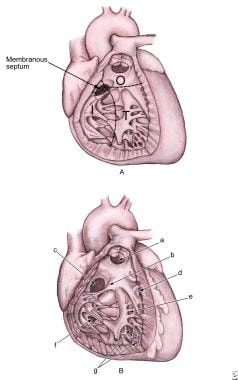
Media file 1:  A, Image shows a ventricular septum viewed from the right side. It has the following 4 components: inlet septum from the tricuspid annulus to the attachments of the tricuspid valve (I); trabecular septum from inlet to apex and up to the smooth-walled outlet (T); outlet septum, which extends to the pulmonary valve (O); and membranous septum. B, Anatomic positions of the defects are as follows: outlet defect (a); papillary muscle of the conus (b); perimembranous defect (c); marginal muscular defects (d); central muscular defects (e); inlet defect (f); and apical muscular defects (g).

Click to see larger pictureClick to see detailView Full Size Image
Media type:  Image

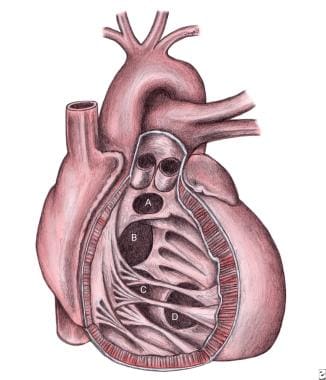
Media file 2:  Schematic representation of the location of various types of ventricular septal defects from the right ventricular aspect. A = Doubly committed subarterial VSD; B = perimembranous VSD; C = inlet or atrioventricular canal–type VSD; D = muscular VSD.
Click to see larger pictureClick to see detailView Full Size Image
Media type:  Image

Media file 3:  Supracristal ventricular septal defect. Top image, Parasternal long-axis view shows the defect just below the aortic root. Middle image, The plane of sound is tilted to view the right ventricular outflow tract, and the defect is observed below the pulmonic valve. Bottom image, Parasternal short-axis view shows the VSD between the aortic root (Ao) and the pulmonic valve (PV). LA = left atrium; LV = left ventricle; PA = pulmonary artery; RA = right atrium; RV = right ventricle.
Click to see larger pictureClick to see detailView Full Size Image
Media type:  CT

Media file 4:  Echocardiogram of a child with a perimembranous ventricular septal defect (VSD). Note the defect at the 10 o'clock position in the parasternal short-axis view. AO = aortic root; LA = left atrium; LV = left ventricle; PA = pulmonary artery; RA = right atrium; RV = right ventricle.
Click to see larger pictureClick to see detailView Full Size Image
Media type:  CT

Media file 5:  Apical 4-chamber views. A, Image shows a large inlet defect. The defect is posterior and at the level of the atrioventricular valves. B, Image shows a small midmuscular ventricular septal defect. LA = left atrium; LV = left ventricle; PA = pulmonary artery; RA = right atrium; RV = right ventricle.
Click to see larger pictureClick to see detailView Full Size Image
Media type:  CT


  • Ando M, Sakai A, Nakamura K, et al. Infective endocarditis affecting both systemic and pulmonary circulations predisposed by a ventricular septal defect. Jpn J Thorac Cardiovasc Surg. Jul 2000;48(7):451-4. [Medline].
  • Barratt-Boyes BG, Neutze JM, Clarkson PM, et al. Repair of ventricular septal defect in the first two years of life using profound hypothermia-circulatory arrest techniques. Ann Surg. Sep 1976;184(3):376-90. [Medline].
  • Barratt-Boyes BG, Simpson M, Neutze JM, et al. Intracardiac surgery in neonates and infants using deep hypothermia with surface cooling and limited cardiopulmonary bypass. Circulation. May 1971;43(5 Suppl):I25-30. [Medline].
  • Castaneda AR, Lamberti J, Sade RM, et al. Open-heart surgery during the first three months of life. J Thorac Cardiovasc Surg. Nov 1974;68(5):719-31. [Medline].
  • Clark EB. Etiology of congenital cardiovascular malformations: epidemiology and genetics. In: Allen HD, Clark EB, Gutgesell HP, Driscoll DJ, eds. Moss and Adams' Heart Disease in Infants, Children, and Adolescents, Including the Fetus and Young Adult. Vol 1. 6th ed. Philadelphia, Pa: Lippincott Williams & Wilkins;2000:64-76.
  • Cohle SD, Balraj E, Bell M. Sudden death due to ventricular septal defect. Pediatr Dev Pathol. Jul-Aug 1999;2(4):327-32. [Medline].
  • Corone P, Doyon F, Gaudeau S, et al. Natural history of ventricular septal defect. A study involving 790 cases. Circulation. Jun 1977;55(6):908-15. [Medline].
  • Flyer DC. Ventricular septal defect. In: Nadas' Pediatric Cardiology. Philadelphia, Pa:. Hanley & Belfus;1992:435-54.
  • Fu YC, Bass J, Amin Z, et al. Transcatheter closure of perimembranous ventricular septal defects using the new Amplatzer membranous VSD occluder: results of the U.S. phase I trial. J Am Coll Cardiol. Jan 17 2006;47(2):319-25. [Medline].
  • Gumbiner CH, Takao A. Ventricular septal defect. In: Bricker T, Fisher DJ, eds. The Science and Practice of Pediatric Cardiology. Vol 1. 2nd ed. Baltimore, Md:. Lippincott Williams & Wilkins;1997:1119-36.
  • Heath D, Edwards JE. The pathology of hypertensive pulmonary vascular disease; a description of six grades of structural changes in the pulmonary arteries with special reference to congenital cardiac septal defects. Circulation. Oct 1958;18(4 Part 1):533-47. [Medline].
  • Jacobs JP, Burke RP, Quintessenza JA, Mavroudis C. Congenital Heart Surgery Nomenclature and Database Project: ventricular septal defect. Ann Thorac Surg. Apr 2000;69(4 Suppl):S25-35. [Medline].
  • Johnson GL, Long WA. Diagnostic modalities: clinical examinations. In: Fetal and Neonatal Cardiology. Philadelphia, Pa:. WB Saunders;1989.
  • Kaplan S, Perloff JK. Exercise and athletics before and after cardiac surgery or interventional catheterization. In: Perloff JK, Child JS, eds. Congenital Heart Disease in Adults. 2nd ed. Philadelphia, Pa:. WB Saunders;1998:189-98.
  • Kidd L, Driscoll DJ, Gersony WM, et al. Second natural history study of congenital heart defects. Results of treatment of patients with ventricular septal defects. Circulation. Feb 1993;87(2 Suppl):I38-51. [Medline].
  • Kirklin JW, DuShane JW. Repair of ventricular septal defect in infancy. Pediatrics. 1961;27:961.
  • Lillehei CW, Cohen M, Warden HE. The results of direct vision closure of ventricular septal defects in eight patients by means of controlled cross circulation. Surg Gynecol Obstet. Oct 1955;101(4):446-66. [Medline].
  • Miyaji K, Hannan RL, Ojito J, et al. Video-assisted cardioscopy for intraventricular repair in congenital heart disease. Ann Thorac Surg. Sep 2000;70(3):730-7. [Medline].
  • Muller WH, Danimann JF. The treatment of certain congenital malformations of the heart by the creation of pulmonic stenosis to reduce pulmonary hypertension and excessive pulmonary blood flow; a preliminary report. Surg Gynecol Obstet. Aug 1952;95(2):213-9. [Medline].
  • Okamoto Y. [Clinical studies on open heart surgery in infants with profound hypothermia]. Nippon Geka Hokan. Jan 1 1969;38(1):188-207. [Medline].
  • Perloff JK, Koos B. Pregnancy and congenital heart disease: the mother and the fetus. In: Perloff JK, Child JS, eds. Congenital Heart Disease in Adults. 2nd ed. Philadelphia, Pa:. WB Saunders;1998:144-64.
  • Pongiglione G, Freedom RM, Cook D, Rowe RD. Mechanism of acquired right ventricular outflow tract obstruction in patients with ventricular septal defect: an angiocardiographic study. Am J Cardiol. Oct 1982;50(4):776-80. [Medline].
  • Roger H. Clinical researches on the congenital communication of the two sides of the heart by failure of occlusion of the interventricular septum. Bull de l' Acad de Med. 1879;8:1074.
  • Rubin JD, Ferencz C, Loffredo C. Use of prescription and non-prescription drugs in pregnancy. The Baltimore-Washington Infant Study Group. J Clin Epidemiol. Jun 1993;46(6):581-9. [Medline].
  • Smythe JF, Teixeira OH, Vlad P, et al. Initial evaluation of heart murmurs: are laboratory tests necessary?. Pediatrics. Oct 1990;86(4):497-500. [Medline].
  • Sparkes RS, Perloff JK. Genetics, epidemiology, counseling, and prevention. In: Perloff JK, Child JS, eds. Congenital Heart Disease in Adults. 2nd ed. Philadelphia, Pa:. WB Saunders Co;1998:165-85.
  • Van Praagh R, Geva T, Kreutzer J. Ventricular septal defects: how shall we describe, name and classify them?. J Am Coll Cardiol. Nov 1 1989;14(5):1298-9. [Medline].
  • Wolfe RR, Driscoll DJ, Gersony WM, et al. Arrhythmias in patients with valvar aortic stenosis, valvar pulmonary stenosis, and ventricular septal defect. Results of 24-hour ECG monitoring. Circulation. Feb 1993;87(2 Suppl):I89-101. [Medline].
  • Wood P. The Eisenmenger syndrome or pulmonary hypertension with reversed central shunt. Br Med J. Sep 27 1958;755-62. [Medline].
  • Wu MH, Wu JM, Chang CI, et al. Implication of aneurysmal transformation in isolated perimembranous ventricular septal defect. Am J Cardiol. Sep 1 1993;72(7):596-601. [Medline].
  • Wu MH, Wang JK, Lin MT, et al. Ventricular septal defect with secondary left ventricular-to-right atrial shunt is associated with a higher risk for infective endocarditis and a lower late chance of closure. Pediatrics. Feb 2006;117(2):e262-7. [Medline].
  • Yip WC, Zimmerman F, Hijazi ZM. Heart block and empirical therapy after transcatheter closure of perimembranous ventricular septal defect. Catheter Cardiovasc Interv. Nov 2005;66(3):436-41. [Medline].
  • Zielinsky P, Rossi M, Haertel JC, et al. Subaortic fibrous ridge and ventricular septal defect: role of septal malalignment. Circulation. Jun 1987;75(6):1124-9. [Medline].

Ventricular Septal Defect, General Concepts excerpt

Article Last Updated: Oct 18, 2006