Practice Essentials
Shigella organisms are a group of gram-negative, facultative intracellular pathogens. They were recognized as the etiologic agents of bacillary dysentery or shigellosis in the 1890s. Shigella were discovered over 100 years ago by a Japanese microbiologist named Shiga, for whom the genus is named. Shigella was adopted as a genus in the 1950s. These organisms are members of the family Enterobacteriaceae and tribe Escherichieae; they are grouped into 4 species: Shigelladysenteriae, Shigellaflexneri, Shigellaboydii, and Shigellasonnei, also known as groups A, B, C, and D, respectively. [1] They are nonmotile, non–spore forming, rod shaped, and nonencapsulated. Subgroups and serotypes are differentiated from each other by their biochemical characteristics (eg, ability to ferment D-mannitol) and antigenic properties. Group A has 15 serotypes, group B has 8 serotypes, group C has 19 serotypes, and group D has 1 serotype.
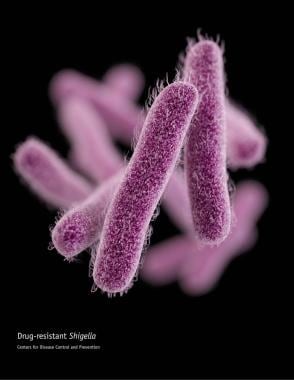 This illustration depicts a three-dimensional (3D), computer-generated image of a number of rod-shaped, drug-resistant, Shigella sp. bacteria. The artistic recreation was based upon scanning electron microscopic (SEM) imagery. Note that the exterior of the Shigella bacteria is fimbriated, covered by numerous thin, hair-like projections, imparting a furry appearance. Courtesy of the Centers for Disease Control (CDC)/James Archer.
Geographic distribution and antimicrobial susceptibility vary with different species. S dysenteriae serotype 1 causes deadly epidemics, S boydii is restricted to the Indian subcontinent, and S flexneri and S sonnei are prevalent in developing and developed countries, respectively. S flexneri, enteroinvasive gram-negative bacteria, is responsible for the worldwide endemic form of bacillary dysentery.
Signs and symptoms
Symptoms include the following:
-
Sudden onset of severe abdominal cramping, high-grade fever, emesis, anorexia, and large-volume watery diarrhea. Seizures may be an early manifestation.
-
Abdominal pain, tenesmus, urgency, fecal incontinence, and small-volume mucoid diarrhea with frank blood (fractional stools) may subsequently occur.
Signs include the following:
-
Elevated temperatures (as high as 106 º F) are documented in approximately one third of cases, and a generally toxic appearance is noticed.
-
Tachycardia and tachypnea may occur secondary to fever and dehydration. Depending on the degree of dehydration, dry mucous membranes, hypotension, prolonged capillary refill time, and poor skin turgor may be present.
-
Abdominal tenderness is usually central and lower, although it may be generalized.
See Presentation for more detail.
Diagnosis
The total white blood cell (WBC) count reveals no consistent findings. A shift to the left (increased number of band cells) in the differential WBC count in a patient with diarrhea suggests bacillary dysentery. Blood culture should be obtained in children who appear toxic, very young, severely ill, malnourished, or immunocompromised because of their increased risk of bacteremia.
Isolation of Shigella from feces or rectal swab specimen is diagnostic but lacks specificity. In approximately 70% of patients with shigellosis, fecal blood or leukocytes (confirming colitis) are detectable in the stool.
A sample for stool culture should be obtained in all suspected cases of shigellosis.
See Workup for more detail.
Management
The clinician should rapidly assess the patient's fluid and electrolyte status and institute parenteral or oral hydration along with antipyretics as needed. Prompt recognition and treatment of seizures and raised intracranial pressure are essential.
Various antimicrobial agents are effective in the treatment of shigellosis, although options are becoming limited because of globally emerging drug resistance.
See Treatment and Medication for more detail.

Pathophysiology
Shigella infection is a major public health problem in developing countries where sanitation is poor. Humans are the natural reservoir, although other primates may be infected. No natural food products harbor endogenous Shigella species, but a wide variety of foods may be contaminated.
Shigellosis is spread by means of fecal-oral transmission. Other modes of transmission include ingestion of contaminated food or water (untreated wading pools, interactive water fountain), contact with a contaminated inanimate object, and certain mode of sexual contact. Vectors like the housefly can spread the disease by physically transporting infected feces.
The infectivity dose (ID) is extremely low. As few as 10 S dysenteriae bacilli can cause clinical disease, whereas 100-200 bacilli are needed for S sonnei or S flexneri infection. The reasons for this low-dose response are not completely clear. One possible explanation is that virulent Shigellae can withstand the low pH of gastric juice. Most isolates of Shigella survive acidic treatment at pH 2.5 for at least 2 hours. [2]
The incubation period varies from 12 hours to 7 days but is typically 2-4 days; the incubation period is inversely proportional to the load of ingested bacteria. The disease is communicable as long as an infected person excretes the organism in the stool, which can extend as long as 4 weeks from the onset of illness. Bacterial shedding usually ceases within 4 weeks of the onset of illness; rarely, it can persist for months. Appropriate antimicrobial treatment can reduce the duration of carriage to a few days.
DNA-DNA hybridization studies demonstrate that E coli share more than 75% nucleotide similarity with Shigella species and Shigella species appears to be metabolically inactive biogroups of E coli. [3]
Virulence
Virulence in Shigella species involves both chromosomal-coded and plasmid-coded genes. Virulent Shigella strains produce disease after invading the intestinal mucosa; the organism only rarely penetrates beyond the mucosa. [4]
The characteristic virulence trait is encoded on a large (220 kb) plasmid responsible for synthesis of polypeptides that cause cytotoxicity. Shigellae that lose the virulence plasmid are no longer pathogenic. Escherichia coli (E coli O157:H7) that harbor this plasmid clinically behave as Shigella bacteria. [5]
Siderophores, a group of plasmid-coded genes, control the acquisition of iron from host cells from its protein-bound state. In the extra intestinal phase of infection by gram-negative bacteria, iron becomes one of the major factors that limit further growth. This limitation occurs because most of the iron in human body is sequestered in hemoproteins (i.e., hemoglobin, myoglobin) or iron-chelating proteins involved in iron transport (transferrin and lactoferrin). Many bacteria can secrete iron chelating compounds, or siderophores, which chelate iron from the intestinal fluids and which bacteria then take up to obtain iron for its metabolic needs. These siderophores are under the control of plasmids and are tightly regulated by genes such that, under low iron conditions, expression of the siderophore system is high.
Regulatory genes control expression of virulence genes. Shiga toxin (Stx) is not essential for virulence of S dysenteriae type 1 but contributes to the severity of dysentery. Both plasmid-encoded virulence traits and chromosome-encoded factors are essential for full virulence of shigellae.
Regarding chromosomally encoded enterotoxin, many pathogenic features of Shigella infection are due to the production of potent cytotoxins known as Stx, a potent protein synthesis–inhibiting exotoxin. Shigella strains produce distinct enterotoxins. These are a family of cytotoxins that contain 2 major immunologically non–cross-reactive groups called Stx1 and Stx2. The homology sequences between Stx1 and Stx2 are 55% and 57% in subunits A and B, respectively.
These toxins are lethal to animals; enterotoxic to ligated rabbit intestinal segments; and cytotoxic for vero, HeLa, and some selected endothelial cells (human renal vascular endothelial cells) manifesting as diarrhea, dysentery, and hemolytic-uremic syndrome (HUS). [6] Stx1 is synthesized in significant amount by S dysenteriae serotype 1 and S flexneri 2a and E coli (Shigella toxin–producing E coli [ShET]). [7]
Stx1 and Stx2 are both encoded by a bacteriophage inserted into the chromosome. Stx1 increases inflammatory cytokine production by human macrophages, which, in turn, leads to a burst of interleukin (IL)-8. This could be relevant in recruiting neutrophils to the lamina propria of the intestine in hemorrhagic colitis and accounts for elevated levels of IL-8 in serum of patients with diarrhea-associated HUS.
Stxs have 2 subunits. Stx is transported into nucleoli. Stx nucleolar movement is carrier-dependent and energy-dependent. Subunit A is a 32-kD polypeptide that, when digested by trypsin, generates A1 with a 28-kD fragment and another small fragment, A2, which is 4 kD. A1 fraction acts like N -glycosidase; it removes single adenine residue from 28S rRNA of ribosome and inhibits protein synthesis. The A2 fraction is a pentamer polypeptide of 7.7-kD protein and is required to bind the A1 fraction to the B subunit. The main function of the B subunit is the binding of toxins to the cell surface receptor, typically globotriaosylceramide (Gb3), on the brush border of intestinal epithelial cells. [8]
In summary, events that occur on exposure to Shigella toxin are as follows:
-
The B subunit of holotoxin binds to the Gb3 receptor on the cell surface of brush-border cells of the intestines.
-
The receptor-holotoxin complex is endocytosed.
-
The complex moves to Golgi apparatus and then to the endoplasmic reticulum.
The A1 subunit is released and it targets 28S RNA of the ribosome, inhibiting protein synthesis. Stxs may play a role in the progression of mucosal lesions after colonic cells are invaded, or they may induce vascular damage in the colonic mucosa. Stx adheres to small-intestine receptors and blocks the absorption of electrolytes, glucose, and amino acids from intestinal lumen. The B subunit of Stx binds the host's cell glycolipid in the large intestine and in other cells, such as renal glomerular and tubular epithelia. The A1 domain internalized by means of receptor-mediated endocytosis and causes irreversible inactivation of the 60S ribosomal subunit, inhibiting protein synthesis and causing cell death, microvascular damage to the intestine, apoptosis in renal tubular epithelial cells, and hemorrhage (as blood and mucus in the stool).
Chromosomal genes control lipopolysaccharide (LPS) antigens in cell walls. LPS plays an important role in resistance to nonspecific host defense encountered during tissue invasion. These genes help in invasion, multiplication, and resistance to phagocytosis by tissue macrophages. LPS enhances the cytotoxicity of Stx on human vascular endothelial cells. Shigella chromosomes share most of their genes with E coli K12 strain MG1655, and the diversity of putative virulence genes acquired by means of bacteriophage-mediated lateral gene transfer is extensive. As a result of convergent evolution involving the gain and loss of functions, Shigella species have become highly specific human pathogens with variable epidemiologic and pathologic features.
A 3-kb plasmid that harbors information for the production of bacteriocin by S flexneri strains has been described. The production of this bacteriocin may be related to dysenteric diarrhea these bacterial strains produce.
Intestinal adherence factor
Intestinal adherence factor favors colonization in vivo and in animal models. This is 97-kD outer-membrane protein (OMP) encoded by each gene on chromosomes. This codes for intimin protein, and an anti-intimin response is observed in children with HUS. [9]
Pathology
The host response to primary infection is characterized by the induction of an acute inflammation, which is accompanied by polymorphonuclear cell (PMN) infiltration, resulting in massive destruction of the colonic mucosa. Apoptotic destruction of macrophages in subepithelial tissue allows survival of the invading shigellae, and inflammation facilitates further bacterial entry.
Gross pathology consists of mucosal edema, erythema, friability, superficial ulceration, and focal mucosal hemorrhage involving the rectosigmoid junction primarily.
Microscopic pathology consists of epithelial cell necrosis, goblet cell depletion, PMN infiltrates and mononuclear infiltrates in lamina propria, and crypt abscess formation.
Shigella bacteria invade the intestinal epithelium through M cells and proceed to spread from cell to cell, causing death and sloughing of contiguously invaded epithelial cells and inducing a potent inflammatory response resulting in the characteristic dysentery syndrome. In addition to this series of pathogenic events, only S dysenteriae type 1 has the ability to elaborate the potent Shiga toxin that inhibits protein synthesis in eukaryotic cells and that may lead to extraintestinal complications, including hemolytic-uremic syndrome and death. Invasion of M cells, the specialized cells that cover the lymphoid follicles of the mucosa, overlying Peyer patches, may be the earliest event. [2]
Etiology
The primary mode of transmission of Shigella infection is fecal-oral contamination by the gram-negative aerobic bacilli.
Contaminated food usually looks and smells normal. Food may become contaminated by infected food handlers who forget to wash their hands with soap after using the bathroom. Vegetables can become contaminated if they are harvested from a field with sewage in it.
Outbreaks of shigellosis have also occurred among men who have sex with men.
Travellers from developed to developing regions and soldiers serving under field conditions are also at an increased risk to develop shigellosis.
Shigellosis can be caused by exposure to contaminated treated water and, more likely, from untreated recreational water.
Epidemiology
United States statistics
In 2013, the average annual incidence of shigellosis in the United States was 4.82 cases per 100,000 individuals. [10] State public health laboratories reported 7746 laboratory confirmed Shigella infections to the CDC in 2012. Of the 7,746 laboratory confirmed isolates, 6867 were identified to species level. Distribution by species was similar to previous years, with S sonnei accounting for the largest percentage of infections (75%), followed by S flexneri (12%), S boydii (0.8%), and S dysenteriae (0.3%).The reporting jurisdictions with the highest incidence rates were Nebraska (13.2 %), New Jersey (7.6%), and Minnesota (7.1%). [11] The highest incidence per 100,000 population for shigellosis (27.77 cases) was among children younger than 5 years.
The largest outbreak of shigellosis since 1988 took place in Michigan in 2016. [12]
The overall incidence of Shigella infection in 2012 was 2.5 cases per 100,000 population, and the rate of HUS in pediatric patients younger than 15 years is 0.49 cases per 100,000 population. Compared with the previous 10 years (2002–2011), a larger portion of Shigella infections in 2012 were reported from January through March. More than 95% of Shigella infections may be asymptomatic. Hence, the actual incidence may be 20 times higher than reported. The CDC estimates that 450,000 total cases of shigellosis occur in the United States every year. The latest major outbreak is reported from Illinois in February 2010 due to S sonnei.
International statistics
Worldwide, the incidence of shigellosis is estimated to be 164.7 million cases per year, of which 163.2 million were in developing countries, where 1.1 million deaths occurred. About 60% of all episodes and 61% of all deaths attributable to shigellosis involved children younger than 5 years. Shigella infection is the leading cause globally of moderate to severe diarrhea in children younger than 5 years. [13] The incidence in developing countries may be 20 times greater than that in developed countries. Although the relative importance of various serotypes is not known, an estimated 30% of these infections are caused by S dysenteriae.
Case-fatality rates for S dysenteriae infections may approach 30%. Patients with malnutrition are at increased risk of having complicated course. Shigella infection in malnourished children often causes a vicious cycle of further impaired nutrition, recurrent infection, and further growth retardation.
Race-, sex-, and age-related demographics
No racial predilection is known.
No sexual predilection is known.
According to recent CDC reports, Shigella infection accounted for 28% of all the enteric bacterial infections. [14] Children younger than 5 years had 7% of total reported cases, a rate indicating a disproportionate disease burden in this population.
Prognosis
Most patients recover even without treatment, although illness is more prolonged and more severe if not treated. The fever usually lessens within 24 hours. Frequency of stool decreases within 2-3 days.
The carrier state usually ceases within 4 weeks of onset of illness even without antimicrobial treatment, and chronic carrier state (>1 y) is rare.
The overall mortality rate in developed countries is less than 1%. In the Far East and Middle East, the mortality rates for infections of S dysenteriae may be as high as 20-25%.
Severely malnourished children with shigellosis and hypoglycemia, hypothermia, altered consciousness, and/or bronchopneumonia are at high risk of dying.
Morbidity/mortality
Although shigellosis-related mortality is rare in developed countries, S dysenteriae infection is associated with substantial morbidity and mortality rates in the developing world.
Case fatality is as high as 15% among patients with S dysenteriae type 1 who require hospitalization; this rate is increased by delayed arrival and treatment with ineffective antibiotics. Infants, non-breastfed children, children recovering from measles, malnourished children, and adults older than 50 years have a more severe illness and a greater risk of death
The overall mortality rate in developed countries is less than 1%.
In the Far East and Middle East, the mortality rates for S dysenteriae infections may be as high as 20-25%.
Complications
Dehydration is the most common complication of shigellosis. Other reported complications include the following:
-
CNS complications
Seizures were previously thought to be caused by the elaboration of Stx. The etiology is presently uncertain. [15]
Syndrome of inappropriate secretion of antidiuretic hormone with profound hyponatremia may occur.
Lethargy, meningismus, delirium, seizures, and hypoglycemia may be observed.
Encephalopathy and meningitis are rare and may be lethal.
-
Septicemia and DIC, particularly in malnourished children
-
Arthritis
Postinfectious arthritis is a late complication of S flexneri infection, especially in persons with HLA-B27 marker.
Arthritis, conjunctivitis, urethritis syndrome is most common in adults with HLA-B27 marker (occurs 2-5 wk after enteritis).
-
GI complications
Cholestatic hepatitis
Rectal prolapse
Toxic megacolon
Pseudomembranous colitis
-
Other manifestations
Conjunctivitis, iritis, corneal ulcers, cystitis, myocarditis, and vaginitis are uncommon.
Ekiri syndrome is a rare syndrome that consists of extreme toxicity, seizures, hyperpyrexia, and headache; it can be rapidly fatal due to brain edema. [15]
-
This illustration depicts a three-dimensional (3D), computer-generated image of a number of rod-shaped, drug-resistant, Shigella sp. bacteria. The artistic recreation was based upon scanning electron microscopic (SEM) imagery. Note that the exterior of the Shigella bacteria is fimbriated, covered by numerous thin, hair-like projections, imparting a furry appearance. Courtesy of the Centers for Disease Control (CDC)/James Archer.