Practice Essentials
Sever disease (calcaneal apophysitis), first described in 1912, is a painful inflammation of the calcaneal apophysis. [1] It is classified with the child and adolescent nonarticular osteochondroses. [2, 3] (The other disease in this group is Iselin disease, which is inflammation of the base of the fifth metatarsal.)
The etiology of pain in Sever disease is believed to be repetitive trauma to the weaker structure of the apophysis, induced by the pull of the tendo calcaneus (Achilles tendon) on its insertion. This results in a clinical picture of heel pain in a growing active child, which worsens with activity. [4, 5, 6, 7, 8, 9, 10, 11]
Sever disease is a self-limited condition; accordingly, no known long-term sequelae arise from failure to make the correct diagnosis. However, the pain that the child experiences not only can limit performance and participation in sports and other activities but also, if left untreated, can limit even simple activities of daily life. The physician's role in management is to minimize pain and facilitate the patient's return to normal activities as soon as possible. The physician also must be able to differentiate Sever disease from other causes of heel pain that are potentially more serious (see Treatment).

Pathophysiology
The calcaneal apophysis develops as an independent center of ossification (possibly multiple). It appears in boys aged 9-10 years and fuses by age 17 years; it appears in girls at slightly younger ages. During the rapid growth surrounding puberty, the apophyseal line appears to be weakened further because of increased fragile calcified cartilage.
Microfractures are believed to occur because of shear stress leading to the normal progression of fracture healing. This theory explains the clinical picture and the radiographic appearance of resorption, fragmentation, and increased sclerosis leading to eventual union. The radiographs showing fragmentation of the apophysis are not diagnostic, because multiple centers of ossification may exist in the normal apophysis, as noted. However, the degree of involvement in children displaying the clinical symptoms of Sever disease appears to be more pronounced.
Etiology
Sever disease, like other similar conditions (eg, Osgood-Schlatter disease, little-leaguer's elbow, and iliac apophysitis), is believed to be caused by decreased resistance to shear stress at the bone–growth plate interface. Studies have indicated that traction apophyses have a higher composition of fibrocartilage than epiphyses subjected more to axial load, which are composed predominantly of hyaline cartilage. [12]
The anatomy of the calcaneal apophysis lends to significant shear stress because of its vertical orientation and the direction of pull from the strong gastrocnemius-soleus muscle group (see the image below).
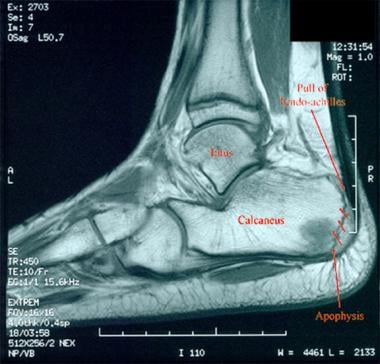 Labeled MRI depicts the anatomy and mechanical forces responsible for the development of Sever disease (shear stress at the calcaneal apophysis).
In a study of 56 male students from a soccer academy, of whom 28 had Sever disease and 28 were healthy control subjects, findings suggested that higher heel plantar pressures under dynamic and static conditions were associated with Sever disease, though it was not established whether the elevated pressures predisposed to or resulted from the disease. [13] Gastrocnemius ankle equinus also appeared to be a predisposing factor. [14]
Martinelli et al, in a study of 430 athletic children (soccer, 29.5%; basketball, 48.1%; volleyball, 22.3%) whose ages ranged from 6 to 14 years, found that the risk of calcaneal apophysitis was significantly higher in younger individuals, in those who had fewer training sessions over the course of a week, and in those whose training sessions were shorter. [15]
Epidemiology
Sever disease is a relatively common problem in growing active children, though little in the way of exact incidence figures has been available. Wiegerinck et al, in a 2014 cross-sectional study described as the first report on the incidence of calcaneal apophysitis in the general population, examined the records of children aged 6-17 years who visited 34 general practices in the years 2008, 2009, and 2010. [16] A total of 16,383 files were searched, and 61 children with this condition were diagnosed, for an incidence of 3.7 per 1000.
Sever disease occurs most frequently in active 10- to 12-year-old boys. In a report by Micheli and Ireland that included 85 patients, the average age of presentation was 11 years 10 months for boys and 8 years 8 months for girls [17] ; 64% of the 85 patients were male. In a study by Duong et al, the average age was 10.4 ± 1.9 years for boys and 9.2 ± 2.2 years for girls. [18]
Prognosis
Although no well-recognized, long-term sequelae of untreated Sever disease exist, this condition causes pain that can limit performance and participation in sports and, if left untreated, can significantly limit even simple activities of daily life.
In a retrospective 10-year study of calcaneal apophysitis in adolescent athletes from a German youth soccer academy (N = 22; mean age, 11.8 ± 2.1 y), Belikan et al found that the mean time to return to play was 60.7 ± 64.9 days. [19] Recovery time and time to return to play were longer in patients with recurrent complaints. Neither age nor body mass index at diagnosis could be shown to have an impact on time to return to play.
-
Sever disease. Lateral radiograph of foot in symptomatic 9-year-old male soccer player. Sclerosis is not diagnostic of Sever disease but is a characteristic radiographic finding.
-
Transverse MRI of foot in symptomatic 11-year-old girl with heel pain showing osteomyelitis. Pain was increased with activity but more constant and with more associated night pain than expected with Sever disease. Treatment included surgical debridement and antibiotic therapy.
-
Labeled MRI depicts the anatomy and mechanical forces responsible for the development of Sever disease (shear stress at the calcaneal apophysis).