Continually Updated Clinical Reference
 
 
  All Sources     eMedicine     Medscape     Drug Reference     MEDLINE
 
eMedicine - Mallet Toe : Article by

Quick Find
Authors & Editors
Introduction
Indications
RELEVANT ANATOMY
Contraindications
Workup
Treatment
Complications
Outcome And Prognosis
Future And Controversies
Multimedia
References


Patient Education
Click here for patient education.


Author: Christopher Brown, MBBS, FRCS(C), FRACS, FAOrthA, Clinical Lecturer, Department of Orthopaedics and Trauma, University of Adelaide, Australia

Christopher Brown is a member of the following medical societies: American Academy of Orthopaedic Surgeons and American Orthopaedic Foot and Ankle Society

Coauthor(s): Nancy Cullen, MD, FRCSC, FRACS, Senior Visiting Medical Officer, Clinical Lecturer, Department of Orthopaedics and Trauma, University of Adelaide, Australia; Linda Ferris, MBBS, BScMed, Chairman, Department of Orthopaedics, Modbury Public Hospital; Clinical Lecturer, Department of Orthopaedics and Trauma, University of Adelaide, Australia

Editors: Heidi M Stephens, MD, Associate Professor, Department of Surgery, Division of Orthopedic Surgery, Director of Diabetic Foot Clinic, Assistant Dean for Clinical Outreach, University of South Florida College of Medicine; Courtesy Joint Associate Professor, Department of Environmental and Occupational Health, University of South Florida College of Public Health; Francisco Talavera, PharmD, PhD, Senior Pharmacy Editor, eMedicine; N Ake Nystrom, MD, PhD, Associate Professor of Orthopedic Surgery and Plastic Surgery, University of Nebraska Medical Center; Dinesh Patel, MD, FACS, Associate Clinical Professor of Orthopedic Surgery, Harvard Medical School; Chief of Arthroscopic Surgery, Department of Orthopedic Surgery, Massachusetts General Hospital; Jason H Calhoun, MD, FAAOS, Chairman, J Vernon Luck Distinguished Professor, Department of Orthopedic Surgery, University of Missouri

Author and Editor Disclosure

Synonyms and related keywords: toe pain, toe callus, mallet toe deformity, hammertoe deformity, toe deformity

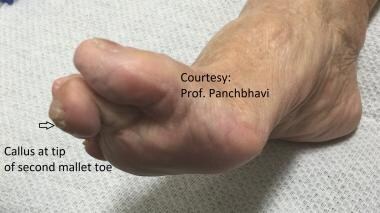
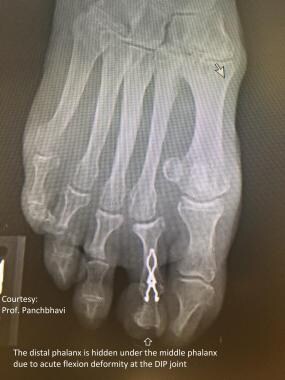
A mallet toe is a fixed or flexible deformity of the distal interphalangeal (DIP) joint of the toe.

Problem

Pain or callosity may be the presenting complaints when the DIP joint of the toe has abnormal flexion, either fixed or flexible.

Frequency

In the United States, mallet toe deformity is much less common than is hammertoe deformity, with a 1:9 ratio. It occurs most often in the longest toe (75%), but can occur in the second, third, or fourth toe. Twelve percent of cases may have associated lateral or medial deviation.

International incidence of mallet toe is unknown.

Etiology

Mallet toe of a long toe is usually idiopathic. Inappropriate shoe wear, iatrogenic causes (eg, following proximal interphalangeal [PIP] joint fusion), congenital abnormalities, trauma, neuromuscular disorders, and pes cavus can lead to the deformity.

Pathophysiology

The principle pathophysiology is flexion of the DIP joint with pressure on the tip of the toe, often with associated attenuation of the extensor tendon. This may lead to callosities or nail deformity on the tip of the toe. The deformity may be flexible, where the principal problem is an overtight flexor digitorum longus. However, it is not associated with contracture of the joint capsule or with fixed deformities where the plantar joint structures are contracted or alteration of the joint surfaces restricting joint range of motion has occurred.

Clinical

Presentation is usually with pain, either from callosity or pressure on the nail. Occasionally, a cosmetic deformity is noticed, often by anxious parents or family, without symptomatology. Obtain a thorough history, noting any family history or history of trauma, prior surgery, or associated infections. Note the severity of presenting symptoms. Note the presence of generalized conditions, such as diabetes, vascular disease, neuropathy, or arthropathic disease.

Examination should reveal the overall foot alignment, presence of palpable pedal pulses, signs of other foot deformities, and prior surgery. Specifically with respect to the toe, assess the metatarsophalangeal (MTP) joint, the PIP joint, and the location of callosities and nail deformity. Assess the flexibility of the DIP joint with the toe plantarflexed and dorsiflexed at the MTP joint and PIP joint.


The usual indication for surgery is the presence of painful deformity. Occasionally, cosmesis may be raised as a presenting complaint.


The DIP joint is a hinge joint with collateral and accessory collateral ligaments and a plantar plate. The flexor sheath extends to the DIP joint.


Contraindications to surgery include vascular compromise, active infection, lack of symptoms, and significant psychiatric disorders. Patients also should have had a trial of simple nonoperative treatment prior to considering surgery.


Lab Studies

  • Obtain routine preoperative hematology.
  • In addition, undertake investigation for intercurrent medical problems (eg, diabetes) prior to surgery.
  • Patients on methotrexate or similar medications may need hematological monitoring prior to surgery.
  • General preoperative studies such as urinalysis may be needed depending on the patient's medical condition.

Imaging Studies

  • Obtain weightbearing radiographs to assess the whole foot.
  • Occasionally, specific films of the DIP joint may be obtained. Dental plates can be useful for these small images.
  • If underlying neurological pathology is suspected, films appropriate for this workup may be needed, such as CT scan of the spine or MRI.
  • Infection may be an indication for technetium or gallium bone scans.
  • Preoperative chest films may be needed depending on the patient's medical condition.

Other Tests

  • Preoperative electrocardiogram (ECG) may be needed depending on the patient's general medical condition.


Medical therapy

Nonoperative treatment focuses on pressure relief under the tip of the toe. This can be accomplished with extra depth toe box footwear. Soft orthoses or toe protectors are useful.

Surgical therapy

Surgical therapy includes flexor tenotomy, possibly including plantar capsular release and pinning; condylectomy and fusion of the middle to distal phalanx; and, occasionally, partial or complete amputation of the distal phalanx.

A flexible mallet toe is best treated with the flexor tenotomy. A fixed deformity requires a condylectomy. An ulcerated or infected toe would do best with a terminal Syme amputation.

Preoperative details

Surgery can be performed under local or regional block, and in appropriate patients, it can be performed on an outpatient or day surgery basis.

Intraoperative details

Local anesthesia and tourniquet control are used.

Tenotomy is performed by making a small lateral or medial incision over the distal end of the middle phalanx. The author prefers to visualize the tendon sheath directly by retracting the skin with double skin hooks or a Ragnell. The sheath is incised longitudinally, and the tendon is hooked with a small arthroscopic probe. The tendon then can be divided under direct vision. If some residual contracture is present, the plantar capsule can be stripped of the phalanx with a freer dissector. A 1.1 Kirschner wire (K-wire) can be used to immobilize the joint in the neutral position. One skin stitch or Steri-Strip is used to close.

DIP joint fusion is carried out by excising a small ellipse over the dorsal aspect of the joint, including the extensor. The bone ends are excised, and pinning is carried out. The skin and extensor are closed in one layer.

Amputation is usually performed as a terminal Syme procedure. The nail bed and the terminal half of the phalanx are excised.

Postoperative details

Routine dressings are applied. Sutures are removed at 10-14 days. Pins are usually removed at 4 weeks.

Follow-up

The patient can mobilize weightbearing in a postoperative shoe. Elevating the limb for the first 5-7 days reduces postoperative swelling.


Recurrence is possible, especially if associated joint lesions at the MTP joint (eg, hyperextension) are not appreciated. Failure to completely divide the flexor can also cause recurrence. Flail toe, if excessive resection has occurred, is occasionally a problem with shoes or stockings, but it is seldom painful. Neurovascular problems, including numbness, neuromata, and dysvascularity, can also occur. Prolonged swelling is often noted, and patients should be warned beforehand that this may occur. Residual nail deformity is also common. Hyperextension deformity of the DIP joint and flexion deformity of the PIP joint can also occur.


Most series found excellent results in 85-97% of cases. Tenotomy seemed to increase satisfaction rates in some series. Bony union of the DIP joint where resection was carried out had higher satisfaction rates than did fibrous union.


Treatment of this condition is relatively straightforward. Some controversy exists over the need for flexor tenotomy when DIP joint fusion is attempted and whether this leads to a higher incidence of hyperextension deformity and PIP joint flexion at the adjacent PIP joint.


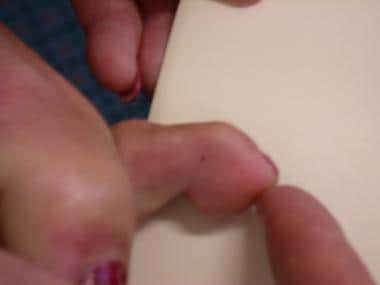
Media file 1:  Classic Mallet toe. Note the flexion when the toe is dorsiflexed.
Click to see larger pictureClick to see detailView Full Size Image
Media type:  Photo


  • Cooper PS. Disorders and Deformities of the Lesser Toes. In: Myerson MS, ed. Foot and Ankle Disorders. Philadelphia, Pa: WB Saunders; 2000:321-322.
  • Coughlin MJ. Operative repair of the mallet toe deformity. Foot Ankle Int. Mar 1995;16(3):109-16. [Medline].
  • Coughlin MJ. Mallet toes, hammer toes, claw toes, and corns. Causes and treatment of lesser-toe deformities. Postgrad Med. Apr 1984;75(5):191-8. [Medline].

Mallet Toe excerpt

Article Last Updated: Dec 15, 2005