Practice Essentials
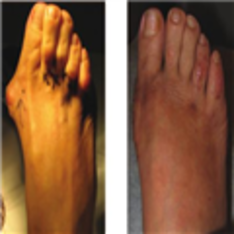
A bunionette is defined as a painful prominence on the lateral aspect of the fifth metatarsal (MT) head. Although it is not as common as a medial bunion, it is a cause of chronic pain and shoe-fitting problems in individuals whose feet are characterized by a widened forefoot or in those who have a lateral splaying or prominence over the fifth MT. [1, 2, 3] The term tailor's bunion is sometimes used as a synonym for bunionette; these lesions often were present on tailors, whose traditional cross-legged sitting posture on benches resulted in pressure being placed on the lateral side of the foot, leading to the development of painful bunionettes.
Treatment often can be nonoperative. [4] Surgery for a bunionette is performed when symptoms of an unacceptable degree are not relieved by conservative treatments, such as shaving the callus or wearing wider shoes, silicon pads, softer shoe coverings, or sandals. Surgical procedures are determined by the pathoanatomy. (See Treatment.) No single universally acceptable procedure exists for all patients; however, the scarf osteotomy appears to be a versatile and effective option, [5] and percutaneous approaches have yielded good results. [6]

Pathophysiology
The pathoanatomy of the bunionette varies with different types of lesions. Usually, there is a component of prominence of the lateral aspect of the fifth metatarsophalangeal (MTP) joint. Stretching and attenuation of the capsule may occur with medial subluxation of the proximal phalanx. Both long flexors and extensors can be medial to the head, leading to a deforming force on the toe that increases with increasing deformity. Rotation of the phalanx also can occur.
Pathologic lesions include the following:
-
Inflamed bursa overlying the lateral aspect of the MT head
-
Bony enlargement of the head itself
-
Increased intermetatarsal angle (IMA) between the fourth and fifth MTs with secondary medial angulation of the phalanx and abnormal curvature of the fifth MT
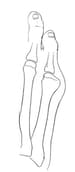
The normal fourth-fifth IMA (4-5 IMA) is approximately 6.2°, and the normal fifth-MTP angle is about 10°. Pathologic values are in the range of 10° for the 4-5 IMA and 16° for the fifth-MTP angle. Lesions may be conveniently divided into three types (see Imaging Studies).
Etiology
Causes of bunionette can be extrinsic or intrinsic. [7] Extrinsic causes can be traumatic, either acute or (more commonly) chronic (eg, tailors' working posture, footwear). Intrinsic causes can be related to structural abnormalities, such as congenital lateral bowing of the MT shaft, abnormal intermetatarsal ligament insertion with prominence of the fifth MT, brachymetatarsia, or primary hypertrophy of the MT head. Congenital splayfoot is a more generalized congenital predisposing lesion.
Iatrogenic causes can involve failed adjacent MT surgery or residual malalignments from hindfoot surgery, which cause increased prominence of the fifth MT. Inflammatory arthropathies also can cause bunionette deformities or soft-tissue lesions in association with bony problems.
Epidemiology
United States statistics
In Western society, the occurrence of bunionettes is generally related to narrow footwear on predisposed foot anatomy. The actual incidence is not accurately known, but it is far less of an isolated presenting problem than hallux valgus. However, it is commonly seen in patients who present with hallux valgus secondary to splaying of the forefoot. It may or may not be symptomatic at the same time. Females represent up to 90% of symptomatic patients in some series.
International statistics
Few reports exist in the literature on the incidence in non-Western countries. This is probably a result of less wearing of constricting shoes and, hence, a lower occurrence rate.
Prognosis
Relief of pain and imporved alignment usually can be obtained with surgical treatment. When cosmesis is the only reason for surgery, satisfaction is not as likely, because minor symptoms may persist for some months following surgery. Continuing progression of underlying arthropathic disease also may lead to recurrence and unsatisfactory results.
Necas et al evaluated the midterm clinical and radiologic outcomes of "shortening" scarf osteotomy of the fifth MT in 27 patients (34 feet) with bunionette deformity. [8] The average American Orthopaedic Foot and Ankle Society (AOFAS) score improved from 59.4 to 93 (mean follow-up, 7.2 y). The 4-5 IMA and the varus angle of the fifth MTP joint decreased from 13.9° and 19.5° preoperatively to 6° and 5.9° at final follow-up. No neurovascular damage was recorded. Complications arose in five feet. The osteotomy healed in less than 3 months, except for two cases. Three feet needed additional surgery.
In a study that evaluated the outcomes of percutaneous distal MT metaphyseal osteotomy (DMMO) without fixation or postoperative strapping in patients with symptomatic bunionette deformity (N = 111; 132 feet; mean follow-up, 24.1 mo [range, 14-39]), Al Ramlawi et al found that the mean visual analogue scale (VAS) improved from 7.6 preoperatively to 0.6 at final follow-up and that the Foot Function Index (FFI) score decreased from 19.2 to 4.4. [6] Patient satisfaction was high (108/111). Average time to bone union after the procedure was 12.6 weeks (range, 12-25). The complication rate was low (1.5%).
-
Type 1 bunionette. Note enlarged head without marked angulation.
-
Type 2 bunionette. Note abnormal bowing of metatarsal and secondary angulation of metatarsophalangeal joint.
-
Type 3 bunionette. Note increased angle between fourth and fifth metatarsals. Angulation at metatarsophalangeal joint is secondary to medial pressure on phalanx.