| Patient Education |
|
Click here for patient education.
|
|
You are in: eMedicine Specialties >
Orthopedic Surgery > NEOPLASMS
Aneurysmal Bone Cyst
Article Last Updated: May 2, 2008
AUTHOR AND EDITOR INFORMATION
Section 1 of 13
Author: Bart Eastwood, DO, Orthopedic Surgeon, Avera St Anthony's Hospital
Bart Eastwood is a member of the following medical societies: American Academy of Orthopaedic Surgeons, American Osteopathic Academy of Orthopedics, and American Osteopathic Association
Coauthor(s):
Mark McFarland, DO, Staff Physician, Department of Orthopedics, Doctors Hospital of Stark County
Editors: Howard A Chansky, MD, Associate Professor, Department of Orthopedics and Sports Medicine, University of Washington Medical Center; Francisco Talavera, PharmD, PhD, Senior Pharmacy Editor, eMedicine; Sean P Scully, MD, PhD, Professor, Department of Orthopedics, University of Miami; Dinesh Patel, MD, FACS, Associate Clinical Professor of Orthopedic Surgery, Harvard Medical School; Chief of Arthroscopic Surgery, Department of Orthopedic Surgery, Massachusetts General Hospital; Harris Gellman, MD, Consulting Surgeon, Broward Hand Center, Voluntary Clinical Professor of Orthopedic Surgery and Plastic Surgery, Departments of Orthopedic Surgery and Surgery, University of Miami School of Medicine
Author and Editor Disclosure
Synonyms and related keywords:
ABC, cystic lesion, primary aneurysmal bone cyst, primary ABC, secondary aneurysmal bone cyst, secondary ABC, giant cell tumor, telangiectatic osteosarcoma
The aneurysmal bone cyst (ABC) is an expansile cystic lesion that most often affects individuals during their second decade of life and may occur in any bone in the body.1, 2, 3, 4, 5, 6, 7, 8 Although benign, the ABC can be locally aggressive and can cause extensive weakening of the bony structure and impinge on the surrounding tissues. The true etiology and pathophysiology remain a mystery, but the mainstay of treatment has been intralesional curettage.9 Recurrence is not uncommon.1, 10 Other surgical options include en bloc resection or wide excision, selective arterial embolization, and curettage with locally applied adjuvants such as liquid nitrogen or phenol.
Related eMedicine topics: Giant Cell Tumor Osteosarcoma
Related Medscape topics: Resource Center Osteoporosis Specialty Site Hematology-Oncology Specialty Site Orthopaedics CME Burgeoning Applications for PET-CT in Oncology CME Musculoskeletal Syndromes Associated With Malignancy (Excluding Hypertrophic Osteoarthropathy) CME Shared Care May Be Feasible for Adult Survivors of Childhood Cancers
History of the Procedure
Jaffe and Lichtenstein first described ABC as its own entity in 1942, when they noted "a peculiar blood-containing cyst of large size."11 Two cases were reported in which a lesion with a "soap-bubble" appearance on radiographs was found on the superior pubic ramus of a 17-year-old male and on the second vertebrae of an 18-year-old male. The lesions were expansile and showed evidence of erosion of the surrounding bone and encroachment of the surrounding tissues. Upon surgical exposure of the lesions, a thin, bony wall that contained bloody fluid was found. Jaffe and Lichtenstein suggested that ABCs may have been mistaken for other benign and malignant bone tumors in the past.11 Although ABC is a separate entity, in some situations, distinguishing ABC from a giant cell tumor or telangiectatic osteosarcoma is difficult.
Problem
As defined by the World Health Organization, the ABC is a benign tumorlike lesion.4 It is described as "an expanding osteolytic lesion consisting of blood-filled spaces of variable size separated by connective tissue septa containing trabeculae or osteoid tissue and osteoclast giant cells."4 Although benign, the ABC can be a rapidly growing and destructive bone lesion. The expansile nature of the lesions can cause pain, swelling, deformity, disruption of growth plates, neurologic symptoms (depending on its location), and pathologic fracture.1, 2, 3
Frequency
ABCs are generally considered rare, accounting for only 1-6% of all primary bony tumors. A group from Austria reported an annual incidence of 0.14 ABCs per 100,000 people12; however, the true incidence is difficult to calculate because of the existence of spontaneous regression and clinically silent cases.
A biopsy-proven incidence study from the Netherlands showed that ABCs were the second most common tumor or tumorlike lesion found in children.13 Most studies have also found a slightly increased incidence in women. Although the ABC can appear in persons of any age, it is generally a disease of the young (but rare in the very young). About 50-70% of ABCs occur in the second decade of life, with 70-86% occurring in patients younger than 20 years. The mean patient age at onset is 13-17.7 years.
Etiology
The true etiology of ABCs is unknown. Most investigators believe that ABCs are the result of a vascular malformation within the bone; however, the ultimate cause of the malformation is a topic of controversy. Three commonly proposed theories are as follows: - ABCs may be caused by a reaction secondary to another bony lesion. This theory has been proposed because of the high incidence of accompanying tumors in 23-32% of ABCs. Giant cell tumors are most commonly present. However, many other benign and malignant tumors are found, including fibrous dysplasia, osteoblastoma, chondromyxoid fibroma, nonossifying fibroma, chondroblastoma, osteosarcoma, chondrosarcoma, unicameral or solitary bone cyst, hemangioendothelioma, and metastatic carcinoma. ABCs in the presence of another lesion are called secondary ABCs. Treatment of the secondary ABC is based on that which is appropriate for the underlying tumor.
- ABCs may arise de novo; those that arise without evidence of another lesion are classified as primary ABCs.
- ABCs may arise in an area of previous trauma.
Related Medscape topics: Specialty Site Hematology-Oncology Specialty Site Orthopaedics
Pathophysiology
The true pathophysiology of ABCs is also unknown.9 Different theories about several vascular malformations exist; these include arteriovenous fistulas and venous blockage. The vascular lesions then cause increased pressure, expansion, erosion, and resorption of the surrounding bone. The malformation is also believed to cause local hemorrhage that initiates the formation of reactive osteolytic tissue. Findings from a study in which manometric pressures within the ABCs were measured support the theory of altered hemodynamics.
Clinical
Patients usually present with pain, a mass, swelling, a pathologic fracture, or a combination of these symptoms in the affected area. The symptoms are usually present for several weeks to months before the diagnosis is made, and the patient may also have a history of a rapidly enlarging mass. Neurologic symptoms associated with ABCs may develop secondary to pressure or tenting of the nerve over the lesion, typically in the spine. Pathologic fracture occurs in about 8% of ABCs, but the occurrence rate may be as high as 21% in ABCs that have spinal involvement. Other findings may include the following:
- Deformity
- Decreased range of motion, weakness, or stiffness
- Reactive torticollis
- Occasionally, bruit over the affected area
- Warmth over the affected area
ABCs are generally treated with surgery. Rarely, asymptomatic ABCs may be seen in which there is clinically insignificant destruction of bone. In such cases, close monitoring alone of the lesion may be indicated because of the evidence that some ABCs spontaneously resolve. When a patient is monitored in this manner, the diagnosis must be certain, and the lesion should not be increasing in size. Some anatomic locations may be difficult to access surgically. If this situation is encountered, other methods of treatment, such as intralesional injection and selective arterial occlusion, may be successful. Impending pathologic fracture, especially a fracture of the hip, is a challenging problem and an indication for intervention, which often includes curettage, adjuvant treatment, and internal fixation.
ABCs may affect any bone in the body; thus, the relevant surgical anatomy varies with location. ABCs most commonly affect the long, tubular bones, followed by the spine and flat bones. These 3 areas account for 80% of all ABCs. When present in long, tubular bones, ABCs tend to be eccentrically located in the metaphysis. ABCs least commonly involve a subperiosteal location, where they may form a predominant soft-tissue mass. However, ABCs can occur in any location, including the diaphysis and epiphysis. Rarely, ABCs have also been known to affect an adjacent bone; however, spinal ABCs are associated with a higher incidence of contiguous lesions. Almost all ABCs of the spine involve the posterior elements, and a high incidence of neurologic symptoms is observed, as well as more local aggressive behavior. The pelvis accounts for approximately 50% of lesions occurring in the flat bones.14 Secondary lesions tend to have a predilection for the areas of the body in which the primary lesion typically arises. In a published review of 897 cases of ABC, the following rates of occurrence were reported15:
- Tibia – 17.5%
- Femur – 15.9%
- Vertebra – 11.2%
- Pelvis – 11.6%
- Humerus – 9.1%
- Fibula – 7.3%
- Foot – 6.3%
- Hand – 4.7%
- Ulna – 3.8%
- Radius – 3.1%
- Other – 9.2%
- Contraindications to selective arterial embolization include the following:
- Uncertain diagnosis; need to perform an open biopsy
- Structural instability; pathologic or impending fracture
- Neurologic symptoms
- Mechanical disruption
- Unsafe location to embolize with angiography or anatomically (eg, segmental arteries, certain cervical and thoracic areas that may lead to spinal cord ischemia)
- Contraindications to intralesional injection are as follows:
- Uncertain diagnosis; need to obtain an open biopsy
- Structural instability; pathologic or impending fracture
- Neurologic symptoms
- Mechanical disruption
- Allergy to injected substance
- Unbearable symptoms; lengthy time to resolution
- Contraindications to radiotherapy include the following:
- Radiotherapy has been used in the past, but this treatment is generally contraindicated because of the risk of sarcoma induction, gonadal damage, and growth-plate disruption.
- Much risk is associated with treating a benign lesion with a therapy that can have damaging adverse effects, although radiation therapy is still occasionally used at low doses to treat surgically inaccessible lesions.
- Local resection
- The region must be expendable and not affect function (eg, spinous process or fibula).
- Some investigators believe that elective arterial embolization should be tried first if it is not contraindicated.
- En bloc excision – Deep lesion
- Resection destabilizes the area. Some surgeons use more than one third of the bone width.
- Loss of function (eg, joint loss) is possible.
- Some investigators believe that elective arterial embolization should be tried first if it is not contraindicated.
- Intralesional removal
- The area may be surgically inaccessible.
- Some investigators believe that elective arterial embolization should be tried first if it is not contraindicated.
- Adjuvant intralesional therapy
- Substances such as liquid nitrogen and phenol could penetrate tissues and damage the surrounding structures. The neural and vascular tissues are at high risk.
- For this reason, some investigators discourage the use of intralesional therapy in the spine.
- Caution should be used in areas prone to fracture; liquid nitrogen can make the surrounding bone stock more brittle and, thus, increase the likelihood of fracture.
Lab Studies
- Alkaline phosphatase levels may be increased, but laboratory studies are generally of no benefit.
Imaging Studies
Diagnostic Procedures
- Some investigators believe that pathognomonic findings on radiographs, CT scans, and MRIs may be used to confirm a diagnosis of ABC. However, if any doubt exists, an open biopsy must be performed because of the high frequency of accompanying tumors. Other authors believe that a histologic diagnosis based on an open biopsy should be routinely determined because it is necessary to confirm the diagnosis of ABC and to ensure that another lesion (eg, a malignancy) does not coexist with the ABC. When biopsy is performed, the sample should include material from the entire lesion; a limited biopsy could easily cause a coexisting lesion to be missed, leaving the patient with a morbid prognosis.
- As with all orthopedic-oncology–related diseases, biopsy is part of the treatment, not the workup. The surgeon performing the biopsy must be able to handle the definitive care for either a benign or malignant diagnosis. A well thought-out referral is preferred to a poorly planned biopsy.
Histologic Findings
The gross appearance of the ABC is that of a blood-soaked sponge. A thin subperiosteal shell of new bone surrounds the structure and contains cystic blood-filled cavities. The tissue within shows brownish intertwining septa. The stroma contains proliferative fibroblasts, spindle cells, areas of osteoid formation, and an uneven distribution of multinucleated giant cells. The tissue within the septations includes cavernous channels that do not contain a muscular or elastic layer in their walls. Areas of new and reactive bone formation can also be found in the ABC. Mitotic figures are common to ABCs, but no atypical figures should be evident. Lastly, the entire lesion should be removed and examined completely to ensure that no other underlying lesions exist. A solid variant of the ABC has also been described; the histologic findings are similar to the cystic lesions, but the solid variant has a solid gross appearance.
Staging
The staging of benign musculoskeletal neoplasms was described by Enneking in 1986, who classified benign lesions as latent, active, or aggressive.18 Part of the Enneking classification contains the Lodwick radiographic grading system.19, 20, 21 Latent or inactive musculoskeletal neoplasms
- Asymptomatic
- Usually incidental findings
- Rare to have a pathologic fracture or other dysfunction
- May grow slowly, but almost always reach a steady state where they no longer grow
- Remain intracompartmental
- Do not deform the compartment
- If palpable, are small, movable, and nontender
- Radiograph
- Well marginated, with a mature shell of cortical-like reactive bone without deformation or expansion of the encasing bone
- Lodwick 1A
- Isotope scan – Little or no increased uptake
- Angiogram – No significant neoangiogenesis
- CT scan – Homogeneous density, good margination, no cortical broaching or cross-facial extension
- Histologic characteristics
- Low cell-to-matrix ratio
- Mature, well-differentiated matrices
- Benign cytologic characteristics
- Encapsulation by mature fibrous tissue or cortical bone
- Little or no reactive mesenchymal proliferation, inflammatory infiltrate, or neoangiogenesis about the lesions
Active musculoskeletal neoplasms - Mildly symptomatic
- Discovered because of patient discomfort or the presence of a pathologic fracture or mechanical dysfunction
- Grow steadily, continue to enlarge during observation
- Appear responsive to contact inhibition but not at normal levels
- Can expand by deformation of the overlying cortical bone, articular cartilage, or fascial septa
- Remain encapsulated
- Only a thin layer of filmy areolar tissue separates the reactive zone between the lesions and the surrounding normal tissue.
- If palpable, are small with moderate tenderness and movable (The increase in size can be felt on serial examinations.)
- Radiograph
- Well-defined, yet irregular margination
- A mature cancellous ring margin, rather than a cortical shell
- Irregular or corrugated inner aspect, resulting in a septated appearance
- Expansion, bulging, deformation, or the combination of overlying cortex/reactive bone is frequently observed.
- Lodwick 1B
- Isotope scan – Increased isotope uptake only around the limits of the defect
- Angiogram – Often, a reactive angiogenesis is observed around the lesion, almost never within.
- CT scan
- Homogeneous density
- Irregular but intact reactive bone, expansion of the overlying cortex, and intracompartmental containment by bone or fascia
- Histologic characteristics
- Relatively balanced cell-to-matrix ratio
- Well-defined matrices
- Benign cytologic characteristics
- An intact capsule of mature fibrous tissue and/or cancellous bone
- Narrow zone of mesenchymal, inflammatory, and vascular reactive tissue between the capsule and the surrounding normal tissue
- Resorption of the preexisting bone by osteoclasts, rather than by neoplastic cells, as the mechanism of expansion
- May have areas of intermittent resorption that produce an irregular, serrated, and sometimes corrugated interface between the capsule and the adjacent reactive bone
Aggressive musculoskeletal neoplasms
- Despite being benign, may act more like a low-grade malignancy
- Often symptomatic
- Discovered because of patient discomfort, a growing mass, or a pathologic fracture
- If palpable, are often large and tender; may feel rapid enlargement on serial physical examinations; may feel more fixed
- May have an inflammatory appearance
- Little contact inhibition
- Penetrate or permeate the natural barriers to tumor growth, which are cortical bone, fascial septa, and articular cartilage
- Penetrate the capsule with fingerlike projections directly into the surrounding zone
- Destroy or resorb the surrounding bone or fascia and permeate into adjacent tissues or compartments rather than expanding by concomitant endosteal resorption and subperiosteal apposition
- In unrestrained areas, may expand rapidly and may be preceded by a pseudocapsule
- Radiograph
- Ragged, permeative interface with adjacent bone
- Incomplete attempts at containment by reactive bone
- Cortical destruction
- Endosteal buttresses
- Periosteal Codman triangles
- Rapid soft-tissue expansion
- Lodwick 1C
- Isotope scan – Increased uptake in the early vascular phase and the late bone phase, often beyond radiographic limits
- Angiogram – Distinct reactive zone of neovasculature on the early arterial phase and an intralesional hypervascular blush on the late venous phase
- CT scan
- Nonhomogeneous, mottled, attenuating areas with defects in attempts at reactive containment
- Early extracompartmental extension from bone
- Indistinct margins in soft tissues
- Possible neurovascular bundle involvement
- Histologic characteristics
- High cell-to-matrix ratio
- Clearly differentiated matrices of varying maturity
- Predominantly benign cytologic characteristics without anaplasia or pleomorphism, but with frequent hyperchromatic nuclei
- Mitosis occasionally encountered
- Possible vascular invasion
- Extensions are usually still continuous with the main mass but may have some satellite lesions
- Thick, succulent zone of reactive tissue between the penetrated capsule and the more peripheral normal tissue (The zone or pseudocapsule encircles but does not inhibit growth of the aggressive tumor; however, it does inhibit tumor nodules from extending directly into normal tissue.)
- Destruction of surrounding bone via reactive osteoclasts, not by tumor cells
- Tumor fingers that may grow into the reactive bone
Lodwick radiographic grading with bone destruction19, 20, 21 - Lodwick IA
- Mandatory geographic destruction
- Characteristic regular, lobulated, or multicentric edge
- No or partial cortex penetration
- Mandatory sclerotic rim
- Expanded shell optional, 1 cm or less
- Lodwick IB
- Mandatory geographic destruction
- Characteristic regular, lobulated, multicentric, or ragged/poorly defined edge
- No or partial cortex penetration
- Optional sclerotic rim
- If sclerotic rim present, expanded shell must be larger than 1 cm
- Lodwick IC
- Mandatory geographic destruction
- Edge characteristic is regular, lobulated, multicentric, ragged/poorly defined, or moth eaten 1 cm or smaller
- Mandatory total penetration of the cortex
- Optional sclerotic rim
- Optional expanded shell
- Lodwick II
- Moth eaten or geographic destruction
- If geographic destruction, mandatory moth-eaten edge is larger than 1 cm
- By definition, total penetration of cortex
- Optional sclerotic rim, but unlikely
- Optional expanded shell, but unlikely
- Lodwick III
- Mandatory permeated destruction
- Any edge
- By definition, total penetration of cortex
- Optional sclerotic rim, but unlikely
- Optional expanded shell, but unlikely
Medical therapy
Selective arterial embolization has shown much promise in small studies. However, relatively few cases have been treated with this therapy because ABCs are rare and because selective arterial embolization has been available only since the 1980s. With the use of angiography, an embolic agent is placed at a feeding artery to the ABC, cutting off the nutrient supply and altering the hemodynamics of the lesion. Various materials, such as springs and foam, have been used to create the emboli. Selective arterial embolization has the advantage of being able to reach difficult locations, being able to save joint function when subchondral bone destruction is present, and making the complications that are associated with invasive surgery (eg, bleeding) less likely to occur. Selective arterial embolization may be performed within 48 hours before surgery to reduce the amount of hemorrhage. Some of the literature suggests that selective arterial embolization can be a primary treatment if the following conditions are met:
- Certain diagnosis of ABC
- Technical feasibility and safety
- Stability; no evidence of pathologic fracture or impeding fracture
- No neurologic involvement
Only case evidence exists for intralesional injection, but the injection may be attempted for cases in which surgical access is difficult and for those in which other modalities are contraindicated. (Note: Do not use this approach if the patient has allergies to the injection components, a pathologic or impeding fracture, neurologic symptoms, or unbearable symptoms such as pain. Do not use intralesional injection if a more proven treatment is indicated.) There has also been case evidence for the use of calcitonin and methylprednisolone injections in the regression of ABCs. The injections are thought to combine the inhibitory angiostatic and fibroblastic effects of methylprednisolone with the osteoclastic inhibitory effect and the trabecular bone-stimulating properties of calcitonin. The injections are performed under CT guidance and anesthesia. Growth of the ABC must be closely monitored, and the treatment may need to be repeated several times. Years may pass before the ABC resolves. ETHIBLOC (Ethicon, Norderstedt, Germany) injection is also performed under CT guidance and anesthesia.22 The injected solution is a mixture of zein, oleum papaveris, and propylene glycol and acts as a fibrosing agent, and an inflammatory reaction may occur after its administration. Bony healing may take months to years. Some case evidence also suggests healing improvement when systemic calcitonin treatment is used as an adjuvant to other treatment modalities.
An Australian study by Clayer in 15 patients with pathologically confirmed ABC suggests that percutaneous aspiration and injection of ABCs using an aqueous solution of calcium sulphate may have value.1 All patients except 1 who have reported pain before the procedure were completely without symptoms at 4 weeks postinjection. The calcium sulphate was reabsorbed within 8 weeks. During the minimum 2-year follow-up period, 2 patients developed local recurrence of the lesion, 1 of whom later developed a pathologic fracture. 2 other patients sustained pathologic fractures at 12 and 22 months postinjection, respectively. Clayer concluded that this procedure has "early clinical and radiological responses and a low complication rate in a consecutive group of patients with ABC."1
Surgical therapy
The unusual stage 1 ABC can be treated with intralesional curettage; the more common stage 2 ABC is treated by intralesional excision. The difference between curettage and excision is that excision involves wide unroofing of the lesion through a cortical window by careful abrasion of all the surfaces with a high-speed burr and, possibly, local adjuvants such as phenol, methyl methacrylate (MMA), or liquid nitrogen. These adjuvants are controversial because firm evidence that they are effective is lacking, and their use entails considerable risk. En bloc or wide excision is typically reserved for stage 3 ABCs that are not amenable to intralesional excision (eg, extensive bony destruction); the recurrence rate after en bloc excision is about 7%. Reconstructive options after wide excision include structural allografting and reconstruction with either endoprostheses or allograft-prosthetic composites. In the past, intralesional excision was the mainstay of treatment. The ABC is accessed, a window is opened in the bony wall, and then the contents of the ABC are removed. Excision of the walls with curettes, rongeurs, or high-speed burrs has been described. The intralesional method leaves more bony structure intact than en bloc (marginal) or regional (wide) resection. Intralesional excision may also be used around joints and other vital areas to try to preserve function. The defect may then be filled with bone chips, bone strut, or other supporting material to add strength and to enhance healing of the excised area. The surgeon may also use adjuvant therapy, which extends the area of treatment beyond that which can be physically excised. The use of liquid nitrogen, phenol, and polymethylmethacrylate (PMMA) may achieve an extended area of treatment. The adjuvants involve the use of chemical, freezing, or thermal means to cause bone necrosis and microvascular damage to the walls of the physically excised cyst, disrupting the possible etiology. Compared with en bloc and regional resection, the use of adjuvants leaves more bone intact, and an increased area is treated compared with that treated with intralesional resection alone. Liquid nitrogen is the most popular adjuvant, and it is often described in the literature. After the ABC is exposed and a window is opened, liquid nitrogen may be applied by pouring it into the cyst through a funnel or by using a machine that is designed to spray the liquid onto the walls of the lesion. The surgeon should be sure to leave the window open, allowing the gas to escape. A total of 2 or 3 cycles of freezing and thawing should be used to obtain maximum bone necrosis. The surrounding tissue, especially the neurovascular bundles, must be protected to ensure these structures are not damaged. Avoiding the use of a tourniquet with cryotherapy is suggested to keep the surrounding tissue vascularized, making it more resistant to freezing. Phenol is much less often used as an adjuvant. Some authors have questioned the effectiveness of phenol because of its poor penetration of bony tissue compared with that of liquid nitrogen. However, phenol has had some success in certain studies, and it has the benefit of being easy to use. Phenol is simply applied to the mechanically removed walls by using soaked swabs. Any remaining phenol is removed with suction, and the cavity is filled with absolute alcohol. Finally, the cavity is irrigated with isotonic sodium chloride solution. PMMA may also be used, although the effectiveness of its thermal properties in causing bone necrosis has been questioned in the literature. However, PMMA does have the benefit of rendering a large lesion mechanically sound and making it easier to recognize a local recurrence. If PMMA is used in a subchondral location, the joint surface should be protected by cancellous grafts or Gelfoam (Pharmacia & Upjohn Co, Kalamazoo, Mich) placed before cementation. It is not clear that removing the cement and replacing it with a bone graft is necessary. NOTE: Special consideration needs to be given when dealing with ABCs that are near open physes. The reader is referred to the literature for general considerations when operating around physes. The reported rate of physeal injury is significant, and patients and their families must be made aware of this possibility. Spinal ABCs usually cause neurologic symptoms and pose treatment challenges. The details of surgical excision can be found elsewhere. There is evidence to support an attempt at 1 or 2 trials of selective arterial embolization before surgical excision. A group in Japan developed an endoscopic approach to the treatment of ABC.23 They successfully treated 4 patients with ABCs that lacked the aneurysmal component. The technique was completed with a variety of curettes, ball forceps, Kirschner wires (K-wires), an arthroscope, and a drill. The method may leave a more stable structure and is minimally invasive. Treatment for a secondary ABC is that which is appropriate for the underlying lesion.
Preoperative details
Extensive preoperative planning should be completed with the use of cross-sectional imaging. Embolization as a treatment or preoperative technique should be considered. When possible, a tourniquet should be used. Thought should also be given to what possible methods and materials may be needed to provide stability after ABC excision or resection.
Intraoperative details
Depending on the size and nature of the lesion, the patient's fluid volume and blood loss may need to be monitored closely.
Related Medscape topics: Resource Center Surgical Blood Management Resource Center Hemodynamic Monitoring
Postoperative details
Activity modification should be as tolerated to the fitness of the patient, the anatomic location of the surgery, and the extent of the surgery and reconstruction. Mechanical or chemical prophylaxis against deep vein thrombosis may also be indicated.
Follow-up
Recurrence usually happens within the first year after surgery, and almost all episodes occur within 2 years.24, 25 However, patients should still be monitored on a regular basis for 5 years. It is beneficial to detect recurrence early when the lesion is still small and easier to treat. Children should be monitored until they have reached maturity to ensure that any possible recurrence does not cause deformity or interfere with their growth. Any patients that have received radiation should be monitored for life because of the risk of secondary sarcoma.
Complications can vary with the location in which the ABC arises. Many of these are related to the proximity of the surrounding tissues.
Universal complications that have been described with surgery include the following: - Recurrence
- Blood loss
- Wound infection
- Wound slough
- Wound hematoma
- Osteomyelitis
- Damage to the surrounding tissue
- Possible physis damage
- Pulmonary embolism
Additional complications that have been shown with spinal locations include the following:
- Tear of the dura
- Transient spastic paralysis from hematomas
- Tear in the vena cava
- Persistent back ache
- Deformity
- Neurologic symptoms
Complications that are associated with liquid nitrogen include the following:
- Rare gas embolism
- Rare late fracture
- Wound necrosis
- Damage to the surrounding tissue (eg, neurovascular bundles, physis)
A complication that is associated with phenol is damage to the surrounding tissue (eg, neurovascular bundles, physis). A complication that is associated with selective arterial embolization is unintentional embolization of a vital area.
The prognosis for an ABC is generally excellent, although some patients need repeated treatments because of recurrence, which is the most common problem encountered when treating an ABC. The overall cure rate is 90-95%.26, 27 A younger age, open growth plates, and a metaphyseal location all have been associated with an increased risk of recurrence.26 The stage of the ABC has not been shown to influence the rate of recurrence; however, most clinicians believe that stage 3 lesions have the highest recurrence rate, other factors being equal. Morphologic types I and II recur more often than types III, IV, and V. Primary recurrence rates have varied greatly in several different studies. Small studies have shown a benefit to using selective arterial embolization, and some authors advocate it as a first-line treatment. Other authors argue that not enough data on selective embolization exist and that surgery is the first-line treatment. Intralesional excision has the most data to suggest that it is a safe and effective method. Recurrence rates for different techniques have varied. Some studies have reported recurrence rates as high as 59% with intralesional excision28 and as low as 0% with resection.15 In a summary of studies of different treatment methods, the following rates of recurrence were reported15: - Irradiation – 34 performed with 4 recurrences (11.8% recurrence rate)
- Irradiation and curettage – 35 performed with 5 recurrences (14.3% recurrence rate)
- Curettage and bone graft – 484 performed with 149 recurrences (30.8% recurrence rate)
- Curettage and cryobiopsy – 78 performed with 10 recurrences (12.8% recurrence rate)
- Marginal resection – 81 performed with 6 recurrences (7.4% recurrence rate)
- Wide resection – 59 performed with 0 recurrences (0% recurrence rate)
Most authors agree that some vascular malformation precedes the appearance of an ABC, but the underlying cause of the vascular malformation is not clear. Approximately 30% of ABCs are associated with other benign and malignant bony tumors. The most common association is with the giant cell tumor; because of this strong association, some authors believe that all ABCs are produced by an accompanying lesion that is then obliterated by the resulting ABC. Others believe that ABCs can develop de novo. In the future, advancements in osteoinductive materials (eg, genetically engineered bone morphogenic protein) may offer a less invasive treatment of ABC.
Related Medscape topics: Resource Center Genomic Medicine Specialty Site Hematology-Oncology
The authors and editors of eMedicine gratefully acknowledge the contributions of previous coauthor Dr H Kurtis Biggs to the development and writing of this article.
| Media file 1:
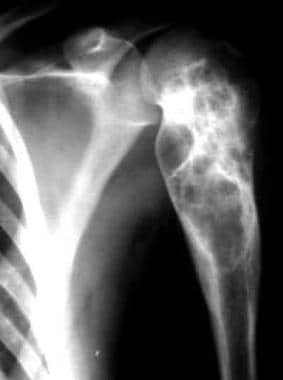
Aneurysmal bone cyst of the upper arm. Courtesy of Johannes Stahl, The Virtual Radiological Case Collection. |
 | View Full Size Image | |
Media type: X-RAY
|
| Media file 2:
Aneurysmal bone cyst of the upper arm. Courtesy of Johannes Stahl, The Virtual Radiological Case Collection. |
 | View Full Size Image | |
Media type: X-RAY
|
| Media file 3:
Aneurysmal bone cyst affecting the lumbar spine. Courtesy of Nick Oldnall, Index: Spine. |
 | View Full Size Image | |
Media type: X-RAY
|
| Media file 4:
Aneurysmal bone cyst of the upper arm in a 13-year-old female adolescent. Left to right, the radiographs were obtained over a period of approximately 2 months. Courtesy of Armed Forces Institute of Pathology. |
 | View Full Size Image | |
Media type: X-RAY
|
| Media file 5:
Aneurysmal bone cyst of the upper arm in an 18-year-old woman. Note the cortical erosion and slight expansion. Courtesy of Armed Forces Institute of Pathology. |
 | View Full Size Image | |
Media type: X-RAY
|
| Media file 6:
Aneurysmal bone cyst of the upper arm. Used with permission from the American Registry of Pathology. Courtesy of Armed Forces Institute of Pathology. |
 | View Full Size Image | |
Media type: Photo
|
| Media file 7:
Aneurysmal bone cyst of the upper arm. Used with permission from the American Registry of Pathology. Courtesy of Armed Forces Institute of Pathology. |
 | View Full Size Image | |
Media type: Photo
|
| Media file 8:
In this histologic image, the vascular spaces vary widely in size and shape, and the septa range from thin to broad. Well-formed bone is focally present. Courtesy of Armed Forces Institute of Pathology. |
 | View Full Size Image | |
Media type: Histology
|
| Media file 9:
In this histologic image, the septum contains fibroblasts, mononuclear histiocytelike cells, multinucleated giant cells, and capillaries. The lining of the large vascular spaces may be indistinct or consist of a single layer of attenuated stromal cells, as seen here. Used with permission from the American Registry of Pathology. Courtesy of Armed Forces Institute of Pathology. |
 | View Full Size Image | |
Media type: Histology
|
| Media file 10:
This histologic image demonstrates lesional tissue that abuts the striated tissue where the cortex has been completely destroyed. Used with permission from the American Registry of Pathology. Courtesy of Armed Forces Institute of Pathology. |
 | View Full Size Image | |
Media type: Histology
|
| Media file 11:
This histologic image shows a fibrous septum that contains a long strand of osteoid that appears to have buckled in the center. Used with permission from the American Registry of Pathology. Courtesy of Armed Forces Institute of Pathology. |
 | View Full Size Image | |
Media type: Histology
|
- Clayer M. Injectable form of calcium sulphate as treatment of aneurysmal bone cysts. ANZ J Surg. May 2008;78(5):366-70. [Medline].
- Segall L, Cohen-Kerem R, Ngan BY, Forte V. Aneurysmal bone cysts of the head and neck in pediatric patients: A case series. Int J Pediatr Otorhinolaryngol. Apr 21 2008;epub ahead of print. [Medline].
- Burch S, Hu S, Berven S. Aneurysmal bone cysts of the spine. Neurosurg Clin N Am. Jan 2008;19(1):41-7. [Medline].
- Schajowicz F. Aneurysmal bone cyst. Histologic Typing of Bone Tumours. Berlin, Germany: Springer-Verlag; 1992:37.
- McCarthy EF, Frassica FJ. Aneurysmal bone cyst. Pathology of Bone and Joint Disorders: With Clinical and Radiographic Correlation. Philadelphia, Pa: W.B. Saunders Co; 1998:279-84.
- Vigorita VJ, Ghelman B. Aneurysmal bone cysts. Orthopaedic Pathology. Philadelphia, Pa: Lippincott-Williams and Wilkins; 1999:262-74.
- Canale ST. Aneurysmal bone cyst within benign tumors of bone. Campbell's Operative Orthopaedics. Vol 1. 9th ed. St. Louis, Mo: Mosby Year-Book; 1998:690.
- Bullough PG, Vigorita VJ. Aneurysmal bone cyst within benign non-matrix-producing bone tumors. Orthopaedic Pathology. 3rd ed. Baltimore, Md: Mosby-Wolfe; 1997:402-4.
- Cottalorda J, Bourelle S. Modern concepts of primary aneurysmal bone cyst. Arch Orthop Trauma Surg. Feb 2007;127(2):105-14. [Medline].
- Sakamoto A, Tanaka K, Matsuda S, et al. Aneurysmal bone cyst of the capitate: case report and a review emphasizing local recurrence. Fukuoka Igaku Zasshi. Oct 2006;97(10):302-7. [Medline].
- Jaffe HL, Lichtenstein L. Solitary unicameral bone cyst with emphasis on the roentgen picture, the pathologic appearance and the pathogenesis. Arch Surg. 1942;44:1004-25.
- Leithner A, Windhager R, Lang S, et al. Aneurysmal bone cyst. A population based epidemiologic study and literature review. Clin Orthop Relat Res. Jun 1999;(363):176-9. [Medline].
- van den Berg H, Kroon HM, Slaar A, Hogendoorn P. Incidence of biopsy-proven bone tumors in children: a report based on the Dutch pathology registration "PALGA". J Pediatr Orthop. Jan-Feb 2008;28(1):29-35. [Medline].
- Kransdorf MJ, Sweet DE. Aneurysmal bone cyst: concept, controversy, clinical presentation, and imaging. AJR Am J Roentgenol. Mar 1995;164(3):573-80. [Medline]. [Full Text].
- Schreuder HW, Veth RP, Pruszczynski M, et al. Aneurysmal bone cysts treated by curettage, cryotherapy and bone grafting. J Bone Joint Surg Br. Jan 1997;79(1):20-5. [Medline]. [Full Text].
- Capanna R, Bettelli G, Biagini R, et al. Aneurysmal cysts of long bones. Ital J Orthop Traumatol. Dec 1985;11(4):409-17. [Medline].
- Tsai JC, Dalinka MK, Fallon MD, Zlatkin MB, Kressel HY. Fluid-fluid level: a nonspecific finding in tumors of bone and soft tissue. Radiology. Jun 1990;175(3):779-82. [Medline].
- Enneking WF. A system of staging musculoskeletal neoplasms. Clin Orthop Relat Res. Mar 1986;204:9-24. [Medline].
- Lodwick GS. Radiographic diagnosis and grading of bone tumors with comments on computer evaluation. Presented at the Proceedings ofthe Fifth National Cancer Conference, Philadelphia, Pa; September 17-19, 1964; pp 369-80.
- Lodwick GS. A systematic approach to the roentgen diagnosis of bone tumors. Tumors of bone and soft tissue. [Papers, M.D. Anderson Hospital]. Chicago, Ill: Year Book Medical Publishers; 1965:49-68.
- Lodwick GS. The bones and joints. In: Hodes PJ, ed. Atlas of Tumor Radiology. Chicago, Ill: Year Book Medical Publishers; 1971.
- Adamsbaum C, Kalifa G, Seringe R, Dubousset J. Direct Ethibloc injection in benign bone cysts: preliminary report on four patients. Skeletal Radiol. 1993;22(5):317-20. [Medline].
- Otsuka T, Kobayashi M, Sekiya I, et al. A new treatment of aneurysmal bone cyst by endoscopic curettage without bone grafting. Arthroscopy. Sep 2001;17(7):E28. [Medline].
- Rastogi S, Varshney MK, Trikha V, et al. Treatment of aneurysmal bone cysts with percutaneous sclerotherapy using polidocanol. A review of 72 cases with long-term follow-up. J Bone Joint Surg Br. Sep 2006;88(9):1212-6. [Medline].
- Vergel De Dios AM, Bond JR, Shives TC, McLeod RA, Unni KK. Aneurysmal bone cyst. A clinicopathologic study of 238 cases. Cancer. Jun 15 1992;69(12):2921-31. [Medline].
- Gibbs CP Jr, Hefele MC, Peabody TD, et al. Aneurysmal bone cyst of the extremities. Factors related to local recurrence after curettage with a high-speed burr. J Bone Joint Surg Am. Dec 1999;81(12):1671-8. [Medline].
- Papagelopoulos PJ, Currier BL, Shaughnessy WJ, et al. Aneurysmal bone cyst of the spine. Management and outcome. Spine. Mar 1 1998;23(5):621-8. [Medline].
- Marcove RC, Sheth DS, Takemoto S, Healey JH. The treatment of aneurysmal bone cyst. Clin Orthop Relat Res. Feb 1995;311:157-63. [Medline].
- Bertoni F, Bacchini P, Capanna R, et al. Solid variant of aneurysmal bone cyst. Cancer. Feb 1 1993;71(3):729-34. [Medline].
- Biesecker JL, Marcove RC, Huvos AG, Miké V. Aneurysmal bone cysts. A clinicopathologic study of 66 cases. Cancer. Sep 1970;26(3):615-25. [Medline].
- Bollini G, Jouve JL, Cottalorda J, et al. Aneurysmal bone cyst in children: analysis of twenty-seven patients. J Pediatr Orthop B. Oct 1998;7(4):274-85. [Medline].
- Boriani S, De Iure F, Campanacci L, et al. Aneurysmal bone cyst of the mobile spine: report on 41 cases. Spine. Jan 1 2001;26(1):27-35. [Medline].
- Buraczewski J, Dabska M. Pathogenesis of aneurysmal bone cyst. Relationship between the aneurysmal bone cyst and fibrous dysplasia of bone. Cancer. Sep 1971;28(3):597-604. [Medline].
- Capanna R, Albisinni U, Picci P, et al. Aneurysmal bone cyst of the spine. J Bone Joint Surg Am. Apr 1985;67(4):527-31. [Medline].
- Capanna R, Campanacci DA, Manfrini M. Unicameral and aneurysmal bone cysts. Orthop Clin North Am. Jul 1996;27(3):605-14. [Medline].
- Capanna R, Sudanese A, Baldini N, Campanacci M. Phenol as an adjuvant in the control of local recurrence of benign neoplasms of bone treated by curettage. Ital J Orthop Traumatol. Sep 1985;11(3):381-8. [Medline].
- Codd PJ, Riesenburger RI, Klimo P Jr, Slotkin JR, Smith ER. Vertebra plana due to an aneurysmal bone cyst of the lumbar spine. Case report and review of the literature. J Neurosurg. Dec 2006;105(6 suppl):490-5. [Medline].
- de Kleuver M, van der Heul RO, Veraart BE. Aneurysmal bone cyst of the spine: 31 cases and the importance of the surgical approach. J Pediatr Orthop B. Oct 1998;7(4):286-92. [Medline].
- Dwyer DM, Thorne AC, Healey JH, Bedford RF. Liquid nitrogen instillation can cause venous gas embolism. Anesthesiology. Jul 1990;73(1):179-81. [Medline].
- Fechner RE, Mills SE. Non-neoplastic lesions that mimic neoplasms. Atlas of Tumor Pathology: Tumors of the Bone and Joints. Vol 8. 3rd ed. Washington, DC: Armed Forces Institute of Pathology (US); 1993:253-8.
- Gladden ML, Gillingham BL, Hennrikus W, Vaughan LM. Aneurysmal bone cyst of the first cervical vertebrae in a child treated with percutaneous intralesional injection of calcitonin and methylprednisolone. A case report. Spine. Feb 15 2000;25(4):527-30; discussion 531. [Medline].
- Jackson WF, Theologis TN, Gibbons CL, Mathews S, Kambouroglou G. Early management of pathological fractures in children. Injury. Feb 2007;38(2):194-200. [Medline].
- Malawer MM, Marks MR, McChesney D, et al. The effect of cryosurgery and polymethylmethacrylate in dogs with experimental bone defects comparable to tumor defects. Clin Orthop Relat Res. Jan 1988;226:299-310. [Medline].
- Marcove RC. A 17-year review of cryosurgery in the treatment of bone tumors. Clin Orthop Relat Res. Mar 1982;163:231-4. [Medline].
- Martinez V, Sissons HA. Aneurysmal bone cyst. A review of 123 cases including primary lesions and those secondary to other bone pathology. Cancer. Jun 1 1988;61(11):2291-304. [Medline].
- McQueen MM, Chalmers J, Smith GD. Spontaneous healing of aneurysmal bone cysts. A report of two cases. J Bone Joint Surg Br. Mar 1985;67(2):310-2. [Medline]. [Full Text].
- Szendröi M, Cser
|