Practice Essentials
The stress fracture, first described by Breithaupt in 1855, [1] is a common overuse injury seen in athletes and military recruits. [2, 3] The injury is usually seen in the lower extremities, but it has also been reported in the upper extremities and the ribs. The most common locations for stress fractures include the tibia, metatarsals, fibula, and navicular bones; less common locations include the femur, pelvis, and sacrum.
A stress fracture is caused by repetitive and submaximal loading of the bone, which eventually becomes fatigued and leads to a true fracture. The typical presentation is a complaint of increasing pain in the lower extremity during exercise or activity. The patient's history usually reveals a recent increase in either training volume or intensity.
The treatment of most stress fractures is relatively straightforward and includes decreased activity and immobilization; however, patients with some stress fractures, such as displaced femoral neck stress fractures [4] and fifth metatarsal base stress fractures, are more likely to have complications such as nonunion. [5, 6] These complications should be monitored closely because surgical intervention may be necessary.

Pathophysiology
Stress fractures result from recurrent and repetitive loading of bone. The stress fracture differs from other types of fractures in that in most cases, no acute traumatic event precedes the symptoms.
Normal bone remodeling occurs secondary to increased compressive or tensile loads or increased load frequency. In the normal physiologic response, minor microdamage of the bone occurs. This is repaired through remodeling. Stress fractures develop when extensive microdamage occurs before the bone can be adequately remodeled. [7, 8]
Often, the patient has a history of an increase or change in the character of activity or athletic workouts. Bones may be more prone to stress fractures if the bone is weakened, as in individuals with osteoporosis or those in whom weightbearing activities are increased.
The three factors that can predispose an individual to the development of stress fractures are as follows [9] :
-
Increase in the applied load
-
Increase in the number of applied stresses
-
Decrease in the surface area of the applied load
The applied load on the bone may be increased by decreasing the surface area across which the weight is distributed or by increasing the total weight that is applied to the bone. High-impact activities, such as jumping or performing plyometrics, running on a new surface, or practicing incorrect biomechanical movements or techniques, may increase the risk of stress fractures.
Oh et al proposed the following classification of stress fractures into four types, adding atypical fractures to the traditional three types [10] :
-
Fatigue fractures - These are due to overuse of bone with normal elastic resistance
-
Insufficiency fractures - These are due to everyday physiologic stress on fragile bone with poor elastic resistance
-
Pathologic fractures - These are due to bone weakness involving tumors
-
Atypical fractures
Etiology
Risk factors
Although stress fractures result from repeated loading, the exact contribution of training factors (eg, volume, intensity, and surface) has not been clearly established. [11] From what we do know, menstrual disturbances, caloric restriction, decreased bone density, muscle weakness, and leg-length differences are risk factors for stress fractures. [12, 13]
Myburgh reported that stress fractures were more common in athletes who had decreased bone density, lower dietary calcium intake, current menstrual irregularity, and less oral contraceptive use, when the athletes were matched for similar training volume and intensity. [14]
Nattiv and Armsey found that genetics, female sex, white ethnicity, low body weight, lack of weightbearing exercise, intrinsic and extrinsic mechanical factors, amenorrhea, oligomenorrhea, inadequate calcium and caloric intake, and disordered eating were additional risk factors for stress fractures. [15] A decreased testosterone level in male endurance athletes has also been implicated as a risk factor for stress fractures. [16, 17, 18, 19] Individuals found to have low bone mass and hormonal disturbances may require endocrinologic management. [20]
Schnackenburg et al did a matched control study on 19 female athletes with tibial stress fractures and found that stress fracture patients had lower tibial cross-sectional areas, lower trabecular bone mineral densities, and less cortical area, as well as decreased knee extension strength. They suggested that impaired bone quality of the posterior cortex and decreased muscle strength were associated with stress fractures in female athletes. [21]
Giladi identified two anatomic risk factors in military recruits. Recruits with stress fractures had significantly narrower tibiae and increased external rotation of the hip. These two variables were independent and cumulative, and when both risk factors were present, the stress-fracture morbidity was 45%. [22]
In a nationwide database analysis, Kale et al identified age and female sex as important risk factors for stress fractures. [23] A total of 41,257 stress fractures (30,555 in women and 10,702 in men) were included in the analysis. A greater proportion of female patients were older and had stress fractures of the foot, whereas a greater proportion of male patients were younger than 19 years and had metatarsal, hip, or tibial stress fractures.
There is some evidence that methotrexate therapy for rheumatic musculoskeletal disease can impair bone metabolism and thereby give rise to so-called methotrexate osteopathy, a condition characterized by a pathognomonic type of stress fractures with a band- or meander-shaped appearance along the growth plate. [24]
Activity and fracture location
Particular locations of stress fractures are commonly associated with particular activities (see Table 1 below).
Table 1. Epidemiologic Features of Stress Fractures According to Location and Activity (Open Table in a new window)
Location of Fracture |
Activity Involved |
Metatarsals, general |
Football, basketball, gymnastics, ballet, military training [25] |
Metatarsal, base of the second |
Ballet |
Metatarsal, fifth |
|
Sesamoids of the foot |
Running, ballet, basketball, skating |
Navicular |
Sprinting, [28] jumping, basketball, football |
Talus |
Pole vaulting |
Calcaneus |
Military drills, running, aerobics |
Fibula |
Running, jumping, ballet, repeated heavy lifting [28] |
Tibia |
Running sports, dancing, ballet |
Patella |
Running, hurdling |
Femoral neck |
Distance running, military training [29] |
Pubic rami |
Military drills, distance running |
Pars articularis |
Gymnastics, ballet, cricket, volleyball, diving, football |
Chest, ribs |
Swimming, [30] golf, [31] rowing, [32] overhead throwing sports [33] |
Sternum |
Wrestling [34] |
Ulna |
Racquet sports, volleyball |
Olecranon |
Baseball, throwing sports |
Epidemiology
Sex-related demographics
Studies of US military recruits revealed a higher percentage of stress fractures in female recruits than in male recruits. [2, 35, 36, 37] Bennell et al also found a 45% incidence of stress fractures in competitive female runners. [7] The women most at risk for stress fractures were those who restricted their food intake and those who had dysmenorrhea.
The triad of disordered eating, amenorrhea/oligomenorrhea, and osteoporosis may be extremely prevalent in female distance runners and ballet dancers, [38] as well as in other female athletes who believe that a low body weight or body-fat percentage provides a competitive advantage. This triple combination is commonly referred to as the so-called female athlete triad. [39]
The amenorrheic female athlete may experience a prolonged state of estrogen deficiency similar to that of a postmenopausal woman. The lower estrogen levels are associated with decreased bone density; even if normal menses returns, this bone loss may be irreversible in high school– and college-aged female athletes. Early identification of female athletes who are likely to develop the female athlete triad is important for the prevention of stress fractures and for maintaining overall future bone health. [39, 40]
Race-related demographics
In a study of military recruits, Markey found no difference in the incidence of stress fractures between recruits of various racial backgrounds. [41]
-
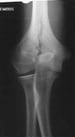
Fifth metatarsal stress fracture.
Tables
Location of Fracture |
Activity Involved |
Metatarsals, general |
Football, basketball, gymnastics, ballet, military training [25] |
Metatarsal, base of the second |
Ballet |
Metatarsal, fifth |
|
Sesamoids of the foot |
Running, ballet, basketball, skating |
Navicular |
Sprinting, [28] jumping, basketball, football |
Talus |
Pole vaulting |
Calcaneus |
Military drills, running, aerobics |
Fibula |
Running, jumping, ballet, repeated heavy lifting [28] |
Tibia |
Running sports, dancing, ballet |
Patella |
Running, hurdling |
Femoral neck |
Distance running, military training [29] |
Pubic rami |
Military drills, distance running |
Pars articularis |
Gymnastics, ballet, cricket, volleyball, diving, football |
Chest, ribs |
Swimming, [30] golf, [31] rowing, [32] overhead throwing sports [33] |
Sternum |
Wrestling [34] |
Ulna |
Racquet sports, volleyball |
Olecranon |
Baseball, throwing sports |
Grade |
Radiographic Finding |
Bone Scan Finding |
MRI Finding |
1 |
Normal |
Poorly defined area |
Increased activity on STIR image |
2 |
Normal |
More intense |
Poor definition on STIR and T2-weighted images |
3 |
Discrete line |
Sharp area of uptake |
No focal or fusiform cortical break on T1- and T2-weighted images |
4 |
Fracture or periosteal reaction |
More intense localized transcortical uptake |
Fracture line on T1- and T2-weighted images |
Site of Stress Fracture |
Percentage Healed at 2-4 wk, % |
Percentage Healed at 1-2 mo, % |
Percentage Healed at > 2 mo, % |
Tibia, proximal third |
0 |
43 |
57 |
Tibia, middle third |
0 |
48 |
52 |
Tibia, distal third |
0 |
53 |
47 |
Fibula |
7 |
75 |
18 |
Metatarsals |
20 |
57 |
23 |
Sesamoids |
0 |
0 |
100 |
Femur, shaft |
7 |
7 |
86 |
Femur, neck |
0 |
0 |
100 |
Pelvis |
0 |
29 |
75 |
Olecranon |
0 |
0 |
100 |
*Adapted from Hulkko et al. [48] Findings were from a case series of 368 stress fractures in athletes, in which the healing times of stress fractures in different locations were assessed. |
|||