Practice Essentials
Osteonecrosis of the femoral head involves the hip joint, with osteocytes of the femoral head dying along with the bone marrow; resorption of the dead tissue by new but weaker osseous tissue can then lead to subchondral fracture and collapse. There are 2 forms of osteonecrosis: traumatic (the most common form) and atraumatic. Other terms to describe this disorder are avascular necrosis and ischemic necrosis, to denote vascular etiology. The term aseptic necrosis also has been used to indicate that infection does not play a causative role.
Osteonecrosis is now a commonly recognized disorder with significant morbidity. The end stage of the process is severe destruction of the femoral head with resultant degeneration of the hip joint. In many patients, even early identification and intervention do not alter the result. Unfortunately, patients who are affected with osteonecrosis are young, usually in the third to sixth decades of life.
Traumatic and atraumatic osteonecrosis are essentially 2 distinct problems. The traumatic form has a definitive causal event and is isolated to the particular injured bone. The atraumatic form has multiple etiologies (eg, excessive alcohol consumption, chronic corticosteroid use, autoimmune and chronic inflammatory disorders [1] ) and can involve multiple bones. The main focus of this article is atraumatic osteonecrosis.
The natural history of atraumatic osteonecrosis is still not well understood. Different etiologies of the disease often have different clinical courses. It has been reported that approximately 56% of asymptomatic patients eventually become symptomatic. [2] Steroid-induced disease has the worst prognosis, with most cases progressing to collapse of the femoral head.
Plain radiographic findings frequently are normal. Therefore, history and physical examinations are paramount for diagnosis; see Presentation.
Treatment is indicated after diagnosis is confirmed with radiographic studies. Along with biophysical modalities, agents that have been used for nonoperative management include bisphosphonates, anticoagulants, vasodilators, and statins. [3] Most studies indicate that the risk for disease progression is greater with nonsurgical treatment than with surgical intervention. Prostheses with novel bearing surfaces (ie, metal-on-metal, ceramic-on-ceramic) are being investigated, to increase the success rate for total hip replacements in patients with osteonecrosis.
For patient education information, see Avascular Necrosis (Aseptic Necrosis or Osteonecrosis).

Pathophysiology
Traumatic osteonecrosis is a direct result of disruption of the blood supply to the femoral head. Death of bone marrow occurs within 6-12 hours after vascular insult. Death of the bone becomes apparent several days later.
The pathophysiology in atraumatic osteonecrosis remains controversial. [4] Fat cell hypertrophy with resultant pressure increase within the femoral head, leading to vascular collapse and then necrosis, has been proposed as a mechanism for steroid-induced osteonecrosis. A fat embolism phenomenon with resultant vascular occlusion is another proposed mechanism. A hyperlipidemic state seems to be related to causation, but the exact mechanism is unknown. Similarly, the lipid hypothesis has also been applied to cases associated with alcohol abuse.
Studies have shown evidence of acquired hypercoagulabiltiy. This effect appears to be augmented by tobacco abuse. [5] Studies have also shown elevated cryofibrinogen levels in atraumatic osteonecrosis. [6]
In caisson disease, circulating nitrogen bubbles occlude blood vessels in response to reduction in ambient pressure during decompression. Sickle cell anemia results in bone death secondary to the sickling process and subsequent vascular occlusion.
Increased intraosseous pressure contributes directly to the propagation of necrosis, regardless of etiology. As bone death occurs, a repair process takes place as dead bone is removed and replaced by new bone. During this phase, the bone underlying the joint surface is weakened. In most patients, subchondral fracture alters the articular surface, resulting in abnormal mechanics and arthritic alterations to the joint.
The disease affects both sides of the joint, as confirmed by PET scan imaging showing earlier involvement in the acetabulum than is discernible by other radiographic modalities.
Etiology
As the name implies, traumatic osteonecrosis is secondary to direct injury to the femoral head with resultant damage of the blood supply. Fracture of the femoral head or neck and hip dislocation are the primary mechanisms of injury.
Atraumatic osteonecrosis has many risk factors. The 2 most commonly associated problems are corticosteroid use and alcohol abuse. [7, 8] The idiopathic cases make up the third most common category. Other factors include sickle cell anemia, Gaucher disease, systemic lupus erythematosus, coagulopathies, hyperlipidemia, organ transplantation, caisson disease, and thyroid disorders. Genetic factors may also play a role.
Hip osteonecrosis resulting from corticosteroid use or alcohol abuse is associated with the worst prognosis. Frequently, steroid-induced osteonecrosis involves multiple bones and, in the case of the hip, results in nearly 100% bilateral involvement. The exact dose required to induce osteonecrosis remains an enigma, but most studies indicate that higher doses, even over a short period of time, present the highest risk. Often, patients on steroids have other associated risk factors.
A case of asymptomatic osteonecrosis of the femoral head (ONFH) was identified one month after hospitalization for COVID-19-related pneumonia treated with systemic steroids. [9]
Osteonecrosis associated with alcohol abuse usually occurs in those who drink more than 400 mL of alcohol per week. It is more common in those with a long-term history of heavy consumption.
Epidemiology
Approximately 10,000-20,000 new cases are identified each year in the United States. At least 50% of patients with atraumatic hip osteonecrosis are thought to have bilateral involvement. Other bones often are involved in the atraumatic form, including the shoulder, knee, and talus.
The traumatic form of hip osteonecrosis occurs in 10% of undisplaced femoral neck fractures, 15-30% of displaced femoral neck fractures, and 10% of hip dislocations. Corticosteroid use contributes to the atraumatic form of osteonecrosis in 25-50% of patients and alcohol-associated osteonecrosis has been reported in 20-45% of cases. [10, 11]
The male-to-female ratio is about 4:1. The typical age ranges from 35 to 50 years old, with the average age of presentation being 36 years.
A national epidemiologic survey in Japan estimated an annual incidence of 2200 new patients diagnosed with osteonecrosis of the femoral head. Osteonecrosis was associated with steroid use (51%), heavy alcohol consumption (31%), both (3%), and neither (15%). Steroid-induced osteonecrosis was diagnosed in 34% of male patients and in 76% of females patients. The underlying diseases requiring steroid administration included systemic lupus erythematosus (SLE), nephritic syndrome, polymyositis/dermatomyositis, asthma, and thrombocytopenic purpura. [12]
Prognosis
The success rate in patients not treated by arthroplasty in stage 0 or I approaches 90% in some series. Once femoral head collapse occurs, these treatments offer limited benefit. Procedures such as the trapdoor procedure potentially may improve results in stage II and III, but presently, total hip replacement remains the treatment of choice once collapse has occurred. If not treated, 80% of femoral heads collapse within 4 years of diagnosis. Location and extent of the necrotic lesion appear to be good indicators of collapse of the femoral head.
The risk of femoral head collapse can be stratified into three groups based on the modified Kerboul combined necrotic angle calculated by the summation of the arc of femoral head necrosis on mid-sagittal and midcoronal MRI, as follows [13] :
-
Low risk: combined necrotic angle less than 190 degrees
-
Moderate risk: combined necrotic angle between 190 and 240 degrees
-
High risk: combined necrotic angle greater than 240 degrees
Core decompression success rates are better than those with conservative treatment, with approximately 70% success in stages before radiographic collapse and limited morbidity. [14] In a systematic review of core decompression without augmentation in patients with nontraumatic osteonecrosis of the femoral head, which included pooled results from 1134 hips, nearly 80% of which were in an early stage of osteonecrosis, approximately 38% of patients underwent a total hip replacement at an average of 26 months after the procedure. [15]
Complications of core decompression are minimal in the hands of experienced surgeons. The most severe complication is fracture, which can occur if core is drilled below the trochanteric ridge. Core decompression has been shown to be a highly cost-effective alternative when a total hip replacement is delayed by 5 years or more.
Complications of bone grafting procedures include donor-site morbidity; peroneal sensory neuropathy, contractures of the flexor hallucis longus, and deep venous thrombosis. Retrieval studies have shown little bone ingrowth, insufficient mechanical support of subchondral bone, and a significant rate of femoral head collapse with tantalum implants. [16]
For trapdoor, 83% good or excellent results were demonstrated in 1 study. [17] Limited complications are reported, aside from deep venous thrombosis.
Cup arthroplasty, unipolar arthroplasty, and bipolar arthroplasty have poor success rates; as disease appears to affect both sides of the hip joint.
Total resurfacing arthroplasty has a greater than 90% survivorship at greater than 3 years, however, femoral neck fracture is the most common and critical complication.
Results are poor for arthrodesis in terms of achieving fusion and patient satisfaction. Total hip replacement early results were poor with early cement techniques, with failures up to 25% or higher. Studies with current techniques have shown success rates at over 90%, making it the treatment of choice following collapse or failure of less-invasive procedures. Complications include infection, peroneal nerve palsy, deep venous thrombosis, intraoperative fracture, and postoperative dislocation; risk-benefit ratio strongly reflects success of procedure.
-
Osteonecrosis, hip. Anteroposterior radiograph showing Ficat stage III disease.
-
MRI showing osteonecrosis of right hip, normal left hip.
-
Bone scan showing osteonecrosis of right hip.
-
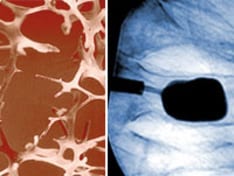
Osteonecrosis, hip. Anteroposterior radiograph core biopsy.
-
Osteonecrosis, hip. A radiograph of a limited femoral resurfacing performed for a collapsed femoral head with damaged femoral head cartilage and intact acetabular cartilage.
Tables
Stage |
Criteria |
0 |
Normal radiograph, bone scan, and magnetic resonance images |
I |
Normal radiograph. Abnormal bone scan and/or magnetic resonance images A: Mild (< 15 % of femoral head affected) B: Moderate (15–30 % of femoral head affected) C: Severe (>30 % of femoral head affected) |
II |
Cystic and sclerotic changes in femoral head A: Mild (< 15 % of femoral head affected) B: Moderate (15–30 % of femoral head affected) C: Severe (> 30 % of femoral head affected) |
III |
Subchondral collapse without flattening (crescent sign) A: Mild (< 15 % of femoral head affected) B: Moderate (15–30 % of femoral head affected) C: Severe (>30 % of femoral head affected) |
IV |
Flattening of femoral head A: Mild (< 15 % of surface and < 2 mm of depression) B: Moderate (15–30 % of surface and 2–4 mm of depression) C: Severe (>30 % of surface and > 4 mm of depression) |
V |
Joint narrowing or acetabular changes A: Mild B: Moderate C: Severe |
VI |
Advanced degenerative changes |
Stage |
Criteria |
0 |
Bone biopsy results consistent with osteonecrosis; other test results normal |
I |
Positive findings on bone scan, MRI, or both A: < 15% involvement of the femoral head (MRI) B: 15-30% involvement C: > 30% involvement |
II |
Mottled appearance of femoral head, osteosclerosis, cyst formation, and osteopenia on radiographs; no signs of collapse of femoral head on radiographic or CT study; positive findings on bone scan and MRI; no changes in acetabulum A: < 15% involvement of the femoral head (MRI) B: 15-30% involvement C: > 30% involvement |
III |
Presence of crescent sign lesions classified on basis of appearance on AP and lateral radiographs A: < 15% crescent sign or < 2-mm depression of femoral head B: 15-30% crescent sign or 2- to 4-mm depression C: > 30% crescent sign or > 4 mm depression |
IV |
Articular surface flattened; joint space shows narrowing; changes in acetabulum with evidence of osteosclerosis, cyst formation, and marginal osteophytes |