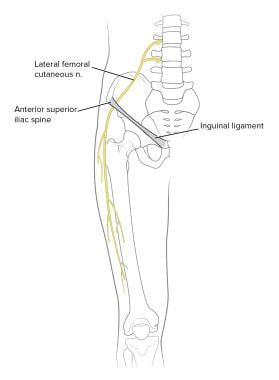
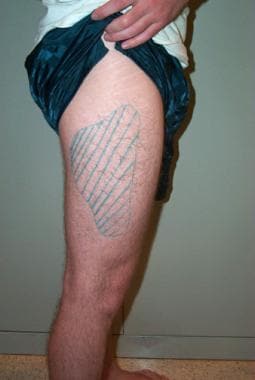
You are in: eMedicine Specialties > Orthopedic Surgery > HIP Meralgia ParestheticaArticle Last Updated: Oct 16, 2006AUTHOR AND EDITOR INFORMATIONAuthor: Ira Kornbluth, MD, Associate, Center for Pain Management, Physical Medicine and Rehabilitation and Pain Management Ira Kornbluth is a member of the following medical societies: American Academy of Physical Medicine and Rehabilitation, American Society of Interventional Pain Physicians, and Physiatric Association of Spine, Sports and Occupational Rehabilitation Coauthor(s): Phillip J Marone, MD, Clinical Professor, Department of Orthopedic Surgery, Jefferson Medical College Editors: Miguel A Schmitz, MD, Consulting Surgeon, Department of Orthopedics, Klamath Orthopedic and Sports Medicine Clinic; Francisco Talavera, PharmD, PhD, Senior Pharmacy Editor, eMedicine; B Sonny Bal, MD, Associate Professor, Department of Orthopedic Surgery, University of Missouri School of Medicine; Dinesh Patel, MD, FACS, Associate Clinical Professor of Orthopedic Surgery, Harvard Medical School; Chief of Arthroscopic Surgery, Department of Orthopedic Surgery, Massachusetts General Hospital; William L Jaffe, MD, Clinical Professor of Orthopedic Surgery, New York University School of Medicine; Vice Chairman, Department of Orthopedic Surgery, Hospital for Joint Diseases Author and Editor Disclosure Synonyms and related keywords: lateral femoral cutaneous nerve neuropathy, neuropraxic injury, axonotmesis, neurotmesis, thigh pain, lateral femoral cutaneous nerve compression, leg neuropathy, thigh neuropathy INTRODUCTIONMeralgia paresthetica is a common but underrecognized condition that is manifested by pain, numbness, and tingling in the anterior and lateral parts of the thigh. Bernhardt first described symptoms corresponding to meralgia paresthetica in 1878. In 1885, Hagar correctly suggested that lateral femoral cutaneous nerve compression was the source of this symptom complex; surgical correction of meralgia paresthetica also dates back to Hagar at this time. A decade later, Roth coined the term meralgia paresthetica from the Greek words meros (thigh) and algos (pain). Anecdotally, Sigmund Freud is said to have diagnosed himself and his son with this condition. ProblemMeralgia paresthetica is caused by entrapment of the lateral femoral cutaneous nerve, which then results in pain and sensory abnormalities in the anterolateral thigh. The lateral femoral cutaneous nerve is a pure sensory nerve that typically receives its innervation from the L2-3 lumbar nerve roots and includes sudomotor fibers. Sudomotor changes, such as mild sweating in the nerve distribution, may be evident, although this is uncommon. Because the lateral femoral cutaneous nerve is purely sensory, no associated motor or reflex findings should be present. FrequencyThe prevalence of meralgia paresthetica has been estimated at 3 cases per 10,000 individuals, and this condition has been reported in up to 35% of patients referred for evaluation of leg discomfort. However, these symptoms are often not recognized or they may be mistaken for other conditions such as lumbar radiculopathy. In a large case series (Seror and Seror, 2006), the presumptive diagnosis by the referring physician was meralgia paresthetica in 47 of 120 patients (39%). This condition has been described in toddlers and elderly persons, but most cases occur in patients aged 30-65 years. Whether a sex predominance exists is unclear. Meralgia paresthetica is usually unilateral but may be bilateral in as many as 50% of cases. EtiologyMetabolic conditions such as diabetes, alcoholism, and thyroid disorders can contribute to the development of a neuropathy in the lateral femoral cutaneous nerve and other peripheral nerves. In most instances, the etiology of meralgia paresthetica involves excessive pressure on the nerve at various sites of possible entrapment. Pressure may be from internal causes such as obesity, pregnancy, or pelvic tumors. There is a higher incidence of obesity in patients with meralgia paresthetica, which strongly suggests that obesity is an independent risk factor. Alternatively, external causes such as tight belts worn around the waist may be identified as the culprit. In addition, the lateral femoral cutaneous nerve may be injured iatrogenically from local trauma during surgical procedures. Hip replacement, iliac crest bone grafting, appendectomy, inguinal lymph node dissection, aortofemoral bypass, uterine surgery, cesarean section, and quadriceps surgery have all been implicated as causative for meralgia paresthetica. PathophysiologyAlong its course, the lateral femoral cutaneous nerve is vulnerable to compression at several sites. The nerve emerges from the psoas muscle, intersects with the inguinal ligament, curves around the anterior superior iliac spine, and exits from the fascia lata. Meralgia paresthetica most commonly occurs from compression of the nerve as it exits the pelvis. Peripheral nerve injuries are described in terms of the nature of the insult and the associated prognosis. Thus, a compressive force results in a neuropraxic injury to the nerve, which is characterized by the loss of myelin without affecting the axon or its axonal sheath. Neuropraxic injuries have the best prognosis and may heal over hours to months, depending on the severity. Loss of the axon or its axonal sheath constitutes a more severe nerve injury and a worse prognosis for healing, because the nerve undergoes wallerian degeneration or destruction of the nerve fibers distal to the injury site. If the injury involves only the axons and spares the axonal sheath (axonotmesis), the patient may make a full, but likely slow, recovery. If the axonal sheath is affected such that the nerve is in discontinuity (neurotmesis), then the prognosis for spontaneous recovery is poor. Most commonly, compressive forces tend to result in neuropraxic injuries, and relief of the compressive force initiates the healingprocess. ClinicalA thorough medical and surgical history is important for the correct diagnosis of meralgia paresthetica, including questioning the patient about the possibility of any relevant trauma. The physical examination in patients with meralgia paresthetica is remarkable for the findings of altered sensation in the anterolateral thigh, including pain, numbness, burning, hyposensitivity, and tingling. Typically, the symptoms begin insidiously and do not extend below the knee. The pain tends to be sharp or burning but also may be dull or achy. The examiner should also consider whether any abnormal postures or movements are contributing to the patient's symptoms. Prolonged standing and standing up from a seated position may aggravate the condition. Motor and reflex examination findings should be normal. If the patient has evidence of motor weakness or low back pain, other diagnoses should be considered because the lateral femoral cutaneous nerve is purely sensory, and a neurologic examination should be conducted. Trigger points, lumbar radiculopathy, plexopathy, and hip pathology can masquerade as meralgia paresthetica. A positive Tinel sign finding may be elicited near the anterior superior iliac spine. Meralgia paresthetica may affect a very large region of the anterior and lateral thigh. However, the involved area can vary significantly depending on the site of entrapment and anatomic variations of the nerve. In a large case series (Seror and Seror, 2006) of 120 patients, 88 (73%) had symptoms solely in the lateral aspect of the distal thigh. In 11 of the 120 patients (9.2%), the anterior aspect of the thigh was exclusively involved. INDICATIONSTreatment for meralgia paresthetica is directed toward identification and relief of the compressive force on the lateral femoral cutaneous nerve. In many instances, the nerve spontaneously heals if the compression is relieved. If symptoms continue, anti-inflammatory medications, local injection, and other nonsurgical modalities can be considered (see Treatment). If these methods fail, surgery may be an option. The decision to pursue surgery depends on the extent and nature of the symptoms. Neurolysis alone, neurolysis with transposition of the nerve, and transection of the nerve are the most commonly performed surgical procedures for meralgia paresthetica. RELEVANT ANATOMYThe lateral femoral cutaneous nerve typically arises from lumbar nerve roots, specifically those at the L2-3 levels, although the nerve can arise from different combinations of the L1-3 nerve roots. The lateral femoral cutaneous nerve pierces the psoas muscle, travels across the iliacus muscle toward the anterior superior iliac spine, and then enters the anterolateral thigh by passing under, through, or above the inguinal ligament. In most individuals, the lateral femoral cutaneous nerve crosses into the anterolateral thigh approximately 1 cm medial to the anterior superior iliac spine. However, the relationship of the lateral femoral cutaneous nerve to the anterior superior iliac spine is quite variable. The nerve may cross into the anterolateral thigh as much as 2 cm lateral or 6 cm medial to the anterior superior iliac spine. A bifurcation into anterior and posterior divisions occurs approximately 5-12 cm below the anterior superior iliac spine. Cadaver dissections have demonstrated that anatomic variations are also found in the origin of the lateral femoral cutaneous nerve. As many as 30% of lateral femoral cutaneous nerves may be derived partially or entirely from adjacent genitofemoral or femoral nerves. CONTRAINDICATIONSNo absolute contraindications are recognized for lateral femoral cutaneous nerve surgery. Relative contraindications include any comorbidities that place the patient at increased general surgical risk. WORKUPLab Studies
Imaging Studies
Other Tests
TREATMENTMedical therapyDevising a strategy to identify and relieve the compressive force should be the first step in the treatment of meralgia paresthetica. For example, a tool belt or tight clothing could induce or exacerbate symptoms. In obese patients, weight loss alone may prove to be very beneficial. Patients should be advised to avoid prolonged sitting because this may increase pressure on the nerve. Abnormal postures and movements should be addressed. Modalities such as heat, ice, and electrical stimulation can be used for symptomatic relief as appropriate. Use of nonsteroidal anti-inflammatory drugs (NSAIDs), tricyclic antidepressants ([TCAs]; eg, amitriptyline [Elavil]), and anticonvulsant agents (eg, gabapentin [Neurontin]) may be helpful in providing some degree of symptomatic relief. Alternatively, local injections using steroid and local anesthetic preparations may reduce symptoms by decreasing any inflammatory component and disrupting the pain circuit. In most instances, the injection is performed just inferior to the inguinal ligament and 1 cm medial to the anterior superior iliac spine. However, the physician should recognize that the nerve pathway can vary significantly and should therefore adjust the location of the injection accordingly. Long-term neurotoxic agents such as phenol are not recommended because of the possibility of adverse effects such as dysesthesias. Surgical therapyIn cases resistant to conservative measures, surgical options may be considered. Preoperative detailsBefore the procedure, the patient should be counseled about the potential risks and outcomes to be expected. Complications include infection, excess bleeding, failure to relieve symptoms, and the worsening of pain. Surgery may be performed with the patient under local or general anesthesia. Intraoperative detailsA small incision is made just distal to the site where the lateral femoral cutaneous nerve intersects the inguinal ligament. The nerve is exposed, and any compressive force is identified. Neurolysis, neurolysis with transposition, and transection are the most commonly performed surgical procedures. Which surgical procedure is most effective and which should be attempted first are topics of some debate. Commonly, neurolysis or neurolysis with transposition is considered prior to transection because transection results in permanent numbness in the nerve distribution. Transection may be the only option if the nerve has been severely damaged or if multiple branches are affected. On the other hand, the rate of symptom recurrence may be higher with the neurolytic procedures than with transection. In transections, the surgeon should ensure that the proximal portion of the nerve is within the pelvis to minimize the formation of a painful neuroma. Complete lysis is achieved by freeing the nerve at the tendinous arc from the iliac fascia; anteriorly, at the inguinal ligament; posteriorly, at a sling of fascia; and, distally, at the deep fascia of the thigh along each division. Postoperative detailsSome surgical site tenderness is expected for a few days and can be managed with analgesics. Range of motion and function should not be restricted after surgery. Follow-upThe patient should have thorough neurologic examinations immediately after the procedure and serial examinations for several months afterward to evaluate whether the procedure helped alleviate the symptoms of meralgia paresthetica and to identify any complications. COMPLICATIONSMeralgia paresthetica is a benign condition; in conservatively treated patients, complications are limited to persistent symptoms despite treatment. No weakness or disabling features should occur from this entity. Surgical complications include bleeding and infection; however, permanent anesthesia of the anterolateral thigh is an expected consequence of transection, and neuromas may develop. NSAIDs have the potential to cause gastrointestinal ulcerations, damage renal and liver function, and exacerbate hypertension. Anticonvulsant medications can precipitate seizures, cause excess fatigue, or induce weight gain. Common effects of TCAs are dry mouth and urinary retention. OUTCOME AND PROGNOSISThe outcome of meralgia paresthetica depends largely on whether the diagnosis and treatment plan are achieved within a reasonable time frame. The prognosis from conservative management alone is quite good because the condition often is self-limited. In 277 patients treated conservatively by Williams and Trzil (1991), 91% had satisfactory symptom relief. In the worst-case scenario, patients treated conservatively had persistent symptoms such as pain, numbness, burning, hyposensitivity, and tingling in the anterolateral thigh. Controversial issues include the efficacy of surgery and the selection of a surgical procedure. van Eerten et al (1995) noted complete symptom relief in 3 of 10 patients who underwent neurolysis and in 9 of 11 patients who had a transection. Similarly, 23 of 24 patients who had a transection in Williams and Trzil's series had complete relief of their presenting symptoms. Ivins (2000) reported results for 8 patients who underwent neurolysis; 4 experienced relief of symptoms, of which 2 had recurrence of their symptoms. Siu and Chandran (2005) reported results from a case series of 45 decompressive procedures in 42 patients who underwent neurolysis: 43% reported complete relief, 40% reported partial relief, and 17% reported no relief. Although transection is more likely to produce complete relief, it likely will cause permanent anesthesia of the anterolateral thigh. FUTURE AND CONTROVERSIESAs physicians and patients become increasingly aware of meralgia paresthetica and as new medications and surgical techniques develop, the diagnosis and initiation of a treatment plan will be made more rapidly. Patients and physicians alike would benefit from an algorithm guiding diagnosis and treatment. MULTIMEDIA
REFERENCES
Article Last Updated: Oct 16, 2006 | ||||||||||||