Continually Updated Clinical Reference
 
 
  All Sources     eMedicine     Medscape     Drug Reference     MEDLINE
 
eMedicine - Foot Drop : Article by

Quick Find
Authors & Editors
Introduction
RELEVANT ANATOMY
Workup
Treatment
Complications
Outcome And Prognosis
Multimedia
References


Patient Education
Click here for patient education.


Author: James W Pritchett, MD, FACS, Clinical Associate Professor of Orthopedic Surgery and Sports Medicine, University of Washington School of Medicine

Coauthor(s): Margaret A Porembski, MD, Research Fellow, Department of Surgery, Massachusetts General Hospital, Shriner's Burns Hospital, Harvard Medical School

Editors: John S Early, MD, Foot/Ankle Specialist, Texas Orthopaedic Associates, LLP; Co-Director, North Texas Foot and Ankle Fellowship Baylor University Medical Center; Francisco Talavera, PharmD, PhD, Senior Pharmacy Editor, eMedicine; Shepard R Hurwitz, MD, Executive Director Designate, American Board of Orthopaedic Surgery; Dinesh Patel, MD, FACS, Associate Clinical Professor of Orthopedic Surgery, Harvard Medical School; Chief of Arthroscopic Surgery, Department of Orthopedic Surgery, Massachusetts General Hospital; Jason H Calhoun, MD, FAAOS, Chairman, J Vernon Luck Distinguished Professor, Department of Orthopedic Surgery, University of Missouri

Author and Editor Disclosure

Synonyms and related keywords: drop foot, steppage gait, equinovarus deformity, dorsiflexor injuries, peripheral nerve injuries, stroke, neuropathies, drug toxicities, diabetes, peroneal neuropathy, peroneal nerve palsy, total knee arthroplasty, proximal tibial osteotomy, hip arthroplasty, rupture of tibialis anterior tendon, compartment syndromes, March gangrene, anterior compartment syndrome, deep posterior compartment syndrome, lumbosacral plexopathy, lumbar radiculopathy, motor neuron disease, parasagittal cortical lesions, subcortical cerebral lesions, Charcot foot, degenerative rupture of tibialis anterior muscle, chronic compartment syndrome, leprosy neuritis

Foot drop is a deceptively simple name for a potentially complex problem. Foot drop can be associated with a variety of conditions such as dorsiflexor injuries, peripheral nerve injuries, stroke, neuropathies, drug toxicities, or diabetes. The causes of foot drop may be divided into 3 general categories: neurologic, muscular, and anatomic. These causes may overlap. Treatment is variable and is directed at the specific cause.

History of the Procedure

Foot drop likely has been a problem for humans throughout our existence. Argument can be made that the biblical story of Jacob limping after wrestling with an angel in the book of Genesis represents the first recorded occurrence of foot drop.

Problem

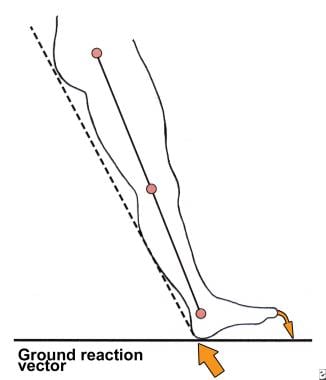
Foot drop can be defined as a significant weakness of ankle and toe dorsiflexion. The foot and ankle dorsiflexors include the tibialis anterior, extensor hallucis longus, and extensor digitorum longus. These muscles help the body clear the foot during swing phase and control plantar flexion of the foot on heel strike. Weakness in this group of muscles results in an equinovarus deformity. This is sometimes referred to as steppage gait, because the patient tends to walk with an exaggerated flexion of the hip and knee to prevent the toes from catching on the ground during swing phase. During gait, the force of heel strike exceeds body weight, and the direction of the ground reaction vector passes behind the ankle and knee center (see Image 1). This causes the foot to plantar flex and, if uncontrolled, to slap the ground. Ordinarily, eccentric lengthening of the anterior tibialis, which controls plantar flexion, absorbs the shock of heel strike. Food drop can result if there isinjury to the dorsiflexors or to any point along the neural pathways that supply them.

Frequency

Peroneal neuropathy caused by compression at the fibular head is the most common compressive neuropathy in the lower extremity. Foot drop is its most notable symptom. All age groups are affected equally, but it is more common in males (male-to-female ratio 2.8:1). Ninety percent of peroneal lesions are unilateral, and they can affect the right or left side with equal frequency.

A foot drop of particular concern to orthopedic surgeons is a peroneal nerve palsy seen after total knee arthroplasty or proximal tibial osteotomy. Foot drop has an estimated prevalence of 0.3-4% after total knee arthroplasty and a 3-13% occurrence rate after proximal tibial osteotomy. Ischemia, mechanical irritation, traction, crush injury, and laceration can cause intraoperative injury to the peroneal nerve. Correction of a severe valgus or flexion deformity also has been suggested to stretch the peroneal nerve and lead to palsy. Postoperative causes of peroneal nerve palsy include hematoma or constrictive dressings.

In a study by Cohen et al (1993), the relative risk of palsy was 2.8 times greater for patients who had received epidural anesthesia for total knee arthroplasty than for those who received general or spinal anesthesia. One postulation is that epidural anesthesia likely decreased proprioception and sensation, continuing to some extent postoperatively, allowing the limb to rest in an unprotected state susceptible to local compression. In addition, intraoperative neurologic damage may not have been readily apparent in the immediate postoperative period because of ongoing effects of epidural anesthesia. In this same study, the relative risk of palsy was 6.5 times greater in patients who had a prior lumbar laminectomy.

A series of patients who developed foot drop following primary hip arthroplasty were carefully examined and found to have spinal stenosis. Up to 70% of patients undergoing hip arthroplasty have electromyographic evidence of nerve injury, but they rarely have clinical symptoms. Patients with preexisting spinal stenosis are believed to be at increased risk for foot drop following hip arthroplasty because of this proximal compromise. This is the double-crush phenomenon described in more detail in the Pathophysiology section.

Etiology

Foot drop may be observed with direct injury to the dorsiflexors. A few cases of rupture of the tibialis anterior tendon leading to foot drop and suspicion of peroneal nerve palsy have been reported. This subcutaneous tendon rupture usually follows a minor trauma with the foot in plantar flexion.

Compartment syndromes also may lead to foot drop. These are surgical emergencies and are not associated only with fracture or acute trauma. March gangrene, a form of anterior compartment syndrome, is thought to be due to edema and small hemorrhages in the muscles of the anterior compartment occurring after strenuous activity in individuals not accustomed to it. Deep posterior compartment syndrome also may result in foot drop as a late sequela due to resultant contracture formation.

Neurologic causes of foot drop include mononeuropathies of the deep peroneal, common peroneal, or sciatic nerves. Lumbosacral plexopathy, lumbar radiculopathy, motor neuron disease, or parasagittal cortical or subcortical cerebral lesions also can manifest as foot drop. These lesions can be differentiated through clinical and electrodiagnostic examinations.

Foot drop also may be seen as a combination of neurologic, muscular, and anatomic dysfunction. Charcot foot is one example.

Pathophysiology

The pathophysiology of nerve damage commonly causing foot drop is as follows:

  • The functional integrity of an axon and its target depend on the continued supply of trophic substances synthesized in the neuronal perikaryon and transported down the axon, known as axoplasmic flow.
  • A laceration interrupts this flow. A crush injury may compromise it as well.
  • A double-crush phenomenon occurs when a proximal insult in a nerve root diminishes axoplasmic flow, making it more susceptible to injury.
  • A distal lesion further compromises the flow, and clinical palsy results. This is the phenomenon thought to be responsible for the increased risk of foot drop after hip replacement in a patient with preexisting spinal stenosis. The spinal stenosis causes the proximal compromise, and intraoperative stretch of the sciatic nerve provides the distal insult.

Clinical

Direct injury to the dorsiflexors

With dorsiflexor injury due to laceration or contusion, both cause and effect are readily apparent on clinical examination. A young healthy or active healthy elderly patient usually benefits from surgical repair of the injury.

If the patient develops a degenerative rupture of the tibialis anterior muscle, foot drop may be observed, but the cause may not be immediately apparent. Such a patient is often an elderly man who suffers a minor trauma with the foot in plantar flexion. The patient stands with the foot everted and has some loss of dorsiflexion when attempting to heel-walk. The degree of foot drop varies depending on time elapsed since the rupture. Active function in the other muscles innervated by the deep and superficial branches of the peroneal nerve essentially rule out the possibility of a peripheral neuropathy. Functional recovery is achieved over time and is aided by bracing of the affected ankle. Surgery may not be required in this situation.

Compartment syndromes

Increased pain with passive stretch of the involved muscles is a consistent diagnostic indicator of a compartment syndrome. Pain out of proportion to the injury usually is the initial presenting symptom. Paresthesias follow, but at this point, irreversible myoneural injury has likely occurred. Foot drop also may be noted; the time of presentation varies with the compartment involved.

  • Anterior compartment syndrome
    • Clinical presentation of an acute anterior compartment syndrome includes pain with passive toe flexion, some weakness of toe extension, and diminished sensation in the first web space because of deep peroneal nerve compression.
    • The extensor hallucis longus usually is the first muscle to show weakness.
    • Anterior compartment syndrome may follow trauma to the extremity but also can be observed in March gangrene. Local erythema, heat, and brawny edema over the anterior compartment are present.
    • Regardless of the cause, wide fasciotomy of the anterior compartment must be performed to salvage the ischemic muscles.
  • Deep posterior compartment syndrome
    • An acute deep posterior compartment syndrome presents as pain and some weakness of toe flexion and ankle inversion. Pain on passive toe extension is referred to the calf.
    • Diminished sensation over the sole of the foot especially on the medial side is noted, resulting from posterior tibial nerve compression.
    • Foot drop develops because of ischemic contracture of the posterior compartment and is seen if the acute syndrome is not treated.
    • Once again, wide fasciotomy of the involved compartment is mandatory at the time of acute presentation.
  • Chronic compartment syndrome
    • This occurs in athletes in their third or fourth decade who have exercise-induced pain in the lower leg or foot within 20-30 minutes of beginning to exercise. Often, this occurs after a recent increase in intensity or duration of training or after a change in the training routine.
    • The symptoms resolve after 15-30 minutes of rest; however, as the syndrome progresses, pain occurs earlier and takes longer to resolve.
    • The anterior compartment is the most commonly involved.
    • Unless the patient has been exercising just before being examined, the physical examination may be nonspecific or normal.
    • Patients with a chronic anterior compartment syndrome may have diminished sensation in the first dorsal web space.
    • Recording of intracompartmental pressures before, during, and after exercise can provide useful diagnostic information as to which compartments may be involved. The following are believed to be indicative of the syndrome: a resting pressure of 15 mm Hg or more and/or a pressure of 30 mm Hg or more 1 minute post exercise and/or a pressure of 20 mm Hg or more 5 minutes post exercise. A slit catheter may be used to measure these pressures with the understanding that accuracy of the readings is influenced by depth of needle insertion; position of the leg, ankle, and foot; and force of muscle contraction.
    • Some preliminary investigation has been completed of MRI as a potential test for chronic compartment syndrome.
    • Nonsurgical treatment of a chronic compartment syndrome is only successful if the patient is willing to discontinue the inciting activity. The surgical treatment of choice is fasciotomy of the involved compartment.

Neurologic defects

Several neurologic defects can cause foot drop (see Introduction, Etiology). Equinovarus deformity associated with toe contracture is the most common lower extremity manifestation of stroke. This can be differentiated from a peripheral neuropathy on examination by eliciting hyperactive deep tendon reflexes and a positive Babinski sign. The patient's gait pattern can also suggest etiology. For example, patients with a paretic foot drop bear weight on the heel during initial foot strike, whereas those with a spastic deformity strike with the forefoot.

Another central nerve insult that can be associated with foot drop is L5 compression. In addition to weakness in the peroneal nerve distribution, the tibialis posterior is weak. Back pain, sciatica, and limitation of straight leg raising also are seen. Motor conduction velocity may remain normal.

Peroneal neuropathy also may be spontaneous, traumatic, or, less frequently, progressive. Peroneal neuropathy is characterized by weakness in dorsiflexion without back pain, sciatica, or other symptoms. Leprosy neuritis, for example, affects nerves where they are close to the skin and pass through a narrow fibrous or osseous canal. In addition to peroneal nerve palsy, patients with leprosy may have involvement of the posterior tibial nerve at the tarsal tunnel leading to anesthesia of the sole of the foot.

Combination of neurologic, muscular, and anatomic dysfunction

These patients typically are diabetic and develop loss of protective sensation and proprioception, leading to unperceived trauma. This is coupled with an autonomic neuropathy that results in loss of sympathetic vasoconstriction and enhanced pedal blood flow, causing demineralization and subsequent bone weakness. Unperceived trauma, demineralization, and bone weakness culminate in destruction of the tarsal bones. This, in turn, forms a bony block at the ankle joint and foot drop. Progressive motor neuropathy is also present, in which the muscles weaken distally to proximally, resulting in loss of strength in the anterior compartment. The anterior muscles are overpowered by the Achilles tendon, leading to abnormal pronator stress at the midtarsal joint, further encouraging osseous breakdown and foot drop.


Fibers from the dorsal branches of the ventral rami of L4-S1 are found in the peroneal nerve, which is paired with the tibial nerve to constitute the sciatic nerve. The sciatic nerve leaves the pelvic cavity at the greater sciatic foramen, just inferior to the piriformis muscle.

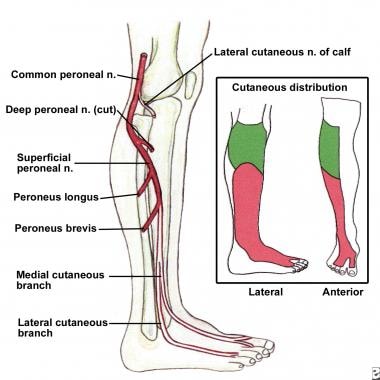
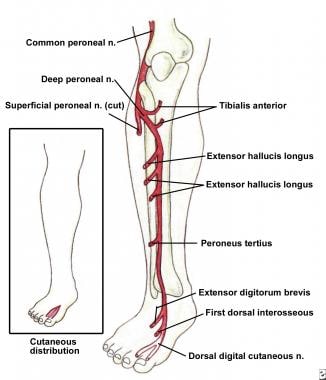
The sciatic nerve bifurcates to form the peroneal and tibial nerves either at the distal third or mid thigh level. The peroneal nerve crosses laterally to curve over the posterior rim of the fibular neck to the anterior compartment of the lower leg, dividing into superficial and deep branches. The superficial branch travels between the 2 heads of the peronei and continues down the lower leg to lie between the peroneal tendon and the lateral edge of the gastrocnemius. It then branches to the ankle anterolaterally to supply sensation to the dorsum of the foot (see Image 2). The deep branch divides just after rounding the fibular neck. The initial branch supplies the anterior tibial muscle. Remaining branches supply the extensor digitorum longus and extensor hallucis longus and a small sensory patch at the first dorsal web space (see Image 3).

The peroneal nerve is susceptible to injury all along its course. As part of the sciatic nerve, its funiculi are relatively isolated from those of the tibial nerve. Therefore, trauma to the sciatic nerve may only affect one of its divisions. Also, the funiculi of the peroneal nerve are larger and have less protective connective tissue, making the peroneal nerve more susceptible to trauma. In addition, the peroneal nerve has fewer autonomic fibers, so in any injury, motor and sensory fibers bear the brunt of the trauma. The peroneal nerve runs a more superficial course, especially at the fibular neck, also making it vulnerable to direct insult. It adheres closely to the periosteum of the proximal fibula, making it susceptible to injury during surgical procedures in this area.


Lab Studies

  • Workup of foot drop proceeds according to the suspected cause. In instances where a cause is readily identified, such as trauma, no specific diagnostic lab studies are required.
  • A spontaneous unilateral foot drop in a previously healthy patient requires further investigation into metabolic causes, including diabetes, alcohol abuse, and exposure to toxins. The following tests would be helpful:
    • Fasting blood sugar
    • Hemoglobin A1c
    • Erythrocyte sedimentation rate
    • Serum protein electrophoresis/immunoelectro-osmophoresis
    • BUN
    • Creatinine
    • Vitamin B-12 levels

Imaging Studies

  • Plain films
    • If foot drop is posttraumatic, plain films of the tibia/fibula and ankle are appropriate to uncover any bony injury.
    • In the absence of trauma, when anatomic dysfunction (eg, Charcot joint) is suspected, plain films of the foot and ankle provide useful information.
  • Magnetic resonance neurography
    • If a tumor or a compressive mass lesion to the peroneal nerve is being investigated, magnetic resonance neurography (MRN) can be used. MRN has made it possible to produce high-resolution images of peripheral nerves, as well as associated intraneural and extraneural lesions.
    • MRN can be performed using a standard 1.5 Tesla MRI system and special phased array imaging surface coils. These coils acquire image data simultaneously from multiple receive-only surface coils. Image data from each coil in the array are combined to form a composite image with an improved signal-to-noise ratio.
    • Compared to standard MRI, MRN allows faster acquisition of anatomically detailed images, smaller field of view, higher resolution, and thinner sections. These features provide images capable of showing the fascicular organization of normal peripheral nerves, thereby making the nerves more clearly distinguishable from other tissue (eg, tumor or blood vessels).
    • In one study, the fascicular structure seen on MRN was found to be functional using intraoperative electrophysiologic testing. The nonfascicular structures were nonfunctional.
    • Images can be processed further to allow stacking of axial sections and slicing of data in another plane of section. This is helpful in mapping longitudinal extent of nerve involvement.

Diagnostic Procedures

  • Electromyelogram
    • In addition to the metabolic disorders listed above, the differential diagnosis of spontaneous foot drop includes spasticity, dystonia, motor neuron disease, L5 radiculopathy, lumbosacral plexopathy, sciatic nerve palsy, compressive peroneal neuropathy, peripheral neuropathy, and some myopathies. An electromyelogram (EMG) is useful in differentiating among these diagnoses.
    • This study can confirm the type of neuropathy, establish the site of the lesion, estimate extent of injury, and predict a prognosis.
    • Sequential studies are useful to monitor recovery of acute lesions.


Medical therapy

Treatment of foot drop is directed to its etiology. If foot drop is not amenable to surgery, an ankle foot orthosis (AFO) often is used. An AFO also is used during surgical or neurologic recovery. The specific purpose of an AFO is to provide toe dorsiflexion during the swing phase, medial and/or lateral stability at the ankle during stance, and, if necessary, push-off stimulation during the late stance phase. An AFO is helpful only if the foot can achieve plantigrade position when standing. Any equinus contracture prohibits its successful use.

The most commonly used AFO in foot drop is constructed of polypropylene and inserts into a shoe. If it is trimmed to fit anterior to the malleoli, it provides rigid immobilization. This is used when ankle instability or spasticity is problematic, such as in patients with upper motor neuron diseases or stroke. If the AFO fits posterior to the malleoli (posterior leaf spring type), plantar flexion at heel strike is allowed, and push-off returns the foot to neutral for the swing phase. This provides dorsiflexion assistance in instances of flaccid or mild spastic equinovarus deformity. A shoe-clasp orthosis that attaches directly to the heel counter of the shoe also may be used.

In patients in whom foot drop is due to hemiplegia, peroneal nerve stimulation can be considered. This type of stimulation was first applied in 1961. Nerve stimulation has advantages to the AFO, as it provides active gait correction and can be tailored to individual patients. In this system, a short burst of electrical stimulation is applied to the common peroneal nerve between the popliteal fossa and fibular head. A switch in the heel of the affected limb controls this burst. The stimulator is activated when the foot is lifted, and it is then stopped when the foot contacts the ground. This achieves dorsiflexion and eversion during the swing phase of gait.

The nerve stimulator can be either external or implanted and radiofrequency activated. The use of electrical stimulation in stroke patients with spastic hemiplegia was reported to be useful in approximately 2% of the cases. This method was found to do little to improve gait speed but did improve inversion and heel strike during the stance phase, enhancing the quality of gait.

Surgical therapy

Foot drop due to direct trauma to the dorsiflexors generally requires surgical repair. When nerve insult is the cause of foot drop, treatment is directed at restoring nerve continuity, either by direct repair or removal of the insult.

If foot drop is secondary to lumbar disc herniation (a finding in 1.2-4% of patients with this condition), consider discectomy. In the early phase of this condition, decreased blood flow due to compression is thought to lead to nerve root ischemia. The nerve root is more susceptible to compression injury than is the peripheral nerve because the vascular network of the nerve root is less developed, with no regional arteriolar blood supply. Foot drop due to nerve root injury may depend on the magnitude and duration of nerve root compression. Early decompression is recommended in cases accompanied by severe motor disturbance, especially in older patients.

A review of surgical management of peroneal nerve lesions by Kim and Kline (1996) demonstrated that neural repair is the first priority in selected patients with peroneal nerve palsy. Failing sufficient recovery from nerve decompression, central or peripheral, or nerve grafting or repair, tendon transfer procedures may be considered. It has been suggested that a tendon transfer may be considered if there is no significant neural recovery at 1 year. If a foot drop is chronic and accompanied by contracture, Achilles tendon lengthening may be necessary to achieve adequate dorsiflexion.

In patients in whom foot drop is due to neurologic and anatomic factors (eg, polio, Charcot joint), arthrodesis may be the preferred option. The goal is to achieve a stable, well-aligned foot and ankle. This may be accomplished via ankle arthrodesis, Lisfranc arthrodesis, and triple or pantalar arthrodesis with or without Achilles tendon lengthening.

Preoperative details

Nerve exploration, decompression, or repair

Decisions regarding appropriate timing of nerve exploration and repair take into consideration the mechanism of insult. Sharp laceration where nerve transection is suspected warrants early repair. Blunt lacerations are repaired 2-4 weeks after injury. Lesions in continuity usually are monitored for several months by clinical examination and EMG for signs of early regeneration. If spontaneous regeneration does not occur, surgical exploration and intraoperative nerve action potential (NAP) recordings are used to determine the need for repair, either by end-to-end sutures or nerve grafts.

Treat patients who are status post knee arthroplasty or tibial osteotomy with peroneal nerve palsy initially by removing all constrictive dressings and repositioning the knee to 20 or 30° of flexion. If an expanding hematoma is noted, urgent exploration is warranted. If functional recovery does not occur within 2 months, nerve exploration and/or release has been advocated. The time interval between symptom onset and decompression appears to affect final functional outcome. However, severity of the preoperative palsy does not seem to affect recovery.

Tendon transfer

If a patient is to undergo tendon transfer surgery, retraining of the transferred tendon and stretching exercises for the Achilles tendon are advocated. Retraining may be avoided with a neurotendinous transposition of the gastrocnemius and the proximal end of the deep peroneal nerve. This procedure requires very specific patient selection in the subgroup of patients with persistent traumatic peroneal nerve palsy. The lesion of the common peroneal nerve must be at, or distal to, its branching from the tibial nerve. This guarantees that intact motor fibers proximal to the lesion are available for transposition. Paralysis must be permanent.

Specifically, there must be no recovery of function for at least 18 months after injury or following the most recent attempt at exploration or repair. Electrodiagnostic changes indicative of permanent damage must be present. Also, there must be good passive range of motion, with at least 90° of dorsiflexion. The muscles innervated by the tibial nerve must be normal. Finally, soft tissue coverage must be adequate.

Intraoperative details

Nerve exploration, decompression, or repair

The recommended approach for nerve decompression is through a longitudinal posterolateral incision centered at the fibular head and paralleling the biceps tendon and fibula. The peroneal nerve is identified at the biceps femoris and traced distally. The nerve is released proximally from its fibrous enclosure at the fibular neck. Distally, it is released to the level where it dives into the peroneus longus. The attachment of the peroneus longus at the fibular neck also is released.

A wider exposure should be used for posttraumatic exploration if immediate repair or grafting is anticipated. With the patient prone, a mildly curved incision is made just medial to the short head of the biceps femoris in the lower thigh. The incision extends to the skin posterior to the head of the fibula and then toward the anterior compartment of the leg. Superficial and deep peroneal nerve branches are exposed distal to the head of the fibula. The peroneal nerve is traced obliquely across the popliteal fossa, and its division can be split away from the tibial fossa if further length is needed. In general, limited exposure should be avoided to perform intraoperative stimulation and recording studies. Having clear exposure of the lesion, as well as viable nerve proximally and distally, is essential. Surgical exploration with NAP monitoring of lesions in continuity can document enough peroneal recovery to avoid unnecessary resection and repair.

Tendon transfer

A common method of tendon transfer moves the posterior tibial tendon, with or without complementary Achilles tendon lengthening. This procedure is accomplished via an open Z-lengthening of the Achilles to allow for a minimum of 15° of passive dorsiflexion. Route of transfer of the posterior tibial tendon may be through the intraosseous membrane or circumtibial. Ober described the circumtibial method in 1933. One series that included patients with leprosy concluded that the circumtibial route had an unacceptably high rate of recurrent inversion, leading to ulceration of the lateral border of the foot. Other series have demonstrated either method to be acceptable.

The circumtibial route is technically easier, but it may be less appealing cosmetically. The intraosseous membrane route can be prone to adhesions if the window in the membrane is too narrow. In addition to discouraging adhesions, a generous window produces a straight line of pull of the posterior tibial muscle tendon unit from its origin to its new insertion on the dorsum of the foot.

Once a transfer route is selected, the point of fixation of the split posterior tibial tendon may be tendon-to-tendon or tendon-to-bone. In tendon-to-tendon fixation, the points of attachment are (1) the peroneus brevis or tertius or extensor digitorum longus tendons for the lateral slip and (2) the tibialis anterior or extensor hallucis longus for the medial slip. In tendon-to-bone fixation, an osseous tunnel in the tarsal or metatarsal bones serves as the point of attachment. One study cited a report of a consequent neuropathic arthropathy of the tarsal joints.

A popular procedure involving the tendon-to-bone attachment is the Bridle procedure, a modification of the Riordan technique described by Rodriguez (1992). This procedure involves insertion of the posterior tibial tendon into the second cuneiform bone, combined with anastomosis of the posterior tibial tendon transfer to the anterior tibial tendon and a rerouted peroneus longus tendon in front of the lateral malleolus to balance the foot in dorsiflexion.

Five incisions are used in this technique (see Image 4). The posterior tibial tendon insertion is secured through incision 1 on the medial foot. Incision 2 is used to retrieve the end of the tendon of the posterior tibial proximal to the tarsal canal into the posterior compartment of the leg (see Images 4-5). Incision 3, on the anterior leg proximal to the ankle, provides wide exposure of the interosseous membrane. The posterior tibial tendon is pulled through the interosseous membrane and a longitudinally split anterior tibial tendon into the anterior compartment between the tibia and anterior tibial tendon. The posterior tibial tendon is anastomosed to the anterior tibial tendon with the foot in full dorsiflexion (see Image 6).

Incision 4, posterior to the lateral malleolus, accesses the peroneus longus and brevis tendons proximal to the lateral retinaculum (see Image 4). The peroneus longus is transected about 2 inches proximal to the tip of the lateral malleolus. The distal transected end of the peroneus longus is retrieved into the foot distal to the superior and inferior peroneal retinaculum. This is then transposed via a direct subcutaneous tunnel, which is anterior to the lateral malleolus. The proximal end of the transected peroneus longus is anastomosed to the peroneus brevis tendon (see Image 6).

Incision 5 accesses the distal stump of the posterior tibial tendon as it is brought to the dorsum of the foot via a subcutaneous tunnel (see Image 4). Here, it is secured to the second cuneiform while maintaining full dorsiflexion of the foot. Ideally, if the tendon has sufficient length, it should be anastomosed to itself through a tunnel in the second cuneiform. If this is not feasible, the tendon may be secured to the bone with sutures or tunneled through and secured with a button.

A series of hemiplegic patients demonstrated favorable results with anterior transfer of the long toe flexors (flexor hallucis longus [FHL] or flexor digitorum longus [FDL]), combined with Achilles tendon lengthening. The FHL or FDL was transferred intraosseously to the fourth metatarsal. If the foot drop was accompanied by a marked varus deformity, posterior tibial tendon lengthening also was performed. Short toe flexors were released if the patient had severe hammertoes.

Another method of reconstruction involving the coaptation of the extensor hallucis longus to the tibialis anterior was investigated in 8 patients who had had polio. At final review, only 2 of the patients maintained efficient dorsiflexion. These poor results were thought to be due to stretching of the coaptation.

During neurotendinous transposition, the lateral head of the gastrocnemius is transposed to the tendons of the anterior muscle group with simultaneous transposition of the proximal end of the deep peroneal nerve. The nerve is sutured to the motor nerve of the lateral head of the gastrocnemius. This restores active voluntary dorsiflexion of the foot and automatic walking. This transfer avoids use of an antagonist muscle to the paralytic group of muscles, avoiding retraining to achieve dorsiflexion. This provides physiologic muscle balance and fully automatic walking.

Postoperative details

Nerve exploration, decompression, or repair

Following a nerve exploration or graft procedure, weight bearing as tolerated is allowed with a 2-3 day period of immobilization of the knee in a Robert-Jones dressing. An AFO may be used while awaiting neural recovery.

Tendon transfer

After a tendon transfer procedure, the patient is placed in a cast and restricted to non–weight-bearing ambulation for 6 weeks. This period is then followed by physical therapy for gait training.


As with any surgical procedure, wound infection may occur. Nerve graft failure also can occur. In tendon transfer procedures, recurrent deformity is reported. In arthrodeses or fusion procedures, there may be pseudoarthrosis, delayed union, or nonunion.


As treatment is directed to the cause, so are prognosis and outcomes. In a peripheral compressive neuropathy, recovery can be expected in up to 3 months, as long as further compression is avoided. A partial peroneal nerve palsy following total knee replacement has a uniformly good prognosis. A variable amount of recovery is seen with a complete postoperative palsy. Follow-up EMG and nerve conduction studies may be useful to assess recovery. A partial palsy recovers faster due to local sprouting. Complete axon loss reinnervates by proximal-to-distal axonal growth only, usually proceeding at 1 mm per day. Therefore, injuries of a nerve close to its target muscle also have a more favorable outcome. In a nerve root compressive neuropathy, one study concluded that severe motor weakness of longer than 6 months duration, a negative straight leg raising test, and old age were considered poor prognostic factors for recovery of dorsiflexion.

When there is direct injury to the peroneal nerve, a more favorable outcome is noted with sharp versus blunt trauma. A traction or stretch injury to the nerve has an intermediate outcome. When nerve grafting is used, functional recovery depends upon the severity of injury, and therefore, the length of graft used. Good functional recovery in grafts longer than 12 cm is rarely seen.


Media file 1:  Diagram of the ground reaction vector during heel strike.
Click to see larger pictureClick to see detailView Full Size Image
Media type:  Image

Media file 2:  Common and superficial peroneal nerve, branches, and cutaneous innervation.
Click to see larger pictureClick to see detailView Full Size Image
Media type:  Image

Media file 3:  Deep peroneal nerve, branches, and cutaneous innervation.
Click to see larger pictureClick to see detailView Full Size Image
Media type:  Image

Media file 4:  Incisions for the Bridle procedure.
Click to see larger pictureClick to see detailView Full Size Image
Media type:  Image

Media file 5:  Posterior leg with the retrieved posterior tibial tendon above the ankle. The window in the interosseous membrane is noted with an "x".
Click to see larger pictureClick to see detailView Full Size Image
Media type:  Image

Media file 6:  The posterior tibial tendon (C) pulled through a slit in the anterior tibial tendon (A) and inserted into the second cuneiform. The posterior tibial tendon is anastomosed to the anterior tibial and the distal stump of the peroneus longus (B) that has been rerouted anterior to the lateral malleolus.
Click to see larger pictureClick to see detailView Full Size Image
Media type:  Image


  • Asirvatham R, Watts HG, Gillies H. Extensor hallucis longus coaptation to tibialis anterior: a treatment for paralytic drop foot. Foot Ankle. Jul-Aug 1993;14(6):343-6. [Medline].
  • Asp JP, Rand JA. Peroneal nerve palsy after total knee arthroplasty. Clin Orthop. Dec 1990;(261):233-7. [Medline].
  • Bauer T, Hardy P, Lemoine J. Drop foot after high tibial osteotomy: a prospective study of aetiological factors. Knee Surg Sports Traumatol Arthrosc. Jan 2005;13(1):23-33. [Medline].
  • Berry H, Richardson PM. Common peroneal nerve palsy: a clinical and electrophysiological review. J Neurol Neurosurg Psychiatry. Dec 1976;39(12):1162-71. [Medline].
  • Bourne RB, Rorabeck CH. Compartment syndromes of the lower leg. Clin Orthop. Mar 1989;(240):97-104. [Medline].
  • Campbell WC. Campbell's Operative Orthopaedics. Third ed. Philadelphia, Pa. C V Mosby:. 1987;223-5.
  • Chaudhry V, Corse A, Weiner L, et al. Foot drop in myasthenia gravis. Neurology. 1998;50(4):A82-3.
  • Cohen DE, Van Duker B, Siegel S. Common peroneal nerve palsy associated with epidural analgesia. Anesth Analg. Feb 1993;76(2):429-31. [Medline].
  • Coventry MB, Upshaw JE, Riley LH. Geometric total knee arthroplasty. II. Patient data and complications. Clin Orthop. Jul-Aug 1973;94:177-84. [Medline].
  • Eisele SA, Sammarco GJ. Chronic exertional compartment syndrome. Instr Course Lect. 1993;42:213-7. [Medline].
  • Granat MH, Maxwell DJ, Ferguson AC. Peroneal stimulator; evaluation for the correction of spastic drop foot in hemiplegia. Arch Phys Med Rehabil. Jan 1996;77(1):19-24. [Medline].
  • Harkless LB, Bembo GP. Stroke and its manifestations in the foot. A case report. Clin Podiatr Med Surg. Oct 1994;11(4):635-45. [Medline].
  • Hoenig LJ. Jacob''s limp. Semin Arthritis Rheum. Feb 1997;26(4):684-8. [Medline].
  • Hove LM, Nilsen PT. Posterior tibial tendon transfer for drop-foot. 20 cases followed for 1- 5 years. Acta Orthop Scand. Dec 1998;69(6):608-10. [Medline].
  • Idusuyi OB, Morrey BF. Peroneal nerve palsy after total knee arthroplasty. Assessment of predisposing and prognostic factors. J Bone Joint Surg Am. Feb 1996;78(2):177-84. [Medline].
  • Katirji B. Peroneal neuropathy. Neurol Clin. Aug 1999;17(3):567-91, vii. [Medline].
  • Kim DH, Kline DG. Management and results of peroneal nerve lesions. Neurosurgery. Aug 1996;39(2):312-9; discussion 319-20. [Medline].
  • Krackow KA, Maar DC, Mont MA. Surgical decompression for peroneal nerve palsy after total knee arthroplasty. Clin Orthop. Jul 1993;(292):223-8. [Medline].
  • Kuntz C 4th, Blake L, Britz G. Magnetic resonance neurography of peripheral nerve lesions in the lower extremity. Neurosurgery. Oct 1996;39(4):750-6; discussion 756-7. [Medline].
  • Lewis J, Mendicino RW, Mendicino SS. Compartment syndromes causing neuropathy. Clin Podiatr Med Surg. Oct 1994;11(4):593-608. [Medline].
  • Lin WS, Chen AC, Su JZ. The menarcheal age of Chinese girls. Ann Hum Biol. Sep-Oct 1992;19(5):503-12. [Medline].
  • Matsui H, Kanamori M, Kawaguchi Y. Clinical and electrophysiologic characteristics of compressed lumbar nerve roots. Spine. Sep 15 1997;22(18):2100-5. [Medline].
  • Mont MA, Dellon AL, Chen F. The operative treatment of peroneal nerve palsy. J Bone Joint Surg Am. Jun 1996;78(6):863-9. [Medline].
  • Morita S, Muneta T, Yamamoto H. Tendon transfer for equinovarus deformed foot caused by cerebrovascular disease. Clin Orthop. May 1998;(350):166-73. [Medline].
  • Moskowitz E. Rupture of the tibialis anterior tendon simulating peroneal nerve palsy. Arch Phys Med Rehabil. Sep 1971;52(9):431-3. [Medline].
  • Ninkovic M, Sucur D, Starovic B. A new approach to persistent traumatic peroneal nerve palsy. Br J Plast Surg. Apr 1994;47(3):185-9. [Medline].
  • Patel MK, Rashed A, Mesraoua B. Cyclosporin neurotoxicity presenting as an unilateral foot drop in a renal transplant patient. Nephron. 1991;58(1):116. [Medline].
  • Pritchett JW. Lumbar decompression to treat foot drop after hip arthroplasty. Clin Orthop. Jun 1994;(303):173-7. [Medline].
  • Pritchett JW. Nerve injury following hip replacement; treatment by shortening. Clin Orthop Relat Research. 2004;(418):168-71.
  • Raynor RB, Saint-Louis L. Postoperative gas bubble foot drop. A case report. Spine. Feb 1 1999;24(3):299-301. [Medline].
  • Rodriguez RP. The Bridle procedure in the treatment of paralysis of the foot. Foot Ankle. Feb 1992;13(2):63-9. [Medline].
  • Rose HA, Hood RW, Otis JC. Peroneal-nerve palsy following total knee arthroplasty. A review of The Hospital for Special Surgery experience. J Bone Joint Surg [Am]. Mar 1982;64(3):347-51. [Medline].
  • Rubin G, Cohen E. Prostheses and orthoses for the foot and ankle. Clin Podiatr Med Surg. Jul 1988;5(3):695-719. [Medline].
  • Sinacore DR, Withrington NC. Recognition and management of acute neuropathic (Charcot) arthropathies of the foot and ankle. J Orthop Sports Phys Ther. Dec 1999;29(12):736-46. [Medline].
  • Soares D. Tibialis posterior transfer for the correction of foot drop in leprosy. Long-term outcome. J Bone Joint Surg Br. Jan 1996;78(1):61-2. [Medline].
  • Strojnik P, Acimovic R, Vavken E. Treatment of drop foot using an implantable peroneal underknee stimulator. Scand J Rehabil Med. 1987;19(1):37-43. [Medline].
  • Terranova WA, McLaughlin RE, Morgan RF. An algorithm for the management of ligamentous injuries of the knee associated with common peroneal nerve palsy. Orthopedics. Aug 1986;9(8):1135-40. [Medline].
  • Weber ER, Daube JR, Coventry MB. Peripheral neuropathies associated with total hip arthroplasty. J Bone Joint Surg [Am]. Jan 1976;58(1):66-9. [Medline].
  • Wilkinson MC, Birch R. Repair of the common peroneal nerve. J Bone Joint Surg Br. May 1995;77(3):501-3. [Medline].
  • Wilson M. Charcot foot osteoarthropathy in diabetes mellitus. Mil Med. Oct 1991;156(10):563-9. [Medline].

Foot Drop excerpt

Article Last Updated: Dec 26, 2006