Continually Updated Clinical Reference
 
 
  All Sources     eMedicine     Medscape     Drug Reference     MEDLINE
 
eMedicine - Tibial Tubercle Avulsion : Article by

Quick Find
Authors & Editors
Introduction
Indications
RELEVANT ANATOMY
Contraindications
Workup
Treatment
Complications
Outcome And Prognosis
Multimedia
References


Patient Education
Click here for patient education.


Author: Janos P Ertl, MD, Clinical Assistant Professor, Department of Orthopedic Surgery, University of California at Davis; Director of Amputee Clinic, Chief of Orthopedic Trauma, Kaiser Hospital

Janos P Ertl is a member of the following medical societies: American Academy of Orthopaedic Surgeons, Hungarian Medical Association of America, Orthopaedic Trauma Association, and Sierra Sacramento Valley Medical Society

Editors: Robert D Bronstein, MD, Associate Professor, Department of Orthopedic Surgery, University of Rochester School of Medicine; Francisco Talavera, PharmD, PhD, Senior Pharmacy Editor, eMedicine; Thomas M DeBerardino, MD, Director, John A Feagin, Jr Sports Medicine Fellowship at West Point, Clinical Instructor in Surgery, Orthopedic Surgery Service, Keller Army Community Hospital at West Point; Dinesh Patel, MD, FACS, Associate Clinical Professor of Orthopedic Surgery, Harvard Medical School; Chief of Arthroscopic Surgery, Department of Orthopedic Surgery, Massachusetts General Hospital; Carlos J Lavernia, MD, FAAOS, Adjunct Clinical Professor, Department of Orthopedic Surgery, University of Miami School of Medicine; Medical Director, Orthopedic Institute at Mercy Hospital

Author and Editor Disclosure

Synonyms and related keywords: tibial tubercle fractures, knee fracture

A tibial tubercle avulsion fracture is usually an injury to the knee occurring in adolescence, during the transitional phase of physeal closure just prior to completion of growth. This fracture most often is an isolated injury related to push-off or landing while jumping as the quadriceps eccentrically contracts to support the individual's weight. The fracture tracks through the proximal tibial epiphysis and may extend into the anterior portion of the knee joint. The proximal tibia physis closes from posterior to anterior, and the fracture pattern is dependent on the amount of physeal closure present at the time of injury. Some authors consider this injury to be a variant of a Salter-Harris III fracture pattern. Open reduction and internal fixation is recommended, as reduction is difficult to maintain against the pull of the quadriceps muscle.

Problem

The difficulty with this fracture is maintaining a satisfactory reduction against the proximal pull of the quadriceps muscle. The patient usually is very close to the end of growth, and fixation of the fragment should not affect remaining growth. In the rare instance in which this fracture occurs in a younger individual, suturing of the periosteum and retinaculum and temporary smooth Kirschner wire (K-wire) fixation may be performed.

Tibial tubercle avulsions have been classified as types I, II, and III. Type I injuries demonstrate minimal displacement and often can be treated with cast immobilization. Type II lesions maintain an intact superior contact between the avulsed portion of the tibial tubercle and the remaining portion of the tibial epiphysis. The articular surface of the knee is not disrupted. In type III injuries, the fracture extends through the articular surface of the knee with occasional meniscal disruption. Type II and III injuries require stabilization of the extensor mechanism through an open technique to replace the fragment and to remove any interposed periosteum. In type III injuries, exploration of the knee joint is necessary to address intra-articular comminution and meniscal pathology.

Frequency

Tibial tubercle avulsion fractures are commonly seen in athletic males (frequently basketball players) aged 14-16 years. These fractures account for 1-3% of physeal injuries.

Etiology

The mechanism of injury usually is an indirect force caused by sudden contraction of the quadriceps muscle. During sudden acceleration and deceleration forces, the quadriceps mechanism forcefully contracts against the patellar tendon insertion. When the force is greater than the strength of the tibial tubercle physis, a fracture is created, leading to avulsion of the tibial tubercle. Additional predisposing factors include patella baja, tight hamstrings, preexisting Osgood-Schlatter disease, and disorders involving physeal abnormalities.

Pathophysiology

The tibial tubercle physis is in continuity with the tibial plateau. The physis progressively fuses from posterior to anterior, making it most vulnerable to avulsion in adolescents aged 13-16 years.

Clinical

The physical examination reveals swelling and tenderness over the anterior tibia. A palpable bone fragment and hemarthrosis may be present. With severe displacement, a high riding patella and loss of active knee extension are present.


Although a type I fracture may not be displaced, it is difficult to maintain this reduction against the pull of the quadriceps muscle. Close observation in the first 2 weeks is necessary. Often, percutaneous or open reduction can be performed to maintain motion within the knee.

Displaced types II and III avulsion fractures require operative fixation due to loss of the extensor mechanism length, tension, and continuity. Type III fractures may demonstrate articular comminution and possible meniscal disruption requiring meniscal repair.


The proximal tibia physis progressively closes from posterior to anterior. The tibial tubercle is vulnerable to injury during the transitional phase of closure.


Type I fractures are minimally displaced and may be treated with cast immobilization. However, close observation is required.


Imaging Studies

  • Standard radiographs including anteroposterior (AP), lateral, oblique, and 15° cephalad views of the knee are recommended.
  • Tibial tubercle avulsion injuries usually are isolated, and any additional injuries require further evaluation as indicated for that injury.

Staging

Classifications have been described by Watson-Jones based on size and amount of displacement, as follows:

  • Type I is a small fragment that is proximally displaced.
  • In type II injuries, the secondary center of ossification has coalesced with the proximal tibial epiphysis, with the fracture occurring at this junction. The articular surface remains intact.
  • In type III injuries, the fracture extends through the articular surface. Comminution and meniscal disruption may be present.

Ogden further subdivided the above Watson-Jones classification into A and B categories to account for the degree of displacement (A) and comminution (B).


Surgical therapy

For all fracture types, ice therapy, splint immobilization, and elevation should be initiated to avoid significant swelling.

Types IB, II, and III tibial tubercle fractures require open reduction and internal fixation. An anterior approach to the knee is used over the proximal tibia. Fixation is best accomplished with 1 or 2 screws through the tibial tubercle into the proximal tibia. C-arm control is recommended to avoid overpenetration of the posterior tibial cortex.

Growth arrest is uncommon, as this fracture usually occurs at the end of physeal closure. Should significant growth remain, smooth K-wires may be used temporarily to allow continued growth and avoid the possibility of recurvatum (hyperextension). In younger patients, the periosteum and retinaculum may be sutured. The screws should be placed at a right angle to the avulsed fragment, proximally and posterior, not inclined distally, to avoid a tendency to pull out.

In type III fractures, comminution and meniscal disruption may be present. An anterior medial arthrotomy is recommended for visualization and exploration. Anatomic reduction should be the goal. Temporary fixation with K-wires may be applied and radiographically evaluated prior to definitive fixation. Repair meniscal tears, and reestablish tibial plateau articular continuity.

An advanced approach to evaluation and treatment is arthroscopic-assisted reduction and internal fixation. The tibial plateau can be visualized, fragments repositioned, and meniscal pathology addressed. Cross training in both arthroscopic techniques and fracture treatment are necessary.

Should a compartment syndrome be identified, preparation is made for release of all the affected compartments. Because of the large vascular bone surface involved, this may be found in type 3 patterns.

Preoperative details

Surgical preparation should include a preoperative planning for the following:

  • Anterior surgical approach
  • Removal of interposed soft tissue (periosteum)
  • Evaluation for intra-articular extension, comminution, or meniscal tear, usually type III injuries
  • Reduction of fragment with bone reduction forceps
  • Evaluation of reduction under fluoroscopic control
  • Placement of 1-2 interfragmentary compression screws; possible washers, cannulated or noncannulated
  • Evaluation of fixation with fluoroscopy
  • Repair of periosteum
  • Evaluation of fixation stability
  • Wound closure
  • Placement of range of motion brace

Intraoperative details

In all open reductions, check for interposed periosteum, remove from the fracture site, and maintain the periosteal attachment for later repair. In type III fractures, a medial peripatellar arthrotomy may be necessary to evaluate the articular surface for comminution, as well as for possible meniscal tear.

Postoperative details

If the fixation is believed to be stable, range of motion therapy is initiated. Consultation with a physical therapist (PT) is requested for crutch-assisted touchdown weightbearing (TDWB) ambulation. Heel slides under PT assistance or continuous passive motion (CPM) is initiated. CPM is started from 0-45° at 2 cycles per minute. CPM is increased incrementally over a 1- to 2-week period or as the patient tolerates. TDWB is continued for a minimum of 5-6 weeks, at which time progressive full weightbearing may be resumed. Lower extremity strengthening and hamstring stretching exercises also are started at this time.

Follow-up

The patient is discharged from the hospital when pain is manageable on an outpatient basis. Follow-up evaluations are performed at 10-14 days, 4 weeks, 2 months, 3 months, and 6 months, with AP and lateral radiographs obtained until the fracture has healed. Additional visits may be required, depending on patient progress. The brace is removed after 5-6 weeks. Physical therapy is continued as an outpatient as outlined above.


Complications of treatment of tibial tubercle avulsion fracture include genu recurvatum (hyperextension) due to premature physeal closure of the anterior physis. However, this complication is rare, as the fracture usually occurs in the transitional physis, near the end of closure and growth.

Residual knee stiffness may occur secondary to prolonged immobilization and arthrofibrosis.

Patella alta may occur if the reduction is not anatomic or if fixation is not stable enough, leading to proximal migration of the tubercle fragment.

An recent episode of a type 3 injury in an athlete that led to compartment syndrome is described. The patient was playing basketball and sustained an acute type 3 injury. The patient was seen in an emergency department, placed on crutches, and told to follow up at his home of record. No immobilization was given. The patient was placed on a commercial airplane with his leg maintained in a dependent position. Upon arrival, the patient exhibited a full-blown compartment syndrome, necessitating a 4-compartment fasciotomy. Arthroscopy and internal fixation of the fracture was performed.


With appropriate surgical treatment and postoperative therapy, a complete recovery without residual symptoms is expected. A return to sports may be expected once the lower extremity strength is 90% that of the unaffected extremity, usually 4-6 months after injury.


Media file 1:  Diagrammatic view of tibial tubercle avulsion classification types I, II, and III.
Click to see larger pictureClick to see detailView Full Size Image
Media type:  Image

Media file 2:  Type III tibial tubercle avulsion. Note intra-articular fracture extension and anterior elevation.
Click to see larger pictureClick to see detailView Full Size Image
Media type:  X-RAY

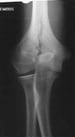
Media file 3:  Anteroposterior view of a type II tibial tubercle avulsion. The injury could be missed if a lateral view is not obtained.
Click to see larger pictureClick to see detailView Full Size Image
Media type:  X-RAY

Media file 4:  Intraoperative view after open reduction and internal fixation of a type III tibial tubercle avulsion.
Click to see larger pictureClick to see detailView Full Size Image
Media type:  X-RAY


  • Bolesta MJ, Fitch RD. Tibial tubercle avulsions. J Pediatr Orthop. Mar-Apr 1986;6(2):186-92. [Medline].
  • Christie MJ, Dvonch VM. Tibial tuberosity avulsion fracture in adolescents. J Pediatr Orthop. 1981;1(4):391-4. [Medline].
  • Ogden JA, Tross RB, Murphy MJ. Fractures of the tibial tuberosity in adolescents. J Bone Joint Surg Am. Mar 1980;62(2):205-15. [Medline].
  • Roberts JM. Avulsion fracture of the proximal tibial epiphysis. In: Kennedy JC (ed). The injured Adolescent Knee. Williams & Wilkens: Baltimore;1979.
  • Roberts JM. Fractures and dislocations of the knee.In: Rockwood CA Jr, Wilkens KE, King RE (eds). Fractues in Children. JB Lippincott: Philadelphia;1984.

Tibial Tubercle Avulsion excerpt

Article Last Updated: Nov 16, 2005