Continually Updated Clinical Reference
 
 
  All Sources     eMedicine     Medscape     Drug Reference     MEDLINE
 
eMedicine - Hallux Varus : Article by

Quick Find
Authors & Editors
Introduction
Indications
Relevant Anatomy
Contraindications
Workup
Treatment
Complications
Outcome and Prognosis
Multimedia
References


Patient Education
Foot Care Center

Corns and Calluses Overview

Corns and Calluses Causes

Corns and Calluses Symptoms

Corns and Calluses Treatment


Author: Amy Jo Ptaszek, MD, Assistant Professor, Department of Orthopedic Surgery, University of Texas Southwestern Medical Center

Amy Jo Ptaszek is a member of the following medical societies: American Academy of Orthopaedic Surgeons, American Medical Association, American Orthopaedic Foot and Ankle Society, and Texas Medical Association

Editors: John S Early, MD, Foot/Ankle Specialist, Texas Orthopaedic Associates, LLP; Co-Director, North Texas Foot and Ankle Fellowship Baylor University Medical Center; Francisco Talavera, PharmD, PhD, Senior Pharmacy Editor, eMedicine; Shepard R Hurwitz, MD, Executive Director, American Board of Orthopaedic Surgery; Dinesh Patel, MD, FACS, Associate Clinical Professor of Orthopedic Surgery, Harvard Medical School; Chief of Arthroscopic Surgery, Department of Orthopedic Surgery, Massachusetts General Hospital; Jason H Calhoun, MD, FAAOS, Chairman, J Vernon Luck Distinguished Professor, Department of Orthopedic Surgery, University of Missouri

Author and Editor Disclosure

Synonyms and related keywords: medial deviation of the great toe, flexible hallux varus, hallux valgus, congenital hallux varus, primary dynamic infantile hallux varus, traumatic hallux varus, idiopathic hallux varus, first metatarsophalangeal joint arthrodesis, MTP arthrodesis, intermetatarsal angle, IM angle

Fossilized evidence of modern man in Africa from 3 million years ago reveals footprints that show hallux varus. Other imprints uncovered in northern Japan are dated to 2300 BC and also show varus alignment. The later impact of shoe wear had a definite influence on alignment of the hallux.

Flexible hallux varus is seen in newborns and is a reflection of intrauterine positioning. On the other hand, the normal 0-20º that is seen in hallux valgus occurs after walking has begun in the child and after shoes have been introduced to the child's feet.

Problem

The term hallux varus refers to medial deviation of the great toe. Hallux varus has variable degrees of severity, symptomatology, and etiology. Causes range from the most common iatrogenic postoperative variety to idiopathic, rheumatic, and posttraumatic (tear of the hallux lateral collateral ligament) forms. Flexible hallux varus is a common finding in newborn children and usually corrects to valgus in early childhood when walking begins.

Frequency

The incidence of iatrogenic postoperative hallux varus ranges from 0% for distal osteotomies without a lateral release to 15% for proximal osteotomies (specifically, the Lapidus procedure) with distal soft-tissue release. Most reports are of crescentic osteotomies, which have an overall varus rate of 10%. The incidence of idiopathic, congenital/infantile, traumatic, and otherwise acquired hallux varus, however, is unknown.

Etiology

Congenital hallux varus is separated into primary and secondary pathologic deformities. Primary hallux varus is a rare condition that is usually related to an overactive abductor hallucis muscle. Secondary hallux varus is related to other congenital abnormalities, such as metatarsus adductus, great toe polydactyly, longitudinal epiphyseal bracket syndrome, and delta phalanx.

Primary dynamic infantile hallux varus is caused by medial insertion of the abductor tendon. Acquired adult hallux varus is described in inflammatory arthropathies, including rheumatoid and psoriatic arthritis. The mechanism of such arthropathies combines destruction of the articular surfaces by pannus, intrinsic muscular contracture, and distention of the joint capsule with subsequent laxity of the collateral ligaments.

Few reports exist of traumatic hallux varus following sports injuries. Of these cases, hallux varus occurred secondary to rupture of the lateral collateral ligament and conjoined tendon.

Spontaneous idiopathic hallux varus may be noted incidentally and is usually supple. An etiologic factor is not always demonstrable. The initial deforming force is likely overpull of the abductor tendon, which is related to medial insertion into the proximal phalanx; this may be influenced by an inflammatory process or by minor trauma. The imbalance leads to varus deformity and subsequent contracture of the medial capsule, decrease of the intermetatarsal (IM) angle, and medial subluxation of the flexor and extensor mechanisms. Shoe wear tends to correct the varus deformity rather than exacerbate it, as it does for hallux valgus. Therefore, spontaneous idiopathic hallux varus may be more common than is reported.

The classic deformity of hallux varus occurs most frequently following a surgical procedure, typically a distal soft-tissue or McBride type of bunionectomy, but it can also be produced following Silver, Chevron, Mitchell, Keller, and Lapidus procedures. Classically, the deformity is characterized by hyperextension of the metatarsophalangeal (MTP) joint, flexion of the interphalangeal (IP) joint, medial deviation of the hallux, and supination of the entire ray. This posture results from muscle imbalance that is brought about by the medial subluxation of the tibial sesamoid. Release or transfer of the adductor hallucis alone is not sufficient to produce dynamic hallux varus; however, when coupled with excision of the fibular sesamoid or transection of the lateral head of the flexor brevis tendon, hallux varus likely results. Other predisposing factors for hallux varus are a small IM angle and a round metatarsal head.

Flexion of the MTP joint is brought about by the flexor hallucis brevis muscle through its pull on the sesamoid sling. If the fibular sesamoid is excised, the metatarsal may buttonhole through the defect and result in hyperextension and medial deviation of the MTP joint. Medial deviation is exacerbated when the adductor tendon is detached and nothing opposes the pull of the abductor hallucis muscle.

Potential contributing factors include overplication of the medial capsular structures, medial displacement of the tibial sesamoid, overpull of the abductor hallucis muscle against an incompetent lateral ligamentous complex, excessive resection of the medial eminence, and overcorrection with a postoperative dressing that holds the MTP joint in a varus position. Another cause of hallux varus is overcorrection of a proximal first metatarsal osteotomy, leading to a negative IM angle.

Clinical

The usual symptoms encountered with hallux varus include deformity, pain, decreased range of motion (ROM), instability, clawing of the great toe, weakness with push-off, and problems with shoe wear. Clinical examination is important to assess the stiffness of the MTP and IP joints. Carefully analyze the degree of extension of the first MTP joint, and determine whether weight bearing and the dynamics of ambulation accentuate the deformity. Examine the plantar surface for any callosity under the metatarsal head. Evaluate and note the ROM of the MTP and IP joints and whether there is any pain or crepitation.

Cosmetic alignment of the hallux may not require radiographic congruence of the MTP joint. Based on the literature, some degree of varus is acceptable to patients, appears to be stable, and does not require reconstruction. According to some sources, there is little clinical significance to hallux varus of 8º or less.1 Additionally, hallux varus is better tolerated by the patient if the condition does not include a cockup deformity. However, over time, a varus deformity becomes fixed, making it difficult to wear shoes. Contracture of the IP joint, coupled with fixed extension of the MTP joint, can produce a painful dorsomedial callosity.


The patient who has hallux varus and is symptomatic despite conservative measures for the condition, such as shoe modification, is a surgical candidate. The treatment options are either soft-tissue or bony reconstruction, including arthrodesis.


Cadaveric biomechanical studies have revealed that the anatomic restraints to hallux varus, in descending order, are the lateral capsule, the adductor hallucis, and the lateral flexor brevis tendon.


Relevant contraindications to tendon transfer reconstruction for hallux varus include, but are not limited to, degenerative arthrosis, inflammatory arthritides, infection, peripheral neuropathy, and vascular compromise, in addition to excessive resection of the medial eminence and fixed deformity of the MTP joint.


Lab Studies

  • Order laboratory studies that are applicable to the specific patient.
  • If infection is suspected, obtain the following indices:
    • Erythrocyte sedimentation rate (ESR)
    • C-reactive protein (CRP)
    • White blood cell (WBC) count
  • Joint aspiration may also be indicated. If inflammatory disease is suspected, obtain rheumatoid arthritis (RA) and antinuclear antibody (ANA) factors.

Imaging Studies

  • Weight-bearing radiographs of both feet, including anteroposterior, lateral, and sesamoid views, help clinicians to assess the degree of varus, the IM and IP angles, the position of the sesamoids relative to the metatarsal head, and any degenerative changes in the MTP and/or IP joints.


Surgical therapy

Various authors have described numerous procedures for the treatment and correction of hallux varus. A sampling of procedures, used both alone and in conjunction with others, are as follows:

  • Lengthening of the medial capsular structures
  • Lengthening of the extensor hallucis longus (EHL)
  • Relocation of the sesamoid(s)
  • Skin resection of the first webspace
  • Syndactyly of the great and second toes
  • Total joint release
  • Abductor hallucis transfer
  • Ligapro suture/technique
  • Split extensor hallucis brevis (EHB) transfer and reverse Akin procedure
  • EHL transfer with IP arthrodesis
  • EHB transfer
  • Keller resection arthroplasty
  • Implant arthroplasty
  • MTP arthrodesis

In 1971, Hawkins described transfer of the abductor hallucis tendon to the lateral aspect of the proximal phalanx with release of the medial capsule and mobilization of the medial sesamoid.2 Patients demonstrated maintenance of alignment between 5 and 54 months. A few years later, Miller described a proximal phalangeal resection for treatment of early-acquired hallux varus (ie, before the deformity became fixed and clawing was present). However, no functional outcome was published.

In 1984, Johnson and Spiegl advocated transfer of the EHL tendon to the proximal phalanx as a dynamic stabilizer, coupled with IP joint arthrodesis for flexible hallux varus without MTP arthrosis.3 This improved flexion of the MTP joint from –23° to +6°, and total ROM increased from 38° to 67°. The varus was corrected an average of 18°. Later, modification utilized a split EHL transfer with preservation of the IP joint in the absence of deformity at the IP joint, which resulted in less MTP motion.

Skalley and Myerson reported their experience with EHL transfer and IP arthrodesis in a retrospective study; the split EHL transfer resulted in symptomatic joint stiffness.4 Later, Myerson and Komenda described a tenodesis of the EHB tendon in conjunction with a medial soft-tissue release for correction of a flexible hallux varus deformity.5 The tenodesis was thought to act as a static restraint, as opposed to a dynamic restraint to varus-deforming forces. The authors reported restoration of alignment to an average of 0°, minimal loss of sagittal plane motion, and no stiffness and/or weakness.5

Tourne et al published a report of a case series of 14 French patients with iatrogenic hallux varus.6 The authors performed MTP arthrodesis in 9 patients who had stiffness and arthrosis. In 5 cases, the lateral ligament complex was reconstructed with use of a Ligapro suture (an elastic polyethylene terephthalate device that is not available in the United States). Arthrolysis was performed in all patients. Tourne et al reported excellent outcomes using this technique in patients who were younger, had a mobile MTP joint, and had no evidence of degenerative changes on radiographs. The reported results were an average postoperative correction of 20° of plantar flexion and 60-90° of dorsiflexion of the MTP joint.

Resection arthroplasty can decompress the joint at the same time the tendons and capsule are balanced. Loss of strength and floppiness has been reported postoperatively but may not be bothersome in patients who are elderly or in those who have significant degenerative disease. Note, however, that implant arthroplasty is ill-advised in light of the soft-tissue imbalance that is present in patients who have hallux varus.

MTP arthrodesis remains a logical salvage technique for patients who have hallux varus deformity with arthrosis and bone loss. Moderate to severe degenerative changes should probably be addressed with arthrodesis or osteotomy.

Correction of the first IM angle may require metatarsal osteotomy in addition to a soft-tissue balancing procedure for the MTP joint.


Potential complications include overcorrection (ie, hallux valgus), avascular necrosis of the metatarsal head, stiffness, progression of degenerative changes in the MTP joint, shortening of the medial column, transfer metatarsalgia, and medial wound complications.


Surgery is aimed at improving the overall position of the hallux, not necessarily the motion. Preoperatively, surgeons must inform patients that further salvage procedures may be necessary and that most surgical procedures that are directed at correcting iatrogenic hallux varus are 60-80% effective. In one series of patients treated with extensor hallucis brevis tenodesis, the American Orthopaedic Foot and Ankle Society (AOFAS) hallux MTP-IP score improved from 61 to 85.7


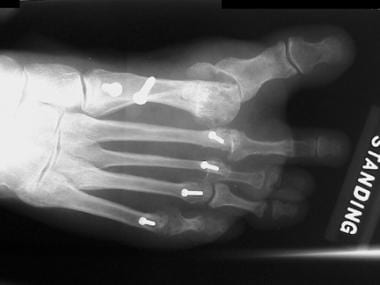
Media file 1:  Anteroposterior radiograph of the foot. This image shows iatrogenic hallux varus following proximal osteotomy and distal soft-tissue realignment.
Click to see larger pictureClick to see detailView Full Size Image
Media type:  X-RAY

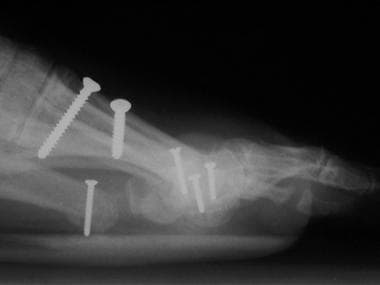
Media file 2:  Lateral radiograph of the foot. This image depicts iatrogenic hallux varus following proximal osteotomy and distal soft-tissue realignment.
Click to see larger pictureClick to see detailView Full Size Image
Media type:  X-RAY

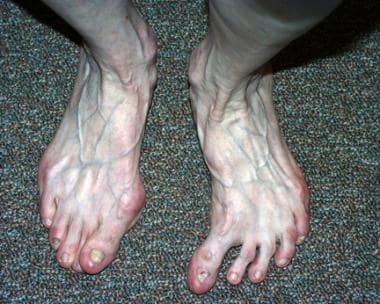
Media file 3:  Clinical photo of idiopathic hallux varus of the left foot.
Click to see larger pictureClick to see detailView Full Size Image
Media type:  Photo

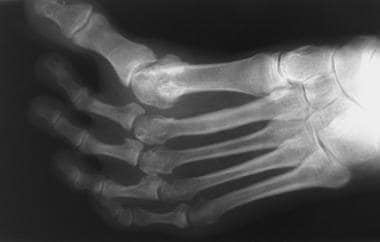
Media file 4:  Anteroposterior radiograph of the foot. This image depicts idiopathic hallux varus.
Click to see larger pictureClick to see detailView Full Size Image
Media type:  X-RAY

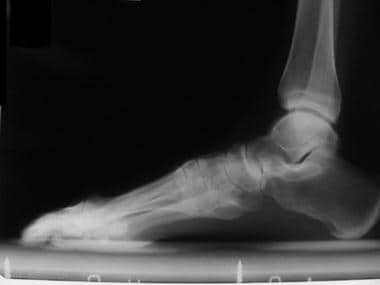
Media file 5:  Lateral radiograph of the foot. This image shows idiopathic hallux varus.
Click to see larger pictureClick to see detailView Full Size Image
Media type:  X-RAY


  1. Mann RA, Coughlin MJ, eds. Adult hallux valgus. Surgery of the Foot and Ankle. 6th ed. St. Louis, Mo: Mosby, Inc; 1993:284-92.
  2. Hawkins FB. Acquired hallux varus: cause, prevention and correction. Clin Orthop Relat Res. May 1971;76:169-76. [Medline].
  3. Johnson KA, Spiegl PV. Extensor hallucis longus transfer for hallux varus deformity. J Bone Joint Surg Am. Jun 1984;66(5):681-6. [Medline][Full Text].
  4. Skalley TC, Myerson MS. The operative treatment of acquired hallux varus. Clin Orthop Relat Res. Sep 1994;(306):183-91. [Medline].
  5. Myerson MS, Komenda GA. Results of hallux varus correction using an extensor hallucis brevis tenodesis. Foot Ankle Int. Jan 1996;17(1):21-7. [Medline].
  6. Tourné Y, Saragaglia D, Picard F, et al. Iatrogenic hallux varus surgical procedure: a study of 14 cases. Foot Ankle Int. Aug 1995;16(8):457-63. [Medline].
  7. Vanore JV, Christensen JC, Kravitz SR, et al. Diagnosis and treatment of first metatarsophalangeal joint disorders. Section 3: hallux varus. J Foot Ankle Surg. May-Jun 2003;42(3):137-42. [Medline].
  8. Docquier PL, Leemrijse T, Rombouts JJ. Clinical and radiographic features of operatively treated stiff clubfeet after skeletal maturity: etiology of the deformities and how to prevent them. Foot Ankle Int. Jan 2006;27(1):29-37. [Medline].
  9. Granberry WM, Hickey CH. Idiopathic adult hallux varus. Foot Ankle Int. Apr 1994;15(4):197-205. [Medline].
  10. Jahss MH. Disorders of the hallux and first ray. Disorders of the Foot and Ankle: Medical and Surgical Management. 2nd ed. Philadelphia, Pa: WB Saunders Co; 1991:1084-9.
  11. Juliano PJ, Myerson MS, Cunningham BW. Biomechanical assessment of a new tenodesis for correction of hallux varus. Foot Ankle Int. Jan 1996;17(1):17-20. [Medline].
  12. Kato T, Watanabe S. The etiology of hallux valgus in Japan. Clin Orthop Relat Res. Jun 1981;157:78-81. [Medline].
  13. Miller JW. Acquired hallux varus: a preventable and correctable disorder. J Bone Joint Surg Am. Mar 1975;57(2):183-8. [Medline][Full Text].
  14. Sanders M. Complications of hallux valgus surgery. Complications of Foot and Ankle Surgery. 1998:1-18.
  15. Thompson SA. Hallux varus and metatarsus varus: a five-year study. Clin Orthop Relat Res. 1960;16:109-18.

Hallux Varus excerpt

Article Last Updated: Aug 30, 2007