Continually Updated Clinical Reference
 
 
  All Sources     eMedicine     Medscape     Drug Reference     MEDLINE
 
eMedicine - Galeazzi Fracture : Article by

Quick Find
Authors & Editors
Introduction
Indications
Relevant Anatomy
Contraindications
Workup
Treatment
Complications
Outcome and Prognosis
Future and Controversies
Multimedia
References


Patient Education
Breaks, Fractures, and Dislocations Center

Broken Arm Overview

Broken Arm Causes

Broken Arm Symptoms

Broken Arm Treatment


Author: Janos P Ertl, MD, Clinical Assistant Professor, Department of Orthopedic Surgery, University of California at Davis; Director of Amputee Clinic, Chief of Orthopedic Trauma, Kaiser Hospital

Janos P Ertl is a member of the following medical societies: American Academy of Orthopaedic Surgeons, Hungarian Medical Association of America, Orthopaedic Trauma Association, and Sierra Sacramento Valley Medical Society

Editors: Peter M Murray, MD, Associate Professor of Orthopedic Surgery, Mayo Clinic College of Medicine; Director of Education, Mayo Foundation for Medical Education and Research, Jacksonville; Consultant, Department of Orthopedic Surgery, Mayo Clinic, Jacksonville; Consulting Staff, Nemours Children's Clinic and Wolfson's Children's Hospital; Francisco Talavera, PharmD, PhD, Senior Pharmacy Editor, eMedicine; Dinesh Patel, MD, FACS, Associate Clinical Professor of Orthopedic Surgery, Harvard Medical School; Chief of Arthroscopic Surgery, Department of Orthopedic Surgery, Massachusetts General Hospital; Harris Gellman, MD, Consulting Surgeon, Broward Hand Center, Voluntary Clinical Professor of Orthopedic Surgery and Plastic Surgery, Departments of Orthopedic Surgery and Surgery, University of Miami School of Medicine

Author and Editor Disclosure

Synonyms and related keywords: Galeazzi fracture-dislocation, reverse Monteggia fracture, Piedmont fracture, Darrach-Hughston-Milch fracture, fracture of necessity, radial shaft fracture, dislocation of the distal ulna, forearm fracture, broken arm

The Galeazzi fracture-dislocation is an injury pattern involving a radial shaft fracture with associated dislocation of the distal radioulnar joint (DRUJ); the injury disrupts the forearm axis joint.

For excellent patient education resources, visit eMedicine's Breaks, Fractures, and Dislocations Center. Also, see eMedicine's patient education article Broken Arm.

History of the Procedure

The Galeazzi fracture injury pattern was first described 1842, by Cooper, 92 years before Galeazzi reported his results. Ricardo Galeazzi (1866-1952), an Italian surgeon at the Instituto de Rachitici in Milan, was known for his extensive work experience on congenital dislocation of the hip. In 1934, he reported on his experience with 18 fractures with the above-described pattern as a compliment to the Monteggia lesion. Such fractures have since become synonymous with his name.

In 1941, Campbell termed the Galeazzi fracture the "fracture of necessity," because it necessitates surgical treatment; in adults, nonsurgical treatment of the injury results in persistent or recurrent dislocations of the distal ulna. Although researchers have been unable to reproduce the mechanism of injury in a laboratory setting, Hughston outlined the definitive management of these fractures in 1957.1

Problem

Galeazzi fractures are isolated fractures of the junction of the distal third and middle third of the radius with associated subluxation or dislocation of the DRUJ. (See also the eMedicine articles Fractures, Forearm and Radius, Distal Fractures.)

Frequency

Galeazzi fractures account for 3-7% of all forearm fractures. They are seen most often in males. Although Galeazzi fracture patterns are reportedly uncommon, they are estimated to account for 7% of all forearm fractures in adults.

Etiology

The etiology of the Galeazzi fracture is thought to be a fall that causes an axial load to be placed on a hyperpronated forearm.

Pathophysiology

The deforming forces include those of the brachioradialis, pronator quadriceps, and thumb extensors, as well as the weight of the hand. The deforming muscular and soft-tissue injuries that are associated with this fracture cannot be controlled with plaster immobilization.

Clinical

Pain and soft-tissue swelling are present at the distal-third radial fracture site and at the wrist joint. This injury is confirmed on radiographic evaluation.

Forearm trauma may be associated with compartment syndrome. See the eMedicine article Compartment Syndrome, Upper Extremity for further treatment information.

Anterior interosseous nerve (AIN) palsy may also be present, but it is often overlooked because there is no sensory component to this finding. A purely motor nerve, the AIN is a division of the median nerve. Injury to the AIN can cause paralysis of the flexor pollicis longus (FPL) and flexor digitorum profundus (FDP) to the index finger, resulting in loss of the pinch mechanism between the thumb and index finger.


Galeazzi fractures are best treated with open reduction of the radius and DRUJ. Closed reduction and cast application have led to unsatisfactory results. The term "fracture of necessity" refers to the fact that the adult Galeazzi fracture is not amenable to treatment by closed means, necessitating surgical stabilization.

Open forearm fractures constitute a surgical emergency. Open wounds may require incorporation into the surgical incision. Immediate stabilization of the radial fracture and the DRUJ is recommended.

Galeazzi fractures in skeletally immature patients are typically treated with closed reduction and casting because of the enhanced viscoelastic nature of pediatric bone, as well as the presence of a stout periosteal sleeve.


See Intraoperative Details.2


The only contraindication to surgical intervention is the existence of life-threatening conditions, which take priority. In these situations, definitive surgical management is deferred until the patient is stabilized.


Imaging Studies

  • Radiographs
    • The diagnosis of a Galeazzi fracture is confirmed on radiographic examination.
    • Standard anteroposterior (AP) and true lateral forearm views are obtained, which must include an AP or a posteroanterior (PA) view, as well as a lateral view, of the wrist, along with AP and lateral views of the elbow.
    • Radiographs of the contralateral extremity can be obtained for comparison.
  • Plain radiographic findings suggestive of injury to the DRUJ are as follows:
    • Fracture at the ulnar styloid base
    • Widening of the DRUJ space on an AP radiograph
    • Dislocation of the radius relative to the ulna on a true lateral radiograph, which is obtained with the shoulder abducted 90°
    • Shortening of the radius by more than 5 mm relative to the distal ulna
  • Assessment of DRUJ integrity is often difficult using plain radiography alone. A bilateral, axial computed tomography (CT) scan of the forearm is the preferred imaging study for diagnosing DRUJ disruption.


Surgical Therapy

All adult Galeazzi fractures must be treated with open reduction and internal fixation (ORIF). Anatomic surgical reduction of the radius and the DRUJ provides the best opportunity for healing.

Preoperative Details

As with any fracture, preoperative planning is necessary. Appropriate radiographs are required, cutout templates are made to simulate reduction, and an implant is chosen. Contralateral extremity radiographs are of benefit as a template.

Preoperative planning is as follows:

  • Operative consent for ORIF and possible bone grafting
  • Radiographs and cutout plan available
  • Small fragment (3.5-mm) fixation system with dynamic compression plates (DCPs) or the newer limited contact dynamic compression plate (LCDCP)
  • Radiolucent hand table
  • C-arm availability
  • Tourniquet

Intraoperative Details

Intraoperative details are as follows:

  • Use standard orthopedic preparation and draping of the extremity and iliac crest, as needed, if bone grafting is required.
  • Exsanguinate, and elevate the tourniquet 200-250 mm Hg.
  • A volar Henry approach is used most often to expose the radius; however, the Thompson approach may be used for proximal radial fractures. The surgeon should use the approach that is most familiar. (See also the eMedicine article Forearm Fractures.)
  • The fracture is reduced with the aid of sharp or broad fracture reduction forceps and manual traction. C-arm radiographic visualization can be used to confirm fracture/bone alignment.
  • Apply a 3.5-mm compression plate.
  • Evaluate the fracture and DRUJ for realignment and reduction.
  • Rotate the forearm and assess for any DRUJ instability.
    • If the DRUJ is stable, specifically evaluate in supination. If reducible and stable in supination, splint in supination for 4 weeks after surgery.
    • If the DRUJ is reducible in supination but unstable, stabilize the DRUJ in supination by placing 2 0.045 Kirschner wires (K-wires) from the ulna into the radius, just proximal to the articular surface.
    • If the DRUJ is unstable and irreducible, perform an open reduction through a dorsal approach, remove soft tissue from the DRUJ, and stabilize the DRUJ in the above-described manner.
  • If displaced, ulnar styloid base fractures may represent significant DRUJ instability that requires ORIF. This can be accomplished through an approach to the ulna, using the interval between the flexor carpi ulnaris (FCU) and the extensor carpi ulnaris (ECU).
  • Release the tourniquet, obtain hemostasis prior to closure, and assess vascular fill to the digits.
  • Although the procedure is controversial, bone graft may be applied to grossly comminuted fractures. As a result of retrospective comparison of comminuted forearm fractures, questions have arisen concerning the need for acute bone grafting. No differences appeared to be present in healing rates and time to union in the small series studies that have been conducted, suggesting that routine bone grafting is not indicated. However, larger, prospective studies are required. Should the surgeon decide to place supplemental autogenous bone graft, this may be harvested from the olecranon and/or the drill bit on each screw placement.
  • Check the reduction with radiograph.
  • Irrigate and close wounds.
  • Apply a long arm splint with the forearm placed in supination.

Postoperative details

Postoperative details are as follows:

  • Elevate the upper extremity.
  • Apply ice to the operative site as needed.
  • Check neurologic and vascular status. Specifically, evaluate for function of the AIN and for the presence of compartment syndrome.
  • Immobilize the forearm in supination for 4 weeks, with removal of any percutaneous pins at 4 weeks.
  • Immediately after surgery, institute occupational therapy for digital and shoulder range of motion.

Follow-up

Follow-up care is as follows:

  • At 7 and 14 days after surgery, the wound is examined. Remove the sutures 10-14 days after surgery, obtain radiographs at each visit, and replace the splint with an above-elbow cast brace in supination.
  • At 4 weeks, obtain radiographs to recheck alignment and reduction of the radius and DRUJ, remove pins if present, recheck radiographs to confirm maintenance of reduction, and replace the cast brace in supination.
  • At 6 weeks, remove the cast, obtain radiographs, and initiate physical therapy for elbow, wrist, and digital motion. Application of a functional forearm brace is appropriate at this time.
  • Reexamine radiographs at 6-week intervals until healing is apparent.


The overall complication rate in the treatment of Galeazzi fractures approaches 40%. Complications include the following:

  • Nonunion
  • Malunion
  • Infection
  • Refracture following plate removal
  • Posterior interosseous nerve (PIN) injury
  • Instability of the DRUJ
Nonunion and malunion are primarily associated with closed reduction, plaster immobilization, intramedullary nails, and inadequate plate fixation.

Radial nerve injury is reportedly the most common nerve injury to occur during either the volar or dorsal forearm approach to a Galeazzi fracture. The radial sensory nerve is reported to be the most frequently injured branch, with damage occurring in association with the Henry (volar) approach. The PIN, another branch of the radial nerve, also is vulnerable (during the dorsal Thompson approach), especially when there is a failure to identify the PIN at the time of dissection.

Plate removal is not without risk and should be undertaken cautiously. A second approach to the forearm may put the PIN at risk at a site that has already been surgically treated. Refracture of the radius is another possibility with plate removal. The patient should be advised of potential complications prior to pursuing hardware removal.

The occurrence of Tardy ulnar tunnel syndrome has been reported in the closed treatment of a Galeazzi fracture; this resulted from a malunion and the compression of a stretched vascular branch situated over the ulnar head.3

Instability of the DRUJ may occur because of a failure to recognize the injury, a failure to reduce the dislocation intraoperatively, nonanatomic radial reduction, or interposed soft-tissue that blocks reduction. Most often, the ECU is the interposed structure.4 Other soft-tissue structures that have been implicated in the blockage of reduction include the extensor digitorum communis (EDC), the extensor digiti minimi (EDM), the FPL, and the median nerve. It is important to achieve an adequate assessment of the DRUJ preoperatively, intraoperatively, and postoperatively. A CT scan may be necessary to confirm DRUJ reduction.


Successful treatment of Galeazzi fractures depends on the reduction of the radius and DRUJ and the restoration of the forearm axis. Hughston outlined the difficulties and complications of nonoperative treatment in 1957.1 An unsatisfactory resultcaused by a loss of reduction that, in turn, led to malunionwas identified in 92% of patients (35 of 38) treated with closed reduction and cast immobilization.

Hughston's study attributed loss of reduction to the deforming force of the brachioradialis, the pull of the pronator quadratus (leading to rotation of the distal radial fragment towards the ulna), and the weight of the hand as a deforming force (leading to dorsal angulation of the radius and subluxation of the DRUJ). These deforming forces cannot be controlled with plaster immobilization; operative management is required in these fractures. The incidence of nonunion of Galeazzi fractures is very low. The rate of union following the open reduction of forearm fractures has been reported to approach 98%.5

Reckling and Moore separately reported satisfactory results with compression plating and immobilization in supination.6, 7


In the future, statically locked intramedullary nailing may prove to be an option for the treatment of Galeazzi fractures, provided that it can neutralize and control the multiple deforming forces associated with these injuries. The indications for intramedullary nailing of forearm fractures have not been clearly defined.


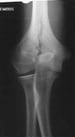
Media file 1:  This anteroposterior radiograph demonstrates a classic Galeazzi fracture: a short oblique or transverse fracture of the radius with associated dislocation of the distal ulna. The dislocation results from the disruption of the DRUJ (distal radio-ulnar joint). Note the prominence of the distal ulna (ulna positive variance).

Click to see larger pictureClick to see detailView Full Size Image
Media type:  X-RAY


  1. Hughston JC. Fracture of the distal radial shaft; mistakes in management. J Bone Joint Surg Am. Apr 1957;39-A(2):249-64; passim. [Medline].
  2. Mulford JS, Axelrod TS. Traumatic injuries of the distal radioulnar joint. Orthop Clin North Am. Apr 2007;38(2):289-97, vii. [Medline].
  3. Saitoh S, Seki H, Murakami N. Tardy ulnar tunnel syndrome caused by Galeazzi fracture-dislocation: a neuropathy with a new pathomechanism. J Orthop Trauma. Jan 2000;14(1):66-70. [Medline].
  4. Alexander AH, Lichtman DM. Irreducible distal radioulnar joint occurring in a Galeazzi fracture - case report. J Hand Surg [Am]. May 1981;6(3):258-61. [Medline].
  5. Wei SY, Born CT, Abene A. Diaphyseal forearm fractures treated with and without bone graft. J Trauma. Jun 1999;46(6):1045-8. [Medline].
  6. Moore TM, Klein JP, Patzakis MJ. Results of compression-plating of closed Galeazzi fractures. J Bone Joint Surg Am. Sep 1985;67(7):1015-21. [Medline].
  7. Reckling FW. Unstable fracture-dislocations of the forearm (Monteggia and Galeazzi lesions). J Bone Joint Surg Am. Jul 1982;64(6):857-63. [Medline].
  8. Chapman MW, Gordon JE, Zissimos AG. Compression-plate fixation of acute fractures of the diaphyses of the radius and ulna. J Bone Joint Surg Am. Feb 1989;71(2):159-69. [Medline].
  9. Giannoulis FS, Sotereanos DG. Galeazzi fractures and dislocations. Hand Clin. May 2007;23(2):153-63, v. [Medline].
  10. Hertel R, Pisan M, Lambert S. Plate osteosynthesis of diaphyseal fractures of the radius and ulna. Injury. Oct 1996;27(8):545-8. [Medline].
  11. Kraus B, Horne G. Galeazzi fractures. J Trauma. Nov 1985;25(11):1093-5. [Medline].
  12. Mikic ZD. Galeazzi fracture-dislocations. J Bone Joint Surg Am. Dec 1975;57(8):1071-80. [Medline].
  13. Stern PJ, Drury WJ. Complications of plate fixation of forearm fractures. Clin Orthop Relat Res. May 1983;(175):25-9. [Medline].
  14. Wright RR, Schmeling GJ, Schwab JP. The necessity of acute bone grafting in diaphyseal forearm fractures: a retrospective review. J Orthop Trauma. May 1997;11(4):288-94. [Medline].
  15. Wyrsch B, Mencio GA, Green NE. Open reduction and internal fixation of pediatric forearm fractures. J Pediatr Orthop. Sep-Oct 1996;16(5):644-50. [Medline].

Galeazzi Fracture excerpt

Article Last Updated: Dec 4, 2007