Practice Essentials
Also called Charcot joint or neuropathic joint, Charcot arthropathy is a progressive condition of the musculoskeletal system that is characterized by joint dislocations, pathologic fractures, and debilitating deformities. Syphilis was believed to be the most common cause of Charcot arthropathy until 1936, when Jordan linked it to diabetes. [1, 2] Diabetes is now considered to be the most common etiology of Charcot arthropathy.
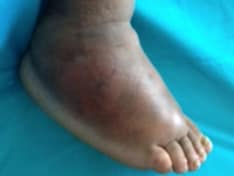
Charcot arthropathy results in progressive destruction of bone and soft tissues at weightbearing joints; in its most severe form, it may cause significant disruption of the bony architecture. Charcot arthropathy can occur at any joint; however, it occurs most commonly in the lower extremity, at the foot and ankle.
Treatment of Charcot arthropathy has been primarily nonoperative. Surgery is warranted in fewer than 25% of cases and generally is used as a preventive measure. (See Treatment.) The major contraindication for surgery is active inflammation. Studies have shown less favorable outcomes when surgery is performed on an acute joint.
For patient education resources, see the Diabetes Center, Sexually Transmitted Diseases Center, and Foot, Ankle, Knee, and Hip Center, as well as Diabetic Foot Care and Syphilis.

Anatomy
Numerous classification systems based on clinical, radiographic, and anatomic pathology describe Charcot arthropathy. Anatomic classification systems are the most commonly used and have the added benefit of predicting outcome and prognosis. The most commonly used anatomic system is described by Saunders and Mrdjencovich. [3] Based on the location of the arthropathy, their system classifies Charcot arthropathy into the following five patterns:
-
Pattern 1 involves the forefoot, which includes the interphalangeal (IP) joints, the phalanges, and the metatarsophalangeal (MTP) joint
-
Pattern 2 involves the tarsometatarsal (TMT) joint
-
Pattern 3 involves the cuneonavicular, talonavicular, and calcaneocuboid articulations
-
Pattern 4 involves the talocrural, or ankle, joint, which is the articulation of the tibia, the fibula, and the talus
-
Pattern 5 involves the posterior calcaneus
Studies have shown that patterns 2 and 3 are the most common, with approximately 45% of cases involving pattern 2 and 35% involving pattern 3.
Another commonly used classification system is the Brodsky and Rouse system. This system describes three anatomic Charcot joints (types 1, 2, and 3a and 3b):
-
Type 1 involves the midfoot
-
Type 2 involves the hindfoot
-
Type 3a involves the ankle; type 3b is a pathologic fracture of the os calcis tubercle
The multilevel Schön classification system is also used; it comprises four types and characterizes Charcot joints on the basis of sites and degree of involvement. [4] Each of the four types has three subsets (eg, type IA, IB, IC), which are based on the severity of involvement. The four types are as follows:
-
Type I - Lisfranc pattern
-
Type II - Cuneonavicular pattern
-
Type III - Perinavicular pattern
-
Type IV - Transverse tarsal pattern
The Schön classification system allows the prediction of outcomes and the estimation of treatment duration.
Pathophysiology
The exact nature of Charcot arthropathy remains unknown, [5] but two major theories exist regarding the pathophysiology of this condition: neurotraumatic and neurovascular.
The neurotraumatic theory states that Charcot arthropathy is caused by an unperceived trauma or injury to an insensate foot. The sensory neuropathy renders the patient unaware of the osseous destruction that occurs with ambulation. This microtrauma leads to progressive destruction and damage to bone and joints.
The neurovascular theory suggests that the underlying condition leads to the development of autonomic neuropathy, causing the extremity to receive an increased blood flow. This in turn results in a mismatch in bone destruction and synthesis, leading to osteopenia.
Charcot arthropathy most likely results from a combination of the processes described in the above theories. The autonomic neuropathy leads to abnormal bone formation, and the sensory neuropathy leads to an insensate joint that is susceptible to trauma. The development of abnormal bone with no ability to protect the joint results in gradual bone fracture and in the subluxation of the joint.
Etiology
Any condition that causes sensory or autonomic neuropathy can lead to a Charcot joint. Charcot arthropathy occurs as a complication of diabetes, syphilis, chronic alcoholism, leprosy, meningomyelocele, spinal cord injury, syringomyelia, renal dialysis, and congenital insensitivity to pain. Diabetes is considered to be the most common cause of Charcot arthropathy. [6, 7] There is also evidence for a relationship between Charcot arthropathy and rheumatoid arthritis (RA). [8]
Epidemiology
The prevalence of Charcot arthropathy ranges from 0.1% to as high as 13% in specialized foot clinics. In patients with diabetes, the incidence of Charcot neuroarthropathy of the foot and ankle ranges from 0.1% to 8%. [7]
Epidemiologic studies do not distinguish between acute and postacute disease. Bilateral disease occurs in less than 10% of patients. Recurrence of disease occurs in less than 5% of patients. Some studies indicate that men and women are equally affected, while others report a 3:1 predilection for males.
Prognosis
Outcomes for Charcot arthropathy are based on immediate diagnosis and treatment. A more favorable outcome is elicited when joints are treated within 2 weeks of injury and when there is strict adherence to weightbearing precautions.
Healing times are increased in diabetics. Location of the disease also affects outcome. Forefoot arthropathies heal in less time than midfoot, hindfoot, or ankle arthropathies, as the following list illustrates:
-
Ankle - Mean healing time, 83 ± 22 days
-
Hindfoot - Mean healing time, 97 ± 16 days
-
Midfoot - Mean healing time, 96 ± 11 days
-
Forefoot - Mean healing time, 55 ± 17 days
The extent of the injury also affects healing time. The more severe the injury, the longer it takes to heal and the greater the likelihood of permanent deformity. It generally takes 1-2 years to completely heal a Charcot joint, from the active phase to quiescence.
Stark et al performed a 5-year retrospective analysis of 50 patients presenting to a tertiary foot clinic with acute Charcot neuroarthropathy, with the aims of (1) determining whether the initial immobilization approach (total-contact casting [TCC] or use of a removable offloading device) influenced time to resolution, (2) determining the relapse rate after TCC use, and (3) determining whether neuroarthropathy location influenced time to resolution. [9] Of the 50 patients, 42 went into remission; 36 were treated with both TCC and removable offloading, five with removable offloading only, and one with TCC only.
Median time to resolution for patients initially treated with TCC was 48 weeks, compared with 53 weeks for those initially treated with a removable offloading device; however, the difference was not significant (P = 0.7681). [9] A relapse rate of 34.9% was noted for patients who were treated with TCC at any point. The location of the neuroarthropathy did not have a significant effect on time to resolution in this study.
Lee et al studied factors influencing outcomes after tibiotalocalcaneal fusion using a retrograde intramedullary (IM) nail in 34 patients followed for a minimum of 2 years. [10] Throughout follow-up, standard ankle radiography was performed along with clinical outcome assessment using a visual analog scale (VAS) for pain, the American Orthopaedic Foot and Ankle Society Ankle-Hind Foot Scale (AOFAS A/H scale) and the Foot and Ankle Outcome Score (FAOS). Demographic factors, preoperative medical status, laboratory markers, and etiology were comprehensively reviewed. The success of the index operation was determined on the basis of clinical and radiologic outcomes.
In a mean of 7 months, 28 of the 34 patients (82%) achieved union on standard radiography. [10] All clinical outcome parameters improved significantly. At final follow-up, five cases of nonunion with AOFAS A/H scale less than 80 and two cases of below-knee amputation due to uncontrolled infection were determined to be failures. Failure was not significantly influenced by etiology, demographics, laboratory markers, or medical status. However, uncontrolled diabetes mellitus significantly increased the failure rate, suggesting that this procedure should be used judiciously in patients with this condition.
-
Neuropathic arthropathy (Charcot joint). Neuropathic arthropathy of shoulder in patient with syringomyelia. Note destruction of articular surface, dislocation, and debris, which are pathognomonic for neuropathic joint.
-
Ankle fracture in 65-year-old diabetic patient.
-
Ankle fracture fixed by using augmented fixation technique.
-
Midfoot acute Charcot arthropathy.
-
Charcot arthropathy. Follow-up at 6 months after internal fixation with "beaming" screws.
-
Severe fracture dislocation of ankle.
-
Hindfoot stabilized with hindfoot arthrodesis intramedullary rod.