Continually Updated Clinical Reference
 
 
  All Sources     eMedicine     Medscape     Drug Reference     MEDLINE
 
eMedicine - Retinitis, CMV : Article by

Quick Find
Authors & Editors
Introduction
Clinical
Differentials
Workup
Treatment
Medication
Follow-up
Miscellaneous
Multimedia
References

Related Articles
Herpes Simplex

Herpes Zoster

HIV

Toxoplasmosis


Patient Education
Click here for patient education.


Author: Michael Altaweel, MD, FRCS(C), Associate Professor, Department of Ophthalmology and Visual Sciences, University of Wisconsin School of Medicine and Public Health

Michael Altaweel is a member of the following medical societies: American Academy of Ophthalmology and Association for Research in Vision and Ophthalmology

Coauthor(s): Matthew D Reed, MD, Fellow, Department of Ophthalmology and Visual Sciences, University of Wisconsin Clinical Science Center

Editors: Vytautas A Pakainis, MD, Chief of Ophthalmology, Dorn Veterans Administration Medical Center, Professor of Ophthalmology, Ophthalmology, University of South Carolina School of Medicine; Simon K Law, MD, PharmD, Assistant Professor of Ophthalmology, Jules Stein Eye Institute; Chief of Section of Ophthalmology Surgical Services, Department of Veterans Affairs Healthcare Center, West Los Angeles; Steve Charles, MD, Director of Charles Retina Institute; Clinical Professor, Department of Ophthalmology, University of Tennessee College of Medicine; Lance L Brown, OD, MD, Ophthalmologist, Affiliated With Freeman Hospital and St John's Hospital, Regional Eye Center, Joplin, Missouri; Hampton Roy Sr, MD, Associate Clinical Professor, Department of Ophthalmology, University of Arkansas for Medical Sciences

Author and Editor Disclosure

Synonyms and related keywords: cytomegalovirus retinitis, CMV retinitis

Background

Cytomegalovirus (CMV) is a ubiquitous DNA virus that infects the majority of the adult population. In the immunocompetent host, infection is generally asymptomatic or limited to a mononucleosislike syndrome. Like many other herpesviruses, CMV remains latent in the host and may reactivate if host immunity is compromised.

In immunocompromised individuals, primary infection or reactivation of latent virus can lead to opportunistic infection of multiple organ systems. In the eye, CMV most commonly presents as a viral necrotizing retinitis with a characteristic ophthalmoscopic appearance. Untreated CMV retinitis inexorably progresses to visual loss and blindness.

Multiple antiviral agents, delivered locally, systemically, or in combination, are currently in use to delay or arrest the progress of the disease. In addition, highly active antiretroviral therapy (HAART) for HIV infection has revolutionized the treatment of CMV retinitis by allowing immune reconstitution in many individuals.

Pathophysiology

Clinical CMV infection can affect multiple organ systems, including the skin (eg, rashes, ulcers, pustules), lungs (eg, interstitial pneumonitis), gastrointestinal tract (eg, colitis, esophagitis), peripheral nerves (eg, radiculopathy and myelopathy), the brain (eg, meningoencephalitis), and the eye (eg, retinitis, optic neuritis).

Frequency

United States

CMV is ubiquitous, infecting 50-80% of the adult population. Clinically evident disease is found almost exclusively in immunosuppressed individuals. Prior to HAART, CMV occurred in 25-40% of all AIDS patients and was the most common opportunistic infection in AIDS patients with a CD4 count below 50 cells/mL. While HAART has decreased the incidence of CMV retinitis by 55-83%, the decline in AIDS-related mortality has led to an increase in the number of patients with CMV disease.

CMV retinitis remains a leading cause of visual loss in patients with AIDS and is increasing in organ transplant recipients as the number of those procedures performed each year increases.

International

The frequency of disease in other developed countries is equivalent. The incidence of CMV in developing countries mirrors the spread of the HIV virus and the availability of antiretroviral medications.

Mortality/Morbidity

CMV retinitis frequently results in considerable loss of visual acuity, and, without treatment, it almost universally leads to blindness. Severe visual loss primarily occurs from the direct spread of retinitis into the posterior pole, affecting central vision, or from retinal detachment (RD) secondary to multiple retinal breaks in the peripheral, necrotic retina.

Early and aggressive treatment with antiviral medication for both CMV and HIV, combined with improved surgical techniques for RD repair, has helped to improve the visual outcomes in these patients.

  • Untreated CMV leads to progressive visual loss and eventual blindness.
  • Retinal detachment occurs in up to 29%.
  • Retinitis permanently destroys the retina; lesions change appearance with treatment but do not become smaller.
  • If the CD4 count is less than 100 cells/mL, CMV retinitis will develop in 20-30% of patients over a year, although retinitis typically develops if the CD4 count is reduced below 50 cells/mL. Of these patients, 5-10% develop other systemic infections (eg, pneumonitis, colitis, esophagitis).
  • With the advent of HAART and immune reconstitution, some patients suffer from a relatively new condition known as immune recovery uveitis (IRU). IRU occurs when the poor immune response of an immunocompromised individual is suddenly increased as the patients restored immune system recognizes and reacts to viral antigens in the retina. This reaction can lead to several complications, including uveitis, leading to hypotony, cataract, and glaucoma; epiretinal membrane (ERM); and cystoid macular edema (CME).

Sex

Although the incidence of CMV retinitis is the same among men and women, the prevalence is higher in men than in women because of the higher prevalence of AIDS in men. The prevalence of CMV retinitis in the heterosexual community has been steadily increasing.

Age

The age of most individuals developing CMV retinitis is 20-50 years.


History

Presenting symptoms vary depending on the location of retinal involvement. Posterior lesions present with diminished visual acuity. More peripheral lesions initially can be asymptomatic. Floaters often are noted if significant vitritis is present. The eye usually is white and quiet.

  • Active CMV retinitis usually is found in conjunction with immunosuppression, whether from AIDS, leukemia, or use of chemotherapy. These points are important in evaluating the patient history. Rarely, CMV retinitis is the first presenting manifestation of AIDS.
  • Natural history
    • CMV retinitis is a slowly progressive disease, requiring weeks to months to involve the entire retina. Vision is lost with involvement of the posterior pole (macula or optic nerve) or retinal detachment.
    • Initial reports described CMV retinitis as an end-stage disease, which indicated a life expectancy of 6 weeks. With the use of antiviral medications, the average survival after diagnosis ranged from 5.5-8 months. The advent of HAART has prolonged survival to years in some instances, and it has allowed discontinuation of medications targeted against CMV retinitis if clinical resolution occurs and the immune status recovers (reflected by a CD4 count of >100 cells/mL).
  • After initiation of therapy, some advance of the leading edge of retinitis may be noted. This usually is not a treatment failure but rather the revealing of an area of subclinical infection that was not previously evident.

Physical

Patients with suspected CMV retinitis should have a complete ocular examination of both eyes. A careful examination should include the following:

  • Carefully check and record the patient's best corrected visual acuity as a baseline. Check for visual field defects that could represent optic nerve damage, RD, or CNS disease from AIDS-related brain diseases (eg, encephalitis, stroke, CNS lymphoma). Ocular motility should be assessed as part of a cranial nerve examination. Pupils should be checked for a relative afferent pupillary defect indicating optic nerve involvement.
  • External examination of the lids and adnexa should be performed for other AIDS associated findings, such as Kaposi sarcoma or lymphoma.
  • A thorough slit lamp examination should show a white and quiet conjunctiva. A red hot eye in an immunocompromised patient should alert the clinician to another possible diagnosis. Fine, stellate keratitic precipitates (KP) characteristic of CMV may be seen on the corneal endothelium. Uveitis may be present in the anterior chamber and, if severe, may require treatment. The level of vitritis can be assessed in the anterior vitreous and may be important for monitoring response to treatment or the occurrence of IRU.
  • A dilated fundus examination with indirect ophthalmoscopy is essential for assessing the location and extent of retinal involvement as well as for evaluating for retinal breaks or detachment. Retinal lesions have several characteristics, as follows:
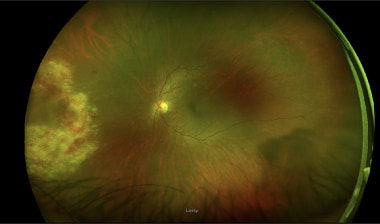
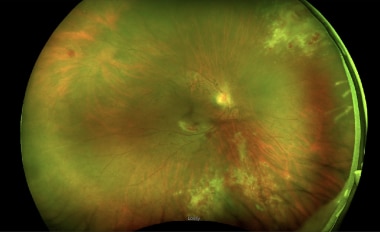
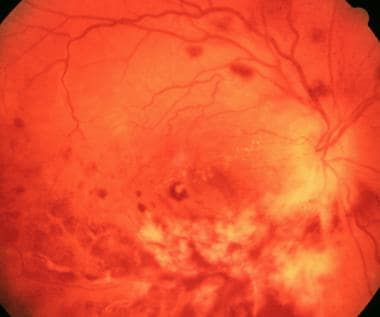
    • Lesions that present posteriorly appear along retinal vessels as large areas of thick white infiltrate accompanied by retinal hemorrhage described as "pizza pie" or "cheese pizza" in appearance.
    • The peripheral type of lesion demonstrates a more granular appearance with satellite lesions and less hemorrhage. Behind the advancing border is necrotic retina with mottled pigmentation from hyperplasia of the retinal pigment epithelium (RPE).
    • Lesions usually begin peripherally and spread posteriorly in a contiguous fashion. However, multiple unconnected lesions are frequent, and involvement of the posterior pole with minimal peripheral disease is possible.
    • Retinitis follows the nerve fiber layer.
    • Retinitis produces wide areas of necrosis, scarring, and atrophy.
    • Even severe retinitis is usually accompanied by minimal vitritis in the immunocompromised patient. If HAART is instituted and immune reconstitution occurs, then IRU with severe anterior and posterior uveitis may occur.
    • Extensive vascular sheathing, often described as frosted branch angiitis, is a known but uncommon appearance.
    • Retinal vascular occlusion/nonperfusion can be seen on fluorescein angiogram.
  • Peripheral holes and tears frequently occur in areas of necrosis.
  • Rate of progression of untreated retinitis is 250-350 µm per week. Skip lesions can occur.
  • Serial examinations may be necessary at early stages to distinguish CMV retinitis from HIV retinopathy with multiple cotton-wool spots.
  • Optic neuritis can develop without apparent retinitis.
  • Most patients with CMV retinitis will initially present with unilateral disease. Untreated, the immunocompromised patient has a 50% risk of developing disease in the contralateral eye within 6 months. This is reduced to 20% with antiviral treatment and further reduced with HAART.

Causes

Any immunosuppression due to disease or medication may allow clinical CMV infection to develop.

  • Acquired immune deficiency syndrome
  • Leukemia, lymphoma, and aplastic anemia
  • Use of immunosuppressive chemotherapy
  • Organ transplant recipients


Herpes Simplex
Herpes Zoster
HIV
Toxoplasmosis


Lab Studies

  • The CD4 count is a marker of immune dysfunction in patients infected with HIV. Patients may be asymptomatic with CMV retinitis; therefore, ophthalmic screening frequency is based on CD4 count.
    • CD4 >50 cells/mL - Little risk; screening examination every 6 months if CD4 50-100 cells/mL; screen yearly if CD4 >100 cells/mL
    • CD4 <50 cells/mL - Up to 35% incidence of CMV retinitis; median time to diagnosis of CMV retinitis is 13 months; screen every 3 months
    • The above screening regimen was used prior to the routine use of HAART. The frequency of examinations likely will be modified by assessing viral load, result of CMV DNA capture, CD4 count, and response to treatment.
  • CMV DNA capture
    • A polymerase chain reaction (PCR) test can be qualitative or quantitative. Specimens can be obtained from blood buffy coat, semen, or urine. Detection of CMV in the blood by DNA PCR is most predictive of developing CMV disease. Patients with AIDS who test positive will have more than a 60% chance of developing CMV end-organ disease.
    • Responders to ganciclovir prophylaxis convert to PCR negative with treatment. Compared to nonresponders, survival is increased 2.4 times at 12 months.
  • Viral load: Increased viral load can be a predictor of development of CMV end-organ disease.
  • HIV test
  • Complete blood count (CBC) with differential is important in evaluation for causes of immunosuppression and in assessment for side effects of ganciclovir use.
  • Blood urea nitrogen (BUN) and creatinine baseline assessment and serial measurements are used to evaluate for side effects of foscarnet or cidofovir use.

Imaging Studies

  • Ultrasound is used for evaluation of retinal detachment, particularly if vitritis obscures adequate fundus visualization.
  • Fluorescein angiogram - Assessment for areas of ischemia
  • Chest x-ray - Assessment for concurrent Pneumocystis pneumonia

Other Tests

  • Fluorescent treponemal antibody absorption (FTA-ABS) test or microhemagglutination-Treponema pallidum (MHA-TP) - Serologic testing for infection with syphilis, a differential diagnosis for CMV retinitis
  • Serum toxoplasma titer - Differential diagnosis for retinitis with vitritis

Procedures

  • Ganciclovir implant
    • This intravitreal implant releases ganciclovir at a steady state for up to 8 months.
    • The implant provides treatment of CMV retinitis in 1 eye only. No systemic effect occurs.
    • The initial implant usually is placed in the inferotemporal quadrant. It may be visualized through a dilated pupil.
    • Possible complications include vitreous hemorrhage, retinal detachment, hypotony, and endophthalmitis.
    • After 8 months, if still required, a second implant may be placed. The first implant can be left in place or removed.
  • Fomivirsen implant: Fomivirsen is not used as a primary therapy but is approved for cases not responding to other therapies.
  • Vitreoretinal surgery
    • Retinal detachment repair is required in 5-50% of patients with CMV retinitis (depending on the trial).
    • Multiple small holes in several areas of the retina are often responsible for the retinal detachment. These occur at the junction of healthy and necrotic retina.
    • Primary repair with vitrectomy, air-fluid exchange, endolaser, and silicone oil tamponade has improved surgical outcome.
  • Laser photocoagulation: Small peripheral retinal detachments can be repaired with laser photocoagulation.
  • Intravitreal injections of ganciclovir, foscarnet, or cidofovir
    • These injections offer high levels of intraocular drug for short periods of time.
    • They are useful in acute vision-threatening cases when rapid drug delivery is needed prior to instituting longer term therapy.
    • Risks of intravitreal injection include hemorrhage, RD, and endophthalmitis.

Histologic Findings

The healthy retina is sharply demarcated from infected retinal cells, which show edema, pathognomonic cytomegalic inclusions, and few surrounding inflammatory cells (consistent with a compromised immune response). Infected cells lyse, leaving an area of full-thickness necrosis and releasing virus particles that infect adjacent retinal cells. The histopathology correlates well with the clinical picture of a posteriorly advancing edge of active disease with formerly active areas undergoing necrosis, scarring, and atrophy.

Staging

CMV retinitis is described by the stage and zone of involvement.

  • Stage
    • Active retinitis - 3 general patterns
      1. Hemorrhagic - Large areas of retinal hemorrhage on a background of whitened, necrotic retina
      2. Brush fire - Yellow-white margin of slowly advancing retinitis at the border of atrophic retina
      3. Granular - Found in the periphery; focal white granular lesions without associated hemorrhage
    • Necrotic stage - End result of all patterns of active retinitis is the progression to necrosis. Retinal tears or holes can develop in these areas.
  • Zone of involvement
    • Zone 1 - Within 1500 µm of the optic nerve or 3000 µm of the fovea
    • Zone 2 - From zone 1 to equator, at vortex vein ampullae
    • Zone 3 - From zone 2 to the ora serrata
  • Zone 2 and 3 are the most common sites of initial retinal involvement.
  • Progression - Spread of retinitis usually is along the leading edge, although skip lesions can occur. Progression occurs at a rate of 250-350 µm per week if untreated.


Medical Care

An internist or infectious disease specialist coordinates medical care. Ophthalmic assessment is required on a regular basis, with frequency dependent on existence of CMV retinitis and on CD4 count. The immunosuppressed individual requires evaluation for other opportunistic infections and surveillance for side effects of prescribed medications.

  • Highly active antiretroviral therapy
    • This treatment regimen has altered the long-term management of CMV retinitis. Because the antiviral medications used to treat CMV are virustatic, it was necessary for patients to continue their use for the rest of their lives. The advent of HAART with consequent recovery of immune function allows individuals to discontinue their CMV therapy if the process has resolved adequately with initial antiviral treatment. As long as the CD4 count remains elevated, there is little risk of disease recurrence.
    • Intravenous or oral therapy can be discontinued, or a scheduled implant replacement can be delayed indefinitely.
    • Careful monitoring of both immune status and ophthalmic findings are necessary to prevent retinal damage from an asymptomatic recurrence.

Surgical Care

Individuals with CMV retinitis commonly require surgical intervention, whether for repair of a retinal detachment or for intravitreal instillation of ganciclovir by injection or implantation.

  • Retinal detachment due to CMV retinitis
    • This condition occurs in 5-29% of eyes in various case series. High incidence of bilaterality exists.
    • Repair is most successful with vitrectomy, endolaser, scleral buckle, and silicone oil endotamponade.
    • A total reattachment rate of 76% exists; macular attachment occurs in 90%. Mean postoperative visual acuity is 6/18.
    • Prophylactic laser for the other eye with CMV did not prevent retinal detachment.
  • Intravitreal ganciclovir implant
    • 1 µg/h sustained release with life span of 8 months - Study of immediate versus deferred therapy
      • Deferred - 15 days to progression
      • Immediate - 226 days to progression, only 5 of 14 progressed
      • Retinal detachment rate 11% (13-26% in IV treatment group)
      • Within 6 months, 50% develop CMV retinitis in fellow eye.
    • Pros
      • Less systemic toxicity
      • Better effect versus CMV in implanted eye
      • Can use AZT concomitantly
      • No indwelling catheter
      • Implant is useful if intolerant of systemic ganciclovir or if progression continues despite intravenous treatment.
    • Cons
      • Sixty-seven percent developed CMV in the fellow eye versus 0-15% rate in intravenous treatment group.
      • No systemic effect for CMV organ disease
  • Intravitreal ganciclovir injection
    • Delayed progression of disease
    • Topical anesthesia
    • Short half-life - Injection is required twice per week.
    • Increased risk of endophthalmitis, retinal detachment, and vitreous hemorrhage

Consultations

Infectious disease specialist

  • Evaluation of general medical condition - Assessment for other end-organ sequelae of CMV infection (pneumonitis, gastroenteritis); evaluation for other opportunistic infections
  • Evaluation for criteria sufficient to meet the diagnosis of AIDS
  • Assessment of confirmatory lab tests
  • Institution of systemic therapy (for CMV retinitis and for AIDS)
  • General internist, hematologist, and/or oncologist referral if CMV retinitis is associated with immunosuppression for non–HIV-related reasons


A number of different antiviral medications are available for the treatment of CMV retinitis. Routes of delivery and adverse effect profiles vary significantly, so treatment programs are tailored to individual patients and their response to treatment. Current therapies use an induction dose to halt active disease followed by a lower maintenance dose that must be continued indefinitely unless immune recovery occurs. In recent years, several developments have drastically improved the quality of life for patients with CMV retinitis.

HAART therapy, as previously mentioned, has allowed immune recovery that, in turn, allows discontinuation of anti-CMV medication. This often obviates the need for multiple implant procedures or the long-term dose related adverse effects of anti-CMV medications.

Valganciclovir, a prodrug of ganciclovir that possesses excellent oral bioavailability and antiviral activity, has been shown to be effective in both the induction phase and the maintenance phase of CMV retinitis treatment. It is available in convenient once daily or twice daily dosing. Valganciclovir has largely replaced other treatments since it avoids the need for frequent IV infusions and long-term IV access ports.

Neupogen (granulocyte colony stimulating factor) can be used in conjunction with valganciclovir in patients experiencing neutropenia. This has helped to lessen one of the most common treatment terminating adverse effects of a very convenient and useful medication.

Foscarnet and cidofovir are effective alternatives in the treatment of CMV retinitis. However, because of their adverse effect profiles and the lack of an orally bioavailable form, they have become second-line treatments. Intravitreal implants are used less frequently but are still needed in patients who have reactivation of retinitis despite systemic treatment or in those who cannot tolerate systemic treatment.

At this time, primary treatment generally consists of induction with either valganciclovir (900 mg PO bid for 2-3 wk) or ganciclovir (5 mg/kg IV bid for 2-3 wk) followed by maintenance with valganciclovir (900 mg PO qd) until the CD4 count is above 100 cells/mL.

Finally, IRU has added a new postscript to the treatment of CMV retinitis. Treatment options are varied, and close follow-up by an experienced ophthalmologist is needed to guard against vision-threatening complications.

Drug Category: Antivirals

Direct action is to inhibit the DNA polymerase of CMV, preventing viral replication.

Drug NameGanciclovir (Cytovene, Vitrasert)
DescriptionAnalog of guanosine, 10-100 times more potent than acyclovir versus CMV in vitro. Selectively inhibits DNA polymerase of CMV cells. Renal excretion.
Virostatic - Discontinuation of use leads to 100% relapse rate within 4 weeks.
Effective - 88% complete response, 9% partial.
Long-term IV access is necessary. Oral administration is possible, but the bioavailability of oral ganciclovir is limited to less than 10%. Although use of this medication for prophylaxis reduces the incidence of CMV end-organ disease by up to 50%, its use usually is not recommended because most patients would be using it unnecessarily and the incidence of side effects is high. A valine ester prodrug of ganciclovir, valganciclovir, has good bioavailability and can be used in place of intravenous ganciclovir for maintenance dosing and for the prevention of recurrences.
Oral ganciclovir - Two trials for maintenance treatment. A faster rate of progression was found in the first trial. With higher dosing (1 g tid), there was an equal rate of progression.A dose dependent increase in neutropenia exists.
Adult DoseIV induction: 5-7.5 mg/kg/d for 2-3 wk IV maintenance: 5 mg/kg/d 5 d/wk
Decrease dose for severe renal failure, neutropenia, or thrombocytopenia; reactivation of retinitis while on maintenance dose will require reinduction
PO maintenance: 1000 mg tid
Intravitreal implant is an effective longer term alternative
Pediatric Dose5 mg/kg IV qd
ContraindicationsDocumented hypersensitivity
InteractionsSynergistic effect with foscarnet; less neutropenia if GCSF coadministered; zidovudine, imipenem, didanosine, tacrolimus
PregnancyC - Safety for use during pregnancy has not been established.
PrecautionsMyelosuppressive; neutropenia up to 40%, usually resolves with drug cessation; thrombocytopenia up to 18%; anemia; teratogenic; infertility; rash
Monitor CBC/platelets q2d during induction, then weekly; reactivation occurs in 50% by 4 mo, median of 47 d; then, repeat induction dose

Drug NameFoscarnet (Foscavir)
DescriptionAnalog of pyrophosphate. Inhibits DNA polymerase of CMV and reverse transcriptase of HIV. Virostatic; renal excretion. As effective as ganciclovir. Median time to relapse on Rx is 53 d. Foscarnet/ganciclovir CMV retinitis trial: 234 newly diagnosed patients randomized. Same efficacy for controlling retinitis and preserving vision. Survival with foscarnet 12.6 mo versus 8.5 for ganciclovir group; mortality risk 1.79x. Controlling for antiretroviral use, still better survival with foscarnet. Foscarnet has anti-HIV activity but has more dose-limiting toxicity.
Adult DosePrehydration (infusion pump): Long-term IV access Induction: 90 mg/kg q12h for 14-21 d
Maintenance: 90-120 mg/kg IV qd
Intravitreal injection: 2400 mcg/0.1 mL q72h
Decrease dose in renal failure
Pediatric DoseAdminister as in adults
ContraindicationsDocumented hypersensitivity
InteractionsSynergistic effect with ganciclovir; compared ganciclovir and foscarnet at half dose versus daily alternation at regular dose 37% incidence of neutropenia, GCSF reversed the majority; dose-limiting nephrotoxicity in 4%; alternating regime preferred, as effective for limiting progression cidofovir, pentamidine
PregnancyC - Safety for use during pregnancy has not been established.
PrecautionsMonitor CBC, creatinine, calcium, magnesium, and potassium q3d during induction, then weekly; adverse effects include nephrotoxic (up to 30% require cessation of use), hypocalcemia, confusion, seizures, arrhythmia, diabetes insipidus, hyperphosphatemia, genital ulcerations

Drug NameCidofovir (Vistide)
DescriptionNucleotide analog that selectively inhibits viral DNA production in CMV and other herpes viruses.
Adult Dose5 mg/kg IV every other wk, plus probenecid (2 g PO 3 h prior, 1 g 2 h after, and 1 g 8 h after cidofovir) Concomitant use of probenecid and prehydration reduces incidence of nephrotoxicity
Intravitreal injection dose: 20 mcg
Pediatric DoseNot established
ContraindicationsDocumented hypersensitivity
InteractionsAvoid use with foscarnet, which also can be nephrotoxic; amikacin, tobramycin, gentamicin
PregnancyC - Safety for use during pregnancy has not been established.
PrecautionsAdverse effects include nephrotoxicity, proteinuria, neutropenia, ocular hypotony; monitor for changes in renal function (urine protein, serum creatinine)

Drug NameValganciclovir (Valcyte)
DescriptionL-valyl ester prodrug of ganciclovir used to treat CMV retinitis in patients with AIDS. Ganciclovir is synthetic analogue of 2'-deoxyguanosine, which inhibits replication of human CMV in vitro and in vivo. Inhibits viral activity by inhibiting viral DNA synthesis. Has the advantage of qd or bid PO administration. Achieves levels comparable to those obtained with IV ganciclovir.
Adult DoseInduction (active CMV retinitis): 900 mg PO bid with food for 21 d
Maintenance: 900 mg PO qd with food
Pediatric DoseNot established
ContraindicationsDocumented hypersensitivity; severe renal dysfunction or hemodialysis; pregnancy; breastfeeding; absolute neutrophil count is <500 cells/mm3, platelet count is <25,000/mm3, or hemoglobin is <8 g/dL
InteractionsInteractions are similar to those reported with ganciclovir; coadministration with cytotoxic drugs, such as dapsone, vinblastine, adriamycin, pentamidine, flucytosine, vincristine, amphotericin B, trimethoprim/sulfamethoxazole combinations, or other nucleoside analogs may result in additive toxicity of rapidly dividing cell populations, including bone marrow, spermatogonia, germinal layers of skin, and GI mucosa (coadminister only if benefits outweigh risks); coadministration with imipenem-cilastatin may cause generalized seizures (use only if benefits outweigh risks); serum creatinine may increase following concurrent use of ganciclovir with either cyclosporine or amphotericin B; in presence of probenecid, ganciclovir renal clearance is reduced; bioavailability may increase when didanosine is administered either 2 h prior to or simultaneously with ganciclovir; bioavailability of ganciclovir may decrease in presence of zidovudine, while bioavailability of zidovudine is increased in presence of ganciclovir
PregnancyC - Safety for use during pregnancy has not been established.
PrecautionsStrict adherence to dosage guidelines essential to avoid overdose; valganciclovir tablets may not be substituted for ganciclovir capsules on one-to-one basis; adjust dose according to CrCl in impaired renal function; may cause granulocytopenia, anemia, and thrombocytopenia

Drug Category: Antisense medications

Inhibit viral replication by interfering with the regulation of viral gene expression.

Drug NameFomivirsen sodium (Vitravene)
DescriptionA phosphorothioate oligonucleotide. The nucleotide sequence is complimentary to the CMV viral mRNA, which encodes proteins responsible for regulation of viral gene expression. Inhibition of viral protein synthesis is achieved when fomivirsen binds the target mRNA. Second-line management.
Adult Dose330 mcg (0.05 mL) intravitreal injection q2wk for 2 doses, then q4wk
Pediatric DoseNot established
ContraindicationsDocumented hypersensitivity; cidofovir administration within preceding 2 weeks, potential worsening of uveitis
InteractionsInteraction with systemically administered drugs has not been studied
PregnancyC - Safety for use during pregnancy has not been established.
PrecautionsAdverse effects include uveitis, ocular discomfort, blurred vision, increased intraocular pressure

Drug Category: Colony stimulating factors

Stimulation of stem cells to produce differentiation, proliferation, and increased functional activity of neutrophils, monocytes, eosinophils, and macrophages.

Drug NameFilgrastim (Neupogen)
DescriptionUp to 40% of ganciclovir users experience dose-limiting neutropenia, which may require discontinuation. GCSF has limited this effect markedly in some studies.
Adult Dose5-10 mcg/kg SC injection qd for 2-4 wk
Pediatric Dose5 mcg/kg SC injection qd for 2-4 wk
ContraindicationsDocumented hypersensitivity to E coli-derived proteins
InteractionsMay develop greater than expected elevation in white blood cell count with lithium; peripheral neuropathy may develop with vincristine
PregnancyC - Safety for use during pregnancy has not been established.
PrecautionsMay possibly act as a growth factor for tumors


Further Inpatient Care

  • Placement of long-term intravenous access for medication delivery

Further Outpatient Care

  • Ophthalmic follow-up care depends on stage of disease (ie, active vs atrophic retinitis), and CD4 count.

In/Out Patient Meds

  • Medications described in the prior section are used on an outpatient basis after initiation in-hospital. See Medication.

Deterrence/Prevention

  • CMV retinitis occurs in immunocompromised individuals. Treatment of underlying disorders can prevent the development of retinitis. Prevention practices to reduce the transmission of HIV would concomitantly reduce the incidence of CMV retinitis.

Complications

  • Untreated retinitis will progress to blindness, from retinal necrosis, optic nerve involvement, or retinal detachment.
  • CMV retinitis can relapse despite ongoing treatment. Drug levels need to be assessed. Reinduction, a change in medication, combination drug therapy, or an ocular implant are alternatives for management.
  • Drug resistance
    • Resistance to ganciclovir, foscarnet, or cidofovir can occur since these drugs are administered long term. The chance of this occurring increases with time. In a study of 76 newly diagnosed patients treated for CMV retinitis with intravenous ganciclovir, resistant isolates were obtained from blood or urine samples in 5.4% of patients at 3 months, 11.4% of patients at 6 months, and 27.5% of patients at 9 months.
    • Management of drug resistance leading to reactivation of CMV retinitis or occurrence in the other eye involves combination therapy. Ganciclovir and foscarnet are synergistic and may be combined in intravenous or intravitreal therapy.
  • Retinal detachment is a potential complication of CMV retinitis, with a 1-year risk of 5-50%. Repair requires laser photocoagulation or vitrectomy with silicone oil tamponade.

Prognosis

  • Untreated retinitis will progress to blindness, from retinal necrosis, optic nerve involvement, or retinal detachment. Of treated patients, 80-95% will respond, with resolution of intraretinal hemorrhages and white infiltrates. If treatment is discontinued and the individual is still immunocompromised (ie, CD4 <50), then the retinitis will recur in 100%. Prior to the advent of HAART, 50% of patients would experience recurrence within 6 months despite maintenance therapy. This rate is reduced if the CD4 count is elevated.
  • If a retinal detachment occurs, repair with vitrectomy and silicone oil tamponade will result in at least a 70% reattachment rate.

Patient Education

  • Visual symptoms that require a repeat examination are vision loss, development of a visual field defect, new floaters, and photophobia.
  • Provide education on the following:
    • Medication use and possible side effects
    • Education on care of long-term intravenous access site
    • Education on HIV transmission


Medical/Legal Pitfalls

  • Ophthalmic examination: Because CMV retinitis is a clinical diagnosis, evaluation by a retina specialist is recommended to distinguish this disease from other signs of HIV retinopathy such as nerve fiber layer infarcts.
  • HIV testing: If CMV retinitis is found in an individual who is not known to be HIV positive, then this test should be performed after an informed consent is obtained.
  • Follow-up examinations: A number of factors will determine the frequency of follow-up examinations, including the stage of CMV retinitis and the CD4 count. It is important to adhere to this schedule to avoid missing progression or recurrence of disease.
  • Cessation of therapy: If the CD4 count rises dramatically and CMV retinitis therapy is stopped, it is important to maintain a frequent examination schedule and counsel the individual appropriately regarding the chance of recurrence if the CD4 count starts to decrease once again.

Special Concerns

  • Most issues of special concern relate to the underlying disorder. Infection with HIV can be transmitted to offspring. The systemic medications used for CMV retinitis should be avoided during pregnancy. The ganciclovir implant would be a preferable route of medication administration if the disease manifestation is restricted to the eye.


Media file 1:  White granular retinitis with intraretinal hemorrhage.
Click to see larger pictureClick to see detailView Full Size Image
Media type:  Photo

Media file 2:  Early necrosis at periphery.
Click to see larger pictureClick to see detailView Full Size Image
Media type:  Photo

Media file 3:  Attenuation of vessels in area affected by retinitis.
Click to see larger pictureClick to see detailView Full Size Image
Media type:  Photo

Media file 4:  Retinitis typically starts in the midperiphery and can progress in a "brush fire" pattern.
Click to see larger pictureClick to see detailView Full Size Image
Media type:  Photo

Media file 5:  Progression of retinitis toward the optic nerve.
Click to see larger pictureClick to see detailView Full Size Image
Media type:  Photo

Media file 6:  Frosted branch angiitis.
Click to see larger pictureClick to see detailView Full Size Image
Media type:  Photo

Media file 7:  Inactive cytomegalovirus retinitis.
Click to see larger pictureClick to see detailView Full Size Image
Media type:  Photo

Media file 8:  Cytomegalovirus papillitis.
Click to see larger pictureClick to see detailView Full Size Image
Media type:  Photo

Media file 9:  Intranuclear inclusions (arrows) found in cytomegalovirus retinitis. Referred to as owl's eye because of the dark intranuclear inclusion surrounded by a clear halo.
Click to see larger pictureClick to see detailView Full Size Image
Media type:  Photo

Media file 10:  Retinal detachment due to peripheral tear in area of necrosis.
Click to see larger pictureClick to see detailView Full Size Image
Media type:  Photo


  • Akerele T, Lightman S. Current and novel agents for the treatment of cytomegalovirus retinitis. Drugs R D. Nov 1999;2(5):289-97. [Medline].
  • Althaus C, Loeffler KU, Schimkat M, et al. Prophylactic argon laser coagulation for rhegmatogenous retinal detachment in AIDS patients with cytomegalovirus retinitis. Graefes Arch Clin Exp Ophthalmol. May 1998;236(5):359-64. [Medline].
  • Ambati J, Wynne KB, Angerame MC, Robinson MR. Anterior uveitis associated with intravenous cidofovir use in patients with cytomegalovirus retinitis. Br J Ophthalmol. Oct 1999;83(10):1153-8. [Medline].
  • Azen SP, Scott IU, Flynn HW Jr, et al. Silicone oil in the repair of complex retinal detachments. A prospective observational multicenter study. Ophthalmology. Sep 1998;105(9):1587-97. [Medline].
  • Bachman DM, Bruni LM, DiGioia RA, et al. Visual field testing in the management of cytomegalovirus retinitis. Ophthalmology. Sep 1992;99(9):1393-9. [Medline].
  • Baldassano V, Dunn JP, Feinberg J, Jabs DA. Cytomegalovirus retinitis and low CD4+ T-lymphocyte counts. N Engl J Med. Sep 7 1995;333(10):670. [Medline].
  • Baumal CR, Levin AV, Read SE. Cytomegalovirus retinitis in immunosuppressed children. Am J Ophthalmol. May 1999;127(5):550-8. [Medline].
  • Baumal CR, Reichel E. Management of cytomegalovirus-related rhegmatogenous retinal detachments. Ophthalmic Surg Lasers. Nov 1998;29(11):916-25. [Medline].
  • Biswas J, Raizada S, Gopal L, et al. Bilateral frosted branch angiitis and cytomegalovirus retinitis in acquired immunodeficiency syndrome. Indian J Ophthalmol. Sep 1999;47(3):195-7. [Medline].
  • Biswas J, Madhavan HN, George AE, et al. Ocular lesions associated with HIV infection in India: a series of 100 consecutive patients evaluated at a referral center. Am J Ophthalmol. Jan 2000;129(1):9-15. [Medline].
  • Bloom PA, Sandy CJ, Migdal CS, et al. Visual prognosis of AIDS patients with cytomegalovirus retinitis. Eye. 1995;9 ( Pt 6):697-702. [Medline].
  • Bowen EF, Griffiths PD, Davey CC, et al. Lessons from the natural history of cytomegalovirus. AIDS. Nov 1996;10 Suppl 1:S37-41. [Medline].
  • Bowen EF, Wilson P, Atkins M, et al. Natural history of untreated cytomegalovirus retinitis. Lancet. Dec 23-30 1995;346(8991-8992):1671-3. [Medline].
  • Boyer DS, Posalski J. Potential complication associated with removal of ganciclovir implants. Am J Ophthalmol. Mar 1999;127(3):349-50. [Medline].
  • Boyraz-Ikiz HD, Witmer JP, Frissen PH. Cytomegalovirus (re)activation plays no role in the ocular vitritis observed after initiation of highly active antiretroviral therapy. AIDS. May 7 1999;13(7):867. [Medline].
  • Brody JM, Butrus SI, Laby DM, et al. Anterior segment findings in AIDS patients with cytomegalovirus retinitis. Graefes Arch Clin Exp Ophthalmol. Jun 1995;233(6):374-6. [Medline].
  • Brown F, Banken L, Saywell K, Arum I. Pharmacokinetics of valganciclovir and ganciclovir following multiple oral dosages of valganciclovir in HIV- and CMV-seropositive volunteers. Clin Pharmacokinet. Aug 1999;37(2):167-76. [Medline].
  • Chernoff DN, Miner RC, Hoo BS, et al. Quantification of cytomegalovirus DNA in peripheral blood leukocytes by a branched-DNA signal amplification assay. J Clin Microbiol. Nov 1997;35(11):2740-4. [Medline].
  • Cochereau I, Doan S, Diraison MC, et al. Uveitis in patients treated with intravenous cidofovir. Ocul Immunol Inflamm. Dec 1999;7(3-4):223-9. [Medline].
  • Cvetkovic RS, Wellington K. Valganciclovir: a review of its use in the management of CMV infection and disease in immunocompromised patients. Drugs. 2005;65(6):859-78. [Medline].
  • D''Aquila R, Walker B. Exploring the benefits and limits of highly active antiretroviral therapy. JAMA. Nov 3 1999;282(17):1668-9. [Medline].
  • Danner SA, Matheron S. Cytomegalovirus retinitis in AIDS patients: a comparative study of intravenous and oral ganciclovir as maintenance therapy. AIDS. Dec 1996;10 Suppl 4:S7-11. [Medline].
  • Davis JL. Differential diagnosis of CMV retinitis. Ocul Immunol Inflamm. Dec 1999;7(3-4):159-66. [Medline].
  • Davis JL, Hummer J, Feuer WJ. Laser photocoagulation for retinal detachments and retinal tears in cytomegalovirus retinitis. Ophthalmology. Dec 1997;104(12):2053-60; discussion 2060-1. [Medline].
  • Davis JL, Serfass MS, Lai MY, et al. Silicone oil in repair of retinal detachments caused by necrotizing retinitis in HIV infection. Arch Ophthalmol. Nov 1995;113(11):1401-9. [Medline].
  • Derzko-Dzulynsky LA, Berger AR, Berinstein NL, Berinstein NL. Cytomegalovirus retinitis and low-grade non-Hodgkin''s lymphoma: case report and review of the literature. Am J Hematol. Mar 1998;57(3):228-32. [Medline].
  • Desatnik HR, Foster RE, Lowder CY. Treatment of clinically resistant cytomegalovirus retinitis with combined intravitreal injections of ganciclovir and foscarnet. Am J Ophthalmol. Jul 1996;122(1):121-3. [Medline].
  • Doan S, Cochereau I, Guvenisik N, et al. Cytomegalovirus retinitis in HIV-infected patients with and without highly active antiretroviral therapy. Am J Ophthalmol. Aug 1999;128(2):250-1. [Medline].
  • Drew WL, Ives D, Lalezari JP, et al. Oral ganciclovir as maintenance treatment for cytomegalovirus retinitis in patients with AIDS. Syntex Cooperative Oral Ganciclovir Study Group. N Engl J Med. Sep 7 1995;333(10):615-20. [Medline].
  • Drusano GL, Aweeka F, Gambertoglio J, et al. Relationship between foscarnet exposure, baseline cytomegalovirus (CMV) blood culture and the time to progression of CMV retinitis in HIV- positive patients. AIDS. Sep 1996;10(10):1113-9. [Medline].
  • Egbert PR, Pollard RB, Gallagher JG, Merigan TC. Cytomegalovirus retinitis in immunosuppressed hosts. II. Ocular manifestations. Ann Intern Med. Nov 1980;93(5):664-70. [Medline].
  • Elkins BS, Holland GN, Opremcak EM, et al. Ocular toxoplasmosis misdiagnosed as cytomegalovirus retinopathy in immunocompromised patients. Ophthalmology. Mar 1994;101(3):499-507. [Medline].
  • Erice A, Jordan MC, Chace BA, et al. Ganciclovir treatment of cytomegalovirus disease in transplant recipients and other immunocompromised hosts. JAMA. Jun 12 1987;257(22):3082-7. [Medline].
  • Freeman WR, Friedberg DN, Berry C, et al. Risk factors for development of rhegmatogenous retinal detachment in patients with cytomegalovirus retinitis. Am J Ophthalmol. Dec 15 1993;116(6):713-20. [Medline].
  • Freeman WR. Retinal detachment in cytomegalovirus retinitis: should our approach be changed?. Retina. 1999;19(4):271-3. [Medline].
  • Fuchs AV, Wolf E, Scheider A, Jager H, Kampik A. [Cytomegalovirus (CMV) retinitis in AIDS. Gancilovir implantation in comparison with systemic therapy]. Ophthalmologe. Jan 1999;96(1):11-5. [Medline].
  • Gilbert C, Handfield J, Toma E, et al. Emergence and prevalence of cytomegalovirus UL97 mutations associated with ganciclovir resistance in AIDS patients. AIDS. Jan 22 1998;12(2):125-9. [Medline].
  • Goldberg DE, Wang H, Azen SP. Long term visual outcome of patients with cytomegalovirus retinitis treated with highly active antiretroviral therapy. Br J Ophthalmol. Jul 2003;87(7):853-5. [Medline].
  • Grant AD, Djomand G, De Cock KM. Natural history and spectrum of disease in adults with HIV/AIDS in Africa. AIDS. 1997;11 Suppl B:S43-54. [Medline].
  • Gross JG, Bozzette SA, Mathews WC, et al. Longitudinal study of cytomegalovirus retinitis in acquired immune deficiency syndrome. Ophthalmology. May 1990;97(5):681-6. [Medline].
  • Guembel HO, Krieglsteiner S, Rosenkranz C, et al. Complications after implantation of intraocular devices in patients with cytomegalovirus retinitis. Graefes Arch Clin Exp Ophthalmol. Oct 1999;237(10):824-9. [Medline].
  • Harb GE, Bacchetti P, Jacobson MA. Survival of patients with AIDS and cytomegalovirus disease treated with ganciclovir or foscarnet. AIDS. Aug 1991;5(8):959-65. [Medline].
  • Hardy WD. Combined ganciclovir and recombinant human granulocyte-macrophage colony-stimulating factor in the treatment of cytomegalovirus retinitis in AIDS patients. J Acquir Immune Defic Syndr. 1991;4 Suppl 1:S22-8. [Medline].
  • Hardy WD. Management strategies for patients with cytomegalovirus retinitis. J Acquir Immune Defic Syndr Hum Retrovirol. 1997;14 Suppl 1:S7-12. [Medline].
  • Holbrook JT, Davis MD, Hubbard LD, et al. Risk factors for advancement of cytomegalovirus retinitis in patients with acquired immunodeficiency syndrome. Studies of Ocular Complications of AIDS Research Group. Arch Ophthalmol. Sep 2000;118(9):1196-204. [Medline].
  • Holbrook JT, Jabs DA, Weinberg DV. Visual loss in patients with cytomegalovirus retinitis and acquired immunodeficiency syndrome before widespread availability of highly active antiretroviral therapy. Arch Ophthalmol. Jan 2003;121(1):99-107. [Medline].
  • Holland GN, Buhles WC Jr, Mastre B, Kaplan HJ. A controlled retrospective study of ganciclovir treatment for cytomegalovirus retinopathy. Use of a standardized system for the assessment of disease outcome. UCLA CMV Retinopathy. Study Group. Arch Ophthalmol. Dec 1989;107(12):1759-66. [Medline].
  • Holland GN. New issues in the management of patients with AIDS-related cytomegalovirus retinitis. Arch Ophthalmol. May 2000;118(5):704-6. [Medline].
  • Holland GN. Treatment options for cytomegalovirus retinitis: a time for reassessment. Arch Ophthalmol. Nov 1999;117(11):1549-50. [Medline].
  • Hoshino Y, Nagata Y, Taguchi H, et al. Role of the cytomegalovirus (CMV)-antigenemia assay as a predictive and follow-up detection tool for CMV disease in AIDS patients. Microbiol Immunol. 1999;43(10):959-65. [Medline].
  • Jabs DA, Enger C, Dunn JP, et al. Cytomegalovirus retinitis and viral resistance: 3. Culture results. CMV Retinitis and Viral Resistance Study Group. Am J Ophthalmol. Oct 1998;126(4):543-9. [Medline].
  • Jabs DA, Enger C, Forman M, et al. Incidence of foscarnet resistance and cidofovir resistance in patients treated for cytomegalovirus retinitis. The Cytomegalovirus Retinitis and Viral Resistance Study Group. Antimicrob Agents Chemother. Sep 1998;42(9):2240-4. [Medline].
  • Jabs DA. Design of clinical trials for drug combinations: cytomegalovirus retinitis--foscarnet and ganciclovir. The CMV retinitis retreatment trial. Antiviral Res. Jan 1996;29(1):69-71. [Medline].
  • Jabs DA. Controversies in the treatment of cytomegalovirus retinitis: foscarnet versus ganciclovir. Infect Agents Dis. Sep 1995;4(3):131-42. [Medline].
  • Jabs DA, Van Natta ML, Thorne JE, et al. Course of cytomegalovirus retinitis in the era of highly active antiretroviral therapy: 2. Second eye involvement and retinal detachment. Ophthalmology. Dec 2004;111(12):2232-9. [Medline].
  • Jabs DA, Van Natta ML, Thorne JE, et al. Course of cytomegalovirus retinitis in the era of highly active antiretroviral therapy: 1. Retinitis progression. Ophthalmology. Dec 2004;111(12):2224-31. [Medline].
  • Jacobson MA, Wilson S, Stanley H, et al. Phase I study of combination therapy with intravenous cidofovir and oral ganciclovir for cytomegalovirus retinitis in patients with AIDS. Clin Infect Dis. Mar 1999;28(3):528-33. [Medline].
  • Jensen OA, Gerstoft J, Thomsen HK, Marner K. Cytomegalovirus retinitis in the acquired immunodeficiency syndrome (AIDS). Light-microscopical, ultrastructural and immunohistochemical examination of a case. Acta Ophthalmol (Copenh). Feb 1984;62(1):1-9. [Medline].
  • Karavellas MP, Plummer DJ, Macdonald JC, et al. Incidence of immune recovery vitritis in cytomegalovirus retinitis patients following institution of successful highly active antiretroviral therapy. J Infect Dis. Mar 1999;179(3):697-700. [Medline].
  • Kaulfersch W, Urban C, Hauer C, et al. Successful treatment of CMV retinitis with ganciclovir after allogeneic marrow transplantation. Bone Marrow Transplant. Sep 1989;4(5):587-9. [Medline].
  • Kempen JH, Jabs DA, Wilson LA. Risk of vision loss in patients with cytomegalovirus retinitis and the acquired immunodeficiency syndrome. Arch Ophthalmol. Apr 2003;121(4):466-76. [Medline].
  • Kempen JH, Jabs DA, Wilson LA. Incidence of cytomegalovirus (CMV) retinitis in second eyes of patients with the acquired immune deficiency syndrome and unilateral CMV retinitis. Am J Ophthalmol. Jun 2005;139(6):1028-34. [Medline].
  • Kestelyn P. The epidemiology of CMV retinitis in Africa. Ocul Immunol Inflamm. Dec 1999;7(3-4):173-7. [Medline].
  • Knox CM, Chandler D, Short GA, Margolis TP. Polymerase chain reaction-based assays of vitreous samples for the diagnosis of viral retinitis. Use in diagnostic dilemmas. Ophthalmology. Jan 1998;105(1):37-44; discussion 44-5. [Medline].
  • Kuppermann BD, Quiceno JI, Flores-Aguilar M, et al. Intravitreal ganciclovir concentration after intravenous administration in AIDS patients with cytomegalovirus retinitis: implications for therapy. J Infect Dis. Dec 1993;168(6):1506-9. [Medline].
  • Lalezari JP, Holland GN, Kramer F, et al. Randomized, controlled study of the safety and efficacy of intravenous cidofovir for the treatment of relapsing cytomegalovirus retinitis in patients with AIDS. J Acquir Immune Defic Syndr Hum Retrovirol. Apr 1 1998;17(4):339-44. [Medline].
  • Lalezari JP. Cidofovir: a new therapy for cytomegalovirus retinitis. J Acquir Immune Defic Syndr Hum Retrovirol. 1997;14 Suppl 1:S22-6. [Medline].
  • Lam TT, Fu J, Chu R, et al. Intravitreal delivery of ganciclovir in rabbits by transscleral iontophoresis. J Ocul Pharmacol. Fall 1994;10(3):571-5. [Medline].
  • Lietman PS. Clinical pharmacology: foscarnet. Am J Med. Feb 14 1992;92(2A):8S-11S. [Medline].
  • Lim JI, Wolitz RA, Dowling AH, et al. Visual and anatomic outcomes associated with posterior segment complications after ganciclovir implant procedures in patients with AIDS and cytomegalovirus retinitis. Am J Ophthalmol. Mar 1999;127(3):288-93. [Medline].
  • Lim JI, Enger C, Haller JA, et al. Improved visual results after surgical repair of cytomegalovirus- related retinal detachments. Ophthalmology. Feb 1994;101(2):264-9. [Medline].
  • Liu JH, Hsu WM, Wong WW, et al. Using conjunctival swab with polymerase chain reaction to aid diagnosis of cytomegalovirus retinitis in AIDS patients. Ophthalmologica. 2000;214(2):126-30. [Medline].
  • Macdonald JC, Torriani FJ, Morse LS, et al. Lack of reactivation of cytomegalovirus (CMV) retinitis after stopping CMV maintenance therapy in AIDS patients with sustained elevations in CD4 T cells in response to highly active antiretroviral therapy. J Infect Dis. May 1998;177(5):1182-7. [Medline].
  • Mansor AM, Li HK. Cytomegalovirus optic neuritis: characteristics, therapy and survival. Ophthalmologica. 1995;209(5):260-6. [Medline].
  • Mansour AM, Li HK. Frosted retinal periphlebitis in the acquired immunodeficiency syndrome. Ophthalmologica. 1993;207(4):182-6. [Medline].
  • Margolis TP. Discontinuation of anticytomegalovirus therapy in patients with HIV infection and cytomegalovirus retinitis. Surv Ophthalmol. Mar-Apr 2000;44(5):455. [Medline].
  • Martin DF, Kuppermann BD, Wolitz RA, et al. Oral ganciclovir for patients with cytomegalovirus retinitis treated with a ganciclovir implant. Roche Ganciclovir Study Group. N Engl J Med. Apr 8 1999;340(14):1063-70. [Medline].
  • Martin DF, Dunn JP, Davis JL, et al. Use of the ganciclovir implant for the treatment of cytomegalovirus retinitis in the era of potent antiretroviral therapy: recommendations of the International AIDS Society-USA panel. Am J Ophthalmol. Mar 1999;127(3):329-39. [Medline].
  • Martin DF, Ferris FL, Parks DJ, et al. Ganciclovir implant exchange. Timing, surgical procedure, and complications. Arch Ophthalmol. Nov 1997;115(11):1389-94. [Medline].
  • Martin DF, Sierra-Madero J, Walmsley S. A controlled trial of valganciclovir as induction therapy for cytomegalovirus retinitis. N Engl J Med. Apr 11 2002;346(15):1119-26. [Medline].
  • Marwick C. First "antisense" drug will treat CMV retinitis. JAMA. Sep 9 1998;280(10):871. [Medline].
  • McAuliffe PF, Hall MJ, Castro-Malaspina H, Heinemann MH. Use of the ganciclovir implant for treating cytomegalovirus retinitis secondary to immunosuppression after bone marrow transplantation. Am J Ophthalmol. May 1997;123(5):702-3. [Medline].
  • McCutchan JA. Clinical impact of cytomegalovirus infections of the nervous system in patients with AIDS. Clin Infect Dis. Oct 1995;21 Suppl 2:S196-201. [Medline].
  • McCutchan JA. Cytomegalovirus infections of the nervous system in patients with AIDS. Clin Infect Dis. Apr 1995;20(4):747-54. [Medline].
  • Meffert SA, Ai E. Laser photocoagulation prophylaxis for CMV retinal detachments. Ophthalmology. Aug 1998;105(8):1353-5. [Medline].
  • Mitchell SM, Membrey WL, Youle MS, et al. Cytomegalovirus retinitis after the initiation of highly active antiretroviral therapy: a 2 year prospective study. Br J Ophthalmol. Jun 1999;83(6):652-5. [Medline].
  • Murray HW, Knox DL, Green WR, Susel RM. Cytomegalovirus retinitis in adults. A manifestation of disseminated viral infection. Am J Med. Oct 1977;63(4):574-84. [Medline].
  • Musch DC, Martin DF, Gordon JF, et al. Treatment of cytomegalovirus retinitis with a sustained-release ganciclovir implant. The Ganciclovir Implant Study Group. N Engl J Med. Jul 10 1997;337(2):83-90. [Medline].
  • Nasemann JE, Mutsch A, Wiltfang R, Klauss V. Early pars plana vitrectomy without buckling procedure in cytomegalovirus retinitis-induced retinal detachment. Retina. 1995;15(2):111-6. [Medline].
  • Nasir MA, Jaffe GJ. Cytomegalovirus retinitis associated with Hodgkin''s disease. Retina. 1996;16(4):324-7. [Medline].
  • Nguyen QD, Kempen JH, Bolton SG, et al. Immune recovery uveitis in patients with AIDS and cytomegalovirus retinitis after highly active antiretroviral therapy. Am J Ophthalmol. May 2000;129(5):634-9. [Medline]&#