Background
The ideal refractive surgical procedure is simple to perform, inexpensive, and applicable to a wide range of ametropias. Astigmatic keratotomy (AK) is one such procedure. Astigmatic keratotomy is used to treat numerous refractive disorders, including congenital astigmatism, residual corneal astigmatism at the time of or following cataract surgery, post-traumatic astigmatism, and astigmatism after corneal transplantation.
Even with the extensive use of excimer laser vision correction platforms to treat refractive error (eg, photorefractive keratoplasty [PRK], LASIK), astigmatic keratotomy continues to be a valuable and versatile tool for the treatment of many eyes.
Early investigative surgeons of astigmatic keratotomy, Thornton, Buzard, Price, Grene, Nordan, and Lindstrom, demonstrated the efficacy, safety and reproducibility of refractive outcomes, and led, albeit over more than a decade, to the adoption of the procedure by the broader ophthalmological community. [1, 2, 3, 4, 5]
Within the past few years, much consideration has been given to an evolutionary variant of the procedure, the limbal relaxing incision (LRI). By moving the incision farther to the periphery, cataract surgeons can safely and predictably remediate mild to moderate amounts of regular astigmatism at the time of cataract surgery by performing this incisional technique, either by hand or by application of femtosecond laser technology. [6] Femtosecond laser offers several potential advantages over manual incision, including fully customizable and reproducible incision parameters, as well as increased safety and titration of effect via intrastromal ablations.

History of the Procedure
Astigmatic keratotomy procedures were first reported in the 1890s. Observations of scar-induced corneal flattening and attempts to rid postsurgical corneal transplant and patients with cataracts of unintended astigmatism [7] sparked the imaginations of early refractive surgeons.
The study of ametropia correction continued over the next 60 years, as surgeons learned to employ radial keratotomy (RK) incisions to decrease myopia and discovered that these radial incisions had little appreciable effect on the amount of astigmatism. However, when the direction of the incisions was turned 90°, a profound astigmatic effect occurred. Sato introduced the idea of coupling: tangential (or arcuate) incisions flatten the steep meridian while steepening the flatter meridian, following Gauss’ law of elastic domes. [8] This combination of flattening the steeper axis and subsequently steepening the flatter axis yields the total amount of astigmatism correction.
In the 1970s, Troutman extended the applicability of coupling in corneal transplant recipients by demonstrating that the donor-recipient interface acted, in essence, like new limbal architecture. Therefore, the same rules apply to incisions made inside the donor-recipient interface as to an untouched normal limbus. [9] Troutman’s work also included the development of the wedge resection for the treatment of very high astigmatism.
No discussion about keratotomies would be complete without reference to the Prospective Evaluation of Radial Keratotomy (PERK) study, which addressed only the effects of symmetrically placed radial incisions. In fact, no astigmatism correction was attempted. The PERK study demonstrated that radial incisions do not change astigmatism in a reproducible way. [10] It was not until later studies that the effects of transverse or arcuate incisions were investigated.
In the 1980s, Nordan’s early approach to astigmatic keratotomy was simply to employ straight transverse incisions that produced targeted corrections in the range of 1-4 D. [4]
Lindstrom developed his own arcuate transverse keratotomy technique and added a nomogram, which took into consideration the number and length of incisions, as well as the patient’s sex and age. [5] The Astigmatism Reduction Clinical Trial (ARC-T) study was born from these activities and showed that Lindstrom’s nomogram could produce predictable results. [3]
Thornton’s technique involved titrating results even further by placing paired arcuate incisions on a curve on the cornea, dictated by either a 7- or 8-mm optical zone size. [1] Others, including Chayez, Chayat, Celikkol, Parker, and Feldman, had recommended optical zone sizes as small as 5 mm at the expense of creating debilitating glare, asthenopia, and monocular diplopia.
Nichamin later developed an extensive nomogram for astigmatic keratotomy to be used at the time of cataract surgery; however, its utility has diminished owing to the rise in popularity of the toric intraocular lens (IOL).
More recently, femtosecond lasers have been used to create astigmatic keratotomy incisions after corneal transplantation and to create LRIs at the time of cataract surgery. These lasers employ sophisticated imaging systems that allow for precise control of incision locations and parameters (ie, depth, length, angle). [11] Further investigations will determine if the lasers prove superior to manual astigmatic keratotomy/LRI procedures.
Indications
Astigmatic keratotomy/LRI procedures can remediate or lessen astigmatism in numerous refractive presentations as either a stand-alone procedure or one that can be easily combined with other forms of surgery. This versatility, the simple surgical setup, and the production of predictable outcomes make this procedure a useful tool for all refractive surgeons, even with the advancement of laser surgery.
Astigmatic keratotomy/LRI surgery combined with or following cataract surgery is frequently used as an ancillary refractive procedure in patients presenting with topographical regular astigmatism at the time of cataract surgery. The addition of an arcuate incision or incisions when the patient exhibits 0.75-2.75 D of regular astigmatism improves the likelihood of attaining excellent uncorrected vision postoperatively.
An astigmatic keratotomy/LRI procedure becomes even more important when multifocal IOLs are chosen because satisfactory simultaneous uncorrected vision at distance and near can be obtained only with a nearly spherical cornea. At the time of this writing, toric multifocal IOLs are not available in the United States, so the need for concurrent astigmatic correction must rely on either manual or laser-assisted incisional placement to mitigate mild to moderate amounts of astigmatism.
A more traditional keratorefractive approach outside of cataract surgery involves using astigmatic keratotomy/LRI surgery in patients who exhibit mixed astigmatism. When a patient requests vision correction surgery and has a refractive error with a spherical equivalent approaching zero (eg, -1.00 + 2.00 X [any axis]), PRK or LASIK may not be necessary.
While an astigmatic keratotomy procedure may appear redundant to PRK or LASIK treatment before or after refractive surgery, synergy between the techniques may benefit some patients. For instance, patients who present with high astigmatism may find that the combined treatment of PRK/LASIK with astigmatic keratotomy may provide a more satisfactory visual result than PRK or LASIK alone. By first reducing high amounts of cylinder by 2-3 D with an LRI, lesser amounts of astigmatic laser correction are needed, allowing for the use of larger optical zone sizes, which ultimately provides for a smoother optical zone transition. This enhanced transition lessens the degree of nighttime glare and ghosting and provides for overall better vision quality. With regard to post-LASIK astigmatic keratotomy surgical interventions, performing an astigmatic keratotomy may be preferable to lifting a well-healed LASIK flap in patients who go on to develop significant astigmatism.
Astigmatic keratotomy also proves useful when treating irregular astigmatism following corneal transplant surgery. While most congenital astigmatism appears as regular (ie, the steep and flat meridians of astigmatism lie 90° away from each other), after corneal transplantation, one quadrant may be especially steep or flat in relation to its reflective counterpart. This is known as nonorthogonal astigmatism and can occur when a segment of the donor-recipient interface has healed too tightly or when the interface has inadvertently slipped. Astigmatic keratotomy, used in conjunction with high-quality corneal topography, allows for an individualized approach as surgeons identify and specifically treat these steep areas.
Relevant Anatomy
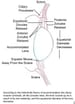
The cornea is a clear, dome-shaped surface that covers the front of the eye. The cornea acts as the eye's main refracting surface, supplying two thirds of the focusing power of the eye, or the equivalent of about 43 D [12] of power in the average human. While this transparent surface appears “simple” in nature, the cornea is actually a highly organized avascular tissue composed of the epithelium, the Bowman membrane, the substantia propria, the Descemet membrane, and the endothelium.
The epithelium, the outermost layer of the cornea, is composed of 5-6 layers of stratified squamous, nonkeratinized cells. This layer, which includes a basement membrane, makes up about 10% of the total corneal thickness; it is highly sensitive owing to thousands of nerve endings located within this layer. The epithelium exhibits excellent regenerative power.
The Bowman membrane lies directly beneath the epithelial basement membrane. The Bowman layer is acellular, containing randomly oriented collagen fibrils, which, when damaged, create scar tissue formation.
The central, and by far thickest, layer of the cornea, the substantia propria (stroma), makes up nearly 90% of the cornea's thickness. This layer is primarily composed of water (78%) and regularly arranged collagen I, III, V, and VII fibrils (16%). The unique size of the collagen fibrils, as well as their spacing and layer arrangement within the water substrate, allows for corneal transparency. Disruptions to this delicate architecture can cause loss of transparency and, subsequently, poor vision. [13]
The Descemet membrane is a thin basement membrane, measuring just 3-10 μm, and lies just below the stroma. Despite its thin presentation, it is a tough membrane, rich in type IV collagen fibers. The Descemet membrane acts as a defensive barrier against injury and infection. This layer is produced by the underlying endothelial cells and can be regenerated if injured.
The endothelium is composed of a single layer of simple, cuboidal, and hexagonal cells that line the inner surface of the cornea. Endothelial cells are derived from the neural crest during development and are thought to be nonregenerative in humans. The natural tendency of nutrient-rich aqueous fluid is to seep into the cornea stroma; the primary function of the endothelial layer is to transport stromal fluid back to the anterior chamber. While these cells have tremendous “engines” for doing so, endothelial cell loss occurs naturally over years, stressing the remaining cells. If disease, trauma, or dystrophy is introduced, the layer’s pumping capacity can be greatly reduced, causing a build-up of fluid in the stromal layer and affecting corneal clarity. [14]
The average central thickness of the human cornea is approximately 555 μm. [15] Normal corneas become thicker toward the limbus, with average values greater than 600 μm. Thickness can be measured with devices such as a pachymeter or optical coherence tomographer (OCT). Many astigmatic keratotomy/LRI nomograms advocate penetrance with a diamond knife or femtosecond laser to 85%-90% of total corneal thickness, as calculated intraoperatively from the thinnest corneal thickness measurement to be traversed by an arcuate incision.
For more information about the relevant anatomy, see Eye Globe Anatomy.
Contraindications
All surgical procedures may provide suboptimal outcomes. While the LRI procedure is thought to create less glare and optical artifacts than its predecessor, astigmatic keratotomy, the most common side effects remain overcorrection and undercorrection of astigmatism. Infection, [16] corneal perforation, and decreased corneal sensation are possible sequelae.
Patients with high astigmatism due to Terrien degeneration, Mooren ulcer, or any disease or dystrophy that produces peripheral corneal thinning should not undergo astigmatic keratotomy/LRI incisions owing to the progressive risk of corneal thinning and evolving astigmatism, potentially leading to perforation. [17]
Patients with chronic diabetes, chemical burn, or other causes of ocular surface disease should be approached with increased caution, as re-epithelialization problems after corneal surgery may ensue.
Caution should be exercised when considering an astigmatic keratotomy/LRI procedure in patients with connective-tissue diseases (eg, rheumatoid arthritis). Patients with extreme dry eye, whether related to rheumatoid arthritis or not , require close follow-up care if undergoing this procedure, as they are more prone to ocular discomfort, dryness, poor healing and potential thinning due to corneal melting.
Patients with astigmatism who previously underwent radial keratotomy may later present for astigmatic "enhancement." Astigmatic keratotomy/LRI surgery is a reasonable option in these patients, but the surgeon should take care when orienting the new incisions. The crossing of a radial incision with a transverse incision, even years after the initial procedure, may produce excessive and unwanted overcorrection. It is recommended to preoperatively map the faded RK incisions, identifying their location with useful landmarks. Since most RK incisions approach the limbus, surgeons should avoid crossing the RK incision with a long, uninterrupted astigmatic keratotomy/LRI incision. Instead, they should use multiple smaller astigmatic keratotomy/LRI incisions straddling the RK incisions to obtain the desired effect. As can be imagined, it is especially difficult to perform astigmatic correction through astigmatic keratotomy/LRI incisions in a patient who has undergone a 16-incision RK.
The potential benefits of astigmatism reduction must be weighed against the risks of the procedure on a case-by-case basis.
-
Thornton astigmatic keratotomy ruler.
-
Close-up view of Thornton astigmatic keratotomy ruler.
-
Example 2. Routine astigmatic keratotomy. In this image, a nasal astigmatic keratotomy is shown. This image was taken minutes after performing the incision. Note that the area around the cut stains lightly with fluorescein.
-
Example 3. Preoperative topography in a patient about to undergo astigmatic keratotomy (AK) following corneal transplantation. This 30-year-old woman underwent corneal transplantation for keratoconus 6 years ago. She presented with a clear graft but with excessive astigmatism. Based on this pre-AK topography and prior surgical experience, an incision was placed just inside the donor-recipient interface from 250° to 300°. A second incision was placed between 30° and 70°. Incisions were not paired at 180° apart, but were localized based on topography. Refraction improved from +0.75 + 3.00 X 58° to +0.50 + 1.50 X 130°. Best-corrected vision remained 20/20.
-
Example 3. Postoperative topography following astigmatic keratotomy for the 30-year-old woman with penetrating keratoplasty for keratoconus.
-
Example 4. Topography shows preoperative and postoperative readings with differential analysis in a corneal transplant recipient (performed for Fuchs dystrophy) who underwent astigmatic keratotomy (AK). After all sutures were removed, she had approximately 6.5 D of keratometric astigmatism. The previous sutures seemed to have been tighter temporally than nasally. She underwent AK with a 50° incision temporally and a 30° incision nasally. The alteration in arcuate size values was related to surgeon preference. Following AK, residual astigmatism was slightly less than 1 D. The 5.5 D of astigmatism alteration from an 80° relaxing incision in a normal cornea is not expected. Posttransplant corneas are variable, and individual results can vary widely. Monitor the results as best as possible intraoperatively and be willing to go back and suture an overcorrection if one should occur.