Background
Widow spiders belong to the genus Latrodectus and are found throughout the world. In the United States, arguably the most famous is the Southern black widow spider (Latrodectus mactans mactans). The term widow spider is preferred because not all species in the genus Latrodectus are black. Other widow spiders in North America include the red-legged widow (Latrodectus bishopi), the Northern black widow (Latrodectus variolus), the Western black widow (Latrodectus hesperus), and the brown widow (Latrodectus geometricus), which has a worldwide distribution.
The redback spider (Latrodectus hasselti) is endemic to Australia. The katipo (Latrodectus katipo) is native to New Zealand. The Mediterranean black widow (Latrodectus tredecimguttatus) is found in Europe. The white widow spider (Latrodectus pallidus) can be found in North Africa, Central Asia, and the Middle East. The button spider (Latrodectus indistinctus) is one of several widow spiders native to South Africa.
The adult female black widow spider is approximately 2 cm in length and shiny black with a red-orange hourglass or spot on the ventral abdomen. The male is much smaller and brown. Juvenile females are also brown but have the general body morphology of the adult. Males and juveniles have a pale hourglass shape, similar to adult females. The female sometimes eats the male during or after copulation. Webs are irregular, low-lying, and commonly seen in garages, barns, outhouses, and foliage. Other widow spiders are generally black but may have red spots, such as Latrodectus tredecimguttatus, or a dorsal red stripe, such as the redback spider. L geometricus is brown with red and yellow markings.
See the images below.
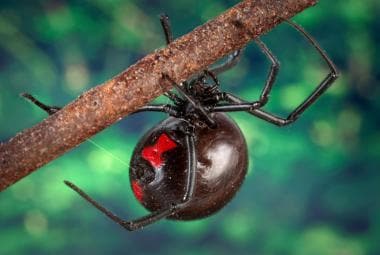 Female black widow spider, Latrodectus mactans, in the process of spinning her web on a tree branch. Note the characteristic red hourglass located on her inferior abdominal surface. This marking can vary in coloration from yellowish to shades of orange and red and, at times, white. The female’s body is an overall shiny jet-black in color. This spider was found on a farm in the US state of Georgia. By James Gathany (http://phil.cdc.gov/phil/) [Public domain], courtesy of Wikimedia Commons (https://commons.wikimedia.org/wiki/File:Black_widow_spider_9854_lores.jpg).
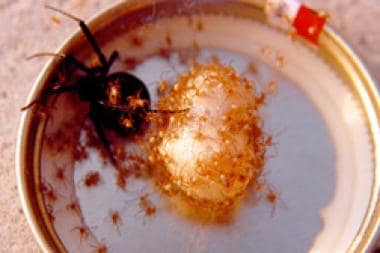
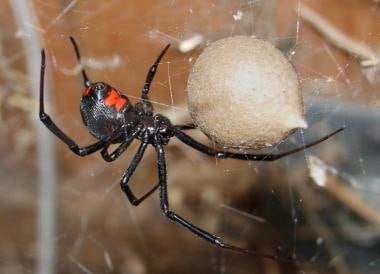 Female black widow spider guarding an egg case; species Latrodectus mactans. By Chuck Evans (mcevan). [CC BY 2.5 (https://creativecommons.org/licenses/by/2.5)], courtesy of Wikimedia Commons (https://commons.wikimedia.org/wiki/File:Black_Widow_Spider_07-04-20.jpg).
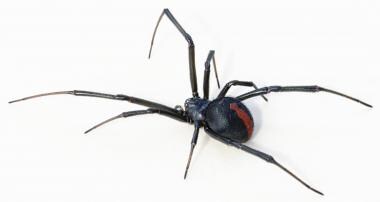 A redback spider (Latrodectus hasseltii) female, found in suburban Sydney, New South Wales, Australia. By Toby Hudson [CC BY-SA 3.0 (https://creativecommons.org/licenses/by-sa/3.0)], courtesy of Wikimedia Commons (https://commons.wikimedia.org/wiki/File:Latrodectus_hasseltii_close.jpg).
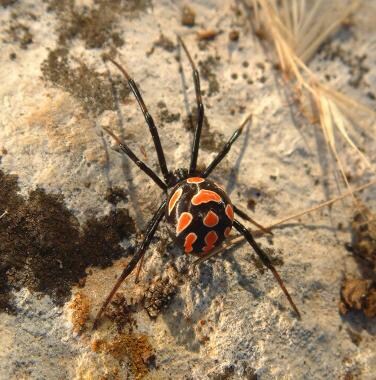 Young female Latrodectus tredecimguttatus; photo taken in Croatia by K. Korlevic. No machine-readable author provided. Kork~commonswiki assumed (based on copyright claims). [Public domain], via Wikimedia Commons (https://commons.wikimedia.org/wiki/File:Latrodectus_tredecimguttatus_female.jpg).
Envenomation is an uncommon occurrence with an extremely variable presentation. Treatment of envenomation often is based on speculation and anecdote, and much of the literature is contradictory. This article attempts to keep recommendations in agreement with the most current standards of care. This article serves as a guideline, and the clinician should use judgment for individual patient encounters.
See Arthropod Envenomation: From Benign Bites to Serious Stings and Venomous Spider Bites: Keys to Diagnosis and Treatment, Critical Images slideshows, for help identifying and treating various envenomations.

Pathophysiology
Alpha-latrotoxin causes the toxic effects observed in humans by opening cation channels (eg, calcium channels) presynaptically, causing increased release of multiple neurotransmitters. This results in excess stimulation of motor endplates with resultant clinical manifestations. Clinically, the predominant effects are neurological and autonomic, in contrast to the dermonecrotic local effects associated with spiders causing necrotic arachnidism (eg, brown spiders from the genus Loxosceles).
Epidemiology
Between January 1, 2016 and December 31, 2018, there were 3,691 widow spider envenomations reported to the American Association of Poison Control Centers (AAPCC). [1, 2, 3] There were 278 patients younger than 6 years, 189 patients aged 6-12 years, and 271 patients aged 13-19 years old.
Minor symptoms were experienced by 121 of the victims. Moderate toxicity, meaning the patient required treatment but did not have life-threatening signs and or residual disability or disfigurement, was observed in 1,139 patients. Major toxicity, in which there were life-threatening signs and/or the exposure resulted in permanent disability or disfigurement, was reported in 743 patients. No deaths were reported. In fact, no deaths from widow spiders have been reported to the AAPCC since it began producing its annual report in 1983. However, deaths have been attributed to widow spider envenomations in Spain (2001), Greece (2003), and Albania (2006), where two deaths were reported. [4, 5, 6]
Prognosis
The vast majority of patients with widow spider envenomations recover fully.
Patient Education
For patient education resources, see Black Widow Spider Bite and Brown Recluse Spider Bite.
-
Black widow spider (Latrodectus mactans) and offspring. Photo by Sean Bush, MD.
-
Female black widow spider guarding an egg case; species Latrodectus mactans. By Chuck Evans (mcevan). [CC BY 2.5 (https://creativecommons.org/licenses/by/2.5)], courtesy of Wikimedia Commons (https://commons.wikimedia.org/wiki/File:Black_Widow_Spider_07-04-20.jpg).
-
Female black widow spider, Latrodectus mactans, in the process of spinning her web on a tree branch. Note the characteristic red hourglass located on her inferior abdominal surface. This marking can vary in coloration from yellowish to shades of orange and red and, at times, white. The female’s body is an overall shiny jet-black in color. This spider was found on a farm in the US state of Georgia. By James Gathany (http://phil.cdc.gov/phil/) [Public domain], courtesy of Wikimedia Commons (https://commons.wikimedia.org/wiki/File:Black_widow_spider_9854_lores.jpg).
-
A redback spider (Latrodectus hasseltii) female, found in suburban Sydney, New South Wales, Australia. By Toby Hudson [CC BY-SA 3.0 (https://creativecommons.org/licenses/by-sa/3.0)], courtesy of Wikimedia Commons (https://commons.wikimedia.org/wiki/File:Latrodectus_hasseltii_close.jpg).
-
Young female Latrodectus tredecimguttatus; photo taken in Croatia by K. Korlevic. No machine-readable author provided. Kork~commonswiki assumed (based on copyright claims). [Public domain], via Wikimedia Commons (https://commons.wikimedia.org/wiki/File:Latrodectus_tredecimguttatus_female.jpg).