| Patient Education |
|
Click here for patient education.
|
|
You are in: eMedicine Specialties >
Ophthalmology > LID
Distichiasis
Article Last Updated: Jul 8, 2008
AUTHOR AND EDITOR INFORMATION
Section 1 of 10
Author: Soheila Rostami, MD, Consulting Staff, Ophthalmic Plastic Consultants
Soheila Rostami is a member of the following medical societies: American Academy of Ophthalmology and American Medical Association
Editors: Jorge G Camara, MD, Professor of Ophthalmology, Department of Surgery, University of Hawaii John A Burns School of Medicine; Chairman, Department of Ophthalmology and Otorhinolaryngology, Director of Fellowship Training Program, St Francis Medical Center; Simon K Law, MD, PharmD, Assistant Professor of Ophthalmology, Jules Stein Eye Institute; Chief of Section of Ophthalmology Surgical Services, Department of Veterans Affairs Healthcare Center, West Los Angeles; Mark T Duffy, MD, PhD, Consulting Staff, Division of Oculoplastic, Orbito-facial, Lacrimal, and Reconstructive Surgery, Green Bay Eye Clinic, BayCare Clinic; Lance L Brown, OD, MD, Ophthalmologist, Affiliated With Freeman Hospital and St John's Hospital, Regional Eye Center, Joplin, Missouri; Hampton Roy Sr, MD, Associate Clinical Professor, Department of Ophthalmology, University of Arkansas for Medical Sciences
Author and Editor Disclosure
Synonyms and related keywords:
abnormal eyelash growth, extra eyelashes, meibomian glands
Background
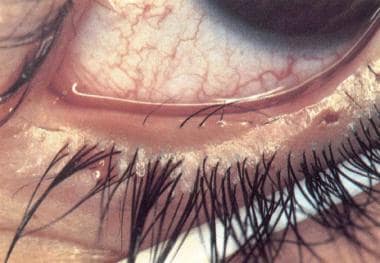
Distichiasis is a rare disorder defined as the abnormal growth of lashes from the orifices of the meibomian glands on the posterior lamella of the tarsal plate (see Media file 1). Two types of distichiasis can be identified, acquired and congenital. In the acquired form, most cases involve the lower lids. Lashes can be fully formed or very fine, pigmented or nonpigmented, properly oriented or misdirected. The congenital form is dominantly inherited with complete penetrance. It can be isolated or associated with ptosis, strabismus, congenital heart defect, or mandibulofacial dysostosis. This defect may be related to the epithelial germ cells failure to differentiate completely to meibomian glands, instead they become pilosebaceous units.
Pathophysiology
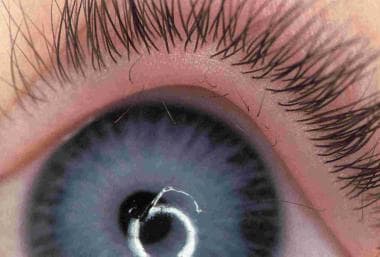
Distichiasis can affect the lower and upper lids (see Media files 1-2). When these abnormal lashes come in contact with the cornea, they may cause severe irritation, epiphora, corneal abrasion, or even corneal ulcers.
Frequency
United States
Distichiasis is a rare disorder.
Race
Distichiasis has been seen in all ethnic backgrounds.
Sex
This condition shows no sex discrimination.
Age
Distichiasis has been seen in all ages.
History
Physical
- Abnormal lashes from the meibomian gland orifices are noted on slit lamp examination.
- The corneal epithelium should be evaluated at the slit lamp after instillation of fluorescein for any defects or abnormalities.
Causes
The congenital form of distichiasis is autosomal dominant with complete penetrance. The metaplasia of meibomian glands and abnormal growth of lashes from these glands, secondary to severe chemical burn, Stevens-Johnson syndrome, OCP, or chronic blepharoconjunctivitis, can cause acquired distichiasis.
Entropion
Trichiasis
Other Problems to be Considered
Epiblepharon
Lid scar
Chronic blepharoconjunctivitis
Cicatricial conjunctivitis
Medical Care
Lubricants and bandage contact lenses can be used temporarily to relieve symptoms. Definitive treatment is removal of the abnormal eyelashes. Mechanical epilation of lashes has been used, but the eyelashes regrow within 4-6 weeks.
Surgical Care
Multiple procedures have been described for treating distichiasis, to include the following: combination of lid splitting and cryotherapy, direct surgical excision by wedge resection, or tarsoconjunctival approach. Moosavi described a simple procedure that could be used to treat severe trichiasis.1 In this procedure, the anterior lamella is removed, and the eyelid is allowed to heal by the laissez-faire technique.1 Complications of surgical interventions are hemorrhage, infection, wound dehiscence, lid margin deformities, entropion or ectropion, and regrowth. Adequate electrocautery, especially for marginal arcade vessel, can reduce the chance of hemorrhage. Performing the procedure in a sterile environment should reduce the chance of infection, and the ability to close the defect can be reduced with a lateral superior or inferior cantholysis with or without Tenzel semicircular flap. The permanent treatments of distichiasis include the following: - Electrolysis
- This method is ideal for cases with few aberrant eyelashes. Topical with local anesthesia or general anesthesia may be used according to the age of the patient.
- A fine 30-gauge electrode is used to deliver low current to each hair follicle. Visualization of the hair shaft is crucial.
- Other recommended techniques involve use of the operating microscope, use of surgical loops, and use of the slit lamp.
- If the treatment is adequate, the eyelashes should be easily wiped with a cotton swab or epilated with a forceps. Recurrent rate with this method is high.
- Eyelid notching and focal madarosis can be seen with aggressive treatment.
- Cryotherapy
- This method results in a more permanent treatment of misdirected eyelashes. Since treatment is not very localized, the area of aberrant cilia should be at least slightly larger than the beveled-tipped cryoprobe.
- Permanent destruction of follicles can be achieved with freezing the follicles to the temperature of –20°C. A thermocouple, if is available, should be used (see Media file 3). The tip should be placed directly on the anterior tarsal surface for distichiasis.
- Protect the globe by placing a shield and lubricants. The lid also should be held away from the globe.
- Nitrous oxide or carbon dioxide has been used as a cryogen. Effective cryosurgical treatment requires a double application of the probe and slow thaw. Complications of this procedure include depigmentation of the skin, eyelid notching, madarosis, severe postoperative pain, edema, symblepharon, necrosis, and regrowth. Cryotherapy, especially with the double freeze-thaw technique, may have a success rate of 95%.
- Argon laser ablation
- This procedure is not widely used, and it is only useful for few aberrant cilia.
- The patient receives topical, local, or no anesthesia, and sits at the slit lamp that is equipped with an argon laser. The laser settings are as follows: power of 1000-1500 mW; spot size of 50-100 µm; and duration of 0.1-0.2 s.
- The lid margin is rotated outward, and the laser is aimed at the hair shaft. A total of 12-30 shots are needed per lash.
- The complications of this procedure are very similar to complications of electrolysis. Recurrence rate for electrolysis and argon laser ablation vary from 12-41%.
- Diode laser
- The 810 nm diode laser has been used to treat abnormal lashes. This laser has also been shown to be safe in the periorbital region. The pulse length used is approximately 50 ms, and the energy intensity is approximately 50 J/cm2.
- For best results, 4-5 treatments are needed 4-6 weeks apart.
- An efficacy study on diode laser treatment of trichiasis has been conducted, and, according to this study, diode laser treatment is an effective tool in treating trichiasis.2
- Trephination
- McCracken and Kikkawa described a new technique, in which they use a Sisler ophthalmic microtrephine 1.0 mm to cut the lash follicles.3
- This technique seems to be safe and much faster than other surgical procedures for the treatment of trichiasis or distichiasis, with less complication and scarring.3
Consultations
Some comprehensive ophthalmologists are capable of taking care of simple cases of distichiasis. However, most patients with this disorder should be referred to an ophthalmic plastics and reconstructive surgeon.
Ophthalmic lubricants without preservatives can be used in the eyes 3-4 times a day to protect the cornea in cases in which evidence of corneal epithelial damage is seen. Surgical intervention in these cases is eminent and the lubricants only help for a short period of time.
Drug Category: Ophthalmic lubricants
Prevent excessive dryness and irritation of the eye.
| Drug Name | Artificial tears |
| Description | Act to stabilize and thicken precorneal tear film and prolong tear film break-up time, which occurs with dry eye states. |
| Adult Dose | 1-2 gtt OU |
| Pediatric Dose | Administer as in adults |
| Contraindications | Documented hypersensitivity |
| Interactions | None reported |
| Pregnancy | A - Fetal risk not revealed in controlled studies in humans
|
| Precautions | Hyperemia, photophobia, stickiness of eyelashes, ocular discomfort, or irritation may occur |
Complications
- In some cases, differentiation of acquired distichiasis from trichiasis may be difficult. In trichiasis, the lashes grow from the anterior lamella, not from the meibomian orifices (see Media file 1). After lid reconstruction, this distinction may not be possible, especially if a skin graft was used.
- Entropion may be confused with distichiasis. The lids must be held in their proper position to evaluate the lashes. Careful examination of the lid anatomy and the lid position prevents the misdiagnosis.
- Epiblepharon is a condition that is mostly present in children. In this condition, the lashes are not truly misdirected, but pushed by the fold of pretarsal skin against the globe.
- Lid scar, chronic blepharoconjunctivitis, and cicatricial conjunctivitis are other conditions that can be confused with distichiasis.
- Complications of surgical interventions are hemorrhage, infection, wound dehiscence, lid margin deformities, entropion or ectropion, and regrowth.
Medical/Legal Pitfalls
- Constant rubbing of lashes against the cornea, especially in the acquired type of distichiasis, can cause corneal epithelial defect, corneal ulcers, or corneal scars. Treatment of distichiasis in a timely fashion is extremely important.
- Prior to surgical treatment of distichiasis, patients need to be informed of the complications, especially the recurrence rate and lid deformities. Patients should understand all of the complications and even the treatment of them, if any are present.
| Media file 1:
This picture demonstrates distichiasis of the lower lid. From Principles and Practice of Ophthalmology by Jakobiec. |
 | View Full Size Image | |
Media type: Photo
|
| Media file 2:
This picture demonstrates distichiasis of the upper lid. From Ophthalmic Plastic Surgery: Prevention and Management of Complications by Dortzbach. |
 | View Full Size Image | |
Media type: Photo
|
| Media file 3:
This picture demonstrates the cryotherapy of the lower lid with distichiasis. From Ophthalmic Plastic Surgery: Prevention and Management of Complications by Dortzbach. |

 | View Full Size Image | |
Media type: Photo
|
- Moosavi AH, Mollan SP, Berry-Brincat A, et al. Simple surgery for severe trichiasis. Ophthal Plast Reconstr Surg. Jul-Aug 2007;23(4):296-7. [Medline].
- Pham RT. Treat of trichiasis using 810 nm diode laser: an efficacy study. Paper presented at: Annual Meeting of the American Society of Ophthalmic Plastic and Reconstructive Surgery; New Orleans, La. October 22-23, 2004.
- McCracken MS, Kikkawa DO, Vasani SN. Treatment of trichiasis and distichiasis by eyelash trephination. Ophthal Plast Reconstr Surg. Sep-Oct 2006;22(5):349-51. [Medline].
- Anderson RL. Surgical repair for distichiasis. Arch Ophthalmol. Jan 1977;95(1):169. [Medline].
- Bosniak S. Principles and Practice of Ophthalmic Plastic and Reconstructive Surgery. Vol 1. WB Saunders Co; 1996:409.
- Dortzbach RK. Ophthalmic Plastic Surgery: Prevention and Management of Complications. Lippincott-Raven Publishers; 1994:42-8.
- Fein W. Surgical repair for distichiasis, trichiasis, and entropion. Arch Ophthalmol. May 1976;94(5):809-10. [Medline].
- Hill JC. Trichiasis and distichiasis. Can J Ophthalmol. Oct 1976;11(4):353-4. [Medline].
- Pham RT, Biesman BS, Silkiss RZ. Treatment of trichiasis using an 810-nm diode laser: an efficacy study. Ophthal Plast Reconstr Surg. Nov-Dec 2006;22(6):445-7. [Medline].
- Scheie HG, Albert DM. Distichiasis and trichiasis: origin and management. Am J Ophthalmol. Apr 1966;61(4):718-20. [Medline].
Distichiasis excerpt Article Last Updated: Jul 8, 2008
|