
You are in: eMedicine Specialties > Ophthalmology > CORNEA Descemet Membrane FoldsArticle Last Updated: Feb 5, 2007AUTHOR AND EDITOR INFORMATIONAuthor: Magdalena F Shuler, MD, PhD, Consulting Staff, Retina Specialists, PA Magdalena F Shuler is a member of the following medical societies: American Academy of Ophthalmology, American Society of Cataract and Refractive Surgery, Florida Medical Association, and Phi Beta Kappa Coauthor(s): Robert H Graham, MD, Senior Associate Consultant, Department of Ophthalmology, Mayo Clinic, Scottsdale, Arizona Editors: Fernando H Murillo-Lopez, MD, Senior Surgeon, Unidad Privada de Oftalmologia CEMES; Simon K Law, MD, PharmD, Assistant Professor of Ophthalmology, Jules Stein Eye Institute; Chief of Section of Ophthalmology Surgical Services, Department of Veterans Affairs Healthcare Center, West Los Angeles; Christopher J Rapuano, MD, Professor, Department of Ophthalmology, Jefferson Medical College; Co-Chairman of the Cornea Service, Co-Chairman of Refractive Surgery Department, Wills Eye Hospital; Lance L Brown, OD, MD, Ophthalmologist, Affiliated With Freeman Hospital and St John's Hospital, Regional Eye Center, Joplin, Missouri; Hampton Roy Sr, MD, Associate Clinical Professor, Department of Ophthalmology, University of Arkansas for Medical Sciences Author and Editor Disclosure Synonyms and related keywords: Descemet's membrane folds, Descemet's folds, Descemet folds, endothelial folds, endothelial cells, eye inflammation, ocular inflammation, ocular infection, corneal infection, inflammation of the cornea, corneal inflammation, anterior chamber, anterior segment inflammation INTRODUCTIONBackgroundThe cornea plays a crucial and vital role in the visual pathway. To maximize the visual potential of the eye, both the clarity of the cornea and the refractive power (curvature) are important. Any disturbance to the clarity or thickness of the cornea will affect its visual potential. The Descemet membrane and endothelial cells play a critical role. PathophysiologyThe cornea is composed of 5 discrete anatomical components, each with specific functions to achieve the goal of clarity and refractive potential. The outermost component, the epithelium, provides a smooth surface due to the interactions of cytoskeletal components and tear film matrix. It also serves an important protective barrier function. The Bowman layer or membrane, the second layer moving in toward the eye, serves as the smooth adhesion layer for the basement membrane of the epithelial cells. This layer is not crucial for clarity or visual function since removal of the Bowman layer during photorefractive keratectomy does not negatively affect vision. The corneal stroma makes up the majority of the width of the cornea. It is composed of collagen fibrils arranged in a regular pattern to allow light to enter and pass through without being diffracted or reflected. Inflammation manifesting as stromal infiltrates and/or stromal edema results in the interruption of the regular periodicity of the collagen matrix and decreased corneal clarity. Because the cornea is avascular, nutrients and wastes are delivered and deposited anteriorly via the tear film and external environment, internally via corneal nerves, and posteriorly via the aqueous humor. The innermost layer of the cornea is the endothelial cell layer, a monolayer of polarized cells. They are arranged with their apical portion toward the aqueous humor in the anterior chamber. The endothelial cells are responsible for maintaining the desiccation of the stroma by actively removing water. The Descemet membrane is the specialized basement membrane of the endothelial cells positioned between the stroma and the endothelial cell layer. Any condition that causes inflammation of the cornea or the anterior chamber can cause Descemet membrane folds. FrequencyUnited StatesThis condition is common because it is associated with many inflammatory conditions of the eye. InternationalSame as in United States. Mortality/MorbidityMorbidity due to decreased vision and pain exists. RaceNo predisposition to race exists. SexThis condition affects women and men equally. AgeThis condition affects all age groups with slower resolution of the folds in elderly persons. CLINICALHistory
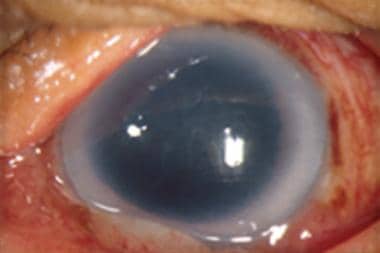
Physical
Causes
DIFFERENTIALSBurns, Chemical Corneal Edema, Postoperative Corneal Graft Rejection Endophthalmitis, Bacterial Endophthalmitis, Fungal Endophthalmitis, Postoperative Foreign Body, Intraocular Glaucoma, Lens-Particle Glaucoma, Neovascular Glaucoma, Phacolytic Glaucoma, Uveitic Keratitis, Bacterial Keratitis, Fungal Keratitis, Herpes Simplex Keratitis, Interstitial Keratopathy, Neurotrophic Keratopathy, Pseudophakic Bullous Postoperative Flat Anterior Chamber Ulcer, Corneal Uveitis, Anterior, Granulomatous Uveitis, Anterior, Nongranulomatous Uveitis, Intermediate
| ||||||||||||||||||||||||||||||||||||||||||||||||||||||||||||||||||||||||||||||||||||||||||||||
| Drug Name | Prednisolone acetate/prednisolone sodium phosphate (Pred Forte, Pred Mild) |
|---|---|
| Description | Decreases inflammation and corneal neovascularization. Suppresses migration of polymorphonuclear leukocytes and reverses increased capillary permeability. In cases of bacterial infections, concomitant use of anti-infective agents is mandatory; if signs and symptoms do not improve after 2 days, re-evaluate patient. Dosing may be reduced, but advise patients not to discontinue therapy prematurely. Sold under multiple preparations and suspensions. |
| Adult Dose | 1-2 gtt q1h to q6h prn |
| Pediatric Dose | Not established; however, can be administered as in adults Minimize systemic effects by using digital pressure at the lacrimal sac |
| Contraindications | Documented hypersensitivity; most viral diseases of the cornea and conjunctiva, including epithelial herpes simples keratitis (dendritic keratitis), vaccinia, and varicella, and also in mycobacterial infection of the eye and fungal diseases of ocular structures |
| Interactions | None reported |
| Pregnancy | C - Safety for use during pregnancy has not been established. |
| Precautions | Caution in steroid responsive patients (increased intraocular pressure due to steroid medications); should not be discontinued abruptly after prolonged use, requires tapered dosing; prolonged use may lead to posterior subcapsular cataract formation and may suppress normal host immune response increasing chance of secondary ocular infection; may lead to corneal/scleral thinning and perforation in various ocular surface diseases |
| Drug Name | Loteprednol etabonate suspension 0.5% (Lotemax) |
|---|---|
| Description | Structurally similar to other corticosteroids but with a variation that enhances penetration into cells, transforms into inactive metabolite quickly. This drug is less likely then prednisolone acetate to increase intraocular pressure with prolonged use (2% compared to 7%). |
| Adult Dose | 1-2 gtt q1h to q6h prn |
| Pediatric Dose | Not established; can be administered as in adults |
| Contraindications | Documented hypersensitivity; most viral diseases of the cornea and conjunctiva, including epithelial herpes simples keratitis (dendritic keratitis), vaccinia, and varicella, and also in mycobacterial infection of the eye and fungal diseases of ocular structures |
| Interactions | None reported |
| Pregnancy | C - Safety for use during pregnancy has not been established. |
| Precautions | Should not be discontinued abruptly after prolonged use, requires tapered dosing; prolonged use may lead to posterior subcapsular cataract formation and may suppress normal host immune response increasing chance of secondary ocular infection; may lead to corneal/scleral thinning and perforation in various ocular surface diseases |
Used to decrease corneal inflammation.
| Drug Name | Ketorolac tromethamine (Acular) |
|---|---|
| Description | Member of pyrrolo-pyrrole group of nonsteroidal anti-inflammatory drugs for ophthalmic use. Has analgesic, anti-inflammatory, and antipyretic properties and also inhibits prostaglandin biosynthesis. |
| Adult Dose | 1-2 gtt qid |
| Pediatric Dose | <12 years: Not established >12 years: Administer as in adults |
| Contraindications | Documented hypersensitivity |
| Interactions | None reported |
| Pregnancy | C - Safety for use during pregnancy has not been established. |
| Precautions | Potential for increased bleeding time; may slow or delay healing; avoid use in patients wearing soft contact lenses; can impede reepithelialization; has been associated with corneal melts, especially in its generic form (no longer available in the United States) |
| Drug Name | Diclofenac sodium ophthalmic (Voltaren) |
|---|---|
| Description | A phenylacetic acid with anti-inflammatory and analgesic properties. Believed to inhibit cyclooxygenase, essential to the synthesis of prostaglandins. |
| Adult Dose | 1-2 gtt qid |
| Pediatric Dose | Not established; can be administered as in adults |
| Contraindications | Documented hypersensitivity |
| Interactions | None reported |
| Pregnancy | C - Safety for use during pregnancy has not been established. |
| Precautions | Potential for increased bleeding time; may slow or delay healing; avoid use in patients wearing soft contact lenses; can impede reepithelialization; has been associated with corneal melts, especially in its generic form (no longer available in the United States) |
Sodium chloride hypertonic ophthalmic solution used to dehydrate the cornea.
| Drug Name | Sodium chloride (Muro 128) |
|---|---|
| Description | Used for temporary relief of corneal edema. Available as 2% and 5% ophthalmic solution concentrations and 5% ointment. The 5% drop is typically the concentration used. |
| Adult Dose | 1-2 gtt q3-4h |
| Pediatric Dose | Administer as in adults |
| Contraindications | Documented hypersensitivity |
| Interactions | None reported |
| Pregnancy | A - Safe in pregnancy |
| Precautions | May cause temporary burning and irritation upon use; if pain, change in vision, or continued redness or irritation of the eye(s) occur, or if initial condition/problem worsens or persists, reevaluate therapy; do not use product if it changes color or becomes cloudy |
| Media file 1: Descemet membrane folds after surgery. | |

![]() | View Full Size Image | Media type: Photo |
| Media file 2: Diffuse illumination showing Descemet membrane folds after surgery. | |

![]() | View Full Size Image | Media type: Photo |
Descemet Membrane Folds excerpt
Article Last Updated: Feb 5, 2007