| Patient Education |
|
Click here for patient education.
|
|
You are in: eMedicine Specialties >
Ophthalmology > RETINA
Retinopathy, Purtscher
Article Last Updated: Jul 2, 2007
AUTHOR AND EDITOR INFORMATION
Section 1 of 11
Author: Edward Chaum, MD, PhD, Professor and Director, Vitreoretinal Service, Plough Foundation Professor of Retinal Diseases, Department of Ophthalmology, Professor of Pediatrics, Anatomy and Neurobiology, and Biomedical Engineering, University of Tennessee Health Science
Edward Chaum is a member of the following medical societies: Alpha Omega Alpha, American Academy of Ophthalmology, American Society of Retina Specialists, American Telemedicine Association, Association for Research in Vision and Ophthalmology, and Juvenile Diabetes Foundation International
Editors: Russell P Jayne, MD, Consulting Vitreoretinal Surgeon, The Retina Center at Las Vegas; Simon K Law, MD, PharmD, Assistant Professor of Ophthalmology, Jules Stein Eye Institute; Chief of Section of Ophthalmology Surgical Services, Department of Veterans Affairs Healthcare Center, West Los Angeles; Steve Charles, MD, Director of Charles Retina Institute; Clinical Professor, Department of Ophthalmology, University of Tennessee College of Medicine; Lance L Brown, OD, MD, Ophthalmologist, Affiliated With Freeman Hospital and St John's Hospital, Regional Eye Center, Joplin, Missouri; Hampton Roy Sr, MD, Associate Clinical Professor, Department of Ophthalmology, University of Arkansas for Medical Sciences
Author and Editor Disclosure
Synonyms and related keywords:
Purtscher retinopathy, Purtscher-like retinopathy, angiopathia retinae traumatica, Purtscher's-like retinopathy, Purtscher's retinopathy, retinal hemorrhages, cotton-wool spots, vascular occlusion, vision loss, blindness
Background
Purtscher retinopathy is a hemorrhagic and vasoocclusive vasculopathy, which, in 1912, was first described as a syndrome of sudden blindness associated with severe head trauma. These patients had findings of multiple white retinal patches and retinal hemorrhages that were associated with severe vision loss. Since its original description, Purtscher retinopathy has been associated with traumatic injury, primarily blunt thoracic trauma and head trauma, and numerous nontraumatic diseases. Purtscher-like retinopathy is seen in diverse conditions, including acute pancreatitis, fat embolization, amniotic fluid embolization, and vasculitic diseases.
Pathophysiology
The original findings of white lesions in the retina associated with intraretinal and preretinal hemorrhages and papillitis were believed to be caused by lymphatic extravasation from trauma. These lesions are now known as cotton-wool spots (ie, retinal microinfarcts at the level of the nerve fiber layer). Fluorescein leakage in Purtscher retinopathy suggests that an acute endothelial cell injury is caused by trauma, possibly predisposing the retinal vessels to occlusion. The exact pathophysiology remains somewhat controversial, and different mechanisms have been proposed. One proposed mechanism is embolization that causes arterial occlusion and infarction of the microvascular bed. Leukocyte aggregation, which is induced by complement C5a, is believed to be the most likely mechanism of embolization because of its known association with trauma, acute pancreatitis, and vasculitic diseases. Other possible sources of emboli include fat emboli in cases of long bone fractures and perhaps pancreatitis from enzymatic digestion of omental fat, amniotic fluid embolization during childbirth and postpartum, air emboli from traumatic chest compression, and granulocyte aggregation resulting from complement activation. Other proposed mechanisms of vascular occlusion include angiospasm resulting from an acute rise in venous pressure from compressive chest injuries or possibly acute head injuries and endothelial cell damage resulting from acutely increased intraluminal pressure.
Frequency
United States
Not reported
International
Not reported
Mortality/Morbidity
- Bilateral manifestations are seen most commonly, but unilateral findings have been reported.
- Decreased vision occurs in the affected eyes, generally in the range of 20/200 to counting fingers. Vision often improves over several months to a range of 20/30 to 20/200, depending on the severity of the retinal findings.
Race
Not reported
Sex
Not reported
Age
Not reported
History
- Patients with traumatic Purtscher retinopathy present with a recent history of blunt chest trauma or head trauma. The severity of chest trauma is not correlated directly with the incidence or severity of retinopathy, which is observed in these patients.
- Patients may present with unilateral or bilateral vision loss (possibly severe) generally within 2 days.
- Macular cotton-wool spots and intraretinal hemorrhages in patients with this history of trauma are diagnostic of the condition.
- Patients also may present with a Purtscher-like retinopathy in the absence of trauma. Various systemic conditions have been associated with developing the following characteristic retinal findings:
- Patients with acute pancreatitis are at risk for developing Purtscher-like retinopathy.
- Patients with long bone fractures are at risk for developing fat embolization and Purtscher-like retinopathy.
- Childbirth
- Purtscher-like retinopathy may be seen in the postpartum period.
- Purtscher-like retinopathy may be due to amniotic fluid embolization with a catastrophic presentation, including shock and disseminated intravascular coagulopathy (DIC).
- Retinal arterial occlusions with microvascular infarcts and labor-associated hemorrhage have been reported in patients with preeclampsia and Purtscher-like retinopathy.
- Protein C and protein S deficiency have been reported.
- Purtscher-like retinopathy has been observed in patients with certain types of systemic vasculitides.
- The most likely etiology is microvascular infarction due to complement C5a-induced leukocyte aggregation.
- Unexplained vision loss in patients with these conditions (eg, systemic lupus erythematosus, dermatomyositis, scleroderma) should raise the possibility of Purtscher-like retinopathy.
Physical
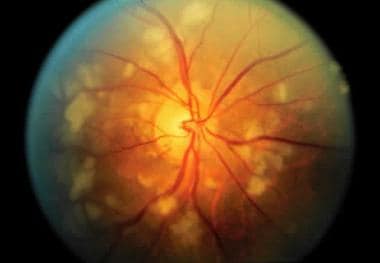
- The most common retinal findings in Purtscher retinopathy are cotton-wool spots around the optic nerve and intraretinal hemorrhage.
- Less common reported findings include serous detachment of the macula, preretinal hemorrhages, dilated vessels, and optic disc edema.
- Confluent cotton-wool spots in the central macula may simulate the cherry-red spot that is seen in central retinal artery occlusion.
- Retinal microinfarcts that are observed in patients with fat embolization are usually smaller in size and located in the peripheral, not central, retina.
- Pigment migration and optic atrophy have been reported as late findings in the disease.
Causes
- Traumatic chest compression and blunt head trauma are common causes.
- Chest trauma that is associated with Purtscher retinopathy ranges from mild to severe; the degree is not necessarily indicative of the risk of developing retinopathy.
- Compressive chest injuries often are seen with unrestrained drivers in motor vehicle accidents (MVAs).
- Patients with known vasculitic disease (eg, systemic lupus erythematosus, scleroderma, dermatomyositis) are at risk for developing a Purtscher-like retinopathy with microvascular occlusion.
- Childbirth and the uncommon complication of amniotic fluid embolism are known risk factors.
- Acute pancreatitis is a known risk factor. The risk from acute pancreatitis may be due to fat embolization or complement activation with secondary leukocyte aggregation and occlusive vasculopathy.
Central Retinal Artery Occlusion
Giant Cell Arteritis
Hypertension
Ocular Manifestations of HIV
Ocular Manifestations of Syphilis
Sjogren Syndrome
Terson Syndrome
Other Problems to be Considered
Fat embolization Amniotic fluid embolization Retinal vasculitis System lupus erythematosus Dermatomyositis Scleroderma Radiation retinopathy
Lab Studies
- Amylase level: Purtscher-like retinopathy is associated with acute pancreatitis; thus, an elevated amylase level may be diagnostic of this condition.
- Complement C5a level
- Activated complement C5a is associated with the development of Purtscher-like retinopathy in numerous conditions.
- This test may be diagnostic in presentations without an antecedent history of trauma.
- A positive antinuclear antibody (ANA) test is helpful in establishing the diagnosis of certain collagen vascular diseases, such as lupus (>95% positive) and scleroderma (about 40% positive). Dermatomyositis rarely shows a positive ANA.
- Similarly, anti–double-stranded DNA antibody is frequently positive in lupus (>75% positive) and scleroderma (about 15-50% positive).
- Rheumatoid factor is positive in approximately 40% of patients with dermatomyositis.
- Evidence of muscle disease and breakdown may be present in patients with dermatomyositis, to include the following:
- Elevated serum transaminase
- Elevated serum creatine phosphokinase
- Elevated serum aldolase
- Elevated serum myoglobin
- Elevated urine myoglobin
- In patients with lupus, antiphospholipid antibodies may be associated with an increased risk of retinal vascular thrombosis.
Imaging Studies
- If the patient has a history of head trauma or thoracic trauma, obtain appropriate x-ray films or imaging studies.
- Skull or rib fractures may be present.
- Severe crushing injuries of the chest in people who are unrestrained during MVAs may be associated with severe deep vascular injury, cardiac or pulmonary contusion, and abdominal organ injury. These injuries may require more extensive investigation.
Other Tests
- Electromyographic (EMG) studies may be helpful in establishing the diagnosis of dermatomyositis.
Procedures
- Fluorescein angiography: Angiography studies (early in the disease) demonstrate capillary leakage and staining of the retinal arteries. In severe disease, the following are often noted together:
- Nonperfusion of the small arterioles that surround the central macula
- Perivenous staining
- Venous dilation and leakage
Histologic Findings
Histopathologic examination of an eye with prior Purtscher retinopathy shows evidence of inner retinal atrophy, which is consistent with inner retinal arterial occlusion. Late findings include nerve fiber layer dropout and evidence of optic atrophy.
Medical Care
- No proven treatment exists for Purtscher retinopathy that occurs after traumatic injury.
- In patients with retinopathy due to systemic vasculitis, steroid therapy is theoretically beneficial.
- Control of the underlying disease with other medications may be indicated.
Surgical Care
Provide surgical care as required for traumatic chest and head injuries that are associated with Purtscher retinopathy.
Consultations
Refer as indicated, based on the etiology of the retinopathy.
Activity
No restrictions are required, unless indicated by severe bilateral vision loss.
No proven beneficial medical therapy for this condition is available. Treat the underlying conditions that have contributed to disease development.
Further Inpatient Care
- As indicated by the workup for trauma or systemic disease
Further Outpatient Care
- As indicated by the medical workup
- A retinal specialist and a general ophthalmologist should provide follow-up care to patients with Purtscher retinopathy.
Deterrence/Prevention
- Since blunt chest trauma is a common cause of Purtscher retinopathy, educate people to wear seat belts. This effort may reduce the risk of people being unrestrained in MVAs.
Prognosis
- Visual prognosis is guarded, although initially decreased vision may improve over a period of months.
- The most important prognostic finding that is associated with a poor visual prognosis is central macular infarction.
Patient Education
- Educate patients regarding the mandatory use of seat belts in cases of blunt trauma.
Medical/Legal Pitfalls
- Patients who present with vision loss as their primary complaint, following a history of blunt chest or head injury, are at risk for having other serious injuries (eg, brain injury, cardiac and pulmonary contusion, abdominal organ trauma). These patients should have a thorough medical evaluation, in addition to an ophthalmic examination, even in the absence of other specific symptoms. Because of the guarded visual prognosis and the likelihood of litigation that is associated with disability-causing MVAs, a thorough ophthalmic examination, including fundus photography and fluorescein angiography, probably is indicated.
| Media file 1:
Characteristic fundus findings of Purtscher retinopathy. Multiple cotton-wool spots surround the optic nerve after blunt thoracic trauma. |
 | View Full Size Image | |
Media type: Photo
|
| Media file 2:
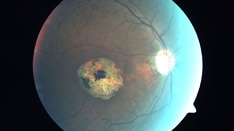
Mild Purtscher retinopathy in a patient after blunt chest compression as an unrestrained driver in a motor vehicle accident. This patient presented with visual loss in the left eye and had unilateral disease. The fundus photograph shows a large cotton-wool spot along the inferotemporal arcade and more subtle microvascular injury between the disc and fovea in the central macula. Whitening of the central fovea is present. Visual acuity was 20/200 but returned to 20/30 after 6 weeks. |
 | View Full Size Image | |
Media type: Photo
|
| Media file 3:
Fluorescein angiogram of the patient in Media file 2 shows focal microvascular occlusion in the area of the cotton-wool spot. Mild venous leakage and staining is seen in the perifoveal capillary bed just beneath the central fovea. A small amount of fluorescein leakage is also seen beneath the fovea. |
 | View Full Size Image | |
Media type: Photo
|
| Media file 4:
Purtscher-like retinopathy in a patient with systemic lupus erythematosus with microvascular encephalopathy and retinopathy. Multiple cotton-wool spots of varying sizes and ages surround the optic nerve. A branch arterial occlusion is present along the supertemporal arcade with retinal whitening between the major artery and vein. Multiple occlusions are seen in arterial and venous trees with disruption of the blood columns. |
 | View Full Size Image | |
Media type: Photo
|
- Agrawal A, McKibbin MA. Purtscher's and Purtscher-like retinopathies: a review. Surv Ophthalmol. Mar-Apr 2006;51(2):129-36. [Medline].
- Ayaki M, Yokoyama N, Furukawa Y. Postpartum central retinal artery occlusion simulating Purtscher's retinopathy. Ophthalmologica. 1995;209(1):37-9. [Medline].
- Blodi BA, Johnson MW, Gass JD, Fine SL, Joffe LM. Purtscher's-like retinopathy after childbirth. Ophthalmology. Dec 1990;97(12):1654-9. [Medline].
- Campo SM, Gasparri V, Catarinelli G, Sepe M. Acute pancreatitis with Purtscher's retinopathy: case report and review of the literature. Dig Liver Dis. Nov 2000;32(8):729-32. [Medline].
- Chandra P, Azad R, Pal N, Sharma Y, Chhabra MS. Valsalva and Purtscher's retinopathy with optic neuropathy in compressive thoracic injury. Eye. Aug 2005;19(8):914-5. [Medline].
- Chang M, Herbert WN. Retinal arteriolar occlusions following amniotic fluid embolism. Ophthalmology. Dec 1984;91(12):1634-7. [Medline].
- Cooper BA, Shah GK, Grand MG. Purtscher's-like retinopathy in a patient with systemic lupus erythematosus. Ophthalmic Surg Lasers Imaging. Sep-Oct 2004;35(5):438-9. [Medline].
- Fischbein F, Safir A. Monocular Purtscher's retinopathy. A fluorescein angiographic study. Arch Ophthalmol. Apr 1971;85(4):480-4. [Medline].
- Gass JD. Purtscher's-like retinopathy. In: Stereoscopic Atlas of Macular Diseases: Diagnosis and Treatment. Mo: Mosby: St. Louis; 1997:452-454.
- Jacob HS, Goldstein IM, Shapiro I, Craddock PR, Hammerschmidt DE, Weissmann G, et al. Sudden blindness in acute pancreatitis. Possible role of complement-induced retinal leukoembolization. Arch Intern Med. Jan 1981;141(1):134-6. [Medline].
- Kelley JS. Purtscher's retinopathy related to chest compression by safety belts. Fluorescein angiographic findings. Am J Ophthalmol. Aug 1972;74(2):278-83. [Medline].
- Lai WW, Chen AC, Sharma MC, Lam DS, Pulido JS. Purtscher-like retinopathy associated with acute renal allograft rejection. Retina. Jan 2005;25(1):85-7. [Medline].
- Marr WG, Marr EG. Some observations on Purtscher's disease: traumatic retinal angiopathy. Am J Ophthalmol. 1962;54:693-705.
- Pratt MV, De Venecia G. Purtscher's retinopathy: a clinicohistopathological correlation. Surv Ophthalmol. Mar 1970;14(5):417-23. [Medline].
- Purtscher O. Noch unbekannte Befunde nach Schadeltrauma. Berl Dtsch Ophthal Ges. 1910;36:294-301.
- Shah GK, Penne R, Grand MG. Purtscher's retinopathy secondary to airbag injury. Retina. 2001;21(1):68-9. [Medline].
- Shaikh S, Ruby AJ, Piotrowski M. Preeclampsia-related chorioretinopathy with Purtscher's-like findings and macular ischemia. Retina. Apr 2003;23(2):247-50. [Medline].
- Umlas JW, Hedges TR 3rd, Zbyszewski K. Purtscher's retinopathy in a patient with acute pancreatitis. Ophthalmic Surg Lasers. May-Jun 2001;32(3):263-4. [Medline].
Retinopathy, Purtscher excerpt Article Last Updated: Jul 2, 2007
|